 by
Tom Gurney
Tom Gurney BSc (Hons) is an art history expert with over 20 years experience
Email:
tomgurney1@gmail.com
/ Phone:
+44 7429 011000
Henri Matisse, Studio, Quai Saint-Michel, 1916: Introduction
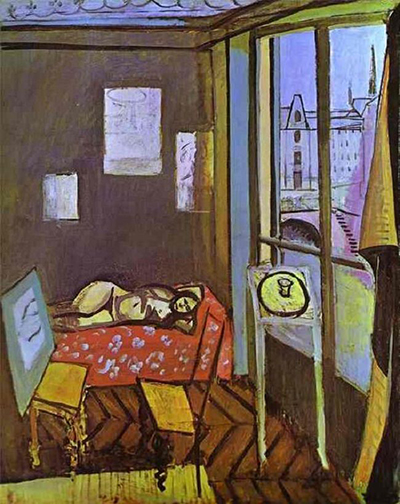
In Studio, Quai Saint-Michel, Henri Matisse places a reclining model in a dark Paris room beside a tall window. The eye moves from her red patterned couch and a picture propped on a chair to the pale buildings beyond the glass. The room is recognizable, but its floor, furniture and window do not settle into a single easy perspective. The Phillips Collection identifies the work as a 1916 oil painting on canvas, measuring 58¼ × 46 inches (about 148 × 117 cm), and records it as object 1307. It depicts Matisse's studio at 19 quai Saint-Michel.[1]
The figure is Laurette, a model who appeared in many of Matisse's works at this time. She lies near the centre of the composition, but her face is not the only focus. At the left, a pale blue-green picture leans on a chair; on the right, the window opens toward the Palais de Justice and Sainte-Chapelle. In one canvas Matisse gathers a model, another image and a view of the city. The question is how these separate spaces can be seen together.[1]
At a Glance
- Artist Henri Matisse
- Work Studio, Quai Saint-Michel
- Date 1916
- Explore Painting
This work across Henri Matisse’s career
Dance (1910)
1910The Red Studio
1911The Piano Lesson
1916The Snail
1953Contents
- What is happening inside the studio?
- Why does the window matter?
- What did Matisse change while painting it?
- Is there a preparatory drawing?
- How does it relate to another Quai Saint-Michel studio picture?
What is happening inside the studio?
Laurette's body stretches across the couch, with a light yellow area around her torso and legs set against red-orange fabric scattered with small pale marks. A dark contour and concentrated black shape near her head hold the figure in place. The red fabric attracts attention before the details of her pose resolve. It also stops the body from becoming an isolated academic study: Laurette is part of a furnished room, surrounded by chairs, wall pictures and the view outdoors.
Three light rectangular forms interrupt the broad dark wall behind her. They look like pictures or papers, but their contents are not clear in the reproduction. Their varied heights break up what could have been one uninterrupted brown plane. The Phillips Collection notes that Matisse changed the size and position of these three works as he developed the painting. Even the apparently plain background was a worked-out arrangement rather than a neutral setting.[1]
The propped picture at lower left is especially important. It sits on a chair, angled toward us, so a painted object inside the room faces the viewer of the larger painting. The Phillips describes the chair as acting like an easel and the small picture as implying the artist's presence. Matisse does not have to portray himself standing at work to make the studio an artist's space. A viewer can look at the model, then at the image turned toward the viewer, and consider the relation between posing, painting and looking.[1]
The empty chair and the picture do not prove that the painter has just left the room. Nor does the presence or absence of facial detail establish a private relationship with the model. What the arrangement visibly gives us is a place for work and observation. The chairs create oblique lines in the foreground, while the herringbone floor pushes back toward the couch. The floor suggests depth, but the closely packed furniture keeps the figure and picture near the canvas surface.
Why does the window matter?
The window rises through the right half of the canvas. Its straight verticals and horizontal crosspieces contrast with the curve of Laurette's body and the angled chairs. Cool blues and pale greens around the opening interrupt the darker wall. Across the river, the pointed and tower-like city forms make a second group of verticals, smaller than those inside the room. The outside view is specific enough for the Phillips Collection to identify the Palais de Justice and Sainte-Chapelle, yet Matisse has not painted it as a separate postcard view.[1]
Look at the area just below the window. A pale tabletop with a small dark circular form sits close to the frame. A chair and window element cross nearby, so the eye has to negotiate several edges at once. This is where the room's compressed perspective is easiest to feel: interior objects and the exterior view are adjacent, and their outlines compete for attention. Matisse's owner record reports his view that the window wall did not divide space into two independent worlds. In this painting, the formal point is visible without turning the remark into a rule for every picture he made. Lines and colours carry the viewer across the threshold.[1]
The painting was made during the First World War, and the Phillips describes its mood as austere. The dark wall and restrained room colour give that reading some visual basis. They do not show a particular wartime event, nor do they make Laurette a symbol for the conflict. The stronger historical fact is that Matisse was working through a studio composition in Paris in 1916, bringing model, framed works and city view into one large canvas.[1]
Watch: Matisse’s art and working methods
Choose a museum film or a close reading to continue exploring Matisse’s work.
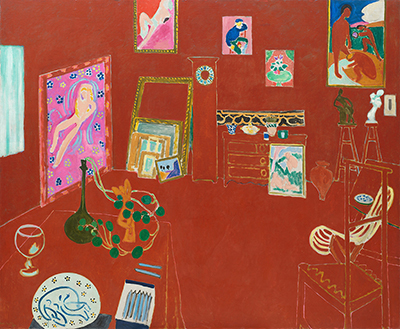
MoMA Conservators discover Matisse's process for "The Red Studio" | CONSERVATION STORIES
Conservators examine the making of The Red Studio.
Watch on YouTubeWhat did Matisse change while painting it?
The surface preserves signs of revision, and Phillips conservation research makes several changes more specific. The tabletop under the window began as a round shape. Matisse scraped paint back toward the light ground and made it square, then painted a smaller dark circular form inside it. The museum cautiously suggests that this last mark may represent a plate; the important compositional point is the change in shape and placement, not a certain label for the object.[2]
Infrared examination revealed an iron grill first painted in the window and subsequently covered. The museum also found multiple adjustments to the chairs: their seats and legs shifted as Matisse tested how they occupied the foreground. An x-radiograph and rounded drying cracks above Laurette point to an earlier, higher position for the nude. Those findings make the finished canvas less like a single instantaneous view. The room was repeatedly reorganized as a painting.[2]
The cracks should be understood carefully. They are material evidence of changes, not simply damage to dramatize the artist's struggle. The Phillips explains that faster-drying paint over slower-drying layers can produce this kind of cracking; a 1951 letter from Matisse's son Pierre to Duncan Phillips discussed similar cracks in works from 1913–17. This correspondence documents a later concern about the painting's surface. It does not itself date an individual brushstroke or tell us what Matisse intended Laurette to mean.[2]
Is there a preparatory drawing?
Yes. The Phillips also holds Study for “The Studio Quai Saint-Michel”, a 1916 pencil drawing on paper measuring 29 × 22 inches. It is a distinct object, 2024.017.0001, given to the museum by Barry S. Goodman in 2024. The Phillips' modern-art curator describes examining the large study with a paper conservator and following changes to the figure's position and the room's perspective between study and painting. The drawing therefore offers evidence of Matisse's search for a composition, rather than a licence to imagine that he merely copied a fixed design onto canvas.[3][4]
The study's recent arrival is also a reminder to keep object histories separate. The oil painting was acquired by the Phillips in 1940 from the Pierre Matisse Gallery; the pencil study was a 2024 gift. The painting's oil medium, near-1.5-metre height and museum object number cannot be transferred to the drawing. The old page for this route called the pictured work a drawing, but the image is the Phillips oil.[1][3]
How does it relate to another Quai Saint-Michel studio picture?
The Centre Pompidou holds a separate canvas, Le Peintre dans son atelier (The Painter in His Studio), dated late 1916 to early 1917. Its owner record describes Matisse himself seen from behind near the window, facing Laurette and a painting on an easel. The Pompidou's catalogue analysis places it within the same sequence of Paris studio and bridge views as the Phillips work; the Phillips calls its own canvas one of four related paintings of this studio. They are related investigations, but they do not depict the same arrangement and have different owners, dimensions and acquisition histories.[1][5]
The difference helps explain the Phillips picture. In the Pompidou canvas, the artist is visibly present. In Studio, Quai Saint-Michel, a chair bearing a picture helps establish the painter's role while the figure remains absent. Both turn the studio into a subject, but one stages the painter and model together, while the other makes the viewer stand among the evidence of painting. An earlier Paris working room appears on this site's Studio Interior page; its circa-1903–04 cupboard and small still life are a different picture and a different phase of Matisse's work.[1][5]
The Phillips Collection in Washington, DC, owns Studio, Quai Saint-Michel. Its current object page is the place to confirm display before visiting. In the painting itself, follow the diagonal path from the propped picture and chairs across Laurette to the window. Then return to the squared table, the wall pictures and the places where contours seem revised. The route shows why this is more than a record of a room: it is a large painting about how a model, an image in progress and a city view can share one shifting space. The paintings directory places it among other documented Matisse works.[1]
Explore 113 Matisse artworks
This directory covers the 113 individual works explored in these articles, rather than a complete catalogue of Matisse’s output. Cut-paper designs and prints appear under Drawing in the medium filter; each row names its form. Dates retain the qualifications explained in the linked articles.
Discussion
Look again at the images and ideas explored in Henri Matisse, Studio, Quai Saint-Michel, 1916. These editorial prompts invite your observations.
Reader Insights
What is happening inside the studio?
Which comparison discussed in the article helps you see the work differently?
How do the materials and historical setting affect your reading?
Join the Conversation
Share a detail, comparison or question about Henri Matisse, Studio, Quai Saint-Michel, 1916 below.
References
- The Phillips Collection , Studio, Quai Saint-Michel , object 1307, owner record and interpretation. View source .
- The Phillips Collection , Breaking It Down: Conversations from the Vault digital press kit, conservation wall text for Studio, Quai Saint-Michel . View source .
- The Phillips Collection , Study for “The Studio Quai Saint-Michel” , object 2024.017.0001, separate drawing record. View source .
- The Phillips Collection , curator interview on the new study, discussion of changed figure and perspective. View source .
- Centre Pompidou , Le Peintre dans son atelier , AM 2585 P, separate related painting and catalogue analysis. View source .
 Henri Matisse.jpg)