 by
Tom Gurney
Tom Gurney BSc (Hons) is an art history expert with over 20 years experience
Email:
tomgurney1@gmail.com
/ Phone:
+44 7429 011000
Henri Matisse, Bathers by a River, 1909–17: Introduction
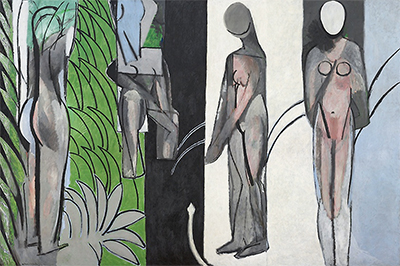
Four figures stand or sit beside what the title calls a river, but the water is difficult to find. A tall black strip cuts through Henri Matisse's Bathers by a River; green leaves press against the left side; broad pale and blue bands divide the rest of the enormous canvas. The bodies are close to life size, their heads reduced to ovals and their limbs partly absorbed by the surrounding forms. This is an image of bathers that asks the viewer to reconstruct a landscape from fragments. Its strange appearance is the result of years of work: Matisse began the canvas in 1909 and returned to it in 1913, 1916 and probably 1917.[1][2]
The Art Institute of Chicago owns the painting. Its record describes an oil on canvas 260 × 392 centimetres across, signed at the lower left, with accession number 1953.158. A visitor encountering it in a gallery sees nearly four metres of painted width, much more than a small reproduction can convey. The scale matters because Matisse was initially thinking about a large decorative program. The picture did not remain the pastoral image imagined at the start; he repeatedly remade its figures, colors and setting on the same canvas.[1]
At a Glance
- Artist Henri Matisse
- Work Bathers by a River
- Date 1909–17
- Explore Painting
This work across Henri Matisse’s career
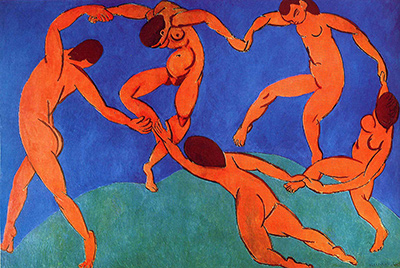
Dance (1910)
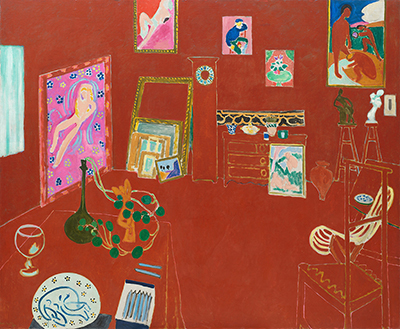
1910The Red Studio
1911The Piano Lesson
1916The Snail
1953Contents
- Why did Matisse begin a painting of bathers?
- What happened in the first two campaigns, 1909–10?
- Why did he return to the canvas in 1913?
- What changed during 1916?
- What did the painting share with Matisse's Back relief?
- Did Matisse finish it in 1917?
- How do the four figures work in the final composition?
- Where is the river?
- Is this a painting about the First World War?
- What makes the painting technically unusual?
Why did Matisse begin a painting of bathers?
The starting point was a commission from Sergei Shchukin, the Russian collector who wanted large paintings for the staircase of his Moscow house. In 1909 Matisse proposed a group of pastoral subjects. A watercolor called Composition No. II, sent to Shchukin in March, showed five women near a waterfall within a green, hilly setting. Two were in the stream. The Art Institute relates this watercolor to the earliest plan for Bathers by a River, although it is a separate work on paper, not a preserved first version of the large oil.[3]
Shchukin asked Matisse to avoid nudes in the commissioned scheme. A drawing on the back of a letter records a response: the two flanking bathers acquire loose drapery, the woman in the water turns away and the group contracts from five figures to four. The collector eventually chose the two panels now known as Dance II and Music. He did not purchase this bathers canvas for his staircase. Matisse kept working on it for his own purposes, so calling it an installed Shchukin panel would confuse its origin with its later history.[3][1]
That distinction helps explain a tension in the finished picture. Its width, large figures and rhythmic arrangement belong to the ambition of a decoration seen from a distance. Yet the surfaces record private, prolonged revisions that did not have to satisfy the collector's original request. The painting could become less immediately harmonious as Matisse pursued another question: how far could he simplify bodies, ground and water before the scene stopped making sense? The Art Institute's exhibition material treats it as a central experiment in the “modern construction” of a picture rather than a straightforward supplement to Dance II and Music.[2]
The 1909 subject also belongs to a much older tradition of bathers in art. Figures beside water allowed painters to arrange bodies in a landscape without telling a specific historical story. Matisse's first idea offered that kind of pastoral space. The final state still carries four human forms and a hint of nature, but the bodies are oddly still, the river has become hard to read and the landscape is broken into upright zones. Remembering the original genre makes the later transformation more striking than a label such as “abstract painting” on its own.
What happened in the first two campaigns, 1909–10?
The Art Institute distinguishes an initial state of March–May 1909. X-radiography reveals four figures surrounding a waterfall and stream on the large canvas. Samples of paint layers support a lighter original palette close to the watercolor Matisse had made for Shchukin. Those findings do not mean that a bright painting lies complete and intact beneath the finished surface. They allow conservators to identify earlier outlines and colors in specific places, then reconstruct a broad change in the artist's plan.[3]
The earliest landscape supplied features that could locate each figure: a waterfall, water below it, leafy growth and a slope. There was more descriptive connection between person and place than in the final canvas. Even at this stage Matisse was not merely copying a natural scene. He was designing a very large composition where bodies would set up a rhythm across the width. The broad decorative task encouraged figures to be read as shapes at a distance, while the subject still offered a story of people beside a river.
During a second phase, from fall 1909 into spring 1910, Matisse shifted the figures. The bather to the left of the stream moved upward and turned toward the viewer. The figure on the right of the waterfall raised her head and straightened her back. The fourth figure was also tightened, although the museum says its exact changes are difficult to distinguish in the crowded X-ray evidence. The second state's bodies were tenser and heavier. The Art Institute connects these revisions with Matisse's simultaneous work on Dance II and Music.[4]
Scientific examination also indicates a richer palette at this stage. The museum cautions that it has not proved Bathers by a River became as intensely red, blue and green as the completed Shchukin panels. That caution matters: conservation findings are not a license to imagine a fully documented, brilliantly colored “lost masterpiece” underneath. They show modifications of specific colors and shapes while the canvas was still in progress. The painting was a site where Matisse tried and retried relationships among figures, waterfall and surrounding bands.[4]
There is a productive comparison with Dance and Music. Those panels resolve bodies against large, clear fields of color in an immediately legible decorative rhythm. The bathers painting began alongside their commission, but its figures became more isolated and the place around them less transparent. The link is historical and formal; the three works should not be presented as a finished three-panel set. Shchukin bought two, while the third continued changing in Matisse's studio.[1][4]
Why did he return to the canvas in 1913?
Matisse resumed major work in May 1913, after his travels in Morocco. The Art Institute connects the heavier modelling of the bathers with drawings from those travels, while also noting his interest in geometry and construction. The left figure's once more graceful stance became rigid and upright. Limbs and body volumes were blocked into wedge-like forms; pale pink, dark gray and black entered the revisions. The museum relates this manner of reshaping a painted figure to Matisse's ongoing changes to his large sculpted Back relief. In both cases, an existing form was a starting material for further invention.[5]
The transformation is unusually well documented because photographer Alvin Langdon Coburn visited Matisse on 13 May 1913. His photographs show the artist with palette and brushes, working on the huge canvas from a ladder. They also record a picture visibly in transition. A photograph cannot display the hidden lower paint layers, but it fixes one moment during the sequence of changes. It prevents us from treating the painting's final surface as if it had simply appeared at one sitting in 1917.[5]
The ladder itself is a useful reminder of scale. At nearly four metres wide and more than two and a half metres high, the canvas required movement across and up its surface. A face that looks like a small oval in a book or on a phone belongs to a body measured in metres. Broad bands of color could organize the whole from a distance, while scraped and repainted passages remained visible close up. Matisse had to judge both levels as he revised.
By early November 1913, another photographer, Eugène Druet, documented a substantially altered canvas. The Art Institute describes more angular, generalized figures and a sharply reduced palette, especially gray. The museum's study combined the black-and-white photograph with paint samples, exposed passages and other physical evidence to reconstruct the likely color appearance of this state. That reconstruction is a research tool, not a color photograph made in 1913; its value lies in making the evidence and the uncertainty legible.[6]
The earlier green idyll had by then become cooler and more severe. The museum notes a high horizon, four bathers and a snake still present, but with forms shifted or reduced and the surrounding landscape reworked. Leafy plants, rippling water and repeated rounded tree shapes made an imagined environment rather than a naturalistic view. The body of the second bather, seated by the waterfall in this stage, has a close formal relation to the distinct Gray Nude with Bracelet of 1913. The relationship shows that Matisse was testing angular bodies and limited color across more than one work, not simply correcting an isolated canvas.[6][7]
One can easily overstate the influence of Cubism here. The Art Institute does connect Matisse's 1913 turn to Cubist ideas and to a more structural approach. That does not make Bathers by a River a work by Picasso or a straightforward example of analytic Cubism. Matisse kept large bodies, a wide decorative format and a recognizable subject. His experiment was to make those elements stronger and stranger by paring down their usual links to natural space.[2][7]
What changed during 1916?
After another interval, Matisse returned to the painting in early spring 1916. By November, a Bernheim-Jeune photograph showed a new state. The woodland and waterfall of 1913 had largely given way to broad upright registers of color. The Art Institute describes blue, green, white and black bands, along with a stylized leaf pattern at the left. Matisse scraped away some paint and built up new layers elsewhere, giving the figures greater geometric weight. The change was more than a new color scheme: the whole scene's method of holding its parts together was reconsidered.[8]
The black band is the most startling element. In earlier states there was water and a waterfall at roughly this part of the composition. In the later one, black no longer reads easily as a blue river under shade. It is a wide vertical interruption that separates neighboring figures and holds the picture together at the same time. A small light, sinuous form low in the band can be read in relation to the snake documented in the earlier composition. Its survival is suggestive precisely because so much of the original riverside setting has disappeared.[6][8]
The painting's 1916 state also has a documented relation to Matisse's The Moroccans, made around 1915–16. The Art Institute identifies a shared concern with the constructive force of black: dark paint can simplify, divide and join areas instead of serving only as shadow. In The Moroccans, broad areas of black organize a scene of figures and setting; in Bathers by a River, the black column interrupts a landscape that once flowed across the width. The two paintings remain distinct subjects and compositions, but looking at them together clarifies why black was so productive for Matisse at this point.[8]
Technical study reveals that the vertical bands were not settled in a single pass. The Art Institute's analysis of X-rays, paint cross sections and pigment materials finds some stripes repainted repeatedly, with altered colors and widths. At the far left, a band changed from light blue to white, to black, back to white, and then to pale blue with a dark leaf design that later gained green. This sequence is much more precise than the loose statement that Matisse “simplified” the painting. He did simplify its broad structure, but he reached that structure through intricate revisions and reversals.[9]
Those alterations are useful for looking at the finished surface. The left foliage feels energetic because many narrow black contours curve across patches of green and pale blue. Its forms are not merely decorative leaves pasted over a background. They carry the memory of Matisse's struggle to decide where one band should end and another begin. At the center, the dark strip provides a hard counterweight. On the right, paler zones let the standing bodies stand out without restoring a conventional open landscape.
The museum's 1916 chronology also places this effort alongside severe interiors and still lifes. Matisse was thinking about how to construct a picture with fewer descriptive cues. Some of these works were closely associated with his response to Cubism, while he was already beginning to seek a less rigid manner. Bathers by a River is valuable because it did not simply discard earlier decisions; it carries a record of them under and within the later paint.[10]
What did the painting share with Matisse's Back relief?
Matisse's large sculpted Back was another project he revisited across years. The Art Institute's account of its second state describes him working from a plaster cast of an earlier version, cutting away material and building up new plaster until the woman's curved body became stockier and more angular. In the third state, underway by May 1913 and developed through 1916, he straightened the spine, reduced details and stressed vertical divisions. A photograph by Coburn on the same May 1913 visit that documented the bathers canvas also shows Matisse at work on the relief. The two projects were therefore not linked only by a historian's later analogy; they occupied his studio and attention during overlapping campaigns.[11][12]
The resemblance is not that a bather directly copies the sculpted back. It lies in a method of remaking an existing figure. On the relief, Matisse could scrape, chisel and add plaster. On the canvas, he could cover earlier painted limbs, cut sharper edges through color and reset a body against a broad band. Both processes made a once softer figure feel more columnar. The Art Institute notes that the third Back presses its central spine or hair column into the surrounding ground, an effect comparable to the way the bathers become inseparable from the upright divisions behind them.[12]
This comparison makes “simplification” less passive. Matisse was not merely leaving out anatomy because he had lost interest in bodies. He was testing what would happen if he gave a body a stronger vertical axis and less descriptive surface. Sculpture offered the physical resistance of plaster; painting offered layers of color that could be changed, hidden and exposed. In each medium, revision was a way to find form rather than simply to correct a mistake.
Watch: Matisse’s art and working methods
Choose a museum film or a close reading to continue exploring Matisse’s work.
Matisse: “For Me It’s Always New”
The Museum of Fine Arts, Boston considers Matisse’s creative practice.
Watch on YouTubeDid Matisse finish it in 1917?
The museum identifies a final, more restrained campaign in 1917, with the end date marked uncertain as October (?). Unlike the dramatic 1916 restructuring, these changes concentrated on particular passages. At the left, Matisse scraped back paint, adjusted leaf contours and clarified lines. Between the third and fourth figures he applied a thin, brushy white layer over blue. Such changes can be missed when the work is reproduced small, but they show that the final state was refined rather than simply abandoned after the major 1916 transformation.[13]
The long date should be read as a sequence of campaigns, not eight years of uninterrupted daily painting. The Art Institute names periods of work in 1909–10, 1913, 1916 and probably 1917. Gaps matter as much as returns: Matisse could make other paintings and sculptures, then see an older canvas anew. The final work contains choices from the different moments, including traces that physical examination can reveal beneath the present surface. It is therefore misleading to label it only “1917” without explaining the earlier beginning, or only “1909” without accounting for the radical late changes.[1][2]
The museum's use of distinct “states” is an analytical aid. It lets us discuss a first composition, a second revision, photographed 1913 and 1916 appearances, and final adjustments. These were not separate canvases displayed together. The same large support underwent change. Nor can every physical mark be assigned to one phase with equal certainty. Photographs document some moments; X-radiographs, cross sections and close examination help infer others. This mix of evidence is why the history can be unusually detailed while some dates and intermediate appearances remain approximate.
How do the four figures work in the final composition?
Begin at the left. A tall figure stands close to the picture's edge, seen largely from behind. Gray and pale flesh-like paint marks the body; dark contours sharpen its back and legs. It is entangled with foliage, so its edge alternates between a human outline and the black curves of leaves. The green area behind it feels dense. The figure is visible, but it does not step cleanly forward as a separate person posed before a backdrop.
The second figure is more difficult to locate at first. It occupies the darker middle-left region beside the black band and has a partly seated or bent posture. Gray limbs emerge from neighboring patches, then merge back into them. In a small image, it may look like one body interrupted by another. That difficulty is part of the final composition's effect: Matisse has made a group of bathers while refusing the clear, evenly spaced silhouettes one might expect from a decorative river scene.
The third bather stands against a broad pale zone. Her head is a gray oval angled downward, and the torso includes restrained pink. One arm slopes toward the dark band, while the legs taper into a narrow base. Her position makes the contrast with the second figure vivid. A body that is comparatively legible still has no facial expression, and its flatly colored parts are almost as abstract as the background behind it.
At the far right, another standing figure faces more toward us. The head appears as a light oval within a dark surrounding shape. Rounded breast outlines and pink down the torso help mark the body, while the legs lengthen into the lower edge of the canvas. Behind and beside it, pale blue makes a comparatively open field. The figure is frontal enough to be recognized quickly, but the blank head prevents a conventional encounter with a named sitter. These are bodies arranged for the painting's structure, not portraits of four identified people.
Taken together, the bathers form a rhythm of upright shapes with different degrees of concealment. The left figure is entangled with leaves; the second is caught by gray and black; the third stands against pale paint; the fourth occupies blue and gray. There is a movement from densely marked left to more open right, but the black strip and the bodies' awkward poses keep that movement from becoming a simple passage into freedom. The scene asks us to compare how each figure is made visible rather than to follow a clear action among them.
The heads deserve attention. Their oval shapes register as heads with very little information beyond position and tone. One is dark gray, another pale, and the rightmost almost white. Matisse withheld eyes and mouth that might turn this into a story about individual bathers. He also changed the relation between figure and ground: a head can become a shape that balances a neighboring band as much as it identifies a person. The absence of faces is visually forceful, yet it does not prove that the painting is about anonymity or dehumanization. Those are possible interpretations, not object facts.
Where is the river?
The title primes us to search for flowing water. The Art Institute's reconstruction confirms that a stream and waterfall belonged to the initial scene. In the finished picture, however, the most prominent central passage is black, vertical and static. The remaining pale and blue zones may invite a water reading, but they do not describe a continuous riverbank and current. The canvas keeps a title tied to its history while showing how thoroughly Matisse reworked that history.[3][1]
The pale snake-like form low in the black band makes the disjunction even more interesting. It is a small remnant of something representational inside a passage that largely works as an abstract division. The museum's November 1913 account identifies a snake in the earlier scene. In the final image, the thin light curve can be followed with the eye without requiring a full naturalistic river around it. That isolated sign invites a closer look at how motifs survive while their surroundings are repainted.[6]
The left leaves likewise hover between landscape and pattern. Their black outlines curl across bright green in a way that names plants but also produces rhythm. They no longer guarantee a particular riverside location. Across the canvas, figure and environment keep exchanging roles: a body becomes an upright gray mass; a band of color takes on the weight of architecture; a plant becomes a network of lines. This is why the picture can be read simultaneously as bathers in nature and as a rigorous arrangement of vertical forms.
Is this a painting about the First World War?
The final major revisions occurred during the war, and the Art Institute suggests that the work's sobriety and a hint of danger may partly reflect Matisse's concerns in that period. The phrase is deliberately cautious. The canvas does not depict soldiers, a battlefield or a named event. It began before the war, in a pastoral commission, and its dramatic changes also belong to Matisse's continuing experiments with structure and color. A direct one-to-one translation from black paint to wartime grief would claim more than the evidence allows.[1]
Still, the timing is relevant. An idyllic theme became a severe arrangement while European life changed around the artist. The contrast between the first watercolor's inviting waterfall and the finished painting's divided space is real. The museum's reading invites us to consider how atmosphere and historical pressure might enter a work without turning it into an illustration of current affairs. The most responsible account keeps both strands visible: formal experimentation over years and a wartime setting for the late campaigns.
The Art Institute's exhibition text provides more specific context for 1916. Matisse had not entered military service, and in a letter to dealer Léonce Rosenberg he described his discomfort at remaining with his brushes while others faced the conflict. The museum links that year to his demanding work on The Moroccans, Back, Bathers by a River and other long-running projects. It explicitly notes that these pictures make no direct reference to the war in their subjects. That evidence is stronger than treating the canvas's dark strip as a coded trench or memorial. It shows an artist persisting with difficult work under wartime pressure, without defining the painting as a war picture.[14]
That context also helps explain why the canvas could be both old and urgent in 1916. Matisse did not begin with a blank support to comment on current events. He took up a large work already marked by years of decisions and subjected it to another exacting revision. The museum describes a broader practice of scraping, incising and adding fresh material in several works from the period. Returning to the bathers allowed him to test those methods at a size and complexity that a new small canvas could not have offered.[14]
The Art Institute's 1916–17 exhibition text notes that Matisse was making other stripped-down interiors and still lifes while revising this canvas, and later explored softer light and landscape again. That larger sequence also resists a single emotional label for his wartime work. Bathers by a River is severe, but the late 1917 adjustments are subtle; nearby work could move in another direction. The artist did not make a permanent conversion from Fauvist color to monochrome austerity.[10][13]
What makes the painting technically unusual?
Many large paintings show revisions. This one has unusually rich evidence for them. X-radiography can register contrasts among underlying paint and forms; samples taken through the layers can show the order of colors in a small spot; archival photographs record the overall appearance at dated moments. Used together, these methods help the Art Institute distinguish the early waterfall, shifted figures, gray 1913 state, 1916 bands and quieter final changes. No single tool reveals the whole history. The understanding comes from comparing several kinds of evidence, each with its own limits.[3][6][9]
The technical record also changes how one thinks about simplification. Broad bands may look quickly laid down, but repeated overpainting can make a seemingly simple stripe the result of many decisions. The Art Institute reports some stripes altered as many as six times in the 1916 phase. Scraping and scumbling—dragging a thin, broken layer of paint across another color—could expose or soften earlier passages. These operations are not just conservation curiosities. They explain why the finished surface has both monumentality and traces of hesitation or adjustment.[9][13]
The finished surface does not display its entire past to the unaided eye. Even when one looks closely in front of the canvas, an underlying waterfall or earlier position of a leg may be concealed by later paint. The Art Institute's technical chronology supplies that hidden evidence. The visible composition still makes sense on its own: its four bodies and vertical bands hold together without the viewer knowing the precise order of every revision. Learning that order changes the experience of the picture, but it does not replace the act of looking at the final arrangement.
How did the picture reach Chicago?
The painting remained with Matisse long after the Shchukin commission had changed course. According to the Art Institute's ownership history, Galerie Paul Guillaume bought it from the artist in September 1926. It passed to Guillaume's widow, Juliette “Domenica” Lacaze, and was sold to Henry and Rose Pearlman of New York in 1951. The Art Institute acquired it from the Pearlmans through an exchange in 1953. That route confirms again that Shchukin did not take possession of this canvas.[1]
Its public names changed over time. Early French publications used forms such as Jeunes filles au bain and Femmes au ruisseau; English catalogues later used Women by a Stream, Girls Bathing and Bathers by a River. The variation reflects a subject that could be described as women, young girls, bathers or figures near water. The current title is the owner's established English label. It is useful, but it should not be mistaken for a precise map of what is plainly visible in the final state.[1]
The painting was shown at Galerie Paul Guillaume in 1926. It appeared in the major 1951–52 Matisse retrospective, just before its acquisition by Chicago, and later in the 2010 Matisse: Radical Invention, 1913–1917 exhibition. These displays helped move it from an unusual, difficult canvas in an artist's long career to a central example of his extended working method. The 2010 technical project made that method especially visible by setting photographs, physical findings and reconstructions beside the finished painting.[1][2]
How should we look at it now?
First let the picture's width register. Follow the figures from left to right without trying immediately to name each background strip. Then return to the dark center and ask what it does to the space between bodies. Move to the leaf contours at left and the open blue at right. Finally, look for small survivals and revisions: the light curve in the black passage, broken edges around limbs, and the subtle change in paint between the last two bathers. This route through the canvas lets its present structure lead the experience before the early watercolor or X-ray explains its history.
The history then deepens what can be seen. An early river scene became a painting where water is nearly absent; a decoration proposed in a collector's orbit became a long personal experiment; a group of bodies became a test of how figures can be divided and joined by color. Matisse preserved and transformed the same canvas through several periods rather than replacing it with an entirely new idea. Bathers by a River is therefore valuable both as a large, unsettling final image and as a record of painting as sustained revision.
The Henri Matisse artist page and paintings directory lead to works from before and after this extended project.
Explore 113 Matisse artworks
This directory covers the 113 individual works explored in these articles, rather than a complete catalogue of Matisse’s output. Cut-paper designs and prints appear under Drawing in the medium filter; each row names its form. Dates retain the qualifications explained in the linked articles.
Discussion
Look again at the images and ideas explored in Henri Matisse, Bathers by a River, 1909–17. These editorial prompts invite your observations.
Reader Insights
Why did Matisse begin a painting of bathers?
Which comparison discussed in the article helps you see the work differently?
How do the materials and historical setting affect your reading?
Join the Conversation
Share a detail, comparison or question about Henri Matisse, Bathers by a River, 1909–17 below.
References
- Art Institute of Chicago , Bathers by a River , object, exhibition and ownership records, owner facts, Shchukin context, interpretation and provenance. View source .
- Art Institute of Chicago , Matisse: Radical Invention , introduction to the painting, chronology of the long painting process. View source .
- Art Institute of Chicago , Bathers by a River , first state, Shchukin watercolor, related drawing and technical reconstruction. View source .
- Art Institute of Chicago , Bathers by a River , second state, fall 1909–spring 1910 figure and color changes. View source .
- Art Institute of Chicago , Bathers by a River , May 1913 state, Coburn photographs and renewed work. View source .
- Art Institute of Chicago , Bathers by a River , November 1913 state, Druet photograph and compositional changes. View source .
- Art Institute of Chicago , Bathers by a River , 1913 color reconstruction, gray palette and comparison with Gray Nude with Bracelet . View source .
- Art Institute of Chicago , Bathers by a River , 1916 state, November photograph, vertical bands and comparison with The Moroccans . View source .
- Art Institute of Chicago , Bathers by a River , 1916 technical reconstruction, paint samples and repeated repainting of bands. View source .
- Art Institute of Chicago , Changing Course, 1916–17 , wider wartime sequence. View source .
- Art Institute of Chicago , Back (II) , plaster revisions through early 1913. View source .
- Art Institute of Chicago , Back (III) , 1913–16 development and relation to Bathers by a River . View source .
- Art Institute of Chicago , Bathers by a River , final state, 1917 surface adjustments. View source .
- Art Institute of Chicago , The Challenge of Painting, January–December 1916 , wartime setting and linked projects. View source .
 Henri Matisse.jpg)