 by
Tom Gurney
Tom Gurney BSc (Hons) is an art history expert with over 20 years experience
Email:
tomgurney1@gmail.com
/ Phone:
+44 7429 011000
Henri Matisse, The Conversation, 1908–12: Introduction
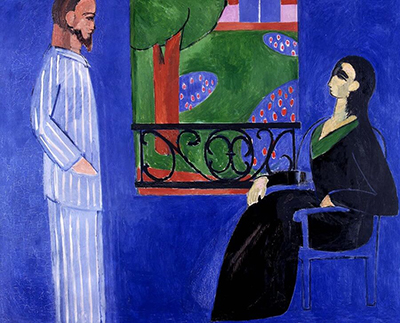
Henri Matisse stands at the left of The Conversation in a pale suit crossed by narrow blue-white stripes. His wife Amélie sits opposite him, dark against an intense blue interior. They face each other across a broad space that contains almost no furniture. Between them, a rectangular opening shows a green garden, a tree trunk and a black wrought-iron railing. The painting's title invites us to imagine words passing from one figure to the other. Matisse gives us their orientation and their shared setting, but no speech or account of the moment. The blue space, window and opposing poses do much of the work that a more detailed domestic scene might assign to gesture and expression. [1]
The State Hermitage Museum in Saint Petersburg catalogues the canvas as Разговор ( The Conversation ), oil on canvas , 177 × 217 centimetres , inventory ГЭ-6521 . Its catalogue date is between 1908 and 1912 . In the same record, the museum's interpretive essay says Matisse painted the blue-green composition in a country house in the summer of 1909 . Those statements can coexist as a broad catalogue range and a narrower account of painting activity; they should not be compressed into an unquestioned single-year completion date. A Centre Pompidou exhibition list used 1909–11 , while MoMA's 1992 retrospective described the work as completed in 1912 . The Hermitage's current object record governs the date range used here. [1] [2] [3]
At a Glance
- Artist Henri Matisse
- Work The Conversation
- Date 1908–12
- Explore Painting
This work across Henri Matisse’s career
Dance (1910)
1910The Red Studio
1911The Piano Lesson
1916The Snail
1953Contents
- Who are the two people?
- Why does blue occupy so much of the canvas?
- What does the garden add?
- Is this a portrait or a composition about space?
- How was it seen in Sergei Shchukin's house?
- How does it compare with Matisse's other family interiors?
- How did the painting reach the Hermitage?
Who are the two people?
The Hermitage identifies them as Henri and Amélie Matisse , and notes that their simplified features retain a likeness. Henri's beard and strong profile help distinguish him; his upright pose and striped clothing make a tall patterned shape at the left edge. Amélie's dark hair and black dress gather into a rounded seated form at the right. Her pale face lifts toward him. These are specific people rather than anonymous figures recruited to illustrate a conversation, but the painting does not record a transcript of their exchange. [1]
The figures are unequal in height because one stands and one sits. Matisse nearly reaches both top and bottom edges of the canvas, giving him a strong vertical presence. Amélie is lower, with the line of her chair leg and the folds of her dress extending toward the bottom right. Their bodies do not meet. Much of the painting's tension comes from the large interval between them and from the black railing crossing that interval within the window. The figures face across a field of blue, yet the garden view occupies the space where a table or another domestic object might ordinarily sit.
The patterned suit is worth looking at closely. Its slim, nearly vertical stripes echo the straight tree trunk and the window's sides, but they also differ from those heavier boundaries. The suit's pale ground keeps Matisse visible against blue even though its stripes are cool-colored. Amélie's dress has the opposite role: a dense dark mass against the same blue, relieved by a green neckline and the pale face and hand. Matisse uses costume to make the two people structurally distinct, not simply to tell us what they wore.
One can describe the scene as solemn or still. The figures' apparent expressions, however, are too sparingly painted to establish anger, affection or a particular marital dispute. Even the word “conversation” does not tell us whether either is speaking at the pictured instant. The more reliable observation is their sustained facing: the standing artist looks across to the seated Amélie, and her raised head returns that direction. The picture holds their relationship in the space between poses rather than spelling it out through anecdote.
Why does blue occupy so much of the canvas?
Blue spreads behind both figures and around the window, touching the edges of clothing and chair. The Hermitage's essay argues that it should not be assigned narrowly to a blue wall or a blue carpet. In the museum's reading, it works as a larger idea of space, carrying a cool emotional force. The visible image supports the practical side of that interpretation: there is no clear floor-wall junction dividing the blue into room surfaces. Matisse lets one color extend where ordinary perspective would separate several planes. [1]
This does not mean the scene has no depth. Henri stands before the blue field; Amélie's chair and the railing help us place her near a window; the green garden lies beyond it. Yet each cue remains shallow. The window is a crisp rectangle rather than a tunnel receding into distance. The foreground blue reaches around the figures without modeling a room with strong shadows. Depth is available when needed to read the scene, but it never takes precedence over the distribution of large colors.
The blue makes a nearly continuous visual link between husband and wife while also marking their separation. Because neither figure touches the other, the field can feel like an interval. Because the same blue surrounds them, it can also feel like a shared atmosphere. The painting resists reducing that dual effect to a simple story of estrangement or harmony. What is certain is that Matisse uses a large color area to organize the whole composition. His standing body, Amélie's seated body and the green opening all become strongly legible because of their edges against it.
The black of Amélie's dress and the railing changes how the blue is perceived. Black can seem especially dense against it, while the pale striped suit comes forward. Green in the window becomes a release from the surrounding cool blue, though not a fully separate world. Small red and pink notes in the garden then register more sharply than their area would suggest. The blue dominates in size; other colors carry much of the scene's rhythm.
MoMA's 1966 Matisse exhibition catalogue described Conversation as a painting in which emotional tension is held within the calm of its color. That is a historical critical reading, not a diagnosis of the couple's marriage. It helps explain why a composition with almost no action can feel charged: opposed profiles and dark lines are absorbed into the seemingly even blue. The longer one looks, the less that blue behaves like an empty background. [4]
What does the garden add?
The opening between the figures is compact but highly active. A broad green area carries a straight reddish tree trunk; rounded blue forms with red and pink marks sit among it. At the top, a small band of red, white and blue architectural color interrupts the foliage. Along the lower edge, a black wrought-iron railing runs horizontally and curls into loops. The view is a constructed pattern of strong shapes rather than a precise botanical survey. It supplies a second kind of space beside the large indoor blue.
The railing is especially important. Its dark horizontal bar ties the two sides of the window together, while the scrollwork curls in front of the green. It is both a recognizable garden or balcony feature and a line drawing across the center of the painting. The loops touch the viewer's eye differently from the straight tree trunk and window frame. They make the opening intricate without filling the whole canvas with ornament. The rail also lies between the two people: it can visually connect their sides of the picture, even as its dark barrier reinforces their separation.
The Hermitage's essay reads the tree and green lawn in symbolic terms, associating them with life, while treating the railing almost like an unreadable monogram. That is the museum's interpretation. The painting itself offers a tree, lawn, rail and colored flower-like forms. A viewer does not need to adopt a fixed symbolic code to see how the rigid trunk, curling iron and rounded foliage differ. Matisse stages a meeting between straight and curved lines within the central opening, then lets those relations echo in the two figures' bodies and clothing. [1]
The garden also changes the apparent scale of the interior. If we concentrate on the full 217-centimetre width of the canvas, the couple can seem monumental, set against a nearly boundless blue. If we look through the window, they are recognizable people beside a particular piece of architecture and greenery. Matisse holds those readings together. The central view keeps the scene attached to a lived place while its simplified shapes allow it to function as a color panel between the figures.
Watch: Matisse’s art and working methods
Choose a museum film or a close reading to continue exploring Matisse’s work.
Matisse: “For Me It’s Always New”
The Museum of Fine Arts, Boston considers Matisse’s creative practice.
Watch on YouTubeIs this a portrait or a composition about space?
It is both. The Hermitage explicitly identifies the sitters and acknowledges portrait likeness, but its essay emphasizes the transformation of an observed moment into an ordered picture. That distinction matters because the work is unusually large for a small domestic exchange. At 177 × 217 centimetres , it presents the two people at a scale that asks viewers to consider the whole field, not just their faces. The figures are integral to its architecture: Matisse's upright body sets one side, Amélie's lower curved mass anchors the other, and the window holds the middle. [1]
The title can mislead if it makes us search for a narrative key. Nothing in the image identifies the topic of discussion, the hour of day or what happened next. There is no document in the museum record tying this exact pose to a named household incident. A reading that turns the canvas into a scene of a known argument would go beyond the evidence. The compositional question is richer: how can two particular people remain recognizable while being reduced to opposing shapes in a vast blue space?
The Hermitage essay proposes a symbolic opposition between straight lines associated with the male figure and curves associated with the female. This describes one way the museum has interpreted the formal contrast, but it should not be taken as a universal rule about gender or as proof of Matisse's intention for every contour. The painting's lines do not obey a strict binary anyway. Henri's body includes curves at his head and hands; Amélie's chair has straight supports; the rail combines horizontal and curling forms. The interplay is more varied than a formula of one straight person and one curved person. [1]
That variety helps the two people remain in a shared world. The railing's loops answer the contour of Amélie's seated pose, while its horizontal bar crosses toward Henri. The striped suit echoes the tree but also resembles a decorative pattern. The visual connections are not an account of marital feeling. They are observable ways Matisse makes each part of the picture answer another. The work is a double portrait whose deepest organization lies in relations among people, color, garden and line.
How was it seen in Sergei Shchukin's house?
The Hermitage states that The Conversation came from the collection of Sergei Shchukin , the Moscow patron who built one of the most important early groups of Matisse paintings. The Metropolitan Museum reports that Shchukin acquired about forty Matisse canvases between 1906 and 1914 and opened his collection to visitors one day a week before the Russian Revolution. This picture was therefore part of a deliberately assembled public-facing private collection, not merely a family painting that stayed in Matisse's home. [1] [5]
A Pushkin Museum exhibition account provides a particularly useful detail about its display. Shchukin placed The Conversation between two later, tall Matisse canvases: Corner of the Studio and Nasturtiums with “Dance” II . The Pushkin account says he acquired those flanking paintings in 1912 and The Conversation in 1913 ; the Hermitage owner record does not specify the purchase year. The documented arrangement placed the central blue exchange between two paintings of Matisse's working environment and a pictured artwork. The placement is a collector's decision, not proof that all three were conceived as one painted triptych from the outset. [6] [1]
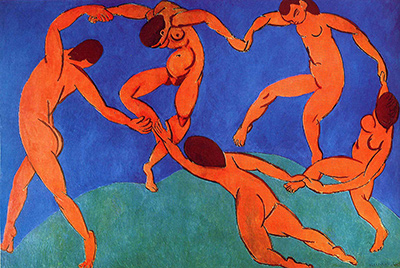
That setting would have altered how a visitor read the canvas. Its large blue field was no longer only a room around two people. Beside nearby panels of studio space and a depiction of Dance , it belonged to a broader arrangement about where Matisse made art and how he displayed it. The tall neighbors also changed its proportions: its wide, nearly square-feeling horizontal span became a central anchor between narrower vertical works. We can imagine this relation from the documented hanging, but the exact experience of every visitor and every later rehanging is not recorded by that source.
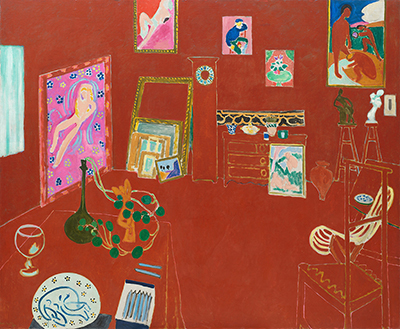
The display also explains why comparison within Matisse's own work is useful. Corner of the Studio gives objects and a place of making; The Conversation strips a domestic encounter down to two figures and a window; Nasturtiums with “Dance” II folds an image of another Matisse composition into studio space. Shchukin's arrangement brought three different subjects together under a shared interest in large color areas and carefully placed forms. The works differ in date and job even when viewed as an ensemble. [6]
How does it compare with Matisse's other family interiors?
The Hermitage also owns The Painter's Family of 1911 . Its owner record identifies Amélie with Matisse's sons Jean and Pierre and his daughter Marguerite in a richly patterned interior. In that painting, the children's checkerboard and the room's decorations give the family a network of objects and activities. The Conversation pares such cues back. The two adults face each other with little to explain what they are doing, and the garden window takes the place of a busy domestic setting. Both pictures transform family life into large-scale painting, but they organize it in sharply different ways. [7]
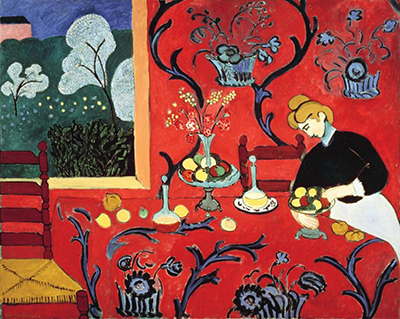
The earlier Red Room (Harmony in Red) offers a contrast in color and figure-ground treatment. Its 1908 Hermitage canvas spreads red patterned fabric across a dining-room setting and opens toward trees outside. In The Conversation , blue unifies the interior and the pattern is concentrated in Matisse's suit and the iron railing. The green garden occupies a distinct central opening instead of appearing as one part of a richly furnished red room. The comparison shows Matisse repeatedly using a window and a dominant color, but it does not make the works interchangeable or assign them to one continuous interior. [8]
The movement from red to blue is not a simple chronological progress toward greater abstraction. The red canvas of 1908, the blue Conversation with its broad date range, and the densely patterned family portrait of 1911 solve different problems. Matisse could simplify one work while filling another with detail. Their owners and dates are useful anchors, but close attention to each picture's actual balance of figures, objects and openings is more informative than a single story of style moving in one direction.
How did the painting reach the Hermitage?
The Met records that Shchukin's collection was nationalized in 1918 after the Russian Revolution. The Hermitage's object record states that The Conversation reached the museum in 1930 from the State Museum of Modern Western Art , with Shchukin's collection as its earlier source. That object-specific date should not be replaced by the general 1948 division often mentioned in histories of the wider Shchukin and Morozov collections. Different works took different administrative routes. The current Hermitage inventory number, ГЭ-6521 , fixes this canvas's present museum identity. [5] [1]
This history has a human as well as an institutional dimension. Shchukin assembled and displayed the work during his lifetime; nationalization removed control of the collection from him. The later museum setting has allowed successive publics to see it, but public access is not a reason to erase that change of ownership. The Hermitage's record supplies the concrete chain needed for this page: Shchukin collection, State Museum of Modern Western Art, Hermitage intake in 1930. More detailed claims about every move or display should be left to specific collection documents rather than inferred from the painting's presence today.
The strongest way to return to the canvas is to look through and across it in stages. First identify Henri and Amélie by the striped pale suit and black dress. Then cover the window mentally and feel how much blue separates them. Restore the garden, follow the tree trunk downward to the black railing, and trace the curling ironwork from one side to the other. The supposed conversation emerges from these visual relations. Matisse gives the pair a recognizable shared place, while color and line leave the content of their meeting open.
For related but distinct works, compare The Painter's Family and The Red Room . The paintings directory and Matisse biography place the Hermitage canvas within the wider career.
Explore 113 Matisse artworks
This directory covers the 113 individual works explored in these articles, rather than a complete catalogue of Matisse’s output. Cut-paper designs and prints appear under Drawing in the medium filter; each row names its form. Dates retain the qualifications explained in the linked articles.
Discussion
Look again at the images and ideas explored in Henri Matisse, The Conversation, 1908–12. These editorial prompts invite your observations.
Reader Insights
Who are the two people?
Which comparison discussed in the article helps you see the work differently?
How do the materials and historical setting affect your reading?
Join the Conversation
Share a detail, comparison or question about Henri Matisse, The Conversation, 1908–12 below.
References
- State Hermitage Museum , Разговор ( The Conversation ), object 28401, owner record, interpretation, dimensions, medium, catalogue date and 1930 intake. Russian page accessed directly; translated and paraphrased for this manuscript. View source .
- Centre Pompidou , 1993–94 activity report and Matisse exhibition listing, La Conversation , 1909–11, oil on canvas, 177 × 217 cm, Hermitage. View source .
- Museum of Modern Art , Henri Matisse: A Retrospective (1992), exhibition overview describing Conversation as completed in 1912. View source .
- Museum of Modern Art , Henri Matisse: 64 Paintings (1966), historical critical account of the blue composition and its controlled tension. View source .
- Metropolitan Museum of Art , Portrait of Sergei I. Shchukin , patronage, pre-revolution public access and 1918 nationalization context. View source .
- Pushkin Museum , Shchukin: Biography of a Collection , Corner of the Studio interpretation, account of the three-work hanging and its proposed acquisition dates. Russian page translated and paraphrased. View source .
- State Hermitage Museum , Семейный портрет ( The Painter's Family ), separate 1911 family interior and named sitters. View source .
- State Hermitage Museum , Красная комната ( The Red Room ), separate 1908 red dining-room composition. View source .
 Henri Matisse.jpg)