 by
Tom Gurney
Tom Gurney BSc (Hons) is an art history expert with over 20 years experience
Email:
tomgurney1@gmail.com
/ Phone:
+44 7429 011000
La Serpentine by Henri Matisse: a standing figure set into motion: Introduction
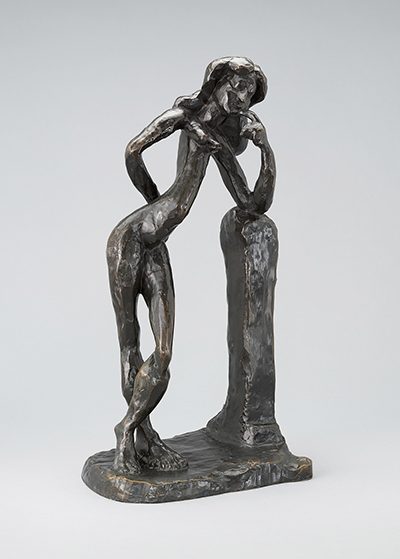
Henri Matisse's La Serpentine stands still and yet seems to move. A woman leans one elbow on a high post, turns her head toward her hand and crosses her legs near the ankles. These could be the ingredients of an easy resting pose. Matisse stretches the torso, presses the hip outward and gives the limbs unequal weight. The eye cannot settle on one straight line from head to foot. It follows a series of bends, as though the body were slowly turning around its own balance. [1] [2]
The Museum of Modern Art in New York dates the sculpture to fall 1909 and places its making at Issy-les-Moulineaux near Paris. Its bronze measures 56.5 centimetres high, 28 wide and 19 deep, and has the collection number 624.1939. A MoMA exhibition catalogue identifies that example as no. 1 of an edition of ten. The 1909 date names Matisse's model for the work; it should not automatically be used as the pour date of every bronze. The Philadelphia Museum of Art, for example, labels its own Serpentine “modelled 1909; cast 1929.” These are related casts, not the same physical object. [1] [2] [3]
At a Glance
- Artist Henri Matisse
- Work La Serpentine
- Date 1909
- Explore Sculpture
This work across Henri Matisse’s career
Dance (1910)
1910The Red Studio
1911The Piano Lesson
1916The Snail
1953Contents
- How does the figure hold its balance?
- Was Matisse copying a model?
- What changed in Matisse's sculpture around 1909?
How does the figure hold its balance?
At the base, one foot stands close to the other while the lower legs cross. The stance looks precarious if judged as an ordinary pose a person must hold unaided. The post changes that. An elbow rests on its top; the arm runs up from the post toward the face, making a supporting loop. Across from it, the other arm curves toward the hip. Together the arms make two different paths around the narrow chest: one tied to the block, the other opening toward the figure's side. The tall support is part of the composition, not scenery placed beside it. [1] [2]
The post also gives the viewer a measure of what Matisse has altered. It is upright and broadly solid; the figure is tilted, narrow in the middle and unexpectedly wide at hip and calves. Against the post's rough rectangle, the body can look almost like a sequence of curved strokes. The straight block steadies the sculpture while making the woman's changes of direction more visible. She leans into it but does not merge with it. A strip of open space remains between support and torso, so the weight of the lean can be felt across the gap. [1]
The head is large compared with the slim torso. It inclines downward, compressing the neck into the turn of the shoulders. The chest narrows; the abdomen and hip move out in a long curve; the legs return toward the small patch of ground they share. That sequence gives La Serpentine its name more convincingly than any literal snake imagery would. The sculpture is a human body, but a sinuous line can be traced through it. Matisse lets proportion shift to keep that line alive. [2] [1]
The bronze surface works against an overly smooth idea of grace. It is broken and irregular around the face, torso, post and base. Light catches ridges and hollows rather than sliding evenly over polished skin. In a photograph, these changing highlights can make the long body look flickering and unsettled. The form remains recognisable, yet its modelling refuses the finish of a lifelike statuette. The same figure can feel casual in pose and intensely worked in its material. [1] [2]
Watch: Matisse’s art and working methods
Choose a museum film or a close reading to continue exploring Matisse’s work.
Illuminating Matisse's Creative Process: A Painter as Sculptor
A museum lecture on Matisse’s work in three dimensions.
Watch on YouTubeWas Matisse copying a model?
The Philadelphia Museum of Art describes the sculpture as inspired by a photograph of a studio model posed with an elbow on a prop and legs crossed. It also notes photographs of Matisse at work showing him progressively thinning and lengthening the body. This is a helpful distinction: the recognisable pose did not dictate the final proportions. The photograph supplied a starting relation of body, support and crossed feet; Matisse altered the figure so that the path of its lines mattered more than anatomical regularity. [3]
MoMA's 1972 sculpture catalogue relates the elbow-on-post pose to a Greek sculptural tradition, while discussing Matisse's unusual proportions. That is a comparison of poses, not an identification of a single ancient statue copied in every detail. The finished bronze has an early twentieth-century studio character: a substantial prop, a roughly modelled surface and a figure whose body is edited for movement. A classical association and a photographed modern model can both illuminate the stance without reducing the sculpture to either one source. [2] [3]
The location matters too. MoMA explicitly places the work at Issy-les-Moulineaux in fall 1909. The Philadelphia account adds photographic evidence of a model's pose and Matisse revising the form. Together these records establish the setting and the visible transformations without providing a precise number of sittings or a named sitter for this figure. Its particular movement is a sculptural decision, not just the record of a person holding still. [1] [3]
What changed in Matisse's sculpture around 1909?
Matisse did not reserve experiments with form for painting. In 1908–09 he was also working on seated figures, standing figures and the first of his large Back reliefs. MoMA's 1972 catalogue sets La Serpentine among those works and singles out its long, deliberately uneven proportions. In the same period, Matisse's paintings and decorative commissions asked how figures could occupy a larger field without depending on academic modelling. The bronze answers a related question at a smaller scale: how can a body in three dimensions be made to feel both stable and continuously turning? [2]
An earlier comparison is The Serf , developed from 1900 to 1903. SFMOMA describes its broad, dense figure and strongly worked surface. Both sculptures refuse smooth naturalism, but their weight behaves differently. The Serf presses mass into a compact standing body; La Serpentine draws the eye along a narrow trunk, a projecting hip and crossed legs. Its support lets the body lean and lengthen without falling apart visually. This comparison shows two distinct sculptural answers to the figure, not an inevitable progression from one to the other. [4] [1] [2]
The MoMA bronze has its own history. Its provenance list passes through Arthur B. Davies, a New York gallery and Abby Aldrich Rockefeller before MoMA received it as a gift. The current museum object record identifies the work in its collection, while the 1972 catalogue supplies the numbered-cast description. Other institutions hold other bronzes of the same model. Musée d'Orsay, for example, catalogues a different numbered bronze now kept at the Musée Matisse in Nice. A search for La Serpentine may therefore return photographs, dimensions and collection labels for different physical casts. The original conception belongs to 1909; each object still needs its own record. [1] [2] [5]
Explore 113 Matisse artworks
This directory covers the 113 individual works explored in these articles, rather than a complete catalogue of Matisse’s output. Cut-paper designs and prints appear under Drawing in the medium filter; each row names its form. Dates retain the qualifications explained in the linked articles.
Frequently Asked Questions
The figure is posed leaning on a post with crossed legs. The title and twisting line can suggest dance or movement, but the consulted owner record does not assign a definite dance performance or narrative identity. What is visible is the tension between a resting pose and an elongated, turning body. [1] [2]
It is a bronze sculpture. MoMA records its example at 56.5 × 28 × 19 centimetres. Its changing silhouette and irregular surface are intended to be seen as three-dimensional form, even when a photograph presents only one angle. [1]
The bronze discussed here belongs to the Museum of Modern Art in New York, object 624.1939. Display arrangements can change, so the museum's object page is the current source for viewing information. Other collections hold other casts of La Serpentine . [1] [3] [5]
Follow the body's curve from the tilted head through the thin waist to the outward hip, then compare that motion with the straight post and the crossed feet below. The work asks how much a familiar pose can be altered before it becomes a new kind of line in space. The sculpture guide follows Matisse's three-dimensional work across other years; the biography places this Issy experiment in his wider career. [1]
Discussion
Look again at the images and ideas explored in La Serpentine by Henri Matisse: a standing figure set into motion. These editorial prompts invite your observations.
Reader Insights
How does the figure hold its balance?
Which comparison discussed in the article helps you see the work differently?
How do the materials and historical setting affect your reading?
Join the Conversation
Share a detail, comparison or question about La Serpentine by Henri Matisse: a standing figure set into motion below.
References
- Museum of Modern Art , “La Serpentine,” collection record, object 624.1939. View source .
- Museum of Modern Art , The Sculpture of Matisse (1972), exhibition catalogue (PDF), pp. 23–24, catalogue no. 40. View source .
- Philadelphia Museum of Art , “The Serpentine,” collection record, modelled 1909, its cast made 1929. View source .
- San Francisco Museum of Modern Art , “Le Serf (The Serf),” collection record. View source .
- Musée d'Orsay , “La Serpentine,” collection record, distinct cast RF 3361. View source .
 Henri Matisse.jpg)