 by
Tom Gurney
Tom Gurney BSc (Hons) is an art history expert with over 20 years experience
Email:
tomgurney1@gmail.com
/ Phone:
+44 7429 011000
Henri Matisse, Laurette in a Green Robe, Black Background , 1916: Introduction
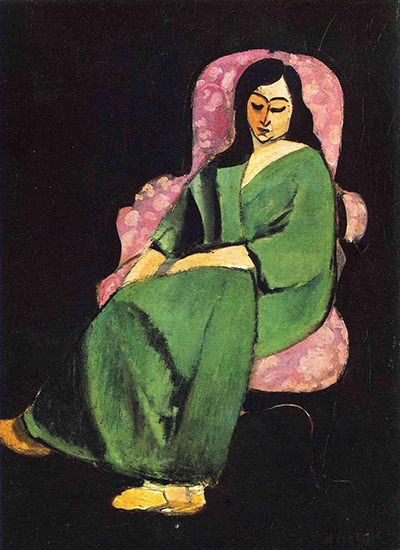
Laurette sits in a pink armchair, her long green robe pooling around her legs. Her head tips down; dark hair falls beside her face; small yellow slippers emerge below the hem. Almost everything outside the figure and chair is black. Henri Matisse painted this portrait in 1916 during a sustained period of work with Laurette, an Italian professional model. The Metropolitan Museum of Art owns the oil on canvas , 73 × 54 centimetres , accession 1999.363.43 . The museum uses the title Laurette in a Green Robe, Black Background ; the older “Lorette” spelling survives in this page's address. [1]
The picture gives few clues about a room, yet it does not look vacant. The pink chair surrounds Laurette's shoulders and sides; black holds the chair and green garment in a compact space. The result depends on the relation among three large areas rather than detailed furniture, wallpaper or a view through a window. Matisse used the same model in many different arrangements, but here the green robe and warm black field make a particularly concentrated portrait. [1] [2]
At a Glance
- Artist Henri Matisse
- Work Laurette in a Green Robe, Black Background
- Date 1916
- Explore Painting
This work across Henri Matisse’s career
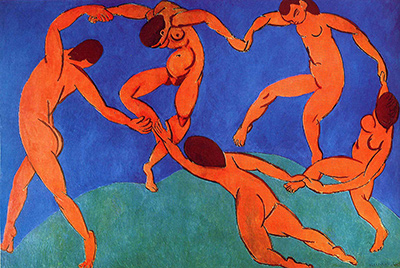
Dance (1910)
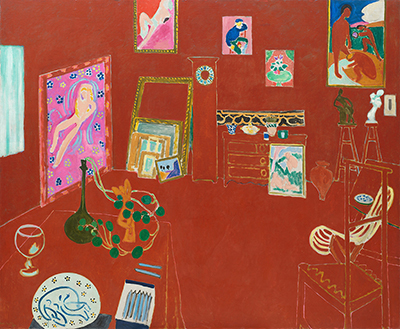
1910The Red Studio
1911The Piano Lesson
1916The Snail
1953Contents
- How does the green robe shape the figure?
- Why is the chair so prominent?
- Is the black background a dark room?
- Who was Laurette, and why did Matisse paint her repeatedly?
- Where does the portrait reappear?
How does the green robe shape the figure?
The robe widens from Laurette's shoulders over her lap and down toward the bottom of the canvas. Its sleeves are loose; one arm bends across her body, while the other reaches toward the left. Instead of tracing the body beneath each fold, Matisse lets green become one continuous, heavy form. Darker green and black strokes mark some of its changes of direction. The viewer reads a seated person from the face, hands and feet, even though the costume hides much of her posture.
The Met's 2012 exhibition identifies the garment as a green gandoura , a Moroccan robe traditionally worn by men. Its name matters because “green robe” can sound like an ordinary fitted dress. This is a loose garment from Matisse's collection of studio textiles, chosen for the forms it could make around a sitter. The record does not establish that it was Laurette's own clothing or that it expressed her identity outside the studio. In the painting, its volume and color are visual materials Matisse tested with her pose. [2]
The light face is small against the robe. A few strong lines define brows, eyes, nose and mouth; its angle draws our attention downward toward the hands and lap. The downturned head tells us where she looks but not why. Calling her sad or thoughtful would turn an observed pose into a claim about her private feeling. The painting leaves that open. What is certain is how the face interrupts the dark hair, pink chair and wide green clothing surrounding it.
Her feet provide another scale check. The yellow slippers are almost the only bright marks near the lower edge. The Met's acquisition account notes them as part of the portrait's informal costume. Their smallness makes the robe look more voluminous, while their warm hue answers the face and hands higher up. Without them, the green shape could nearly become a closed mass. Matisse lets those two little accents return the eye to the human figure inside it. [3]
Why is the chair so prominent?
The armchair is a pink patterned shape rather than a fully described object in a furnished room. It rises behind Laurette's head and peeks around both sides of her body. Its curved top softens the meeting between hair and black field; its rounded arms make the figure seem held without enclosing her completely. The Met describes the seat as a plush Second Empire armchair . That identification comes from the chair's shape, not from a claim that we can locate every piece of furniture in Matisse's studio from this painting alone. [3]
Pink varies across the upholstery, with pale flower-like marks visible around Laurette's head and shoulders. These marks are quieter than a whole wall of patterned fabric would be. They give the sitter a setting while preserving the painting's tight focus. At the left, a narrow pink edge guides the eye from face toward the resting arm; on the right, a small rounder area steadies the green sleeve. The chair's color balances the robe's green without splitting the canvas into two equal halves.
The chair also helps make the black background work. Without its warm, irregular outline, Laurette's hair and the dark side of her robe might disappear into the surrounding field. Pink separates some edges and lets others merge. The portrait does not draw a continuous line around every shape. It alternates sharp contrasts—yellow slippers against black, pale face against hair—with softer boundaries where green and dark meet. This changing clarity creates depth without architectural perspective.
Watch: Matisse’s art and working methods
Choose a museum film or a close reading to continue exploring Matisse’s work.
Matisse: “For Me It’s Always New”
The Museum of Fine Arts, Boston considers Matisse’s creative practice.
Watch on YouTubeIs the black background a dark room?
The black covers nearly everything not occupied by Laurette and the chair. It removes windows, floorboards and walls as independent motifs. But it is not simply a negative space or a sign that the room was unlit. The Met quotes Matisse describing black as a color of light rather than darkness in relation to this portrait. That sounds paradoxical until one looks at how it allows pink, green and pale skin to appear bright. Black supplies a strong field against which their differences can be felt. [1]
The black is also warm and painted. It gathers around the chair rather than opening a deep void behind it. Near some edges, dark hair and shadow nearly join the field; elsewhere the green outline pulls forward. This makes the viewer notice how much of Laurette we need to see in order to understand her pose. Matisse has not eliminated space altogether. He has compressed it so that the relation between model, chair and surrounding color becomes the subject of attention.
His use of black in this period was broader than one portrait. The Met's exhibition discussion says he sometimes used black to steady an arrangement of color and simplify its construction. In Laurette in a Green Robe , it has that structural role: it unifies the narrow canvas while letting the pink chair and green garment remain distinct. A description that calls it merely gloomy misses the way it makes the sitter visually present. [2]
Who was Laurette, and why did Matisse paint her repeatedly?
Laurette was an Italian model with whom Matisse worked over six or seven months in 1916–17 , according to the Met's exhibition account. In those sessions he varied pose, clothing, scale and setting across a large group of works. Some show her alone; others include another sitter. The museum describes the move from pairs of related canvases toward a more extended series as significant to his painting process. Laurette's repeated posing made it possible to change one pictorial element while holding another familiar. [2]
The number of Laurette works depends on what is counted. The Met's current object page speaks broadly of almost fifty pictures; an older acquisition bulletin distinguishes at least twenty-five of her alone from approximately fifteen with others. These statements need not be forced into one exact total. They agree that this portrait belongs to sustained work, not an isolated sitting. She appears in the green gandoura in several paintings. A separate canvas titled Laurette Seated on a Pink Armchair also belongs to the series; its related subject and chair do not make it another state of this Met painting. [1] [3] [2] [4]
The model's part is important without making every facial detail a biographical clue. Laurette changed costume and pose across sessions; Matisse altered how a body might sit within a painting. The records tell us little about her life beyond the studio. What the pictures demonstrate is a working relationship through which he could test a form more than once. In this portrait, the test is especially clear: green clothing, pink chair, dark surround and a small face are enough to make an image both direct and carefully constructed.
Where does the portrait reappear?
Centre Pompidou owns a larger painting called The Painter in His Studio , made around late 1916 to early 1917 . It shows Laurette sitting in the studio and a small version of the green-robe, black-background portrait on an easel . The museum uses the portrait's signed 1916 date as evidence when discussing the chronology of that studio scene. In other words, this Met canvas became a picture inside another Matisse painting, where viewer, artist, model and painted image are all brought into relation. [5] [3]
The Pompidou studio picture is not a second copy of the portrait. It places the model and her representation in the same space. Looking back at the Met work, we can see why it was useful for that purpose: its simple green-pink-black arrangement remains recognizable even when reduced on an easel. That self-reference gives the seemingly isolated sitter a studio context without requiring us to invent the room absent from her own portrait.
Begin another look at the yellow slippers, move up the robe to the hands, then let the pink chair carry your eye to Laurette's face. Finally look at the black all around. The painting's power lies in that sequence of small human clues and large color areas. For a very different Laurette pose from the same period, see Sleeping Nude ; the paintings guide traces Matisse's broader use of model, studio setting and color.
Explore 113 Matisse artworks
This directory covers the 113 individual works explored in these articles, rather than a complete catalogue of Matisse’s output. Cut-paper designs and prints appear under Drawing in the medium filter; each row names its form. Dates retain the qualifications explained in the linked articles.
Discussion
Look again at the images and ideas explored in Henri Matisse, Laurette in a Green Robe, Black Background , 1916. These editorial prompts invite your observations.
Reader Insights
How does the green robe shape the figure?
Which comparison discussed in the article helps you see the work differently?
How do the materials and historical setting affect your reading?
Join the Conversation
Share a detail, comparison or question about Henri Matisse, Laurette in a Green Robe, Black Background , 1916 below.
References
- Metropolitan Museum of Art , Laurette in a Green Robe, Black Background , current owner record, title, date, medium, dimensions and black-color account. View source .
- Metropolitan Museum of Art , Matisse: In Search of True Painting , Gallery Three, Laurette sessions, green gandoura and black in the 1910s. View source .
- Metropolitan Museum of Art , Recent Acquisitions: A Selection 1999–2000 , portrait, model-series, chair and studio-picture details. View source .
- Metropolitan Museum of Art , 2012 exhibition highlights, separate Laurette Seated on a Pink Armchair and related series works. View source .
- Centre Pompidou , Le Peintre dans son atelier , distinct studio painting and image of the Met portrait on its easel. View source .
 Henri Matisse.jpg)