 by
Tom Gurney
Tom Gurney BSc (Hons) is an art history expert with over 20 years experience
Email:
tomgurney1@gmail.com
/ Phone:
+44 7429 011000
Henri Matisse, Blue Nude I, 1952: Introduction
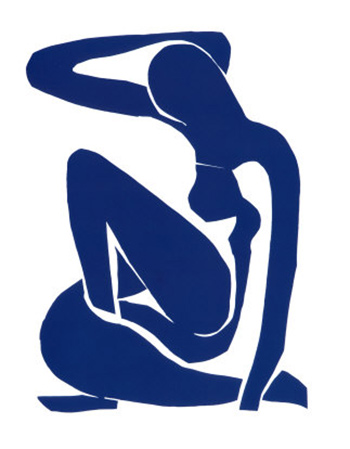
A seated figure fills a white rectangle with blue shapes. One arm curves over her head, a raised knee presses up toward her chest, and a long arm descends beside the body. There is no room, floor, fabric or landscape. Yet Henri Matisse's Blue Nude I feels less like a missing picture than a complete one: the spaces between blue pieces define a bent elbow, a waist, overlapping legs and a sense of bodily weight. Its economy depends on looking at white as carefully as blue.[1][2]
The original is a 1952 cut-out, not an oil painting. It is made of gouache-painted paper, cut and pasted onto paper mounted on canvas, and measures 106.3 × 78 centimetres according to its owner, the Fondation Beyeler in Riehen/Basel, Switzerland. The site's older page title, simply Blue Nude, conceals a useful distinction: the pictured work is specifically Blue Nude I (Nu bleu I), one of four related seated blue nudes Matisse made in 1952. It is separate from his 1907 oil Blue Nude (Souvenir de Biskra) and from the 1952 works numbered II, III and IV.[1][3][4]
At a Glance
- Artist Henri Matisse
- Work Blue Nude I
- Date 1952
- Explore Cut paper and drawing
This work across Henri Matisse’s career
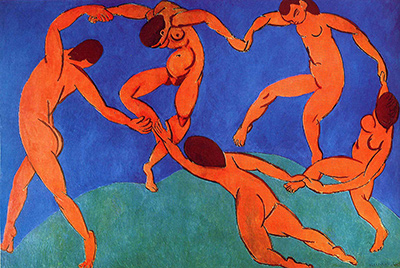
Dance (1910)
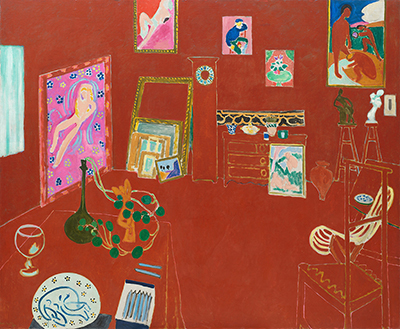
1910The Red Studio
1911The Piano Lesson
1916The Snail
1953Contents
- What do the blue shapes show?
- Why does the white background matter so much?
- How was a cut-out made?
- Where does Blue Nude I fit among the four?
- Is this the same Blue Nude as the painting from 1907?
- What happened to Blue Nude I after Matisse?
- How should we look at it now?
What do the blue shapes show?
The uppermost blue form sweeps from the left edge toward the head and turns into an arm raised over it. The head tips down, becoming an oval interrupted by a narrow white curve at the neck. A second shoulder and arm fall along the right side of the composition. Near the centre, a small cluster of blue and white angles connects the chest to the abdomen. Below, a high knee, a tucked leg and a rounded lower body occupy much of the sheet. Read quickly, the figure looks almost continuous. Follow the pale gaps and the joints become more complicated.[1]
The clearest white opening is the long space under the lifted arm. It gives the arm an arch and separates it from the head. A narrower white path runs beside the right side of the torso, making the descending arm visible without an outline drawn in another colour. Lower down, slender white wedges distinguish thigh from shin and one folded leg from the other. These gaps are not empty background left over when the image was completed. They actively make the figure legible. Fondation Beyeler's own account emphasizes that the white intervals carry nearly as much weight as the blue forms.[2]
The pose combines compression and reach. The raised knee pulls the lower body inward, while the overhead arm expands the silhouette across the top. The long arm on the right draws the eye downward again. One can trace a circuit from the arm's broad horizontal sweep through the head and torso to the folded legs, then back up the right edge. This movement lets Matisse describe volume without shading or conventional perspective. A woman sits in a recognizable pose, yet every part of her is also a colored shape arranged against white.
Look at the lower edge in particular. A blue projection extends left of the folded body, while a shorter shape reaches right of the descending arm. They make the figure feel supported even though there is no depicted chair or ground line. The white surface below is enough for the eye to imagine a base. The image's balance is therefore made by the cut edges and the limits of the rectangular support, not by surrounding furniture.
Why does the white background matter so much?
In a conventional drawing, a dark outline might separate the body from an otherwise passive sheet. Here each blue edge does double work. It is at once the boundary of a paper fragment and the contour of a shoulder, knee or foot. White enters deep into the figure in places, especially around the bent legs, and changes how the blue parts connect. A flat piece of painted paper can appear to turn, press or overlap because the eye interprets those white openings as space.
This is why Blue Nude I is more than a silhouette laid on blank paper. The figure appears assembled from different shapes, but the joins are not simply mechanical seams to be hidden. Narrow gaps reveal how Matisse decided where one mass would stop and another would begin. A viewer can read the result as a single body from a distance and as a precise negotiation of fragments at close range. The Fondation Beyeler describes a play between figure and ground, plane and volume; those paired terms arise from what the cut pieces make the eye do.[2]
The limited palette intensifies the exchange. Matisse does not use a second colored patch to explain the arm or a shadow to round the knee. Blue carries the entire visible body. The unpainted light ground makes its shape appear both solid and open. Color and contour arrive together: where the blue paper ends, the line of the figure appears. The result demonstrates what Matisse meant when he linked cutting paper with drawing in color, even though the finished work cannot be reduced to a slogan about simplicity.[2][5]
How was a cut-out made?
Matisse's late cut-outs brought painting, cutting and arrangement into one process. The Museum of Modern Art explains the general studio method: assistants covered paper sheets with gouache, an opaque water-based paint; Matisse selected the colored sheets and cut forms from them; the forms could be pinned temporarily and moved before permanent mounting. For large pieces, assistants could help position paper on studio walls. A cut-out therefore began with painted material, but its image emerged through the scissors and through the placement of those painted pieces.[5]
That account describes the practice, not a filmed sequence for every individual work. The Beyeler catalogue caption tells us the materials and final mounting of Blue Nude I; it does not document every pin Matisse used or the exact order in which he arranged this figure's parts. Its visible economy must not be mistaken for proof that no choices or adjustments occurred. Equally, the extensive charcoal repositioning documented for Blue Nude IV cannot simply be transferred to I. The four nudes share a medium and subject, while their working histories differ.[1][3]
MoMA's process research makes a further distinction between a pinned studio arrangement and a permanently mounted object. Pinning made positions changeable; mounting made an artwork safer to handle, frame and move, but could flatten some of the physical liveliness of pinned paper. The museum notes a shift in mounting practice around 1950–52, when the Paris firm Lucien Lefebvre-Foinet began adapting a method for Matisse's cut-outs. That is useful context for a 1952 work, though it does not establish which firm mounted this particular Beyeler piece. The work's present surface belongs to the history of making and preserving cut paper as art.[5]
Matisse had not discovered scissors overnight. MoMA traces his use of cut paper as a design method back to earlier projects, including the Barnes Foundation's Dance mural in the 1930s. In the 1940s he developed cut paper into an independent medium. By 1952, it could support both room-sized environments and concentrated, single-figure works. Blue Nude I is a useful example of the latter: its composition is contained within a tall rectangle, but the figure feels powerful enough to press against almost every side.[5]
Watch: Matisse’s art and working methods
Choose a museum film or a close reading to continue exploring Matisse’s work.
Matisse: The Cut Outs
Tate introduces its exhibition devoted to Matisse’s cut-paper work.
Watch on YouTubeWhere does Blue Nude I fit among the four?
The numerals I, II, III and IV identify four distinct seated compositions. They are not a simple diary of the order in which Matisse began them. In a 2026 study, the Centre Pompidou explains that Blue Nude IV was started first and required repeated rearrangement over many sessions, then was brought to completion after the others. I, II and III were made successively in shorter sessions. Matisse's assistant and model Lydia Delectorskaya later recalled each of those three as an unusually swift act of cutting on a different day. The source distinguishes the time needed to cut a form from the much broader history of preparing material, arranging it and mounting it.[3]
The four also look different. They share blue painted paper, a light ground, bent legs and an arm raised near the head, but proportions and gaps change from one to another. The Beyeler figure in I has a sweeping overhead arm and a relatively compact circuit through the folded legs. In Blue Nude II, owned by the Centre Pompidou, the body is broader and the central leg structure reads differently. The other two alter the height, curves and distribution of blue. The variations are the substance of the series: Matisse did not reproduce a single cut-out four times.[3][6]
Ownership helps keep the identities clear. Fondation Beyeler owns Blue Nude I; Centre Pompidou owns II and III; Blue Nude IV is at the Musée Matisse in Nice under the French state deposit described by Pompidou. Other blue figure cut-outs of 1952, including Blue Nude, The Frog and Standing Blue Nude, are related works with their own titles and compositions. This matters when an unnumbered web image is called simply “Blue Nude.” Matching its particular pose to an owner record prevents facts about one work from drifting onto another.[3][6]
Fondation Beyeler's 2024 Matisse retrospective put Blue Nude I among works spanning his career, and its press materials also identified two other blue figure cut-outs of 1952: Blue Nude, The Frog and Blue Nude with Green Stockings. The first extends the seated figure into a wider, more playful field; the second adds green and pink accents and changes the body's scale. Their shared year and color do not make them extra numbers in the I–IV group. They demonstrate that Matisse could use the blue nude as a starting point for quite different arrangements. The tightly contained I is easier to understand beside these experiments: its force comes from concentrating the body into one tall white rectangle, while the surrounding variations test how far the motif can spread or change color.[7][3]
The older page's suggestion that “Blue Nude VI” came first does not match the four-work sequence documented by the museums. The relevant slow and repeatedly altered composition is IV, not a numbered VI. Correcting that point makes the quick cutting of I more meaningful: it was one of the concentrated variations made within a series that also included a longer, more experimental path.[3]
Is this the same Blue Nude as the painting from 1907?
No. Matisse's Blue Nude (Souvenir de Biskra) is an oil painting of 1907 in the Baltimore Museum of Art's collection. The shared words in the titles and the seated, compressed female pose invite comparison, but the objects are separated by 45 years, different materials and different pictorial problems. The 1907 painting uses a modeled body in a colored setting; the 1952 Blue Nude I uses cut, blue painted paper against a pale support. One is an early painting, the other a late cut-out.[3][4]
The Centre Pompidou's curator Claudine Grammont suggests that Matisse had the earlier canvas in mind when he made the 1952 nudes. That is a plausible, attributed reading of a lifelong motif, not proof of a step-by-step transfer from one object to the other. The comparison shows how he returned to a figure folded into a compact shape while changing the means of construction. In 1907, paint and bodily modeling made the shape; in 1952, scissors and the relation of blue to white did much of that work.[3]
The connection also helps avoid a familiar mistake about Matisse's late career. Physical illness after an operation in 1941 affected how he worked, but it did not turn cut paper into a mere substitute for “real” painting. MoMA describes the cut-outs as a culmination of long-standing questions about color and line, one that had roots in design experiments well before the operation. The seated nude gives those questions a human form. Looking across the 1907 and 1952 works reveals continuity of subject alongside a considerable change in method.[3][5]
What happened to Blue Nude I after Matisse?
Fondation Beyeler's exhibition label says Ernst Beyeler purchased Blue Nude I directly from Matisse's daughter in 1960. The work is now in the museum's collection at Riehen/Basel. That path matters because it shows a late cut-out moving from the artist's family into a major collection within only a few years of his death. The museum has continued to present it as a central example of Matisse's late paper works, including in its 2024 retrospective. This history belongs to the particular cut-out pictured here; it should not be borrowed for the other Blue Nudes simply because their titles and dates resemble one another.[2][7]
MoMA's 2014 cut-outs checklist listed Blue Nude I from the Beyeler collection, and the Beyeler retrospective included it again in 2024. Such presentations give viewers the chance to examine the cut-paper surface at the object's actual scale. They also remind us that this is a physical, handled work with a history of mounting, travel and display, rather than only a graphic design circulated as an image. Reproductions are valuable for following its contours, but they often make the edges and paper surface appear more uniform than they do in front of the work.[7][6]
The reproduction on this page cannot convey every quality of the original. At the museum's recorded size, the figure is more than a metre high. One can see a body at near-human scale rather than a small blue icon. Measurements, support, material and ownership therefore belong to the account of the work, even though the viewer's first response may be to its immediate blue-and-white design. The tall rectangle also imposes a limit that matters in person: the arm approaches the upper edge while the lower leg presses toward the base, making the surrounding white feel measured rather than unlimited.[1]
How should we look at it now?
Start with the overhead arm and the wedge of white beneath it. Follow the blue into the bowed head, then find the slim white division that gives the right arm its length. Next look down at the lifted knee and the triangular opening inside the folded legs. Each break in the blue allows a body part to emerge. From farther away, those breaks disappear into one poised figure; from closer up, the result looks like a sequence of decisive cuts and placements.
This is the achievement of Blue Nude I. Matisse used a minimal color relation to produce a body that seems at once flat, heavy, compact and mobile. Its companions show that there was no one final solution to the seated pose. The earlier Biskra painting shows that the pose had a long history in his work. The Beyeler cut-out makes that history newly visible through scissors, painted paper and a white ground that is as active as the figure itself.
The title's numeral is therefore more than cataloguing detail. It asks us to see this object as one answer in a group of four, while its particular arm, knee and white gaps make it irreducible to the group. A small web reproduction can make the four look interchangeable. Returning to the boundaries of this single figure restores Matisse's choices at the scale of one cut-out.
Explore the Matisse cut-outs directory for the late medium, compare the separate Blue Nude II and Blue Nude IV, or see the earlier Blue Nude (Souvenir de Biskra). The Henri Matisse artist page places these works across his longer career.
Explore 113 Matisse artworks
This directory covers the 113 individual works explored in these articles, rather than a complete catalogue of Matisse’s output. Cut-paper designs and prints appear under Drawing in the medium filter; each row names its form. Dates retain the qualifications explained in the linked articles.
Discussion
Look again at the images and ideas explored in Henri Matisse, Blue Nude I, 1952. These editorial prompts invite your observations.
Reader Insights
What do the blue shapes show?
Which comparison discussed in the article helps you see the work differently?
How do the materials and historical setting affect your reading?
Join the Conversation
Share a detail, comparison or question about Henri Matisse, Blue Nude I, 1952 below.
References
- Fondation Beyeler , Nu bleu I catalogue caption in its 2017 collection press material, owner title, medium, dimensions and collection. View source .
- Fondation Beyeler , English exhibition room label for Nu bleu I , visual interpretation and acquisition note. View source .
- Centre Pompidou , “The Secret History of Henri Matisse's Blue Nudes”, 2026 series research, Delectorskaya account, object distinctions and Biskra comparison. View source .
- Baltimore Museum of Art , modern collection, distinct 1907 Blue Nude in the Cone Collection. View source .
- Museum of Modern Art , “The Cut-Outs”, materials, studio practice and mounting history. View source .
- Museum of Modern Art , Henri Matisse: The Cut-Outs checklist, 2014 object listings for Blue Nude I and related works. View source .
- Fondation Beyeler , Matisse: Invitation to the Voyage press kit, owner caption and image restrictions. View source .
 Henri Matisse.jpg)