 by
Tom Gurney
Tom Gurney BSc (Hons) is an art history expert with over 20 years experience
Email:
tomgurney1@gmail.com
/ Phone:
+44 7429 011000
Le Bateau (Sailboat) by Henri Matisse: a boat made from almost nothing: Introduction
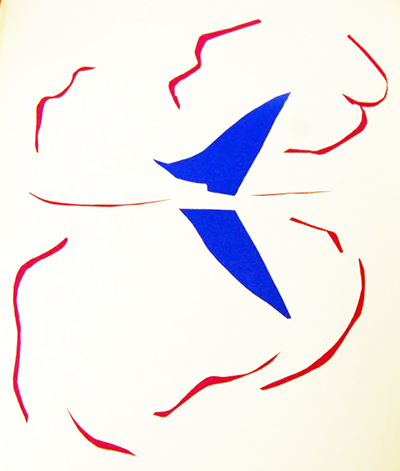
In Le Bateau , also called Sailboat , Henri Matisse leaves most of the paper white. Two pointed blue shapes occupy the centre. Thin red curves appear around them in separate strokes, as though an outline has been interrupted and resumed elsewhere. The upper shape suggests a sail; the one below suggests its reflection. A narrow white gap between them can become the surface of the water. Few parts are needed to make the image readable, and each part can also be enjoyed simply as colour and cut edge. [1]
At a Glance
- Artist Henri Matisse
- Work Le Bateau (Sailboat)
- Date c. 1952
- Explore Cut paper and drawing
This work across Henri Matisse’s career
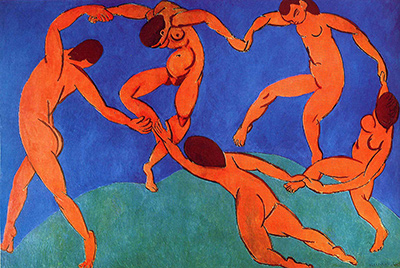
Dance (1910)
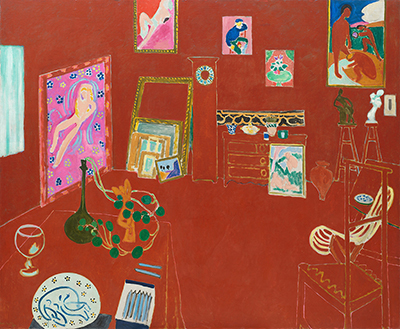
1910The Red Studio
1911The Piano Lesson
1916The Snail
1953Contents
- Where is the boat in the cut-out?
- Why was it once displayed upside down?
- When was Le Bateau made, and who owns it?
- What can the 1961 catalogue tell us about scale?
Where is the boat in the cut-out?
Begin with the blue. The upper piece rises to a sharp point and widens into a low, curving edge. It reads like a sail caught at an angle. The lower piece points down instead. It is similar enough to the upper shape to suggest a reflection, yet it does not duplicate it exactly. That difference lets the image imply water without Matisse having to draw ripples, a horizon or a shoreline. A pair of short red horizontal marks near the centre makes the divide feel even more precise. [1]
The red lines resist becoming one complete boat. A stroke descends from the upper left; another bends near the top; a larger curve runs down the right and curls beneath the blue shapes. Their gaps leave the eye to supply connections. Against so much white, the red and blue carry the whole arrangement. The composition is spare, but it is not symmetrical: each blue wedge has a different contour, and the scattered red pieces balance rather than mirror one another. [1]
MoMA's 1961 catalogue identifies the original as gouache on cut-and-pasted paper, measuring 56¼ × 44 inches. That is a substantial sheet, even though the motif looks slight in a small reproduction. Cutting painted paper allowed Matisse to make the shape itself the mark, instead of painting a drawn boat inside a continuous field. [1]
Why was it once displayed upside down?
The artwork gained an unusual public history at MoMA's 1961 exhibition The Last Works of Henri Matisse: Large Cut Gouaches . Contemporary reporting in TIME describes how visitor Genevieve Habert noticed that the museum's hanging differed from the correctly oriented image in its catalogue. She read the more distinct upper form as the boat and the form beneath it as a reflection. After she raised the problem, the museum corrected the display. MoMA's own exhibition schedule places the show in autumn 1961. [1] [2] [3]
The incident is revealing because the image gives few ordinary clues to which way is up. There is no shore or sky to settle the matter. The catalogue's illustration establishes the orientation shown here; the paired blue shapes make the logic of sail and reflection legible once the page is seen that way. The story does not mean the composition was casual or that orientation was meant to be optional. Its economy makes each placement matter. [1] [2]
Watch: Matisse’s art and working methods
Choose a museum film or a close reading to continue exploring Matisse’s work.
Matisse: The Cut Outs
Tate introduces its exhibition devoted to Matisse’s cut-paper work.
Watch on YouTubeWhen was Le Bateau made, and who owns it?
MoMA's 1961 catalogue calls the work Sailboat and dates it (1952) , with the year in parentheses. Some later summaries use 1953, but the catalogue does not settle an exact completion date. It lists a private collection for the 1961 exhibition. Showing the work at MoMA does not, by itself, establish that the museum owns it now; that historic credit cannot establish its present location. [1]
The catalogue sets Sailboat among Matisse's large late cut-paper works. It also illustrates The Swimming Pool , where blue forms move across a much longer white band. In this boat, the white has a different job: the small gap between two blue shapes becomes the implied water surface. The comparison shows how Matisse could use unfilled paper as an active part of an image at very different scales. It does not make the boat a study for the pool. [1]
What can the 1961 catalogue tell us about scale?
The MoMA catalogue did not present Sailboat as a tiny emblem. It listed a sheet roughly 143 by 112 centimetres, large enough for the red fragments and blue forms to occupy a person's field of view. The relation between a small-looking boat and a substantial white surround is therefore part of the work, not an accident of reproduction. At this scale, the gap between the two blue wedges can be walked past with the eyes: it becomes a visible band of unpainted paper where an imagined waterline might lie. The catalogue's photograph lets us see the arrangement; its dimensions restore something a thumbnail cannot convey. [1]
Its place in the exhibition also clarifies the range of Matisse's late paper work. The catalogue puts the boat among blue nudes, acrobats and the enormous Swimming Pool . The boat is neither a figurative body nor a room-length decorative scheme. It shows how a few interrupted marks can suggest a recognisable subject while leaving most of a sizeable sheet open. The upside-down episode became famous because the image is so economical, but the size and deliberate spacing recorded by MoMA make a slower, more attentive look possible. [1] [2]
Explore 113 Matisse artworks
This directory covers the 113 individual works explored in these articles, rather than a complete catalogue of Matisse’s output. Cut-paper designs and prints appear under Drawing in the medium filter; each row names its form. Dates retain the qualifications explained in the linked articles.
Frequently Asked Questions
It can first look like one. Read against the title and the upper wedge, it works as a reflection below a suggested waterline. The shapes are related without being identical, which keeps the image lively rather than diagrammatic. [1]
No continuous sea or sky is painted around the motif. MoMA catalogued the original as gouache on cut-and-pasted paper. The boat and water emerge from placed colour shapes, red line fragments and the white paper left between them. [1]
The 1961 catalogue lists it as lent from a private collection for the museum's exhibition. That record documents its display there, not a commission or present museum ownership. [1]
Return to the central white gap: it separates the two blues while making them belong to the same scene. The cut-outs guide follows this way of building with painted paper through Matisse's other late works, and the artist home places it within his wider career.
Discussion
Look again at the images and ideas explored in Le Bateau (Sailboat) by Henri Matisse: a boat made from almost nothing. These editorial prompts invite your observations.
Reader Insights
Where is the boat in the cut-out?
Which comparison discussed in the article helps you see the work differently?
How do the materials and historical setting affect your reading?
Join the Conversation
Share a detail, comparison or question about Le Bateau (Sailboat) by Henri Matisse: a boat made from almost nothing below.
References
- Museum of Modern Art , The Last Works of Henri Matisse: Large Cut Gouaches (1961), printed pp. 30–31 and catalogue no. 22, p. 45. View source .
- TIME , “Art: What's Up?”, 15 December 1961. View source .
- Museum of Modern Art , 1961 exhibition schedule, p. 1. View source .
 Henri Matisse.jpg)