 by
Tom Gurney
Tom Gurney BSc (Hons) is an art history expert with over 20 years experience
Email:
tomgurney1@gmail.com
/ Phone:
+44 7429 011000
Henri Matisse, Woman Reading (La Liseuse) , 1895: Introduction
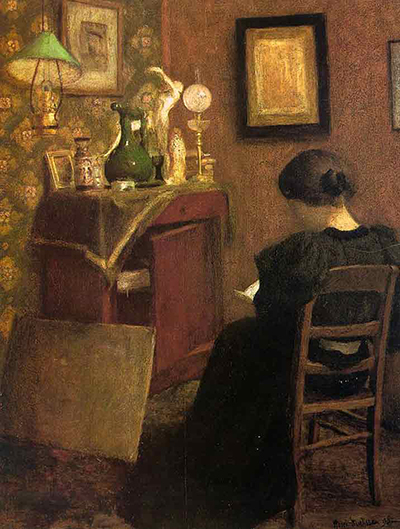
A woman sits with her back turned, absorbed in a small book or sheet of paper. She occupies the right side of a dim room; a cabinet, lamp, vessels, pictures and patterned wall fill the space beside her. This is Henri Matisse's La Liseuse , usually translated here as Woman Reading . The Centre Pompidou dates it to winter 1895 , when Matisse was still at the start of his public career. It is an oil painting on wood , 61.5 × 48 centimetres , now in the Musée national d'art moderne collection under inventory AM 3968 P . The shorter English title should not hide its owner title or its exact physical identity. [1]
The picture is much darker than the works for which Matisse later became famous. That contrast can be useful, but it should not make this painting seem like an accidental prelude. Its reader, furniture and wall pictures form a carefully arranged interior. Light catches a few objects and the woman's neck, while much of her dress merges with the shadowed room. The painting asks us to look slowly: from figure to cabinet, across the wall, and back to the partly hidden act of reading.
At a Glance
- Artist Henri Matisse
- Work Woman Reading (La Liseuse)
- Date 1895
- Explore Painting
This work across Henri Matisse’s career
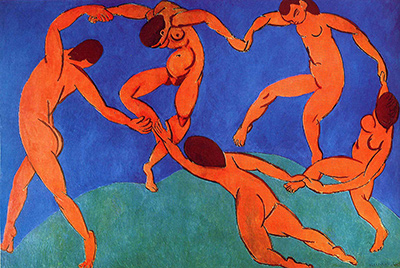
Dance (1910)
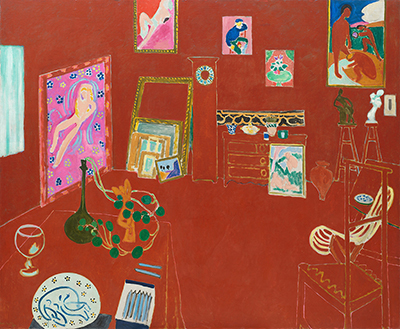
1910The Red Studio
1911The Piano Lesson
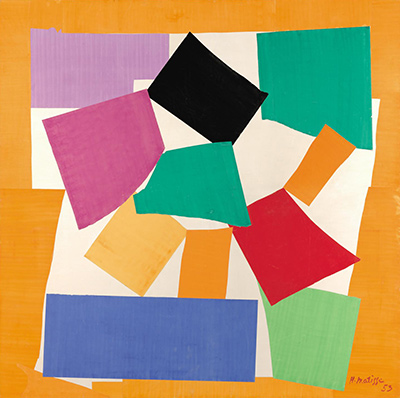
1916The Snail
1953Contents
- What does the room show?
- Who is the reader?
- Why is the date 1895 rather than 1894?
- What happened at the 1896 Salon?
- How does another reading picture change the view?
What does the room show?
The reader sits on a wooden chair at the right, angled away from us. The back of her dark dress creates a long shape down toward the lower edge. Her head, turned toward the page, is the brightest part of her figure. We do not see her face clearly, and the text she reads is not legible. Matisse gives enough to establish an activity without turning it into a story about the book's contents or the woman's private thoughts.
To the left stands a piece of furniture draped with cloth. A green-shaded lamp and several small objects rise from its top. A reflective vessel and a narrow upright form catch light against the darker background; a small framed picture sits near them. Above and beyond, pictures on the walls mark this as an interior where artworks are present. The Centre Pompidou's curator describes it as an interior-studio and notes the pictures within the picture, a device Matisse would return to in later work. That interpretation is grounded in visible frames, not in a claim that we can identify every depicted artwork from a small reproduction. [1]
The wall itself is not blank. Large flowers in the wallpaper appear most clearly on the left, then recede into the brown and olive tones of the room. Pattern is present, but subdued. Later Matisse interiors can make textiles and wallpaper compete strongly with figures; here the pattern provides a quiet texture around the reader. The cabinet's draped cloth adds another patterned or tonal surface, giving the room layers without forcing every object to the front.
A larger framed work hangs above the reader. Its bright interior catches attention precisely because her dress is dark. The frame makes a rectangle within the painting's own rectangle, while the cabinet and chair create smaller divisions below. These structures keep the crowded setting orderly. The eye moves between rectangles, then settles on the softer contour of the woman's neck and shoulder. Matisse balances the stillness of her pose against the room's many verticals and framed surfaces.
The foreground is comparatively spare. A pale, broad shape leans at lower left, interrupting the darker floor and cabinet. It might invite a specific identification, but the reproduction does not make that certain. What matters compositionally is its light value and its angle: it opens a path toward the cabinet before the eye crosses to the reader. The painting is full of things, yet it leaves enough difference in light and shape for us to navigate them.
Who is the reader?
The title calls her a reader, not a named portrait sitter. The Centre Pompidou's essay reports art historian Jack Flam's proposal that she was probably Caroline Joblaud , Matisse's companion at the time and the mother of his daughter Marguerite. This is a scholarly identification based on comparison with other early works, not a name inscribed on the painting or a certainty established by the pose alone. It should remain a possibility rather than become a biographical fact. [1]
Her turned back is important whether or not that identification is right. We see the curve of her head, the light on her neck and her attention directed toward the page. We are permitted to observe her activity but not to share her reading. The curator Isabelle Monod-Fontaine relates this reserved presentation to Corot , whose retrospective Matisse could have seen in Paris in 1895. This is an attributed comparison about pictorial manner: a figure turned inward, not a documented statement that one particular Corot painting was copied here. [1]
The choice not to face us also shapes the room. Had the woman turned outward, her expression might have become the scene's center. Instead, the back of her dark clothing joins the furniture and shadows into a continuous area, while her reading forms a quiet point of focus. The viewer must notice the space around her to understand the painting. Calling the scene “peaceful” is reasonable as a response, but it cannot tell us her mood or why she picked up the page.
Watch: Matisse’s art and working methods
Choose a museum film or a close reading to continue exploring Matisse’s work.
Matisse: “For Me It’s Always New”
The Museum of Fine Arts, Boston considers Matisse’s creative practice.
Watch on YouTubeWhy is the date 1895 rather than 1894?
The Centre Pompidou catalogues the work as made in Paris, winter 1895 and records the painted signature and date as “Henri Matisse 95-” . Its essay also transcribes a letter in which Matisse remembered drawing the woman the previous summer and finishing the picture during the winter. These pieces of evidence fit the owner's 1895 date. Some older or popular accounts give 1894, but the current owner record is the sound basis for the page heading. The signature and artist's account make this more than a stylistic guess. [1]
The dating matters because it places Woman Reading before Matisse's better-known color experiments but within an active early practice. The dark palette does not prove that he lacked interest in color, nor does the painting need to be judged by how closely it resembles works made a decade later. Its problem is specific: how to build an intimate interior, a figure seen from behind and several objects into one readable scene. The small light accents show how much can be achieved within a restrained range of hues.
This is also a painting on wood , not canvas. The support is an object fact supplied by the museum, and it distinguishes this work from later reading pictures painted on canvas. A photograph can make the difference invisible, which is why museum metadata matters. The exact size helps too: just over sixty centimetres high, it is an intimate panel, though its furniture and wall images give the room a sense of greater depth.
What happened at the 1896 Salon?
Matisse sent La Liseuse to the Salon de la Société nationale des Beaux-Arts in 1896 . The Centre Pompidou identifies that year's Salon as his first exhibition participation. The work attracted an unusually concrete form of early recognition: the French state bought it in June 1896 . It was the state's second purchase of a Matisse work, after a painted copy after Carracci acquired earlier that year. This sequence is more precise than saying only that the young artist suddenly “became famous.” [1]
In a letter of 9 June 1896 , Matisse told a cousin about the purchase. He described the picture as an interior with a woman reading seen from behind and reported a price of 800 francs . His wording confirms that the turned figure was central to how he identified the work, while the sale records institutional interest at the beginning of his career. It does not mean the painting already carried all the artistic ideas of his later Fauvist works. [1]
The painting then had a history outside the modern art museum. According to Pompidou, Madame Félix Faure , wife of the French president, selected it for the presidential summer residence at Rambouillet in the same year. It remained there until its assignment to the Musée national d'art moderne in 1961 . Pompidou records it as on deposit at the Musée départemental Matisse in Le Cateau-Cambrésis since 2002 . A deposit identifies where the museum records place the work; it is not a promise that the panel is always on public view there. [1]
This path is unusual enough to affect how one sees the picture. An intimate scene of a woman reading moved from the artist's early Salon presentation into a state purchase and a presidential residence, then into a national modern-art collection. That history shows that the painting was valued before Matisse's famous break toward intense color. Its early recognition belongs to this particular panel, not to a general story in which every later Matisse work was immediately accepted.
How does another reading picture change the view?
Matisse returned to a seated reader in Liseuse en robe violette , painted in Corsica in 1898 . The Musée des Beaux-Arts de Reims owns that separate oil on canvas , measuring 37.8 × 46 centimetres , inventory 949.1.40 . Its reader sits in profile near a table and bottle, rather than presenting her back within a densely furnished room. The Centre Pompidou identifies the 1898 sitter as Amélie Parayre , whom Matisse had recently married. That identification belongs to the later painting; it should not be transferred to the earlier La Liseuse . [2] [1]
Pompidou's essay also emphasizes the more assertive color of the Corsican work. Comparing the two does not require a tale of steady progress from “bad” brown to “good” bright paint. Matisse chose different means for two versions of a related subject. The 1895 picture makes a reader part of a shadowed room full of frames and objects; the 1898 picture changes the sitter, setting, support and color relation. Each decision alters where the viewer looks and how the act of reading is held within the image. [1] [2]
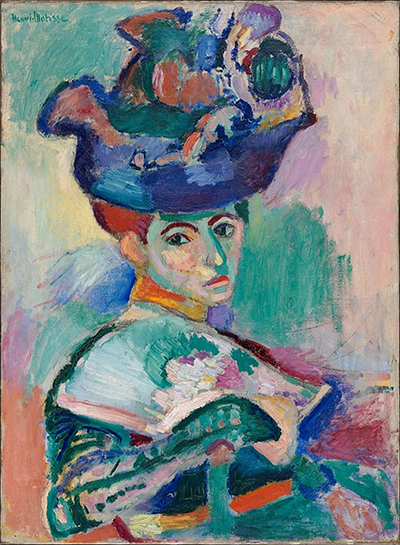
The comparison makes Woman Reading a useful early point of entry into Matisse's career. The decorative wallpaper is still quiet, but already noticed by the Pompidou curator; pictures inside a picture already interest him; the figure's relation to her surroundings is carefully staged. Later canvases such as Woman with a Hat put color under far more pressure. The paintings guide and biography place those changes within a longer practice. Here, start with the reader's turned head, then let the lit objects and framed images lead you around the room before returning to her page.
Explore 113 Matisse artworks
This directory covers the 113 individual works explored in these articles, rather than a complete catalogue of Matisse’s output. Cut-paper designs and prints appear under Drawing in the medium filter; each row names its form. Dates retain the qualifications explained in the linked articles.
Discussion
Look again at the images and ideas explored in Henri Matisse, Woman Reading (La Liseuse) , 1895. These editorial prompts invite your observations.
Reader Insights
What does the room show?
Which comparison discussed in the article helps you see the work differently?
How do the materials and historical setting affect your reading?
Join the Conversation
Share a detail, comparison or question about Henri Matisse, Woman Reading (La Liseuse) , 1895 below.
References
- Centre Pompidou , La Liseuse , owner record and Isabelle Monod-Fontaine's catalogue analysis of date, medium, sitter proposal, Salon, state purchase and later collection history. View source .
- Musées de Reims , Liseuse en robe violette , owner record for the distinct 1898 Corsican painting. View source .
 Henri Matisse.jpg)