 by
Tom Gurney
Tom Gurney BSc (Hons) is an art history expert with over 20 years experience
Email:
tomgurney1@gmail.com
/ Phone:
+44 7429 011000
Henri Matisse, La Chevelure (The Flowing Hair), 1952: Introduction
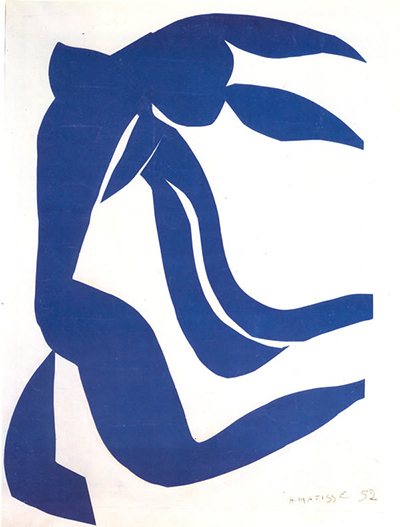
A blue figure seems to sweep across the white sheet in Henri Matisse's La Chevelure (The Flowing Hair) . Two long bands extend from the head toward the right, giving the image its title, while the body bends and opens around broad white spaces. The silhouette has the energy of a gesture caught in motion. It is easy to see why an older English page called it “Blue Nude with Hair in the Wind,” but La Chevelure is the name attached to this 1952 cut-out in later exhibition and Matisse-family-licensed records. The later title identifies this particular cut-paper figure more precisely. [1] [2]
At a Glance
- Artist Henri Matisse
- Work La Chevelure (The Flowing Hair)
- Date 1952
- Explore Cut paper and drawing
This work across Henri Matisse’s career
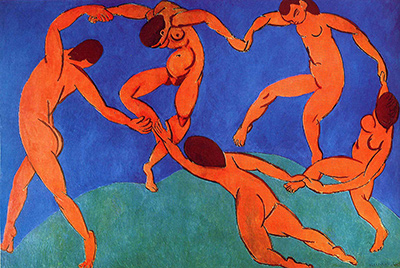
Dance (1910)
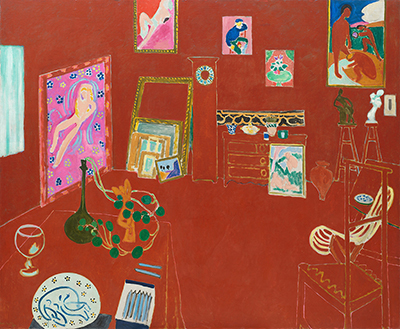
1910The Red Studio
1911The Piano Lesson
1916The Snail
1953Contents
- How does the figure move?
- How was La Chevelure made?
- Where does it sit among the Blue Nudes?
- What does the later mermaid comparison reveal?
How does the figure move?
The paper figure is large against an almost empty white field. A solid blue mass at left gives it weight, while the narrow projections across the upper right suggest hair moving away from the head. Another blue extension reaches outward at mid-height; a longer sweep carries the lower body toward the right edge. The eye follows these directions before it can settle on a conventional seated pose. The motion comes from the relationships between cut shapes, not from a painted landscape, wind lines or a second figure.
White areas are just as active. A sharp opening near the upper body separates neighboring blue forms. A larger wedge below it keeps the bending torso and lower forms from fusing into one block. Their edges create a sense of the body turning, even though the material lies flat. The figure appears both connected and stretched apart. That balance gives the work more movement than a blue silhouette with every gap closed would have.
The title directs attention to the two streaming shapes at the top, but they also help organize the whole sheet. They point right, echoing the outward reach lower down. The heavier blue at left holds the figure against these extensions, so it seems to gather itself and move at the same time. The small “H. Matisse 52” inscription visible near the lower edge belongs to the pictured composition. A photograph or later print may repeat that mark; it is not, by itself, proof that a particular reproduction is the signed original.
How was La Chevelure made?
The Matisse-family-licensed account identifies the original as gouache on paper, made with paper cut-outs . In Matisse's late practice, assistants painted sheets with opaque gouache; he cut colored shapes and tried arrangements that could be pinned before final mounting. MoMA documents this as a general working method. The blue here is therefore the color of painted paper cut into forms, rather than blue oil paint brushed into the outline of a nude. The published sources do not establish the exact sequence of cuts, pinning and mounting for this one work. [1] [3]
Some viewers encounter the design through a later lithograph or a licensed object rather than the original cut-paper work. A 2017 Hayward Touring exhibition included lithographic prints after Matisse's late cut-outs and captioned this design La Chevelure (Flowing Hair) . Those prints reproduce an image Matisse made in 1952; they are not interchangeable with the 1952 arrangement of painted and cut paper. The distinction matters whenever a seller's dimensions, printing information or signature description is attached to a copy. [2]
Watch: Matisse’s art and working methods
Choose a museum film or a close reading to continue exploring Matisse’s work.
Matisse: The Cut Outs
Tate introduces its exhibition devoted to Matisse’s cut-paper work.
Watch on YouTubeWhere does it sit among the Blue Nudes?
The four numbered Blue Nudes also use blue cut paper and white gaps to make a female figure, but they are separate, compact seated compositions. La Chevelure opens outward. Its projected hair and extended lower forms give it a more expansive, dancing rhythm. It is reasonable to compare the figures' use of one color and the white ground, while keeping their titles, poses and physical objects distinct. The 1907 Baltimore Blue Nude (Souvenir de Biskra) is further removed: it is an oil painting of a reclining body, not a member of this 1952 cut-paper group. [4]
MoMA's 1978 Matisse collection catalogue offers a more specific connection. Its curator describes La Chevelure and Acrobats as gestural figure experiments that helped establish a form later varied for the mermaid in The Parakeet and the Mermaid . This is a proposed sequence in Matisse's 1952 work. It does not mean the surviving La Chevelure was physically pasted into the mural. The comparison is useful because the streaming forms here can be read as a step from self-contained blue figure to a figure that might move among leaves and birds in a larger decoration. [4]
What does the later mermaid comparison reveal?
MoMA's 1978 catalogue places La Chevelure beside Acrobats when discussing the development of a gestural figure form later varied in The Parakeet and the Mermaid . This is more specific than grouping blue cut-outs by colour. The two extended bands at the head and the body's outward reach make the figure less enclosed than the numbered Blue Nudes . In the mural, a related figure could take a place among leaves, birds and other cut forms. The comparison suggests how a standalone body might be adapted to a larger decorative field; it does not identify this sheet as a piece removed from that mural. [4]
The white between the blue extensions seems open, but each gap gives an edge to a limb or lock of hair. MoMA's account of the cut-out process helps explain why these intervals matter: shape and surrounding space could be adjusted together as pieces were placed. The old “hair in the wind” name captures one impression, while La Chevelure keeps attention on the hair form itself. Neither title supplies a landscape or a narrative cause for the movement. The cut body and the empty sheet do that visual work. [4] [3]
The present owner of the original has not been verified from a current collection record, and published measurements differ. The secure points for this page are the 1952 date, the title La Chevelure , the cut-paper medium and the pictured form. Look at how the two upper blue bands lead the eye out into white, then return to the weight of the body at left. The figure's movement emerges in that passage between color and open space.
Compare the individual Blue Nude I , Blue Nude II and Blue Nude IV pages, or see how a blue figure enters the larger Parakeet and the Mermaid . The cut-outs directory follows the medium across Matisse's late work.
Explore 113 Matisse artworks
This directory covers the 113 individual works explored in these articles, rather than a complete catalogue of Matisse’s output. Cut-paper designs and prints appear under Drawing in the medium filter; each row names its form. Dates retain the qualifications explained in the linked articles.
Discussion
Look again at the images and ideas explored in Henri Matisse, La Chevelure (The Flowing Hair), 1952. These editorial prompts invite your observations.
Reader Insights
How does the figure move?
Which comparison discussed in the article helps you see the work differently?
How do the materials and historical setting affect your reading?
Join the Conversation
Share a detail, comparison or question about Henri Matisse, La Chevelure (The Flowing Hair), 1952 below.
References
- East Fork , La Chevelure licensed product and artwork record, Matisse-family collaboration, original title, 1952 date and gouache cut-paper medium; product is a later representation. View source .
- Gerald Moore Gallery/Hayward Touring , Matisse: Drawing with Scissors release (2017), caption for La Chevelure and distinction between cut-outs and 1958 lithographic prints. View source .
- Museum of Modern Art , “The Cut-Outs” (2014), general material preparation, cutting, pinning and mounting process. View source .
- Museum of Modern Art , Matisse in the Collection of the Museum (1978), p. 162, late-1952 figures and the mermaid variation. View source .
 Henri Matisse.jpg)