 by
Tom Gurney
Tom Gurney BSc (Hons) is an art history expert with over 20 years experience
Email:
tomgurney1@gmail.com
/ Phone:
+44 7429 011000
Zulma by Henri Matisse: a figure cut into colour: Introduction
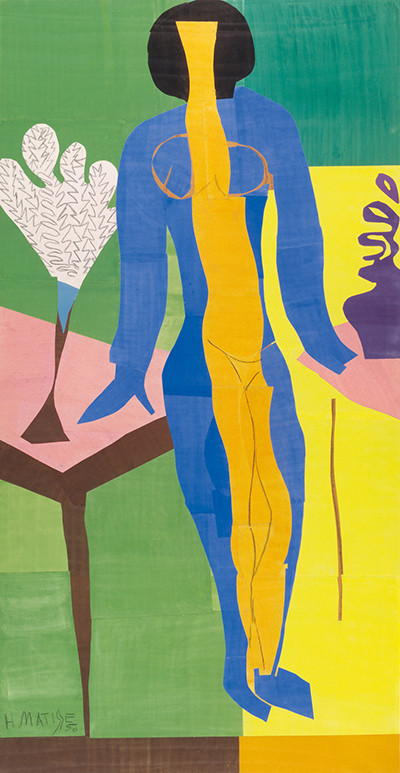
Henri Matisse's Zulma is a standing figure and a room assembled from cut, painted paper. A blue outer shape gives the body its reach, while a long warm-coloured form runs down its centre. A dark, rounded head, an angled table with a pale bouquet and a purple vase-like form on the right make the scene recognisable. Yet each part keeps the blunt fact of its colour and cut edge. The figure stands in a room without being modelled like an oil-painted nude. [1] [2]
Made in early 1950, Zulma is more than two metres high. Its size gives the person on the paper a bodily presence that a small reproduction can obscure. The work belongs to SMK – National Gallery of Denmark in Copenhagen, which records its medium as gouache on paper and its dimensions as 238 × 133 centimetres. MoMA's 2014 cut-outs exhibition describes it more fully as gouache-painted paper, cut and pasted. That material distinction is central: this is an original composition of paper forms, not a printed plate from the earlier Jazz book. [1] [3]
At a Glance
- Artist Henri Matisse
- Work Zulma
- Date 1950
- Explore Cut paper and drawing
This work across Henri Matisse’s career
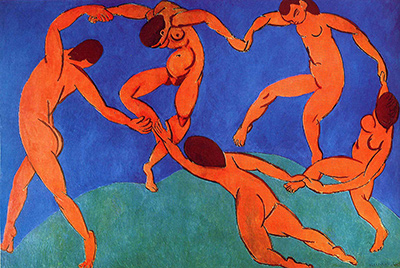
Dance (1910)
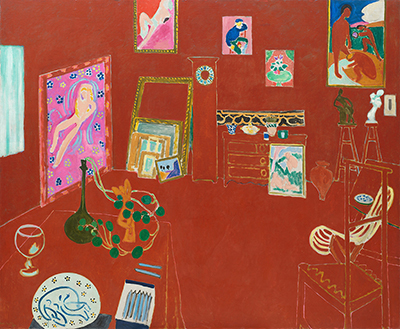
1910The Red Studio
1911The Piano Lesson
1916The Snail
1953Contents
What do you see in Zulma?
The figure faces the viewer, its broad blue sides and outstretched hands held around a narrower yellow-orange centre. Black hair forms a simple cap at the top. The narrow warm strip crosses the face and continues down the body, interrupting any easy reading of skin or clothing. Fine drawn curves and short marks suggest parts of the torso and legs, but they do not turn the paper back into conventional painted modelling. The body is legible through the relation of its large pieces and the spaces among them. [1] [2]
The setting matters almost as much. At the left, a brown table extends diagonally beneath a pale, branching bouquet in a narrow blue vase. On the right, a purple vase-like form rises above a yellow horizontal plane. Pink, green and yellow areas meet around the figure, while a narrow brown band runs along the bottom. These broad zones tell the eye where the figure might stand, even as they resist the stable depth of an ordinary interior. In MoMA's audio guide, curator Jodi Hauptman singles out the angled table for creating an unusually definite sense of space among the cut-outs shown in that exhibition. That is a useful observation to test while looking: remove the table in your mind and the blue figure may appear to float more freely among colours. [2]
The left-hand bouquet is both an object in the room and an exercise in line. Its pale leaves carry drawn marks, so their interior has a different texture from the larger flat pieces. A thin line can suggest growth within one leaf, while a cut edge gives the cluster its outline. On the opposite side, the purple vase-like form is simpler and more solid. The two do not mirror one another. They balance the tall central figure with different kinds of detail, helping a scene made from separate papers feel held together. [1]
Watch: Matisse’s art and working methods
Choose a museum film or a close reading to continue exploring Matisse’s work.
Matisse: The Cut Outs
Tate introduces its exhibition devoted to Matisse’s cut-paper work.
Watch on YouTubeHow was it made?
In Matisse's late practice, sheets of paper were painted with gouache and cut into shapes that could be tried in different positions. Studio assistants helped prepare the sheets and place forms on walls under his direction. The process did not make every cut-out a single instant of inspiration, nor did it turn assistants into invisible labour. A figure could arrive early in an arrangement and other pieces could be moved around it as the space developed. [4] [5]
For Zulma there is a more particular account. The Grand Palais preserves assistant Paule Caen-Martin's recollection that Matisse began with the central blue figure while Lydia Delectorskaya was away. Green and yellow forms followed, then a warm vertical piece and drawn marks; the table, vase, floor and other details were developed on the next day. Her memory gives the visible composition a working sequence, though it is an eyewitness account rather than a mechanical diagram of every layer. It also shows how a cut-paper figure could prompt the room around it, instead of arriving as the last addition to a fully planned background. [5]
The work therefore brings cutting and drawing together. The blue body's edge can describe a shoulder or arm in one sweep, while marks inside the yellow form specify parts of the anatomy that an edge alone would leave open. Paper, gouache and line do different tasks. Matisse could move a cut form and see the whole figure change; he could add a drawn mark and sharpen a local reading without rebuilding the silhouette. A viewer can follow both kinds of decision in the finished surface. [1] [5]
Why does it feel like a painting of a room?
Many late cut-outs spread forms across a field or around a wall with little conventional interior space. Zulma holds onto an older Matisse subject: a figure among furnishings, plants and broad areas of colour. MoMA's audio discussion describes its close relationship to an easel painting. The paper is still visibly cut and assembled, but the angled table and floor invite the eye to place things in front of or beside one another. The work is neither a return to oil painting nor an abandonment of the room. It tests what a room can become when its parts are cut out of colour. [2]
SMK compares this relationship of colour and contour with Matisse's 1905 Portrait of Madame Matisse (The Green Stripe) , also in its collection. The two works are separated by forty-five years and different materials. In the portrait, a band of green divides the painted face and helps organise neighbouring colours; in Zulma , a long warm form and blue silhouette make the figure from pieces of coloured paper. Neither work relies on a normal description of skin. The comparison shows a question Matisse kept asking in new ways: how can a coloured shape make a person present while remaining visibly a coloured shape? [1]
The name Zulma does not by itself identify a documented sitter, and the work should not be turned into a biographical portrait without evidence. SMK calls its subject a nude in an interior, a recurring theme across Matisse's painting and sculpture. Here that theme has become an arrangement at near human height. The figure's direct facing position can make the viewer feel addressed, while the angled floor and tables keep us aware of the constructed scene around her. For more on the artist's late working circumstances, the biography supplies the wider story; the cut-outs guide follows the medium across different subjects and scales. [1]
Explore 113 Matisse artworks
This directory covers the 113 individual works explored in these articles, rather than a complete catalogue of Matisse’s output. Cut-paper designs and prints appear under Drawing in the medium filter; each row names its form. Dates retain the qualifications explained in the linked articles.
Frequently Asked Questions
It is an original cut-paper composition made with gouache-painted paper, cut and pasted. Paint supplies colour to the sheets, but its forms are built through cutting and placing paper rather than brushing a figure onto one continuous canvas. SMK lists it as a collage and MoMA's checklist gives the fuller material description. [1] [3]
SMK records it as 238 cm high and 133 cm wide. That is why its standing figure can meet a viewer at almost bodily scale. A screen image is useful for following the colours and small drawn marks, but it can make this physical relation easy to miss. [1]
The owner record supplies the title and identifies a nude in an interior, but it does not establish a particular model's identity. The title should be used as the artwork's name without turning an unsupported guess about the sitter into a fact. [1]
To keep exploring the late figure, compare Zulma with Blue Nude II or Venus : each asks coloured paper to carry a body, but their settings and proportions differ. Return to Zulma and follow the diagonal table edge beside the pink plane. It is one of the places where a cut shape makes a room, not just an outline. [3]
Discussion
Look again at the images and ideas explored in Zulma by Henri Matisse: a figure cut into colour. These editorial prompts invite your observations.
Reader Insights
What do you see in Zulma ?
Which comparison discussed in the article helps you see the work differently?
How do the materials and historical setting affect your reading?
Join the Conversation
Share a detail, comparison or question about Zulma by Henri Matisse: a figure cut into colour below.
References
- SMK – National Gallery of Denmark , “Zulma,” owner record. View source .
- Museum of Modern Art , “Zulma,” exhibition audio. View source .
- Museum of Modern Art , Henri Matisse: The Cut-Outs , exhibition checklist (PDF), p. 19. View source .
- Museum of Modern Art , “Matisse: The Cut-Outs — In the Studio”. View source .
- Grand Palais , “Drawing with scissors: Henri Matisse's cut-out gouache technique”, 2026. View source .
 Henri Matisse.jpg)