 by
Tom Gurney
Tom Gurney BSc (Hons) is an art history expert with over 20 years experience
Email:
tomgurney1@gmail.com
/ Phone:
+44 7429 011000
Polynésie, le ciel by Henri Matisse: a sky assembled from paper: Introduction
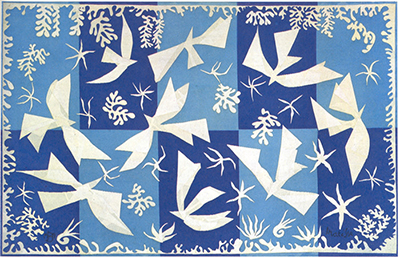
White birds seem to wheel, dive and cross a broad blue field in Henri Matisse's Polynésie, le ciel ( Polynesia, the Sky ). Small star-like forms flicker between them. The ground is divided into rectangles of darker and lighter blue, yet those joins do not halt the apparent movement. One pale form stretches across a change of colour; another turns into a gap between blocks. The work feels airy even while it makes its paper construction visible. [1] [2]
Centre Pompidou dates the original composition to 1946 and records it as pasted papers heightened with gouache, mounted on canvas. It measures 200 × 314 centimetres. The object is a large design for a tapestry, rather than the tapestry woven from it. The museum holds it on deposit from the Mobilier national and France's national tapestry manufactures, with a 1975 deposit date. Its French title is Polynésie, le ciel . [1]
At a Glance
- Artist Henri Matisse
- Work Polynésie, le ciel
- Date 1946
- Explore Cut paper and drawing
This work across Henri Matisse’s career
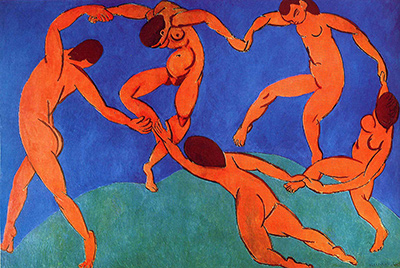
Dance (1910)
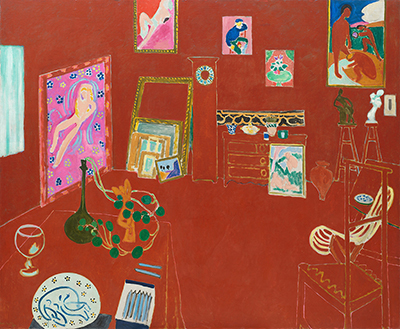
1910The Red Studio
1911The Piano Lesson
1916The Snail
1953Contents
How does the sky move?
The composition is wide enough to encourage a sweep from side to side, but it has no single horizon or centre of perspective. A loose white border runs around the blue area, as though the field were held inside a frame made of the same cut material as its motifs. Inside, rectangular blue zones alternate in tone. Some are close to deep navy; others are much lighter. Their joins form a loose grid that could have made the picture static. Instead, the white shapes cross them in different directions, pulling the eye diagonally and back across the surface. [1] [2]
Several of the largest white shapes read as birds in flight. Broad, pointed wings and narrow bodies can be found at different angles: rising, banking or dropping through the blue. They are not drawn with feathers, eyes or other small details that would settle each into a particular species. Their outlines carry the action. A slight turn at the tip of a wing changes its direction; an open blue interval between white parts lets a form seem to beat or tilt. The picture offers a recognition of flight without turning into a naturalist's chart of birds. [1] [2]
Smaller motifs complicate that reading. White spoked stars, branching shapes and tiny curling forms appear among the birds. They can resemble light, flowers or fragile growth as much as things belonging strictly to the sky. A few spread near the edges; others sit between larger winged forms. Their different scales prevent the broad blue blocks from feeling empty. The field is neither a cloudless atmosphere nor a literal landscape. Matisse lets signs of life drift together, while the title gives the viewer a direction in which to read them. [1]
Colour is unusually restrained. The main opposition is white against two blue tones, with subtle shifts in the paper and gouache. That limited palette puts weight on every contour. A wing-shaped edge can be read from across the room, then a smaller branching motif asks for closer attention. The pale forms are not confined to separate squares of the grid. They cross the tiled background, so the same white shape may appear different against a dark and then a light blue. The contrast makes the sky feel continuous even though its support is openly assembled. [1]
Watch: Matisse’s art and working methods
Choose a museum film or a close reading to continue exploring Matisse’s work.
Matisse: The Cut Outs
Tate introduces its exhibition devoted to Matisse’s cut-paper work.
Watch on YouTubeWhat was Matisse making?
The Centre Pompidou catalogue account describes a particular construction for the Polynésie pair. Matisse began with pasted papers: white motifs such as birds, flowers and fish were cut from writing paper, sometimes in several parts, and set over a regularly tiled ground made from blue and green industrially coloured packing paper. Gouache was then added. In the museum's medium description, these are pasted papers heightened with gouache and mounted on canvas. The result is an original collage surface, not a woven surface and not a later printed reproduction. [1]
That material history helps explain a visual puzzle. The blues look at once regular and variable. A tiled backing establishes rhythm, but its pieces do not disappear into one mechanically uniform colour. The white forms can be built and adjusted in parts while still reading as one bird or star-like sign at a distance. MoMA's broader account of Matisse's cut-outs describes painted sheets, cutting, provisional arrangement and final mounting as stages of the practice. The Pompidou record supplies the more specific materials for this design; no consulted source reconstructs every individual move Matisse made on this sheet. [1] [3]
The composition was made as a design for tapestry. Pompidou explains that Matisse had already prepared a Window at Tahiti tapestry design in 1935. When approached about another tapestry project, he proposed the two works called Polynésie . Their shapes and flat areas could be translated into weaving, although the finished textile would have its own texture and decisions. The first weavings were made in 1947. After seeing them, Matisse proposed three further variants—two for the sky design and one for the sea design—but Pompidou says these variants were never executed. The 1946 paper composition should therefore not be mistaken for one of those later unmade revisions. [1]
The tapestry designs also have an exhibition history. Pompidou records the textiles in a 1949 exhibition in Paris alongside other recent Matisse works. The original paper maquettes stayed with the Mobilier national until their deposit at the Musée national d'art moderne in 1975. That distinction matters when looking up an image: the cut-paper design, an early woven tapestry and an unexecuted variant are related, but they are not interchangeable objects. [1]
Why “Polynesia” if it was made in France?
The museum connects the pair to Matisse's memories of a 1930 journey to Tahiti. Polynésie, le ciel was made sixteen years later. The work is therefore better read as an arrangement of remembered impressions than as a direct sketch made on the shore. Its birds, drifting signs and blue field offer a felt sense of air and light. They do not map a named island or copy a single observed moment. This distinction leaves the work's abstraction and its remembered place in view at the same time. [1]
The companion work, Polynésie, la mer ( Polynesia, the Sea ), makes the relation clearer. Pompidou dates it to 1946, identifies the same pasted-paper and gouache method, and records a width of 314 centimetres. It is slightly shorter at 196 centimetres. The shared grid and white motifs make a pair, while the titles turn attention in two directions: upward to birds and sky, outward or downward to marine life. They are coordinated views of a remembered environment, not one panorama split neatly at a horizon line. [1] [4]
Another name can cause confusion. Pompidou also owns Océanie, le ciel ( Oceania, the Sky ), a separate 1946 printed linen hanging associated with textile maker Zika Ascher. Its museum record gives a different size, 177 × 370 × 5 centimetres, and describes an editioned textile. It is not the 200 × 314 centimetre Polynésie, le ciel paper design discussed here. Both drew on Pacific memories and cut-paper thinking, but their titles, processes and object histories should remain distinct. [5] [1]
Explore 113 Matisse artworks
This directory covers the 113 individual works explored in these articles, rather than a complete catalogue of Matisse’s output. Cut-paper designs and prints appear under Drawing in the medium filter; each row names its form. Dates retain the qualifications explained in the linked articles.
Frequently Asked Questions
Centre Pompidou dates the original paper composition to 1946. It records the first tapestry weavings in 1947 and later unexecuted variant proposals. The year 1946 identifies the paper design, not the date of every related textile. [1]
The 200 × 314 centimetre object in Pompidou's record is the original pasted-paper design, heightened with gouache and mounted on canvas. Tapestries were woven from the design. A photograph of a woven textile may look similar, but its medium and production history are different. [1]
No. Océanie, le ciel is a separately catalogued printed linen hanging. Polynésie, le ciel is the large cut-and-pasted paper design for a tapestry. The similar English titles can hide that material difference. [1] [5]
Return to the central blue blocks and follow one white bird across their joins. The eye completes its flight even as it sees the work's cut and pasted construction. The cut-outs guide places this method in Matisse's wider practice. Beasts of the Sea offers a later, more varied marine composition, and the biography traces the journey and working years behind these paper works. [1]
Discussion
Look again at the images and ideas explored in Polynésie, le ciel by Henri Matisse: a sky assembled from paper. These editorial prompts invite your observations.
Reader Insights
How does the sky move?
Which comparison discussed in the article helps you see the work differently?
How do the materials and historical setting affect your reading?
Join the Conversation
Share a detail, comparison or question about Polynésie, le ciel by Henri Matisse: a sky assembled from paper below.
References
- Centre Pompidou , “Polynésie, le ciel,” collection record and 1989 catalogue analysis. View source .
- Centre Pompidou , educational visit guide (PDF), pp. 16–17. View source .
- Museum of Modern Art , “Henri Matisse: The Cut-Outs,” process overview, 2014. View source .
- Centre Pompidou , “Polynésie, la mer,” collection record. View source .
- Centre Pompidou , “Océanie, le ciel,” collection record. View source .
 Henri Matisse.jpg)