



 by
Tom Gurney
Tom Gurney BSc (Hons) is an art history expert with over 20 years experience
Email:
tomgurney1@gmail.com
/ Phone:
+44 7429 011000
Matisse's Notre-Dame, une fin d'après-midi : a Paris view through the studio window: Introduction
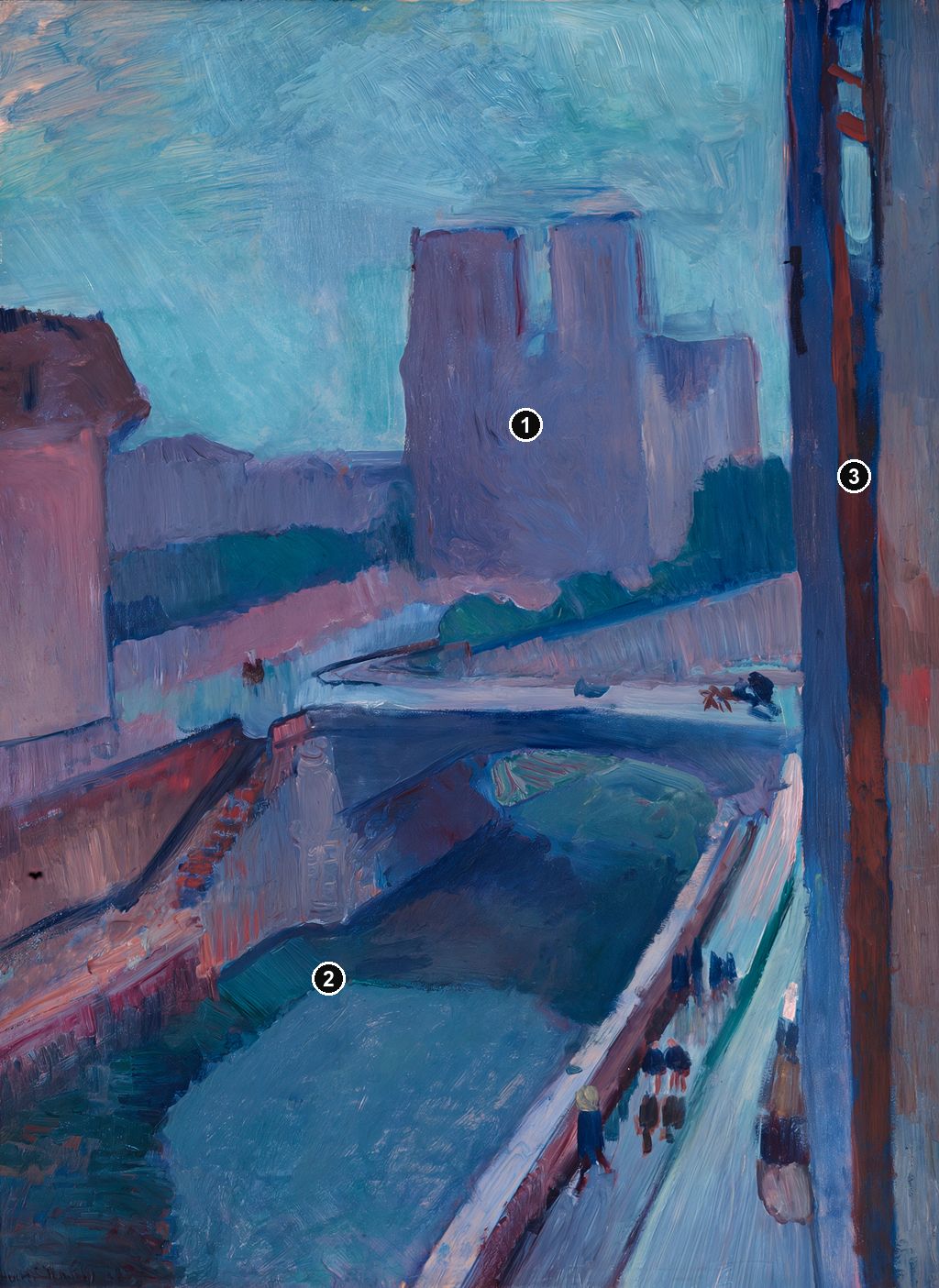
Henri Matisse's Notre-Dame, une fin d'après-midi draws the eye down the Seine toward the cathedral. The two towers are visible beyond a bridge, but they do not stand alone. A blue sky and blue-green river fill much of the picture, a left-bank road leads into the distance, and an open shutter or window edge rises at the right. The near frame is as important as the far monument. Matisse signed and dated the work 1902 . It belongs to the Buffalo AKG Art Museum , which translates the title as A Glimpse of Notre Dame in the Late Afternoon . [1]
Buffalo records oil on paper mounted on canvas , with a support measuring 72.39 × 54.61 centimetres and accession number 1927:24 . The paper support is a meaningful object fact: this is neither Tate's smaller circa-1900 oil on canvas nor MoMA's much later 1914 view. Buffalo's record identifies the signature and date at lower left. Its collection credit names a 1927 gift of Seymour H. Knox, Jr. The canvas's visible composition, material and collection record should guide the page before any broad story about Matisse's life is attached to it. [1] [2] [3]
At a Glance
- Artist Henri Matisse
- Work Notre-Dame, une fin d'après-midi
- Date 1902
- Explore Painting
This work across Henri Matisse’s career
Dance (1910)
1910The Red Studio
1911The Piano Lesson
1916The Snail
1953Contents
- What does the window add to the view?
- Why do the colours matter?
- How does this view compare with the other Notre-Dame paintings?
- What is known about its later history?
- Annotated details
What does the window add to the view?
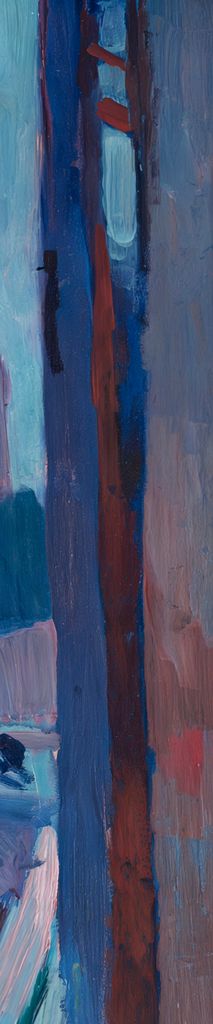
The dark upright at the right edge prevents the picture from becoming an open panorama. Buffalo describes it as part of the open window shutter, with an interior wall also visible. It brings the viewer's position into the composition: we look out from a room, rather than hover invisibly over the river. The vertical strip also answers the cathedral towers. Near and far architecture bracket the river view, while their different sizes help suggest distance. The shutter is not just an incidental border; it is one of the shapes that gives the painting its structure. [1]
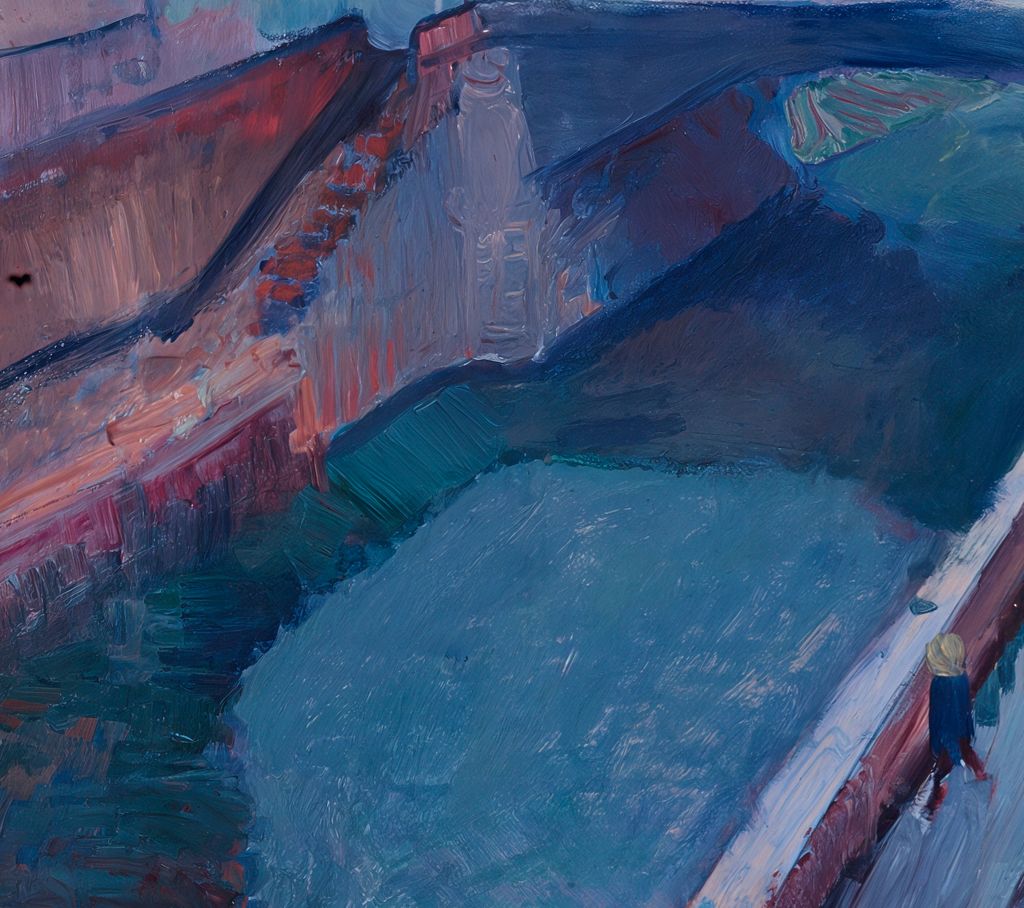
The left side makes that position more complicated. A nearer building edge and riverside approach run down toward the bridge. Small dark marks suggest people and traffic along the bank. The road's diagonal is forceful, leading from the lower-left foreground into the middle distance. On the opposite side, a bright sloping embankment or road carries smaller marks toward the bridge. Together these routes pull the eye through the picture, while the right-hand shutter presses it back toward the surface. We can feel a view receding into Paris and a painting assembled from emphatic coloured planes at the same time. [1] [4]
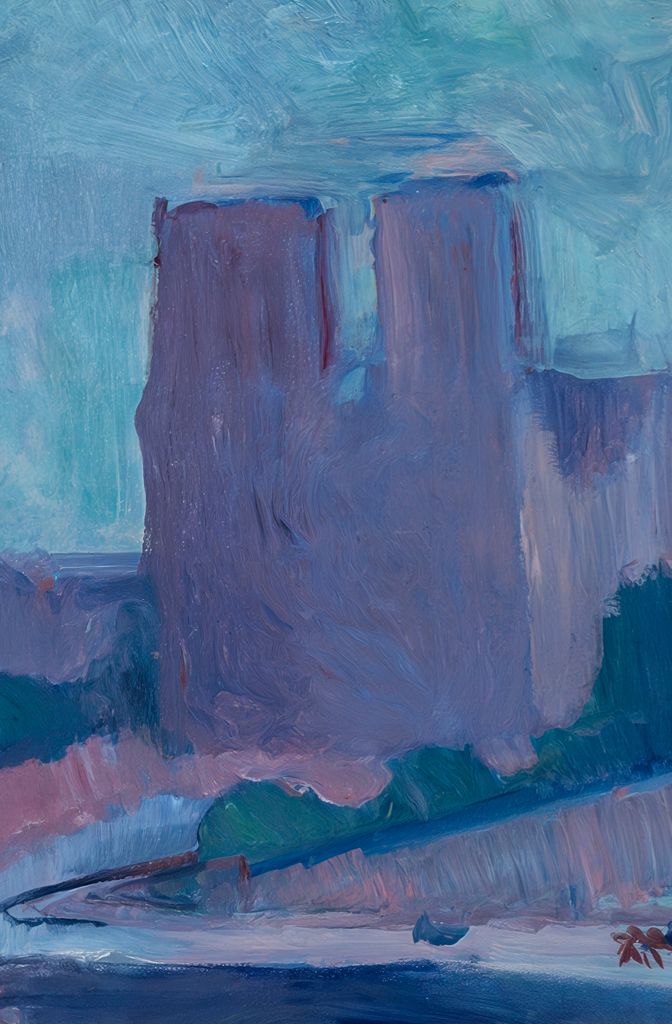
The bridge cuts across the river rather than serving as a small accessory beneath Notre-Dame. Its pale top, darker sides and visible arch divide the blue-green water into near and distant stretches. The cathedral rises beyond it, its towers simplified into broad purple-blue forms. The sky above is comparatively open, but it too carries varied blue and yellowish marks. By balancing a near window frame, a mid-distance bridge and a farther cathedral, Matisse makes a familiar landmark part of a more complex act of looking. [1]
The Met's account of Matisse's repeated Notre-Dame views helps explain the unusual frame. It notes that from his Quai Saint-Michel studio windows he could see the cathedral to the right, and that the 1902 picture emphasises the perspective toward it while including a glimpse of his own building. The picture therefore records something about where the painter looked from as well as what he looked at. The studio is not shown as a furnished interior; it enters through the wall and shutter, which make the view visibly partial. [4]
Watch: Matisse’s art and working methods
Choose a museum film or a close reading to continue exploring Matisse’s work.
Matisse: “For Me It’s Always New”
The Museum of Fine Arts, Boston considers Matisse’s creative practice.
Watch on YouTubeWhy do the colours matter?
The painting is often described as sombre because its blues, greens, pinks and purples are less blazing than the colours of Matisse's later Fauve paintings. Buffalo's owner text uses precisely those colour families. Yet the surface is far from a simple dark wash. The sky is a comparatively light blue, the cathedral shifts through violet and pink, and the river's blues and greens differ from both. Warm touches appear along the banks and on the near window edge. These contrasts make the city legible without giving every wall and stretch of water an ordinary local colour. [1]
Broad, block-like strokes build the bridge, cathedral and banks. Buffalo compares this handling with later paintings by Paul Cézanne in its collection, while noting that Matisse's earlier versions of the subject had used a more representational palette. That curatorial comparison is formal: it concerns abbreviated shapes, visible brushwork and the refusal to describe every surface in detail. It does not prove that Matisse was copying one named Cézanne canvas while looking from this window. The important observation is how individual colour passages hold their own even as they describe a coherent Paris view. [1]
Colour also links distances. Purple in the cathedral relates to cooler tones along the river; warmer pink on the bridge and buildings is answered by orange and ochre at the edges. The eye can travel along these echoes rather than simply following perspective lines. The large blue field of sky gives the upper half breadth, while the river repeats some of its coolness in darker, more varied marks below. This is a painting of a place, but it is also a study in how colour can organise what is near, what is far and what lies between. [1]
Buffalo connects the work's loose brushwork and unusual colour choices to the development of Fauvism in 1905 , several years later. That is a useful historical line, provided it is not shortened into a claim that the 1902 painting already belongs to a fully established Fauvist movement. Its colour choices still carry a recognisable cathedral, bridge and river, while testing how much of their form can be suggested through large painted areas. The work sits in a period of experiment between the more observational early views and the bolder 1905 breakthroughs. [1]
Nor can the palette safely diagnose Matisse's personal feelings. A blue and purple cathedral does not tell us whether the painter was happy, distressed or reacting to a particular family event on the day he worked. The museum gives art-historical and visual evidence for the use of colour; it does not present the painting as a psychological chart. Reading what the colour does within the picture is more reliable: it binds window, bridge, water and towers while allowing each part to retain a distinct weight. [1]
Annotated Details from Notre-Dame, une fin d'après-midi
The numbered points identify visible features discussed in this article. Return from each detail to the whole composition. Notre-Dame, une fin d'après-midi — Henri Matisse
Details from NOTRE-DAME, UNE FIN D'APRÈS-MIDI
Compare the cropped details with the complete images above. Notice how their colours, shapes and positions contribute to the larger compositions.
The distant towers
Two violet-blue towers rise beyond the bridge. Their edges remain soft within the surrounding colour and light.
River and diagonal banks
The banks lead the eye into the picture while the river breaks into changing blue-green marks. The diagonals make the foreground active.
The near window edge
The cropped edge at right keeps the view connected to an interior position. It gives the distant cathedral a close, upright counterweight.
How does this view compare with the other Notre-Dame paintings?
Matisse returned to the cathedral across years. Tate's Notre-Dame of circa 1900 is a smaller oil on canvas , 46 × 37.5 centimetres , with boats and river activity prominent in the foreground. Buffalo's 1902 work is larger and painted on paper later mounted on canvas; its window shutter and bank leading toward the bridge are especially strong components. Similar subject matter should not lead to one title, date or support being copied across both. Each view frames the cathedral and Seine differently. [1] [2]
MoMA's View of Notre Dame belongs to spring 1914 . Its object record and 1978 catalogue place it after Matisse returned to a Quai Saint-Michel studio. The catalogue explicitly contrasts the 1902 painting's strong recession into depth with the 1914 work's blue, surface-oriented geometry. In the latter, the familiar landmark is much less descriptive. The 1902 work is thus valuable as a distinct solution: the view still extends convincingly through a bridge toward the cathedral, but the strokes and colours already have an independence that rewards attention in their own right. [5] [3]
The Met cautions against imagining these Notre-Dame pictures as a methodical series in the manner of Monet's repeated Rouen Cathedral facades. Matisse knew the view from his working surroundings and returned to it with changing aims. That distinction helps us avoid looking for a simple progression in which each canvas is merely a step toward the next. Buffalo's work is a complete 1902 composition. Tate's earlier small view and MoMA's later blue view clarify its choices by contrast, but neither replaces the particular experience of the bridge, shutter and cathedral held together here. [4] [2] [3]
What is known about its later history?
The Buffalo AKG record credits Seymour H. Knox, Jr., with a 1927 gift . Its provenance field also lists Reinhardt Galleries in New York and a transaction involving A. Conger Goodyear that year. The public fields do not, in this brief format, explain every relationship between the gift credit and transaction wording. It is enough for a reader to know that the painting entered the Buffalo collection in 1927 , decades before the Second World War. The museum's own dated record gives no basis for a story that it was hurried to the United States to escape Nazi destruction. [1]
The object's longer life does not change what is in the image. The lower-left signed date, unusual paper support and Buffalo accession number keep its identity clear. Its title suggests a late-afternoon glimpse, but the picture does not provide a measured time of day or weather report. It shows how a painter in his early thirties could turn a daily view into an active composition of window, river crossing, cathedral and colour. Readers can place it within Matisse's painting collection and compare the two other Notre-Dame routes, while keeping this 1902 Buffalo work distinct. [1] [4]
Explore 113 Matisse artworks
This directory covers the 113 individual works explored in these articles, rather than a complete catalogue of Matisse’s output. Cut-paper designs and prints appear under Drawing in the medium filter; each row names its form. Dates retain the qualifications explained in the linked articles.
Frequently Asked Questions
It belongs to the Buffalo AKG Art Museum , accession 1927:24 . The museum's object page is the source for current collection and display information. [1]
Matisse signed and dated it 1902 at lower left. Buffalo records oil on paper mounted on canvas , not oil painted directly on an ordinary canvas support. [1]
Discussion
Look again at the images and ideas explored in Matisse's Notre-Dame, une fin d'après-midi : a Paris view through the studio window. These editorial prompts invite your observations.
Reader Insights
What does the window add to the view?
Which comparison discussed in the article helps you see the work differently?
How do the materials and historical setting affect your reading?
Join the Conversation
Share a detail, comparison or question about Matisse's Notre-Dame, une fin d'après-midi : a Paris view through the studio window below.
References
- Buffalo AKG Art Museum , Notre-Dame, une fin d'après-midi , 1927:24. View source .
- Tate , open collection metadata for Notre-Dame , N05905. View source .
- The Museum of Modern Art , Matisse in the Collection of the Museum of Modern Art (1978), pp. 94–95. View source .
- The Metropolitan Museum of Art , Matisse: In Search of True Painting , Gallery Three. View source .
- The Museum of Modern Art , View of Notre Dame (1914). View source .


 Henri Matisse.jpg)
