



 by
Tom Gurney
Tom Gurney BSc (Hons) is an art history expert with over 20 years experience
Email:
tomgurney1@gmail.com
/ Phone:
+44 7429 011000
Portrait of Madame Matisse: The Green Stripe — colour across a face: Introduction
Henri Matisse's Portrait of Madame Matisse , often called The Green Stripe , is a small painting with a striking division down the centre of Amélie Matisse's face. The band of green runs from the hairline through the nose toward the mouth and chin. Yellow and orange meet cooler pale colours on either side, while dark hair and a divided background frame her steady gaze. The picture remains recognizably a portrait of Matisse's wife, but its colours are arranged for force and balance rather than for a lifelike account of skin under ordinary light. [1]
At a Glance
- Artist Henri Matisse
- Work Portrait of Madame Matisse
- Date 1905
- Explore Painting
This work across Henri Matisse’s career
Dance (1910)
1910The Red Studio
1911The Piano Lesson
1916The Snail
1953Contents
- Which portrait is The Green Stripe?
- What does the green stripe do?
- How are the other colours arranged?
- Does the colour tell us how Amélie felt?
- How does the work fit into Matisse's 1905 experiments?
- How did the portrait reach Copenhagen?
- Annotated details
Which portrait is The Green Stripe?
The work belongs to Statens Museum for Kunst (SMK) in Copenhagen, where it is catalogued as KMSr171 . SMK dates it 1905 and identifies its medium as oil on canvas . At 40.5 × 32.5 centimetres , it is intimate in scale. Its French title is Portrait de Madame Matisse. La raie verte ; the English nickname draws attention to the vertical line that organizes the face. The sitter is Amélie Matisse , Henri's wife. She had worked as a milliner and operated a Paris hat shop; SFMOMA's research on another 1905 portrait also describes her substantial household and business role. She was an active partner as well as a frequent model. These facts help distinguish the Copenhagen canvas from other portraits of her made in the same year and across the artist's career. [1] [2]
SMK's account places the painting probably in autumn 1905 , after Matisse returned to Paris from a summer in Collioure , where he worked alongside André Derain. The exact month is less secure than the year, so “probably” matters. The portrait belongs to a moment when Matisse was testing how colour could act independently of the tones expected in a natural likeness. A green face stripe is startling because it refuses to behave as a conventional shadow, yet the face remains clear enough to meet the viewer's eyes. [1]
The painting should also be separated from Woman with a Hat , another 1905 portrait of Amélie now at SFMOMA. That is a larger picture with a wide hat, elaborate dress and a more open arrangement of energetic strokes. Its debut at the 1905 Salon d'Automne provoked public controversy. The owner records do not establish that the Copenhagen portrait had that same exhibition history or the same immediate response. It is useful to compare their colour experiments without merging two objects into one story. [1] [3] [2]
What does the green stripe do?
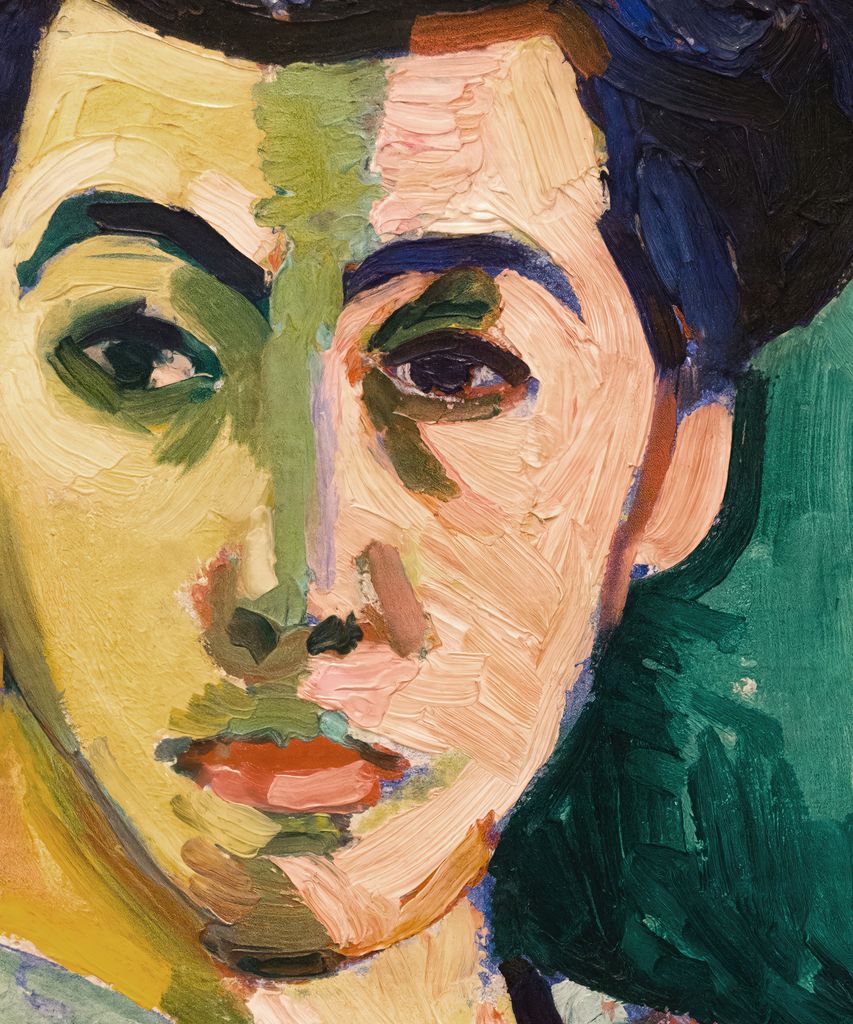
The narrow green band divides the face while helping to hold it together. It runs through an area where traditional portrait painting might build the nose from graded highlights and shadows. Matisse instead gives the viewer a strong colour boundary. On one side, yellow and warmer tones press forward; on the other, paler and cooler passages answer them. The nose is still readable, but it is also a line of colour joining forehead, cheeks, mouth and chin. Its importance is structural as well as startling. [1]
SMK describes the stripe as part of a division between warm and cool halves that gives the face a flatter, almost mask-like quality. That does not mean the sitter is literally wearing a mask. It means the picture asks us to see broad colour shapes before the familiar gradual modeling of facial volume. The green can be read partly as a transformed shadow, but the canvas does not require a single light source that explains every patch. Colour has become an active choice in the construction of the portrait. [1]
The effect changes with viewing distance. Close to the surface, the stripe looks like a painted mark with its own width and edge. From farther away, it helps the two coloured sides of the face fit into one head. The eyes, brows and mouth continue to provide recognition; the stripe does not erase Amélie. It gives the portrait an internal axis that a viewer can follow up and down, then outward into the hair, clothing and background. The work's intensity comes from these few relationships rather than from an accumulation of small descriptive details. [1]
Annotated Details from Portrait of Madame Matisse
The numbered points identify visible features discussed in this article. Return from each detail to the whole composition. Portrait of Madame Matisse — Henri Matisse
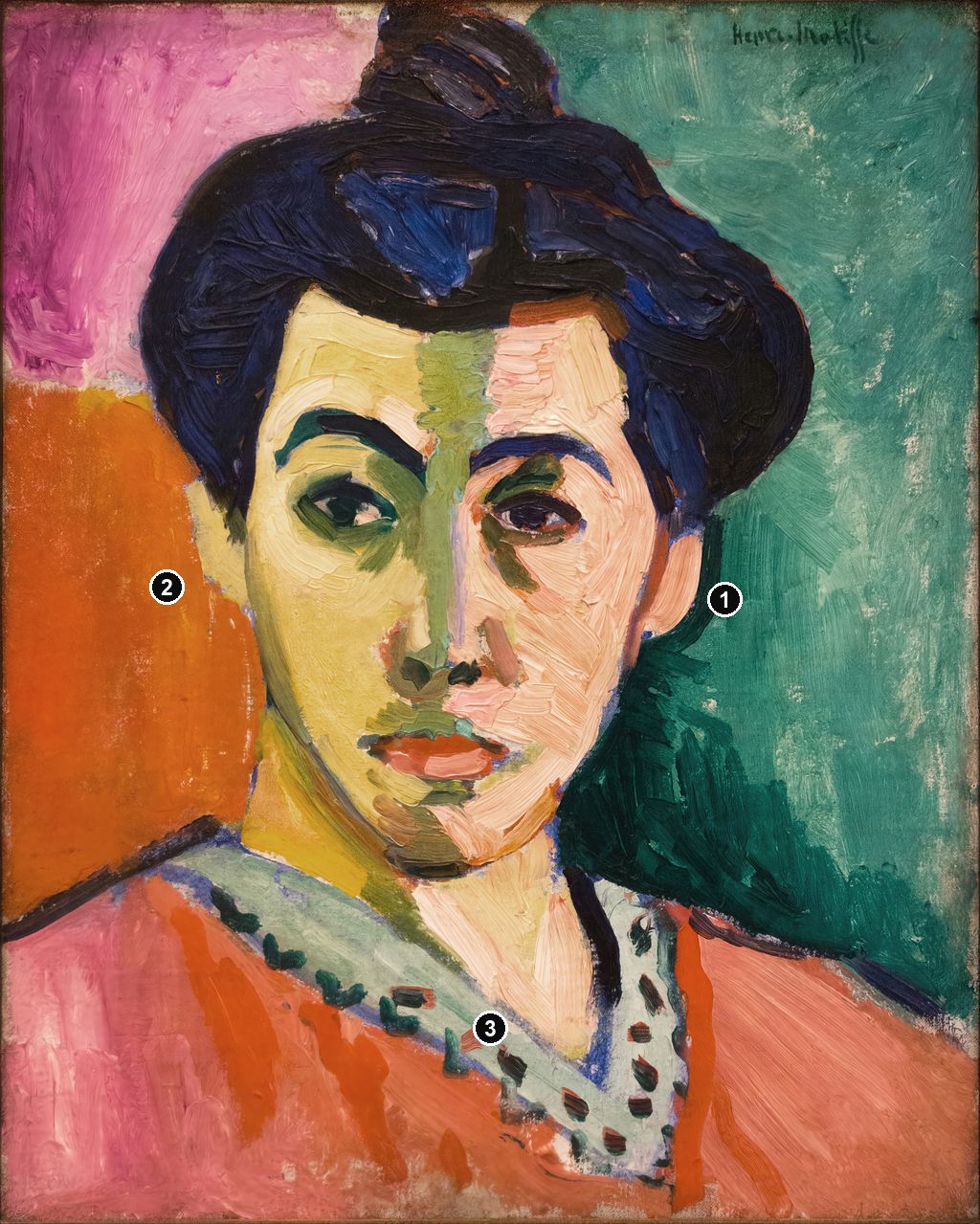
Details from PORTRAIT OF MADAME MATISSE
Compare the cropped details with the complete images above. Notice how their colours, shapes and positions contribute to the larger compositions.
The green division
A green band runs down the forehead and nose. Warm and cool passages on either side build the face through colour rather than a uniform skin tone.
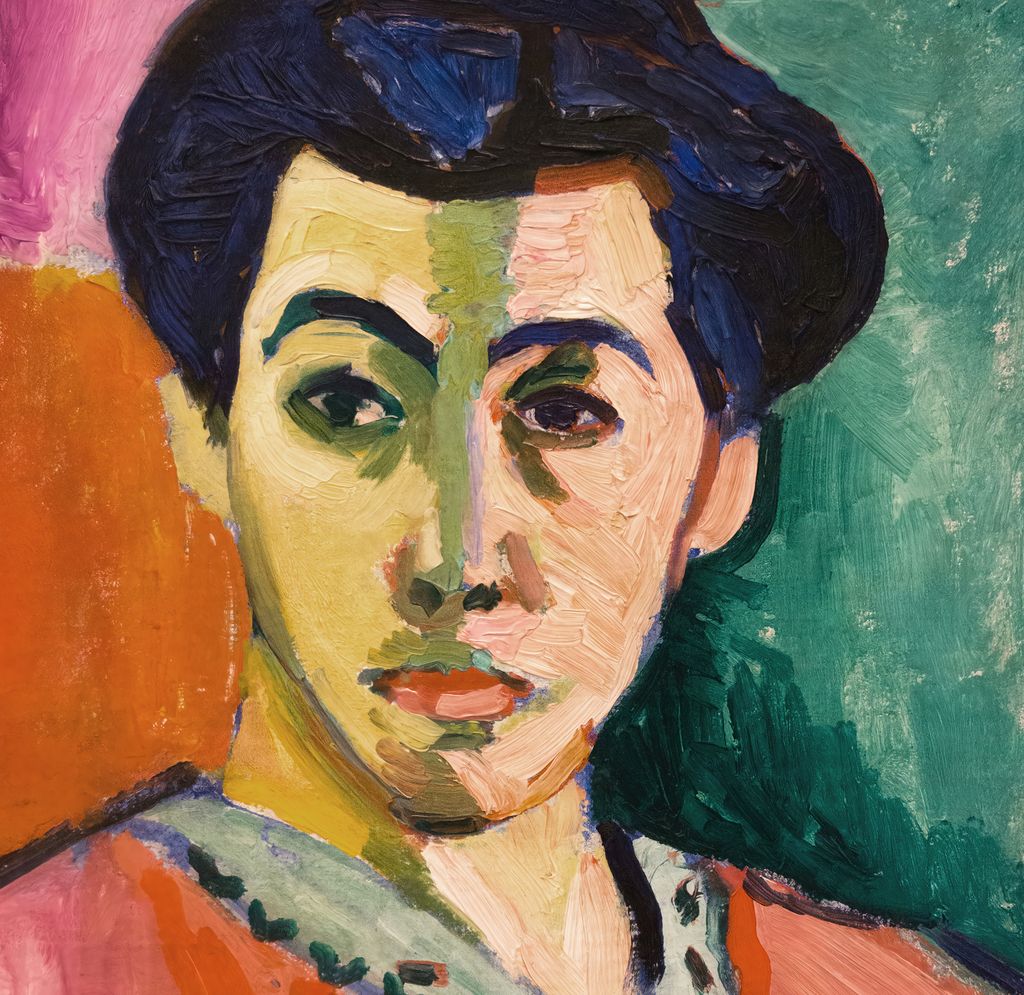
Three background colours
Pink, orange and green meet behind the sitter. Their boundaries answer the contour of the head and change the apparent warmth of the face.
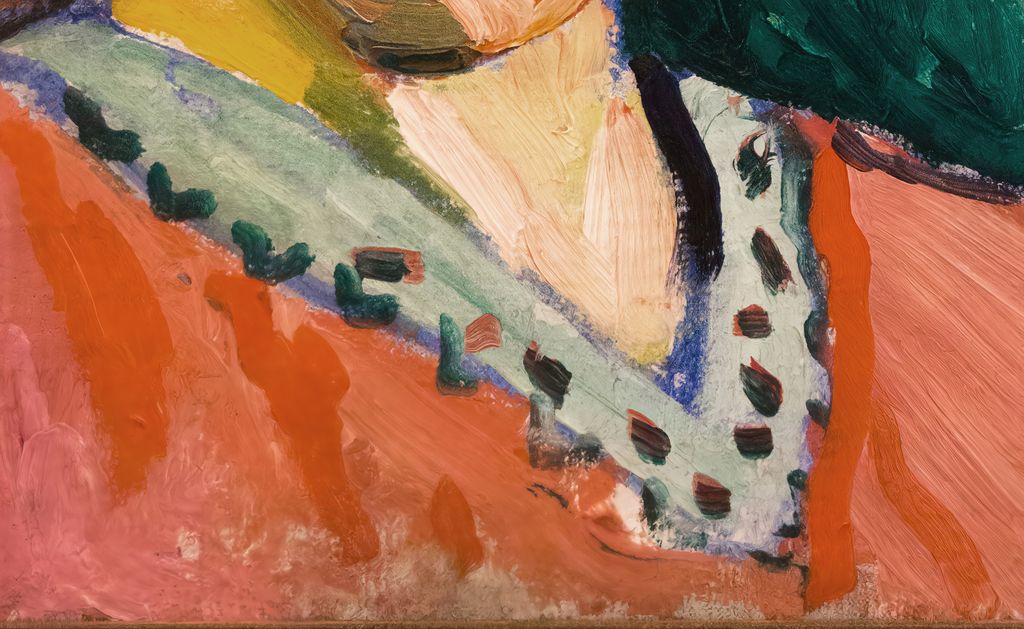
Dress and neckline
The dark neckline and small alternating marks lead into the pink-red garment. These compact details hold the lower part of the portrait together.
How are the other colours arranged?
Amélie's dark hair makes a wide cap above the face. Deep blue and near-black strokes define it against the cooler upper-right background and the pink-violet area at upper left. Below, her clothing brings red and orange forward. The collar is lighter, patterned with dark spots, so the head has a clear base without needing a fully described room or chair. The portrait is tightly cropped: face, hair, shoulders and a few blocks of surrounding colour carry nearly all of its visual information. [1]
The background is divided as firmly as the face. A warm red-orange field appears behind one shoulder, while cooler green occupies much of the other side. This arrangement makes the warm and cool passages in Amélie's face feel part of a larger design. The colour does not stop at the edge of the person. It moves between sitter and setting, allowing a cheek to answer a wall-like patch or a dark lock of hair to become a boundary between two fields. Space is suggested, but the picture does not open into a deep interior. [1]
SMK's curators emphasize the portrait's simple geometric structure and its reduction of ordinary light-and-shadow modeling. The face has shape, yet much of its force comes from flat neighbouring areas. A bright yellow plane, a green stripe and a pale cheek can hold one another in balance without blending into an even flesh tone. This is why the picture is more precise than the phrase “wild colour” alone suggests. Its unusual colours have places and relationships; they are not scattered at random. [1]
Watch: Matisse’s art and working methods
Choose a museum film or a close reading to continue exploring Matisse’s work.
Matisse: “For Me It’s Always New”
The Museum of Fine Arts, Boston considers Matisse’s creative practice.
Watch on YouTubeDoes the colour tell us how Amélie felt?
The painting does not provide a reliable map of Amélie's personality. It can be tempting to call one half warm and welcoming and the other cold or distant, then convert those colours into two psychological selves. That reading goes beyond what the canvas or its owner record can support. SMK explicitly cautions against treating the work as a close naturalistic likeness or a psychological portrait that reveals private truths about the sitter. Amélie's face is recognisable, but Matisse is also testing what a face can become when colour is given unusual independence. [1]
Nor can the palette establish how Matisse felt toward his wife on the day he painted it. The red clothing does not prove affection, and the green does not prove distance. Such claims turn choices about a painted surface into facts about a marriage. A more grounded account begins with what is visible: strong contrasts, a face divided and rejoined by colour, and a pose that still allows the sitter to look outward. The work's emotional effect on a viewer is real, but it need not be translated into a documented feeling or personality trait. [1]
This restraint also makes the sitter more, rather than less, present. Even with an abstracting stripe, Amélie's eyes and mouth give the viewer a specific human face. The colour construction never becomes a purely decorative pattern detached from a person. SMK's reading of the portrait stresses precisely that tension: recognition survives while conventional realism gives way. The result is neither a straightforward likeness nor an anonymous study of colour. It is a portrait that lets the act of painting remain visible. [1]
How does the work fit into Matisse's 1905 experiments?
During the summer at Collioure, Matisse and Derain developed paintings that gave colour and visible brushwork new freedom. SMK places The Green Stripe after Matisse's return from that trip and reads its unorthodox colour as a continuation of those experiments. The painting compresses the problem into a face. A landscape can hold unexpected red trees or green water without asking us to judge a person's likeness. Here, the colour must work against the viewer's close expectations for a human face and still let us recognise Amélie. [1] [4]
A related but separate 1905 ink drawing of Amélie , Madame Matisse assise , belongs to the Centre Pompidou. Its catalogue places it in Collioure and describes Matisse experimenting with freer line and bodily form. It does not prove that every brushstroke in the Copenhagen oil came from this one page. It helps show that Amélie was a recurring model while Matisse explored both drawing and painting. The ink sheet and the green-stripe canvas are different objects, each with its own material, size and collection history. [5]
The comparison with Woman with a Hat is more direct because both are oil portraits of Amélie made in 1905 . In the San Francisco picture, a large hat, clothing and fan spread colour across a more elaborate seated pose. In the Copenhagen painting, the tighter crop concentrates the experiment in a face and the few fields surrounding it. SFMOMA documents the Salon d'Automne controversy around Woman with a Hat . That public reception helps explain the period's unease with Matisse's colour, but it should remain attached to the exhibited painting rather than become an invented reception record for The Green Stripe . [1] [3] [2]
How did the portrait reach Copenhagen?
SMK's provenance begins with Sarah and Michael Stein , who bought the portrait at Galerie Druet in Paris in March–April 1906 . Later it entered the collection of the Danish buyer Christian Tetzen-Lund . SMK records its acquisition in 1936 through the J. and Elisabeth Rump foundation , which donated it to the museum. The owner record documents more complicated movements and negotiations in the years between the Stein purchase and the Danish acquisition; the short sequence here identifies the main documented owners without pretending every intervening step was simple. [1]
The Stein connection is easy to confuse with other Matisse paintings. Leo and Gertrude Stein owned Le Bonheur de vivre , whereas SMK's specific provenance names Michael and Sarah for this portrait. Keeping those branches of the family distinct matters because a famous surname alone cannot establish which apartment displayed a work or who bought it. SMK's account notes that photographs show the portrait prominently displayed in Michael and Sarah's home. Its early life was therefore part of the Paris avant-garde's domestic viewing culture as well as Matisse's studio practice. [1] [6]
Explore 113 Matisse artworks
This directory covers the 113 individual works explored in these articles, rather than a complete catalogue of Matisse’s output. Cut-paper designs and prints appear under Drawing in the medium filter; each row names its form. Dates retain the qualifications explained in the linked articles.
Frequently Asked Questions
The line divides warm and cool colour areas and helps structure the nose and face. SMK describes its flattening, mask-like effect. It can suggest the place of a shadow without obeying a conventional light source. Its visible role is compositional; the record does not assign it a fixed symbolic meaning. [1]
It belongs to Statens Museum for Kunst in Copenhagen, catalogued as KMSr171 . A gallery location can change, so the museum's current object record is the best place to check before a visit. [1]
For more of Matisse's changing approaches to colour and portraiture, follow the painting collection or return to the artist overview .
Discussion
Look again at the images and ideas explored in Portrait of Madame Matisse: The Green Stripe — colour across a face. These editorial prompts invite your observations.
Reader Insights
Which portrait is The Green Stripe ?
Which comparison discussed in the article helps you see the work differently?
How do the materials and historical setting affect your reading?
Join the Conversation
Share a detail, comparison or question about Portrait of Madame Matisse: The Green Stripe — colour across a face below.
References
- SMK Open , Portrait of Madame Matisse: The Green Stripe , KMSr171. View source .
- SFMOMA , “Matisse's Femme au chapeau : From Scandal to Icon”. View source .
- SFMOMA , Femme au chapeau (Woman with a Hat) , 91.161. View source .
- The Metropolitan Museum of Art , “Fauvism”. View source .
- Centre Pompidou , Madame Matisse assise , AM 1984-43. View source .
- Barnes Foundation , Le Bonheur de vivre , BF719. View source .


 Henri Matisse.jpg)
