 by Tom Gurney
Tom Gurney BSc (Hons) is an art history expert with over 20 years experience
Published on June 19, 2020 / Updated on October 15, 2026
Email: tomgurney1@gmail.com / Phone: +44 7429 011000
Two Semi-reclining Male Figures (Uffizi 717 E), attributed to Titian: Introduction
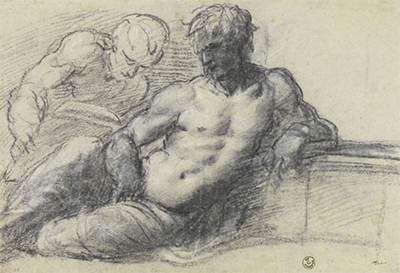
Two men share the surface of this drawing. The figure in front leans across a low support, his torso turned toward us; another bends behind his shoulder, rendered with fewer strokes. The sheet belongs to the Uffizi Galleries' Department of Prints and Drawings in Florence as inventory 717 E. An enlarged reproduction shows that number on the mount, and its figures and marks match the drawing illustrated here. The familiar name “Young Man Reclining” describes only part of the image. It does not identify a sitter, story or finished painting.[1][2][3]
The drawing has often been given to Titian, but its authorship is debated. Catherine Whistler's study of Venetian drawing identifies this exact Uffizi sheet and reports both the established Titian attribution and arguments for Tintoretto. She concludes that the choice between them remains open. The careful way to present 717 E, therefore, is as a drawing attributed to Titian, while explaining why another Venetian hand has been proposed. The object is identifiable even though the maker is not settled.[1]
At a Glance
- WorkTwo Semi-reclining Male Figures
- CollectionUffizi Galleries, GDSU 717 E
- AttributionTitian or Tintoretto; disputed
Contents
- What is visible on the sheet?
- Light, blue paper and repeated lines
- Titian or Tintoretto?
- A drawing without a known finished painting
- How to read its title
What is visible on the sheet?
The dominant man rests diagonally across the paper. His head inclines toward his right shoulder; one arm reaches outward and the other bends near the ledge. His chest and abdomen receive close tonal attention, while his lower body dissolves into fabric and darker passages. A broad horizontal mark at the right suggests a support or edge behind him. The foreground figure does not appear to be asleep simply because he reclines: the line of his arm and the twist of his trunk retain physical tension.[1][2]
The second figure is smaller in visual effect, although not necessarily smaller in a fictional scene. He bows behind the first man's shoulder. His rounded back, head and arms are described rapidly. The contrast is fundamental to the drawing: one body is studied through slow changes in light, while the other remains closer to an abbreviated notation. Whistler calls attention to this difference between the elaborately worked protagonist and the characterful companion. The image invites a viewer to ask how two bodies occupy a shared space, without supplying an answer about who they are.[1][2]
No securely readable book appears in the fuller reproduction. An independent photograph has circulated with an Italian descriptive filename calling the second man a figure with a book; that label is insufficient evidence for an object held in his hands. The visible forms can be described as an arm, bowed head and clustered marks behind the main figure. Turning those marks into a definite book would give the sheet a narrative detail that the available image does not clearly support.[2][3]
The setting is equally spare. A bank of hatching extends behind the men, and the foreground body seems to lean on a hard horizontal edge. Neither a room nor an outdoor landscape is clearly specified. Whistler notes the figures' dialogue with the differing depth of relief sculpture. This is a comparison of visual effect, not proof that the artist copied a particular relief. The darker rear figure almost recedes into a low plane, while the light body in front pushes toward us.[1][2]
Light, blue paper and repeated lines
Whistler describes charcoal and white chalk on blue paper. The coloured support is active in the image: it supplies a middle tone between the black material and the white touches. Dark areas can be built by layering and rubbing charcoal; white strokes and smudges make the chest, arm and shoulder advance. It is more accurate to see the light as something the draughtsman constructed on paper than to imagine a fully shaded body simply outlined and filled in.[1]
Look at the principal man's torso. The deepest marks gather beneath the chest and through the abdomen. Lighter areas do not all have hard borders; they fade into the paper tone. His shoulder and bent arm are modelled through transitions rather than a single uninterrupted contour. Whistler emphasizes the sensuous treatment of charcoal and white chalk here, finding an effect of light moving over soft flesh. These observations are specific to 717 E and help explain why the foreground body has long interested scholars debating its maker.[1][2]
The figure was not fixed in one pass. Whistler notes repeated contours, extensive revisions and white used to correct parts of the arms and hands. In the reproduction, several edges around the bent limbs look searched out rather than traced once. Such revisions matter because they expose a draughtsman testing position and volume. They do not, by themselves, establish which named artist held the chalk: drawing and redrawing were shared practices among Venetian workshops.[1][2]
The rear figure has a different energy. Its shorter, rougher marks capture a bent posture with less tonal finish. The juxtaposition might be deliberate, or it might record unequal attention within a working study. A viewer can see the contrast, but the reason for it remains an inference. We cannot tell from this sheet alone whether the secondary figure was an early idea left unfinished, an assistant to the main pose, or part of a composition now lost.[1][2]
Titian or Tintoretto?
The attribution dispute is about the sheet's manner, not whether the visible drawing matches inventory 717 E. Whistler summarizes earlier scholarship in a detailed note. Harold Wethey entertained a possible Tintoretto attribution; Maria Agnese Chiari Moretto Wiel catalogued it as attributed to Titian; W. R. Rearick accepted it as Titian. The sheet appeared among secure Titian drawings in an Oxford exhibition in 2015, yet discussion there revived the Tintoretto proposal. These positions cannot be collapsed into an unqualified artist credit.[1]
Whistler finds affinities with Tintoretto in the vigorous revision and in the abbreviated rear man. She also argues that the soft modelling of the principal figure has a different sensibility, closer to Titian's attentive use of dark and light in a Uffizi study of a helmet. Her conclusion is deliberately limited: the drawing could be by Titian or Tintoretto, and its relationship to their practices remains instructive whichever attribution proves right. This is a useful model for reading 717 E: the differences within the sheet are evidence in the debate, rather than flaws to be explained away.[1]
An artist's name on a reproduction is less substantial than this argument. The full-sheet image circulated under Titian's name; the independent photograph also uses his Italian name. Those captions document a traditional attribution and help identify images, but they do not replace scholarly comparison or the Uffizi's current object record. The museum's Euploos drawing catalogue was under maintenance when this account was checked, so its present online heading, exact measurements and provenance could not be confirmed directly. This page does not supply such fields by guesswork.[1][2][3][4]
The disagreement also explains why a date should be cautious. Whistler places the drawing in a discussion of the mid-1540s Venetian interest in a lifelike, sculptural body. That is a historical and stylistic context, not a dated inscription or a fixed museum date for 717 E. A specific commission, patron or final painting has not been identified in the cited study. The drawing's purpose remains unknown.[1]
A drawing without a known finished painting
It is tempting to use the two figures as a key to a lost picture. The strong main body could suit a mythological, biblical or allegorical scene, and the bowed companion could be read in several ways. None of those scenarios is demonstrated by the located object evidence. Whistler explicitly leaves the sheet's purpose open. Identifying it as a preparatory study for a named painting would require a credible comparison and a source that makes that connection, not merely a plausible story about the poses.[1][2]
The uncertainty makes the act of drawing easier to see. A painter thinking through figures need not settle every narrative detail at once. Here the principal form receives repeated study, while the second is suggested rapidly. The material contrast between charcoal, white and blue paper lets the artist test how light gives a body weight. The sheet can therefore tell us about choices on paper even when it cannot tell us which finished canvas, if any, followed.[1][2]
Whistler considers Venetian drawing dal vivo: the practice of studying a posed living body. She sets 717 E among works that explore the human figure with a lifelike effect, while also discussing its sculptural quality. It would go beyond the evidence to assert that both men were drawn from two models simultaneously, or that the sheet records a particular studio session. The bodies may reflect observation, memory, sculpture, invention or a combination. The paper preserves decisions made by the draughtsman; it does not preserve the entire working situation.[1]
Compare this uncertainty with more securely connected studies in the drawings guide. Titian's study of legs has a documented proposed relationship to the executioner in a Martyrdom of Saint Lawrence. For 717 E, no comparable finished image has been demonstrated. The technique guide explains why a drawing's marks and a painting's execution can be related without making every surviving sheet a direct cartoon or a copy from a named work. Each object needs its own evidential chain.[1]
The neighbouring Uffizi inventory 718 E, a study of a young woman, is a separate drawing. Whistler discusses it as an early example of Titian's layered black-and-white chalk on blue paper. The resemblance in materials makes comparison useful, but adjacent inventory numbers do not prove that 717 E and 718 E were made together or by the same person. The younger woman's head is a distinct object, with its own attribution history.[1]
How to read its title
“Two Semi-reclining Male Figures” is a descriptive title. It points to what is visible and avoids assigning a story to the men. The old label “Young Man Reclining and a Man with a Book Behind” gives priority to one figure and may overinterpret the other. More importantly, neither label is a signature or an artist's statement. The work should be located through its Uffizi 717 E inventory and discussed with the Titian–Tintoretto attribution question in view.[1][2][3]
Its value does not vanish with that question unresolved. The drawing records a concentrated effort to make one body occupy space through soft light, heavy shadow and revised line, while another form is kept almost provisional. That tension between finish and abbreviation is visible without claiming certainty about a commission or hand. It is precisely the sort of surviving evidence that makes Venetian drawing more complex than a simple opposition between artists who drew and artists who only painted.[1][2]
Researched Titian and related works
Frequently Asked Questions
It is in the Uffizi Galleries' Department of Prints and Drawings, Florence, inventory 717 E. The number is visible on a full-sheet reproduction and is cited in scholarly research.[1][2]
No. It has often been attributed to Titian, but Tintoretto has also been proposed. Catherine Whistler treats the attribution as an open question.[1]
An independent photograph's descriptive filename mentions a book, but the fuller reproduction does not establish a clearly readable one. The safer description is a second bowed male figure.[2][3]
No specific finished painting or commission is established in the cited study. Its purpose remains unknown.[1]
Whistler describes charcoal and white chalk on blue paper. Those materials create its layered shadows and light.[1]
Discussion
What do you notice when you look closely at Two Semi-reclining Male Figures (Uffizi 717 E), attributed to Titian?
Share a specific observation or a source that adds context.
Reader Insights
Which detail changes your reading?
How does its original setting affect what we see?
Which part of the evidence remains uncertain?
Join the Conversation
Add your observation below.
References
- Catherine Whistler, “Tintoretto and drawing ‘dal vivo’ in sixteenth-century Venice,” Oxford University Research Archive accepted manuscript, 2021, especially p. 17 and note 42 on Uffizi 717 E, materials and attribution history. View source.
- Wikimedia Commons, RMN-derived full-sheet reproduction, Two semi-reclining male figures 717 E, showing the same composition and inventory mark. The Commons artist field reflects a traditional attribution, not a resolved maker. View source.
- Francesco Bini (Sailko), independent photograph of the same Uffizi drawing, with a different descriptive filename. View source.
- Gallerie degli Uffizi, Department of Prints and Drawings, including notice that the Euploos online catalogue is under maintenance. View source.