 by Tom Gurney
Tom Gurney BSc (Hons) is an art history expert with over 20 years experience
Published on June 19, 2020 / Updated on October 15, 2026
Email: tomgurney1@gmail.com / Phone: +44 7429 011000
Titian’s Portrait of Doge Marcantonio Trevisan: Introduction
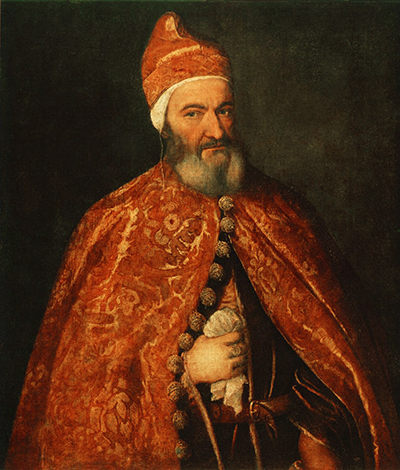
The sitter in this painting wears the distinctive cap and richly patterned robe of a Venetian doge. The Museum of Fine Arts, Budapest catalogues the canvas as Titian’s Portrait of Doge Marcantonio Trevisan, made about 1553–54, in oil on canvas. It measures 100 × 86.5 centimetres and carries inventory number 4223. The painting is currently recorded as on view in the museum’s Old Master Paintings galleries. These object details anchor a specific surviving portrait rather than a general image of a Venetian ruler.[1]
Trevisan held the dogeship in 1553–54, a brief period that coincides with the museum’s dating. The official costume makes his position recognisable, but the portrait does not reduce him to a costume. Titian gives sustained attention to the sitter’s face, beard, hands and the heavy fall of the garment. We can describe that balance between office and person from the canvas without assuming the sitter commissioned it, where it first hung or whether it was the official state portrait.[1][2]
At a Glance
- WorkPortrait of Marcantonio Trevisani
- Research recordartsandculture.google.com
Contents
- Looking at the Budapest canvas
- Titian and portraits of doges
- A second Trevisan is not this picture
- What the wartime record adds
- The surviving portrait
Looking at the Budapest canvas
The figure stands against a very dark ground. His cap rises above his face, and the broad mantle extends toward both sides of the picture. Light catches the forehead, beard and the hand near the centre. The robe’s red and orange pattern surrounds those smaller areas of flesh; the long row of large fastenings gives the garment a strong vertical rhythm. The broad shape of the cloak establishes the office at a distance, while the particular face becomes more apparent as the viewer comes closer.[1]
The clothing is not an incidental display of wealth. The shaped cap, called a corno dogale, and the mantle identify Venice’s chief magistrate. A separate Italian national catalogue describing another portrait of Trevisan explicitly names those dogal attributes. On the Budapest painting, their recognisable forms allow the viewer to read the public role before any written name is supplied. Titian then makes the aged face and held posture carry the likeness within that established type.[1][2]
The hand is a small but useful counterweight to the robe. Its pale form interrupts the dark and red lower part of the canvas, pulling attention from the ornamental surface to a bodily presence. The visible fingers hold pale material close to the chest. It would be easy to make that gesture signify a particular oath, vote or act of government, but the owner’s brief record does not identify such an episode. The painting supplies a pose, not a documentary account of a political event.[1]
The museum’s dimensions also help explain its effect. At a metre high, this is a substantial half-length portrait, yet it is not an entire wall of state imagery. Its concentrated format presents one officeholder. Where it was first displayed is a different question from its present place in Budapest, and the owner’s public record does not settle the original setting.[1]
Titian and portraits of doges
Titian had a formal role in Venetian civic painting. The Museo Nacional Thyssen-Bornemisza explains that, as Official Painter to the Republic, he was responsible for portraits of new doges in a commemorative frieze in the Doge’s Palace. That palace portrait series was lost in the 1577 fire and later replaced with portraits by Domenico Tintoretto. This history makes the Budapest picture especially interesting: a surviving likeness of a doge by Titian can be studied beside the knowledge of an official series that no longer exists.[3]
It does not follow that Budapest 4223 is itself the lost palace portrait or that it was certainly made as its replica. Those are distinct claims requiring evidence about commission and version history. The Budapest catalogue credits Titian and dates the extant canvas, but does not establish such a relationship. In the case of Titian’s Portrait of Doge Francesco Venier, the Thyssen museum explicitly calls its surviving Madrid canvas an autograph replica of the lost official portrait. The absence of an equivalent statement for Trevisan should be respected.[1][3]
The Venier comparison is useful because the two men held the same office in successive years, but the paintings are not interchangeable. The Thyssen dates Venier’s portrait about 1554–56, gives its own dimensions as 113 × 99 centimetres, and describes a curtain, window and landscape behind that doge. Budapest’s Trevisan appears against darkness, without that elaborated setting. Both use recognisable dogal dress; each places the sitter within a different pictorial space. These are observable differences between two catalogued canvases, not evidence that one was copied from the other.[1][3]
The Doge Andrea Gritti portrait offers another comparison within Titian’s long engagement with Venetian rulers. It belongs to the National Gallery of Art in Washington, and its sitter and chronology are separate from Trevisan’s. Grouping these works can clarify the visual vocabulary of dogal portraiture, provided each painting keeps its own museum, inventory and evidence.[1][3][4]
A second Trevisan is not this picture
An Italian national heritage catalogue describes a later portrait of Doge Marcantonio Trevisan held by the Fondazione Giorgio Cini in Venice. It dates that other canvas broadly to 1575–99 and records debate about its maker, including suggestions connected with Tintoretto’s school and Palma il Giovane. The catalogue says it recalls Titian’s portrait in Budapest. That comparison is evidence of a related sitter and type, not evidence that the Cini painting and Budapest 4223 are the same object.[2]
The distinction also shows why a title alone is an unreliable identifier. Portraits of a doge can be copied, adapted and reattributed after his death; a later canvas may preserve a familiar costume and face while belonging to another hand. Budapest’s current museum record names Titian and identifies inventory 4223. The Cini catalogue has a different owner, date and national catalogue number 0500123613. The two works should therefore be considered as separate witnesses to Trevisan’s image.[1][2]
The sitter’s name appears in several forms. The Budapest museum uses Trevisan; a twentieth-century German collection card spells Trevisani. Both refer to the same doge, making the inventory number and institution valuable as stable identifiers.[1][5]
What the wartime record adds
The German Historical Museum’s database for the Munich Central Collecting Point preserves cards for a work numbered 929/14. Its restitution card names a portrait of Doge Marcantonio Trevisani by Tiziano Vecellio, calls it oil on canvas and connects it to Budapest’s catalogue number 4223. It records a receipt on 26 June 1945 and an issue on 20 December 1946. This gives a documented point in the painting’s wartime and immediate postwar movement.[5]
The card should be read with care. Its dates are administrative entry and exit dates, not a complete account of how the picture left Budapest or every place it passed through. Its dimensions list 86.5 centimetres high and 100 wide, the reverse of Budapest’s current 100 high by 86.5 wide. The vertical portrait and current owner record support the latter orientation. The discrepancy is worth retaining in a research record rather than silently harmonising the two sources. Neither the card nor the public museum entry supplies a continuous ownership chain back to Titian.[1][5]
The surviving portrait
The portrait asks the viewer to read office and person together. The doge’s cap and robe establish rank at once, while the head and visible hand interrupt the broad ceremonial shapes with more particular forms. The dark surrounding field concentrates attention on that contrast. Photographs of the canvas vary in colour and sharpness, so the museum’s object record is the anchor for its identity, dimensions and attribution; a reproduction alone cannot settle questions about its original surface.[1][6]
The painting itself gives a direct view of Trevisan’s public likeness as the Budapest museum now presents it: a canvas catalogued under Titian’s name, made during or close to the doge’s term, with office declared through cap and robe and individuality carried by the face and hand. The lost palace series, Madrid’s Venier and Venice’s later Trevisan portrait provide context, but none should displace the precise surviving object.[1][2][3]
See the Titian paintings guide for related canvases and the individual doge pages for their distinct records.[1]
Researched Titian and related works
Frequently Asked Questions
At the Museum of Fine Arts, Budapest, inventory 4223. The museum records it as on view in its Old Master Paintings galleries.[1]
The cited Budapest record does not establish that. Titian made official doge portraits for the palace, but that series was destroyed in 1577.[1][3]
Discussion
What do you notice when you look closely at Titian’s Portrait of Doge Marcantonio Trevisan?
Share a specific observation or a source that adds context.
Reader Insights
Which detail changes your reading?
How does its original setting affect what we see?
Which part of the evidence remains uncertain?
Join the Conversation
Add your observation below.
References
- Museum of Fine Arts, Budapest, “Portrait of Doge Marcantonio Trevisan,” inventory 4223. View source.
- Italian General Catalogue of Cultural Heritage, “Ritratto del Doge Marcantonio Trevisan,” a different Venice canvas, national catalogue 0500123613. View source.
- Museo Nacional Thyssen-Bornemisza, “Portrait of Doge Francesco Venier,” inventory 405, with account of Titian’s official portraits. View source.
- National Gallery of Art, “Doge Andrea Gritti,” collection record 1961.9.45. View source.
- German Historical Museum, Munich Central Collecting Point database, 929/14, restitution card. View source.
- Wikimedia Commons, “Budapest tiziano.JPG,” independently made photograph, CC BY-SA 3.0. View source.