



 by Tom Gurney
Tom Gurney BSc (Hons) is an art history expert with over 20 years experience
Published on June 19, 2020 / Updated on October 15, 2026
Email: tomgurney1@gmail.com / Phone: +44 7429 011000
Titian’s Portrait of a Young Woman at Capodimonte: Introduction
The young woman turns towards us, touches a pearl hanging from a long gold chain and meets the viewer’s gaze. Her elaborately braided hair, pale patterned dress and transparent sleeve trim invite a close look. Yet the most useful fact about this portrait may be the limit of what is known: the sitter has no securely established name. Italy’s national catalogue calls the painting Ritratto di giovane donna (Portrait of a Young Woman), records it as an oil painting by Titian from about 1545 and identifies it as Q135 in the Museo e Real Bosco di Capodimonte, Naples.[1] Capodimonte’s object text dates it 1545–46.[2]
That inventory number anchors this discussion to one canvas. It separates the portrait from other pictures called Portrait of a Girl, from portraits traditionally associated with Titian’s daughter Lavinia and from a later copy in Parma. It also keeps the portrait distinct from the Farnese Danaë at Capodimonte: the two paintings have intersecting collection and wartime histories, but they are different objects.[1][3][4]
At a Glance
- WorkPortrait of a Girl
- Research recordcatalogo.beniculturali.it
Annotated details from Portrait of a Girl
Select a numbered area to find its detail below. Open a detail image to view it larger.
Details from PORTRAIT OF A GIRL
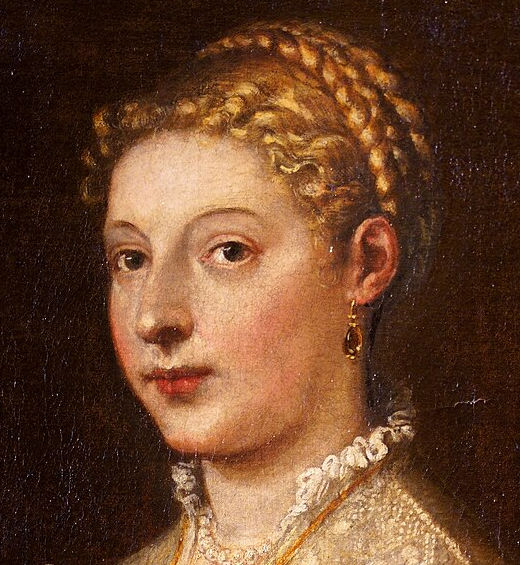
Capodimonte Young Woman Braided Hair and Face
Capodimonte Young Woman Brocade and Hand
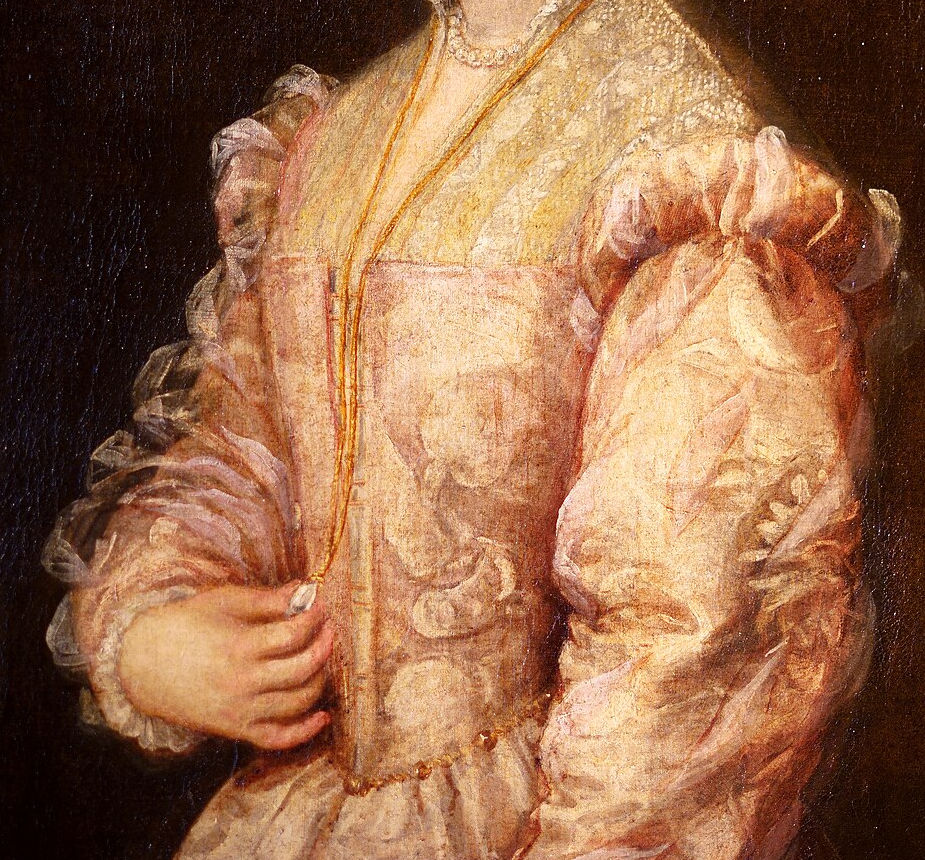
Photo: Commonists, CC BY-SA 4.0; cropped and resized from Wikimedia rendition. Painting: Titian, Portrait of a Young Woman, Museo e Real Bosco di Capodimonte Q135. Image source · Reuse licence
Contents
- What the portrait shows
- Who was she?
- Titian, attribution and date
- From the Farnese collection to Naples
- The wartime journey and return
- A later portrait after the portrait
- How to read its title
What the portrait shows
The figure is seen from about the waist upwards against a dark, unelaborated background. Her body is angled, while her face turns towards the viewer. The hairstyle is built from thick coils of golden hair, smaller curls at the forehead and an earring that catches light beside the cheek. A narrow pale ruff surrounds the neck. The sleeves of her dress swell into soft folds, with translucent white material at their edges. Across the bodice, the pale cloth is enlivened by a woven or embroidered pattern rather than a flat field of colour.[2]
Her right hand draws attention to a single pearl at the end of a long gold chain. The gesture gives the picture a second point of focus below the face: eye, hand and pendant form a visual route through the otherwise quiet pose. Capodimonte’s description singles out the pearl, chain, jewellery, silk dress and lace, and takes them as signs of costly presentation.[2] What the pearl meant to this sitter, or to the person who commissioned her portrait, is not documented in the cited records. It would be tempting to give it a fixed meaning such as marriage or chastity; the painting alone does not establish one.
The contrast between face and costume matters. The face is comparatively still and direct; the clothes offer restless changes of pink, cream, gold and white. The dark ground gives those lighter areas space to register without competing architecture or narrative action. The hands and jewellery make the sitter visible as a person choosing, or being made to adopt, a particular public appearance. This is a reading of the composition, not proof of her rank, marital status or name.[1][2]
Who was she?
The national catalogue stops at “young woman” and does not identify a sitter.[1] Capodimonte’s text on Google Arts & Culture offers a more specific possibility: a woman called Angela, described there as a courtesan associated with the Farnese palace in Rome and Cardinal Alessandro Farnese. Its wording is conditional. It also says the portrait may have been executed either in Venice or in Rome.[2] Those possibilities are useful to know, but neither supplies the missing link between a named person and this physical canvas.
The traditional identification with Lavinia Vecellio, Titian’s daughter, is another proposal, noted alongside Angela in the Contini-Volterra Photographic Archive’s record of this painting.[6] A resemblance to a painting elsewhere, blonde hair, or an age judged plausible from the picture would be weak evidence without a secure inscription or document. The same caution applies to attempts to identify a Farnese daughter. The portrait’s later presence in the Farnese collection shows ownership; it does not, by itself, tell us who posed.[1][2][3] Museum catalogues can preserve conjectures while choosing a neutral title, and here that distinction should remain visible to the reader.
There is an instructive afterlife to the question of identity. A much later variant of the portrait, now in the Galleria Nazionale at the Pilotta in Parma, was once inventoried at the Reggia di Caserta as a “Princess of the House of Farnese.” The Pilotta catalogue identifies that painting as a late seventeenth-century copy after the Capodimonte portrait, not another name for Q135. Its old princess title belonged to the copy’s inventory history; it cannot be transferred back as documentary identification of Titian’s sitter.[4]
Titian, attribution and date
The Italian national record lists Titian as the artist and gives a date around 1545. Capodimonte’s accompanying text offers 1545–46.[1][2] This places the portrait among work connected in time to Titian’s Farnese patronage, but the date does not prove that a Farnese family member sat for it. Nor does the collection record determine whether Titian painted it in Venice or Rome. Capodimonte expressly leaves those two places open.[2]
Attribution language needs some care. The national catalogue and Capodimonte present the picture under Titian’s name.[1][2] The Pilotta, when discussing the later variant, describes its model as the Capodimonte portrait “attributed to Titian.”[4] That phrasing is a reminder that a copy’s catalogue may qualify its original; it does not license a claim that the museum has reclassified Q135 as a work by a named assistant. The published records cited here do not establish which individual passages were painted by which hand. The visible handling of hair and cloth can be described without pretending it settles the attribution.
The date also leaves room for the sitter’s uncertainty. A painting made around the middle of the 1540s could have entered a patron’s collection through a commission, gift, inheritance or later acquisition. Without evidence for the first transaction, the portrait’s documented appearance in the Farnese holdings cannot be projected backward to an original commission. The work’s subsequent ownership and its making are related questions, but one does not answer the other.[1][3]
From the Farnese collection to Naples
The national catalogue supplies an unusually useful route for the picture after its creation. It records the canvas at Palazzo Farnese in Rome before 1641, and there until 1662. It then passed to Parma, first in the Palazzo del Giardino and later in the Ducal Gallery, before reaching Naples through Charles of Bourbon and the Farnese inheritance.[1] The Pilotta’s account of the later copy describes the Capodimonte model as being in Parma from 1680 to 1734.[4] These records should be read together: the first provides the broader transfer sequence, while the second gives the interval used to explain when a copy might have been made. They do not establish the day, route or precise circumstances of every move.
This history helps explain why a mid-sixteenth-century portrait is now in southern Italy. It also shows why “Farnese portrait” is an ambiguous phrase. It may describe an object’s ownership, patronage, setting or sitter. For Q135, later Farnese ownership is recorded; a particular sitter and original commission are not.[1][3] A useful caption therefore states the museum, inventory, approximate date and attribution before turning to conditional identifications.
The wartime journey and return
Capodimonte has published an account of the evacuation and recovery of works from its collection during the Second World War. It names Titian’s Ritratto di fanciulla alongside Danaë among the pictures caught in the movement from protective storage at Montecassino through the German-controlled transfer at Spoleto. Some of the evacuated crates were diverted to Germany. Capodimonte later identifies the portrait among the works discovered in the salt mines at Altaussee in Austria.[5] In this context the museum’s Ritratto di fanciulla refers to the same young-woman portrait; the national catalogue’s Q135 identifier remains the clearest way to specify it.[1][5]
The museum says the portrait had become covered with mould in storage. That is a concrete condition report in a public account, although it is not a substitute for a treatment record or a present-day conservation assessment. The recovered works returned to Italy on 13 August 1947 for an exhibition in Rome’s Palazzo Venezia and went back to Naples soon afterwards.[5] The episode adds a twentieth-century chapter to the canvas’s provenance and explains why its survival cannot be taken for granted.
Capodimonte’s account gives Danaë a specific place in Göring’s private rooms, but it does not give the portrait that same location.[5] Keeping the two objects apart avoids turning a shared route of confiscation and recovery into a shared display history. The portrait’s wartime identification, the report of mould and the 1947 return are substantial enough without that embellishment.
A later portrait after the portrait
The Pilotta’s Ritratto femminile, inventory GN1468, helps show how Q135 was copied and reinterpreted. The Parma museum dates its oil canvas to the late seventeenth century and measures it at 94 × 75 cm. Its catalogue calls it a variant copy after the Capodimonte portrait and suggests a possible Parma-area setting for its production, when Titian’s model was in Parma. The copy later came from the Reggia di Caserta.[4] It is a separate painting with its own history, not a second Capodimonte original.
The Pilotta identifies specific changes. Where Q135 displays one pendant pearl, the copy adds more abundant, more conspicuous pearl jewellery. It follows the general form of the dress but changes its fabric to something the catalogue judges less rich.[4] These are more informative than a vague claim that “many versions exist.” They show a later painter retaining a recognisable face and pose while revising the signs of wealth. They also make the old “Farnese princess” title less secure as evidence about Q135: costume and caption could both be changed after the original portrait was made.
Other portraits of young women traditionally called Lavinia form a separate identification problem. The girl with a platter of fruit and Capodimonte Q135 should be compared as different works, not merged because of a proposed family name. The paintings guide places this canvas in the broader Titian group, while the Q135 record supplies the evidence needed to keep it distinct.[1]
How to read its title
Portrait of a Girl, Portrait of a Young Woman, Ritratto di fanciulla and Ritratto di giovane donna are descriptive titles in circulation for the Capodimonte work.[1][2][5] They need not mark separate paintings. The inventory number and collection location do that work more reliably. A name such as Lavinia or Angela, by contrast, makes a claim about a historical person. The difference is more than wording: it is the difference between describing what the picture shows and asserting a relationship that still needs evidence.
For now the painting rewards looking without that final name. Its restrained expression, carefully staged hand and luminous dress give a vivid account of a sitter’s appearance, even as the sources leave her identity open. The firm story is a Titian portrait recorded as Q135, held by the Farnese, moved through Parma to Naples, endangered in war, recovered, and still capable of generating copies and conjectures. None of those facts requires us to turn a plausible identification into a settled one.[1][2][4][5]
Researched Titian and related works
Frequently Asked Questions
That has been proposed, but the Italian national catalogue does not identify the sitter. Capodimonte’s own interpretive text offers Angela as another possibility, and marks that possibility as uncertain.[1][2][6]
The sitter touches the single pearl at the end of a long chain, making it one of the picture’s visual focal points. Capodimonte describes the jewellery as part of her costly dress. A precise personal or symbolic meaning for this pearl has not been established by the checked sources.[2]
The sixteenth-century portrait discussed here is Capodimonte Q135 in Naples. Parma holds GN1468, a distinct late seventeenth-century variant copy after it.[1][4]
It was among Capodimonte works diverted to Germany during the wartime evacuation, recovered at Altaussee and returned to Italy in August 1947. Capodimonte reports that the portrait had acquired mould in storage.[5]
Discussion
What do you notice when you look closely at Titian’s Portrait of a Young Woman at Capodimonte?
Share a specific observation or a source that adds context.
Reader Insights
Which detail changes your reading?
How does its original setting affect what we see?
Which part of the evidence remains uncertain?
Join the Conversation
Add your observation below.
References
- Catalogo Generale dei Beni Culturali, “Ritratto di giovane donna,” national catalogue 1500625122, Capodimonte Q135. View source.
- Museo e Real Bosco di Capodimonte via Google Arts & Culture, “Portrait of a Young Woman,” object description and date. View source.
- Museo e Real Bosco di Capodimonte, “Collezione Farnese,” collection history. View source.
- Complesso Monumentale della Pilotta, “Ritratto femminile,” GN1468, catalogue by Luisa Viola. View source.
- Museo e Real Bosco di Capodimonte, Giovanna Bile, “L’Italia chiamò — Capodimonte oggi racconta la Liberazione delle opere d’arte durante la Seconda Guerra Mondiale.” View source.
- Vanderbilt University, Contini-Volterra Photographic Archive, “Portrait of a Young Woman,” photographic collection record TITI.0248. View source.


