



 by Tom Gurney
Tom Gurney BSc (Hons) is an art history expert with over 20 years experience
Published on June 19, 2020 / Updated on October 15, 2026
Email: tomgurney1@gmail.com / Phone: +44 7429 011000
Titian's Design for a Seated Portrait of Emperor Charles V: Introduction
Charles V sits in a red-upholstered chair, dressed almost entirely in black. A broad strip of gold brocade hangs behind him on one side; a stone column and a quiet landscape open the picture on the other. The portrait is in Munich's Alte Pinakothek, inventory 632. Its owner dates it to 1548 and records oil on canvas measuring 204.5 × 122 centimetres. The sitter is the Habsburg Emperor Charles V.[1][2]
The museum gives the painting a qualified maker history. Titian supplied a design in his own hand, but largely entrusted the work's execution to a workshop assistant, probably Lambert Sustris. That statement identifies Titian's role in composing an imperial image and a substantial workshop role in realising it, while marking the proposed assistant with the museum's word “probably.”[1]
At a Glance
- WorkEmperor Charles II
- Research recordsammlung.pinakothek.de
Annotated details from Emperor Charles II
Select a numbered area to find its detail below. Open a detail image to view it larger.
Details from EMPEROR CHARLES II
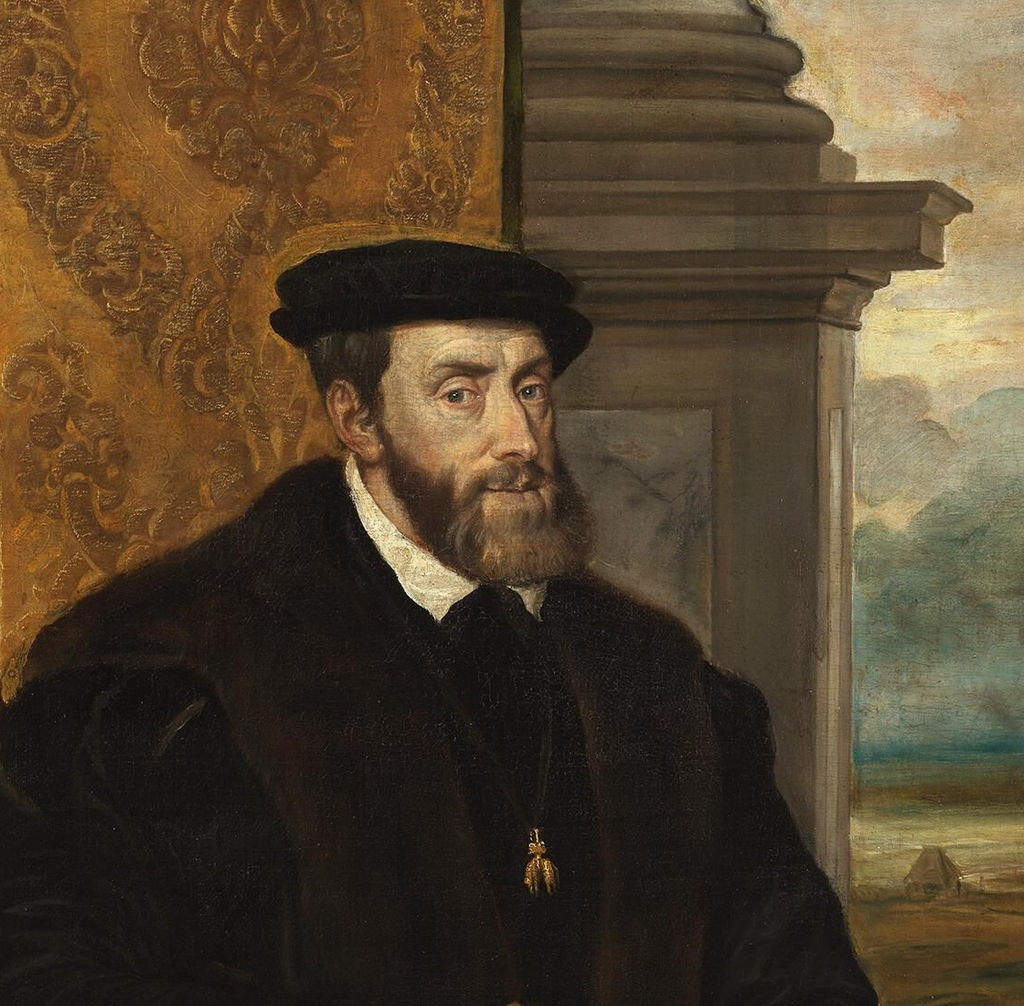
Emperor Charles V Face and Column
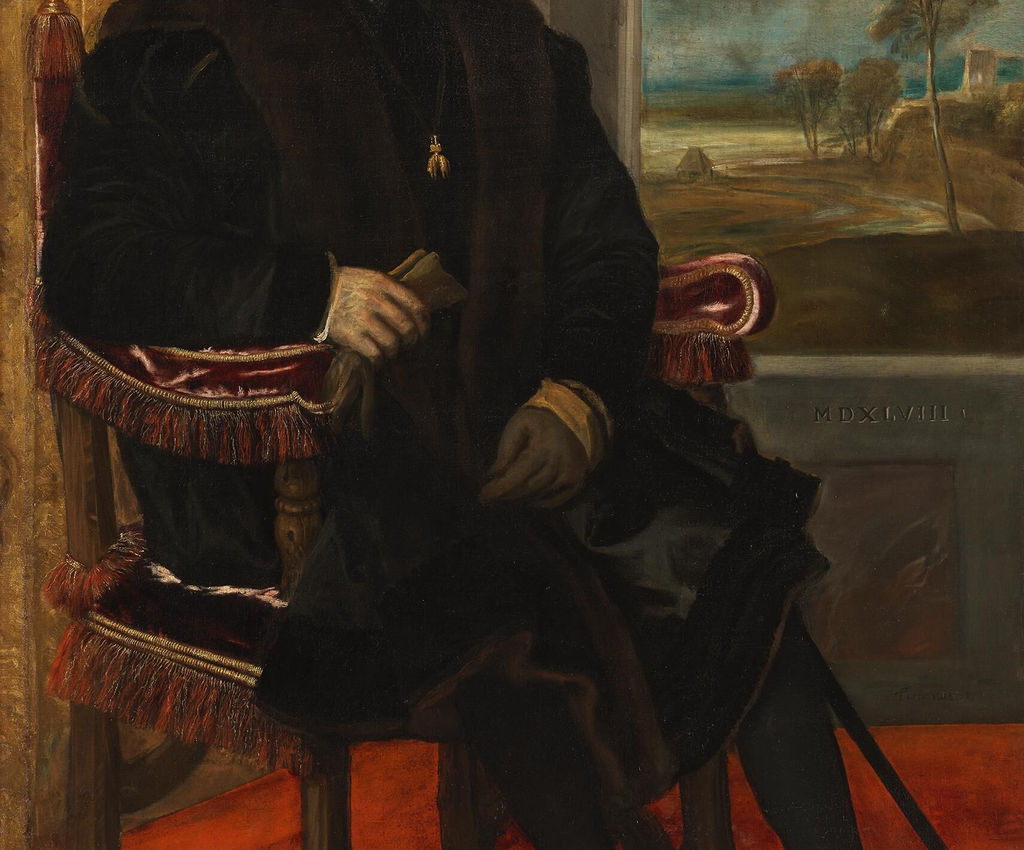
Emperor Charles V Chair and Inscription
© Bayerische Staatsgemäldesammlungen, CC BY-SA 4.0. Cropped and resized; derivative images CC BY-SA 4.0. Image source · Reuse licence
Contents
- An emperor seated at Augsburg
- Design, workshop and attribution
- Three images of Charles V
- The painting in Munich
An emperor seated at Augsburg
The picture was made during the Diet of Augsburg in 1548. Charles had appointed Titian a court painter and raised him to the nobility in 1533. The Bavarian collections' artist account also records Titian's first Augsburg visit early in 1548 at the emperor's request, during which he portrayed Charles and other court figures. This painting belongs to an ongoing relationship with the Habsburgs rather than an isolated encounter. Titian knew the demands of imperial representation by the time the seated portrait was designed.[1][3]
Charles occupies almost the full height of a tall, narrow canvas, yet he does not stand. One hand rests near the arm of the chair; the other lies low in his lap. Black sleeves, cap and long garments form a dense shape above the strong red floor. The pose slows the figure down. Unlike an equestrian ruler in motion, he governs the picture through presence, stillness and a setting built around his seated body.[1]
The golden field at the left gives that dark figure a bright backdrop. Its pattern suggests costly woven material, while the fringed chair and red carpet reinforce courtly display. Behind Charles, the column carries architectural weight and divides the interior from the open view at the right. Landscape and sky prevent the setting from closing completely around him. The elements are not an exact throne room identified in the museum's record; they are signs assembled to lend an imperial sitter space, scale and dignity.[1]
The emperor's face complicates this splendour. The owner reads it as visibly aged and fatigued, without the smooth idealisation that a state image might have offered. He wears a close black cap and a beard, and the features remain particular even within the formal arrangement. The painting does not tell us his medical condition or private mood at one instant. It shows how a public likeness can admit age while surrounding its sitter with the material language of power.[1]
The small pendant at his chest identifies the Golden Fleece, the Burgundian order associated with the Habsburg court. Its scale is modest beside the vast brocade and column, but it is placed where light can pick it out against the black costume. Rank appears through both large environment and a concentrated item worn on the body. The two scales of display keep the viewer's attention moving from imperial setting to identifiable person.[1][2]
A painted 1548 can be seen at the right of the composition. It corresponds with the museum's date, yet it should not be used to claim that every passage was executed on a single day or by a single hand. The owner's account of a Titian design followed by substantial assistant work remains the guide to authorship. The date anchors the finished image in the Augsburg year, not a simple account of its labour.[1]
Design, workshop and attribution
A major painter's workshop could take part in works for important patrons. Here the Alte Pinakothek does not merely infer a generic “school of Titian.” It says the painting rests on Titian's own sketch and that he delegated much of the execution. Lambert Sustris is its probable candidate for that work. A viewer can therefore discuss the composition as Titian's image of Charles while avoiding unwarranted claims that Titian personally painted every face, hand, furnishing or stretch of landscape.[1]
The qualification matters in both directions. Titian's authored design helped set the proportions, pose and balance of symbols. Workshop execution gave the physical canvas its visible surface. Neither contribution can be erased by making the other absolute. The museum's Sustris entry records a separate full-length portrait by him dated 1548, evidence that he was painting court portraiture at the time; it is not a signature or document proving his hand in every part of Munich 632.[1][4]
The museum describes the result as at once a representation of office and a character study. That formulation follows the painting's visual structure. Gold, stone and carpet proclaim high station. Charles's aging face and quiet hands give the imperial body a weight different from a timeless emblem. A collaborative process could still produce an image that satisfied both demands. How the court received the picture is not established by the short owner record, so its psychological effect should be described as a reading of the finished work.[1]
The current frame has a separate entry in the collection record: Italian, dated to the third quarter of the sixteenth century. It belongs to the object's physical presentation rather than the sitter's pose or the 1548 sketch. Looking at painting and frame together may heighten the impression of ceremony; their dates and makers are distinct questions. The owner gives only a broad acquisition note, from Munich's Electoral Gallery, rather than a full chain from Charles's court to the Alte Pinakothek.[1][2]
That provenance limit matters because the emperor's image circulated through court networks and later collections. It would be tempting to invent an original palace room or a particular presentation ceremony from the painting's imposing appearance. The published Munich entry does not supply either. Its firm facts are the Augsburg dating, the artist-and-workshop account, the Electoral Gallery source and the present inventory. Those facts already make the object identifiable without filling the gaps with an imagined journey.[1]
The portrait's space is not entirely straightforward. The brocade reads like a wall hanging close behind the emperor, while the landscape extends far into the distance. The column mediates between them. The seated body seems secure, yet the red floor tilts toward the viewer. A Metropolitan Museum of Art study notes this spatial tension in the Munich composition. It shows that the room is a pictorial construction arranged for Charles, not simply a neutral interior copied from one fixed vantage point.[5]
Three images of Charles V
The same year Titian made the famous Emperor Charles V at Mühlberg, now in the Prado as P000410. That much larger canvas shows Charles mounted after his 1547 victory over the Schmalkaldic League. Its military equipment, horse and landscape differ fundamentally from Munich's seated black-clad ruler. The Prado also stresses that the equestrian picture did not simply display a defeated enemy: in the political context of the 1548 Augsburg Interim, the court sought an image of an emperor able to govern states and faiths in tension.[6]
Putting the two 1548 portraits beside one another shows distinct choices of imperial presence. The mounted painting projects a commander moving through terrain, while the Munich canvas holds Charles in place amid fabric and architecture. Both could address political authority during the Augsburg period. They should not be treated as two crops or versions of one scene, nor should the Prado painting's armour or its particular political programme be transferred automatically to the Munich picture.[1][6]
The earlier Prado Charles V with a Dog is another full-length portrait, dated 1533 and inventoried as P000409. It belongs to Titian's first years of direct Habsburg patronage and has a relationship to a prior image by Jakob Seisenegger. Its dog and dress are absent from the Munich composition. The three pictures trace changes in how the emperor could be shown over fifteen years, but each has its own object record, support, size and making history.[7]
The Prado explains that the 1533 dog portrait stands in a line of full-length images made by Seisenegger from 1530 onward. That tradition provided one way of displaying Charles as a ruler: standing, finely dressed and accompanied by an animal familiar from Burgundian court portraiture. The Munich artist chose another arrangement. The seated pose makes the chair and the relation between face and architecture central. It also gives the black garment a large, simple silhouette instead of setting it against a dog. This is a comparison of portrait types, not evidence that Munich 632 directly copied or rejected any one Seisenegger canvas.[1][7]
The Mühlberg portrait provides a comparison for the other 1548 image. A label that says only “Emperor Charles” would not be enough to choose between them. Munich 632 means the seated portrait designed by Titian and largely executed in his workshop; Prado P000410 means the mounted image. Both portray Charles V in different roles.[1][6]
The painting in Munich
The Bavarian State Painting Collections identify the Alte Pinakothek as the work's collection and trace its acquisition from Munich's Electoral Gallery. The portrait rewards close attention to the pendant, date, black dress, brocade, chair and landscape: status is built through objects as well as the sitter's bearing. The museum's attribution wording must accompany that visual reading. A clear photograph reveals painted details, but it cannot by itself settle which workshop member made each one.[1]
Charles's stillness is the lasting feature of the portrait. The red floor and woven gold insist on ceremony, while the dark figure and older face keep the human sitter present. Titian's design, with a probable assistant's substantial execution, offers an imperial image that neither hides age nor surrenders authority to it. The exact Munich inventory and the owner's qualified attribution are the clearest starting points for reading the painting today.[1]
Researched Titian and related works
Frequently Asked Questions
It is Emperor Charles V. The Alte Pinakothek identifies the seated sitter as Charles V, Holy Roman Emperor and king of Spain as Charles I.[1]
The museum says Titian made the design but delegated much of the canvas's execution to an assistant, probably Lambert Sustris. “Probably” is an attribution qualification, not a signed certainty.[1]
The museum dates the canvas 1548, during the Diet of Augsburg. It is now in Munich's Alte Pinakothek, inventory 632.[1]
Discussion
What do you notice when you look closely at Titian's Design for a Seated Portrait of Emperor Charles V?
Share a specific observation or a source that adds context.
Reader Insights
Which detail changes your reading?
How does its original setting affect what we see?
Which part of the evidence remains uncertain?
Join the Conversation
Add your observation below.
References
- Bayerische Staatsgemäldesammlungen, “Portrait of Emperor Charles V,” Alte Pinakothek collection record 632. View source.
- Bayerische Staatsgemäldesammlungen, “Bildnis Kaiser Karls V. im Lehnstuhl,” German collection record. View source.
- Bayerische Staatsgemäldesammlungen, “Tiziano Vecellio, gen. Tizian,” artist biography. View source.
- Bayerische Staatsgemäldesammlungen, “Lambert Sustris,” artist record. View source.
- Metropolitan Museum of Art, Metropolitan Museum Journal 50 (2015), discussion of the seated Charles V setting. View source.
- Museo Nacional del Prado, “Emperor Charles V at Mühlberg,” collection record P000410. View source.
- Museo Nacional del Prado, “Emperor Charles V with a Dog,” collection record P000409. View source.


