 Buy Art Prints Now
from Amazon
* As an Amazon Associate I earn from qualifying purchases.
Public-domain reproduction via Web Gallery of Art and Wikimedia Commons. Resized. Image source · Reuse licence
 by Tom Gurney
Tom Gurney BSc (Hons) is an art history expert with over 20 years experience
Published on June 19, 2020 / Updated on October 15, 2026
Email: tomgurney1@gmail.com / Phone: +44 7429 011000
Titian's Study for the Duke of Urbino: A Full-Length Idea on Paper: Introduction
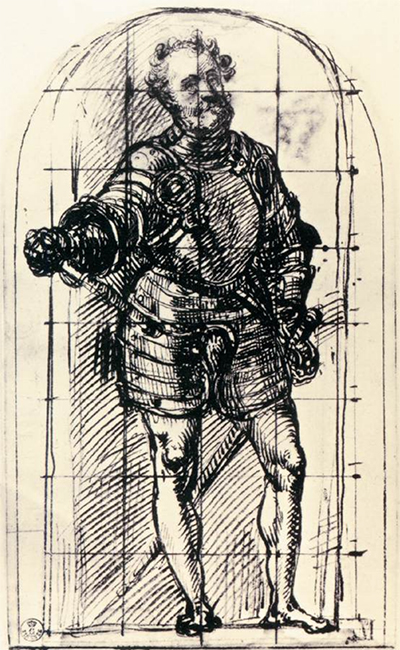
A man in armour stands under a rounded arch, one arm thrust towards the edge of the sheet. Lines cross his face, torso and legs in a regular grid. This small pen-and-ink drawing, kept in the Uffizi's prints and drawings collection as 20767 F, is known as Titian's Study for the Duke of Urbino. It has an unmistakably different scale and format from the finished painted portrait of Francesco Maria I della Rovere: the drawn figure is shown from head to foot, while the duke in the surviving painting appears to about mid-thigh. The Italian national catalogue calls the drawing a possible first idea for that portrait, a useful but deliberately cautious description.[1][2][3]
The sheet matters because it lets us see an alternative in the planning of a celebrated ruler's image. Its grid, emphatic arm and crowded armour ask how a standing military body might be arranged within a picture. The finished painting answers differently, placing the duke against crimson cloth with his arm and command baton directed at the viewer. The drawing alone cannot tell us exactly when every change occurred or prove that a complete full-length oil portrait was ever made.[1][2]
At a Glance
- WorkStudy for the Duke of Urbino
- Research recordcatalogo.beniculturali.it
Contents
- What is shown in the drawing?
- What might the grid have been for?
- Whose armour, and whose likeness?
- How did the design change?
- A ruler represented in two media
What is shown in the drawing?
The figure occupies most of a narrow, upright sheet. A curve over his head resembles an architectural niche or framed recess; quick diagonal strokes darken the space behind his body. A series of upright and horizontal construction lines divides the design. The head is turned slightly to one side, framed by hair and beard. One arm projects outward, its foreshortened hand becoming a forceful mark near the left edge as we see it. The other hangs nearer the hilt of a sword.[3][4]
Armour receives concentrated attention across the shoulders, breast and hips. Short strokes and darker hatchings articulate overlapping metal forms, while the legs and feet are treated more loosely. That imbalance need not be a defect. A working drawing can investigate a pose or costume in some passages more fully than others. Here the upper body's armour and the reaching arm carry much of the design's authority even though the entire figure is outlined.[3][4]
The Web Gallery of Art records the sheet as pen and ink on yellowed white paper, 237 × 141 millimetres, dated about 1536. Those measurements describe the drawing, not the much larger canvas. The surviving Uffizi portrait is an oil painting measuring 114 × 103 centimetres, inventory 1890 no. 926. Keeping both object numbers in view prevents a small study, a painted image and later reproductions from being collapsed into one work.[1][2][3]
What might the grid have been for?
The square divisions can help an artist measure positions, test proportions, copy a figure at a different scale, or transfer parts of a design. Across this sheet they also let a viewer follow how the head, torso and extended arm occupy the narrow space. It would be easy to call the grid proof that Titian enlarged this exact composition onto a full-length canvas. The sources do not demonstrate such a transfer, and the surviving painting does not preserve the drawn composition at full length.[1][3]
A grid records a kind of practical planning, but not its whole history. We cannot tell simply by looking at the reproduction whether every line was drawn at the same moment, which surface might have received a transfer, or whether the marks served an alternative comparison in the workshop. The secure observation is that the visible drawing has measured divisions. Their particular use remains an interpretation.[3][4]
This distinction is especially important here because the finished portrait made use of a different pictorial solution. Titian might have explored full-length presentation before choosing a closer view, or a drawing might have been considered alongside several other studies that do not survive. Neither possibility amounts to a record of a missing painting. The paper is evidence of a design, not a photographic record of all the stages between idea and oil.[1][2]
Whose armour, and whose likeness?
Francesco Maria I della Rovere, Duke of Urbino, was a military commander. The Uffizi's account of the finished portrait says that his parade armour was sent to Titian in Venice so it could be represented carefully. In the summer of 1536, the duke requested its return. These documents explain why the armour mattered to the commission, and why a study centred on an armed figure might be associated with the painted portrait.[2]
The armour's presence does not prove that Francesco Maria himself stood for this sketch. The national catalogue suggests the full-length drawing may have been made from a model wearing the armour. The Web Gallery of Art likewise argues that the drawn head differs from the duke in the finished painting. Those are interpretive arguments about a working process. A resemblance comparison at this small scale cannot independently identify the person who posed, and no named model is documented in the cited records. The most reliable claim is that the sheet explores an armoured figure in relation to a commission for the duke.[1][3]
The finished painting makes military identity more explicit. The duke grips a Venetian baton before a rich red backdrop. Behind him the Uffizi identifies a dragon-crested helmet, additional batons representing other commands, and an oak branch that alludes to the della Rovere family name and lineage. The drawing does not show that complete setting. Its armoured body can be compared with the later display of authority, but its simpler background should not be retroactively filled with the canvas's shelf, emblems and inscription.[2]
How did the design change?
The national catalogue's Italian discussion calls Uffizi 20767 F probably an initial thought for the portrait, perhaps derived from an armoured model and then changed while Titian planned the paired image of Francesco Maria and his wife, Eleonora Gonzaga della Rovere. The recorded paintings have matching dimensions, and the Uffizi says they reached the Ducal Palace at Pesaro in spring 1538. Seen as a pair, their shared scale helps explain why the duke's finished portrait might have been framed more closely than the full-length design.[1][2]
That explanation is a proposal, not a diary of decisions made by Titian. The catalogue does not produce a sequence of dated drawings or a letter saying he abandoned this sheet for Eleonora's format. It reasons from the surviving works and the history of the commission. A reader can accept that the pair is relevant while keeping the cause of the change open. The two portraits are securely associated; the precise step by which the drawing gave way to the painting is less secure.[1][2]
An older theory tried to reconcile drawing and painting by suggesting that the duke's canvas had originally shown the whole body and was later cut down. The national catalogue rejects that proposal. It also notes that records of more than one ducal portrait once encouraged speculation about a separate, now-lost full-length painting corresponding to the drawing; that identification cannot be demonstrated. Neither a trimmed original nor a lost companion canvas should be asserted as fact merely because the sheet includes feet.[1]
The catalogue adds a different technical finding: X-radiography of the finished painting revealed an earlier portrait of a young man beneath its surface. That observation belongs to the canvas, not to the paper study. It demonstrates how carefully object evidence must be assigned. An underlying image in one work does not show that this drawing was transferred onto it, or that a complete full-length version stood beneath the present composition.[1]
A ruler represented in two media
The draughtsman's problem and the portrait painter's problem overlap without being identical. On paper, an extended arm and a fully standing body make a forceful silhouette inside an arch. In the painting, the closer framing brings the duke's face, armour and baton into a more immediate encounter with the viewer. The accessory objects and red velvet stage his political and military standing. Neither medium is simply an unfinished or finished copy of the other; each lets different information dominate.[2][3][4]
The Uffizi dates the portrait around 1537 and documents its making between 1536 and 1538. The drawing's approximate 1536 date places it in the same planning period, but it is not itself a dated contract or a record of a sitting. Pietro Aretino praised the resulting portraits of Francesco Maria and Eleonora in poems, according to the Uffizi. That later reception belongs to the paintings as a pair. It does not tell us whether anyone outside Titian's working circle saw this small gridded study.[2][3]
What the sheet does offer is a rare close view of a choice that did not reach the surviving portrait in the same form. The outward arm, standing pose, frame and grid make the design active and measured at once. The painted portrait can be read beside it to see both continuity in the armoured ruler and change in crop, setting and address. The drawings guide places the sheet within the more fragmentary evidence for Titian's work on paper.[1][2]
Researched Titian and related works
Frequently Asked Questions
No. Uffizi 20767 F is a small drawing on paper. The finished oil painting of Francesco Maria I della Rovere is a separate object, 1890 no. 926, showing him to about mid-thigh.[1][2][3]
No. The national catalogue regards it as a possible early idea and rejects a theory that the surviving canvas was later cut down. A separate lost full-length painting cannot be established from the evidence it cites.[1]
That has not been documented. The national catalogue suggests that a model might have worn the duke's armour; the Uffizi confirms the armour was sent to Venice for the painted commission. These facts do not identify the drawn face as Francesco Maria's likeness.[1][2]
Discussion
What do you notice when you look closely at Titian's Study for the Duke of Urbino: A Full-Length Idea on Paper?
Share a specific observation or a source that adds context.
Reader Insights
Which detail changes your reading?
How does its original setting affect what we see?
Which part of the evidence remains uncertain?
Join the Conversation
Add your observation below.
References
- Catalogo Generale dei Beni Culturali, official record 0900287428 for Titian's painted Portrait of Francesco Maria della Rovere, with discussion of drawing 20767 F (Italian). View source.
- Uffizi Galleries, “Portrait of Francesco Maria della Rovere,” owner collection account for the finished painting, inventory 1890 no. 926. View source.
- Web Gallery of Art, “Study for the Duke of Urbino,” drawing record and discussion. View source.
- Wikimedia Commons, public-domain reproduction of the Uffizi drawing, “Tiziano, studio per ritratto del duca di urbino.” View source.