



 by Tom Gurney
Tom Gurney BSc (Hons) is an art history expert with over 20 years experience
Published on June 19, 2020 / Updated on October 15, 2026
Email: tomgurney1@gmail.com / Phone: +44 7429 011000
Titian's Christ Shown to the People (Ecce Homo): Introduction
A ruler raises his hand, showing a wounded man to people outside the picture. The man is Jesus; the ruler is Pontius Pilate. At the left, a young page watches as Jesus stands exposed beside Pilate's fur-lined and embroidered clothes. This is the scene known as Ecce Homo, after Pilate's presentation of Christ to the crowd. The painting is at the Saint Louis Art Museum, where it bears the title Christ Shown to the People (Ecce Homo), object number 10:1936. The museum dates the oil-on-canvas work to about 1570–76 and measures it at 109.2 × 94.8 cm.[1]
The painting is sometimes called Mocking of Christ, but that names an earlier part of the Passion story. In John 19, soldiers scourge Jesus, place a crown of thorns on him and mock him; Pilate then brings him before the people. Titian chooses the moment of presentation. No crowd appears in the frame, so Pilate's outward gesture and the direction of the figures' attention make the viewer imagine those who will respond. The absent audience is central to the painting's effect.[1][2]
At a Glance
- WorkChrist Shown to the People (Ecce Homo)
- Research recordslam.org
Annotated details from Christ Shown to the People (Ecce Homo)
Select a numbered area to find its detail below. Open a detail image to view it larger.
Details from CHRIST SHOWN TO THE PEOPLE (ECCE HOMO)
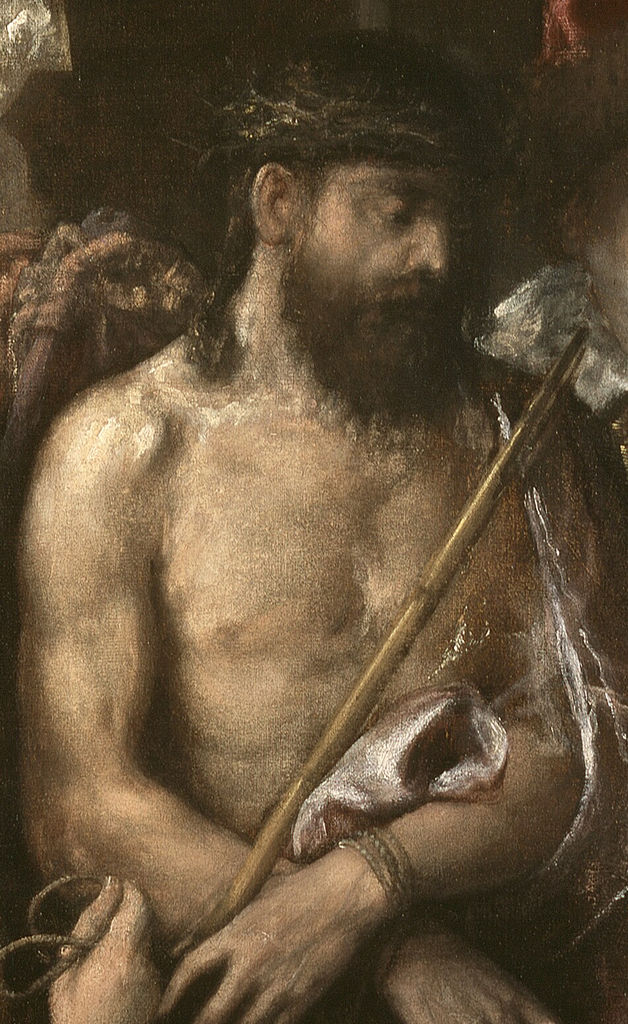
Christ Shown to the People Christ and Reed
Christ Shown to the People Pilate and Page
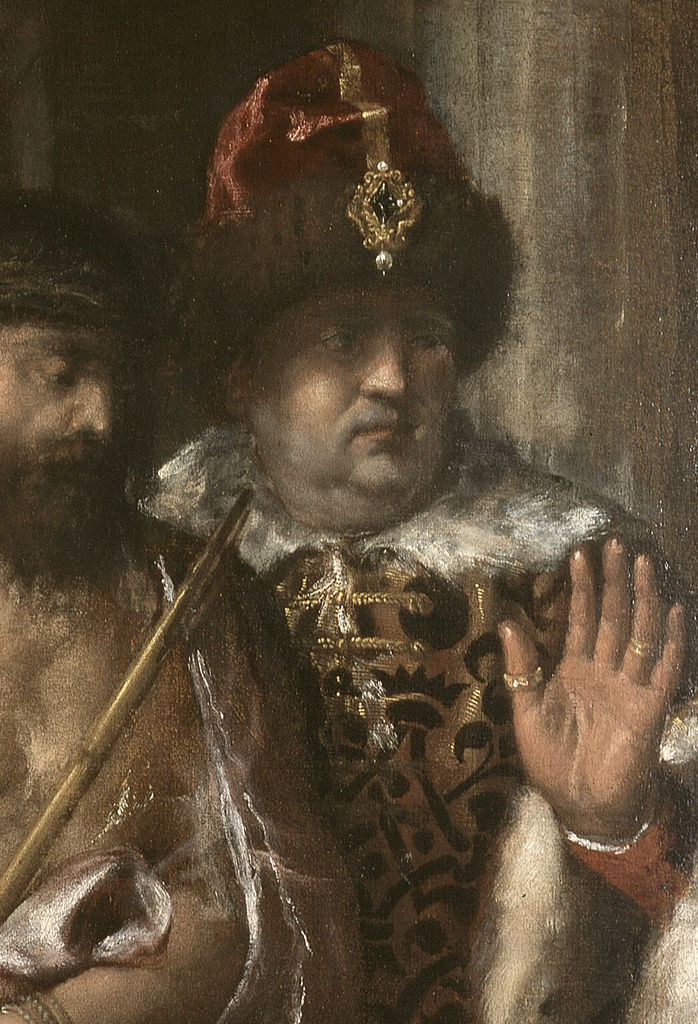
Image: Saint Louis Art Museum, Public Domain. Painting: Titian, Christ Shown to the People (Ecce Homo), 10:1936; details cropped and resized. Public domain. Image source · Reuse licence
Contents
- Three figures, two kinds of power
- What does “Ecce Homo” mean here?
- A late painting, and the question of finish
- Was it made for the Duke of Urbino?
- Looking at the painting now
Three figures, two kinds of power
Christ occupies the middle of a closely packed group. He wears the thorn crown and holds the reed associated with his mocking. His bare torso receives a diffuse light, while his head bends downward. To the right Pilate wears a heavy cloak and a richly decorated garment. His hand is raised as though addressing people just beyond the edge of the canvas. The young page on the left, smaller and lower in the composition, is also finely dressed. The museum points to the contrast between Pilate's and the page's costly appearance and Christ's near nakedness.[1]
That contrast carries the story without depicting its next event. The civic authority seems visibly grander, but Jesus is the still centre toward which the other figures direct attention. The page's glance connects the lower left to Christ's body; Pilate's gesture sends the eye out to the unseen crowd. Christ's lowered face and bound-looking hands do not answer Pilate with another gesture. A viewer has to move between the suffering figure and the public announcement being made about him. The painting turns the Gospel's brief presentation into an encounter sustained by posture, colour and touch.[1][2]
The surface gives different materials different weight. Pale skin emerges against the dark surroundings; the robe's fur, textile pattern and the page's adornment catch scattered highlights. A warm torchlike glow, as the museum describes it, brings the figures out of the shadow. Titian does not give the viewer an architectural setting or a sweeping crowd scene in which to get lost. The close framing concentrates attention on the few faces, the raised hand and Christ's body. This focus is one reason the image can be read at once as a narrative scene and as a devotional image for considering his humiliation.[1]
What does “Ecce Homo” mean here?
In John's account Pilate has Jesus brought out after the scourging and the soldiers' mockery. He announces that he finds no guilt in him, then presents him in the crown and cloak. The familiar Latin title means “Behold the man.” Titian's canvas does not illustrate every sentence: the soldiers are absent, and the crowd remains unseen. It shows the instant when a ruler turns private injury into public spectacle. The page is a figure in Titian's composition, not a named participant in John's text.[1][2]
The distinction from the earlier mocking episode also matters for identifying other Titian works. A picture of soldiers striking Christ or crowning him would take place before this presentation. In Saint Louis, the hands and faces guide attention toward Pilate's act of showing. The site's Titian paintings guide includes other Passion subjects; their shared religious theme should not collapse separate episodes into one event.[1][2]
A late painting, and the question of finish
The Saint Louis museum dates the work near the end of Titian's life and says scholars have judged it unfinished at his death, pointing particularly to sketchy paint in the upper left. The museum also describes sensitive modelling, a subdued palette and confident, visible brushwork as characteristics of his late manner. On the canvas, some passages appear more resolved than others. It is worth looking from Christ's softly modelled torso to the less settled area above and beside the figures rather than treating the entire surface as uniformly rough.[1]
“Unfinished” needs a precise use. A painting may have been interrupted; an artist may also deliberately leave brushwork open as an expressive choice. The Metropolitan Museum of Art makes that distinction in its discussion of the non finito in later painting, including Titian. The Saint Louis object's upper-left passage and its owner's dating support the museum's conclusion about this particular work. Loose paint elsewhere is not, by itself, a proof that Titian meant to return to it. The visual energy of the present surface is part of what viewers encounter, whatever the exact sequence of its final working sessions.[1][3]
Was it made for the Duke of Urbino?
A tempting identification has followed this painting. In 1566, an agent named Agatone wrote to Guidobaldo II della Rovere, Duke of Urbino, about a picture of “Christ” completed by Titian. Later ducal inventories mention an Ecce Homo. Some scholars connected those documents to the Saint Louis canvas. But the museum's detailed provenance note stresses that Agatone's letter does not identify the subject more specifically than “Christ,” and that the later inventory descriptions do not securely identify this physical painting. Another scholar has argued that the duke's Ecce Homo was a different, now lost work.[1]
The date compounds the difficulty. A painting dated about 1570–76 does not easily match a report of completion in 1566, although the museum allows that work on it could have begun earlier. Its provenance heading preserves the proposed della Rovere ownership, while its notes make clear why the link remains uncertain. It would misstate the evidence to say that this canvas was definitively commissioned by the duke or to name him as its established first owner.[1]
A 1644 document is suggestive in another way. A letter attributed to the painter and dealer Gabriele Balestrieri describes a Titian bought in Venice for Paolo Coccapani, bishop of Reggio, as partly finished and partly sketched. The Saint Louis museum records August L. Mayer's proposal that this was the same picture. The description may suit the visible state of Ecce Homo, but again the identification is a proposal, not a documented chain that closes every gap.[1]
The later trail is firmer. The museum records ownership or handling involving the Earl of Effingham, Rudolf Heinemann and Adolph Loewi, Robert Frank and Arnold Seligmann, Rey & Co., drawing on exhibition records, correspondence and dealer documents. It purchased the painting from Seligmann's firm in 1936. The record itself explains qualifications and uncertain transitions; those should be kept alongside, rather than hidden by, a smooth list of names.[1]
Looking at the painting now
Begin with Pilate's raised hand and imagine the crowd he addresses. Return to Christ's downward gaze and the page beside him. Then compare the brightness and texture of skin, fur, jewellery and the sketchier area above. That route connects the biblical moment, the painting's moral contrast and its still debated state of finish. The museum's specific title, date and object number keep this canvas distinct from other scenes of Christ's mockery and from possible pictures mentioned in sixteenth-century documents.[1][2]
The painting survives as a powerful encounter even where its early ownership cannot be settled. Titian leaves the crowd outside the frame, and the viewer is put close to those who present, witness and endure the scene. The open questions about the upper-left passage and the duke's commission belong to its history; they need not be answered more firmly than the evidence allows.[1][3]
Researched Titian and related works
Frequently Asked Questions
In the Saint Louis Art Museum, object 10:1936.[1]
Mockery and crowning precede Pilate's presentation in John 19. The Saint Louis painting depicts the presentation, which the museum titles Christ Shown to the People (Ecce Homo).[1][2]
The museum says scholars judge that it was, particularly because of the sketchy upper-left passage. That conclusion is specific to this object and should be distinguished from Titian's general late use of visible brushwork.[1][3]
It has been linked to a 1566 letter and later ducal inventories, but the museum explains why neither securely identifies this canvas. Its first commission remains uncertain.[1]
Discussion
What do you notice when you look closely at Titian's Christ Shown to the People (Ecce Homo)?
Share a specific observation or a source that adds context.
Reader Insights
Which detail changes your reading?
How does its original setting affect what we see?
Which part of the evidence remains uncertain?
Join the Conversation
Add your observation below.
References
- Saint Louis Art Museum, “Christ Shown to the People (Ecce Homo),” object 10:1936, including interpretive and detailed provenance notes. View source.
- United States Conference of Catholic Bishops, Gospel of John, chapter 19, verses 1–5, for the narrative sequence. View source.
- The Metropolitan Museum of Art, “Unfinished Works in European Art, ca. 1500–1900,” on interruption and the non finito aesthetic. View source.


