 by Tom Gurney
Tom Gurney BSc (Hons) is an art history expert with over 20 years experience
Published on June 19, 2020 / Updated on October 15, 2026
Email: tomgurney1@gmail.com / Phone: +44 7429 011000
Titian's Portrait of Federico II Gonzaga: Introduction
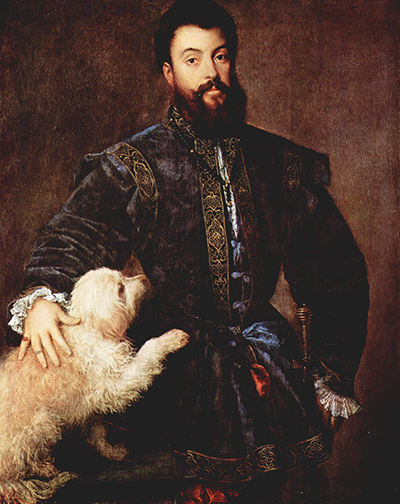
Federico Gonzaga places one hand on his sword and the other on a small white dog. The animal looks up at him, turning a formal likeness into an exchange between sitter and companion. Titian painted the portrait in 1529. It is now in the Museo Nacional del Prado, Madrid, inventory P000408: oil on panel, 125 × 99 centimetres. The museum calls Federico the first Duke of Mantua, a title by which he is known today; the painting shows him during a particular moment of his courtly career, before the many later images and stories attached to his name.[1]
The dog is the detail by which most viewers remember the picture. It also helps identify this particular work. A second portrait of Federico in armour is documented in 1530, whereas the Prado panel shows him in dark, richly decorated civilian dress. Nor is the dog the one beside Charles V in Titian's later full-length imperial portrait. The Madrid panel has its own support, dimensions, date, signature and collecting history.[1][3]
At a Glance
- WorkPortrait of Federico II Gonzaga
- Research recordMuseo Nacional del Prado
Contents
- A letter that dates the portrait
- Dress, sword and the responsive dog
- A possible marriage image
- From the Leganés collection to the Prado
A letter that dates the portrait
On 16 April 1529 Federico wrote to his uncle Alfonso I d'Este, Duke of Ferrara, apologising for keeping Titian with him. The painter had begun Federico's portrait, he explained, and Federico wanted it finished. The Prado connects that letter with the surviving panel. It is unusually direct evidence that a Gonzaga sitter was involved while Titian was working. It supports the 1529 date without requiring us to guess the month in which the final paint was applied.[1]
The letter also shows how a court painter's time could be contested. Titian had commitments to Alfonso, Federico's uncle, yet Federico held him to finish his own likeness. A portrait could be important enough to interrupt another patron's access to the artist. That exchange does not give a complete contract, price or delivery date for P000408, but it places the image inside the practical relationships between painter and ruling families. The later armoured Federico mentioned by the Prado belongs to a separate commission and should not be used to reinterpret the dress in this one.[1]
Titian had already painted Alfonso in a three-quarter portrait about 1523–25, now known through copies. The Prado compares its arrangement with Federico's: one hand on a sword, the other resting on an object. For Alfonso the object was a cannon, a reference to his expertise in artillery. Federico's right hand rests on the dog instead. The comparison is revealing because it separates a stable court portrait formula from the attribute chosen for each person. Similar pose does not make the two sitters interchangeable.[1]
Dress, sword and the responsive dog
Federico turns toward the viewer against a subdued brown field. Dark fabric and embroidered edging give substance to his torso without the glitter of armour. Fine pattern and metallic details appear around the fastenings and sleeves. The left hand finds the sword hilt at his hip, enough to signal a nobleman's rank and ability to bear arms. Yet the portrait's strongest gesture is gentler: the right hand reaches down to the little white animal. Two rings on that hand add another mark of wealth and personal display.[1]
The Prado describes the dog as a Maltese and notes Federico's fondness for dogs. Its particular breed matters less to the museum's interpretation than its response: it raises its head as though recognising the person above it. The animal makes the sitter's hand seem active rather than merely posed on a prop. It adds a moment of affection to an image that still depends on sword, costly clothing and confident bearing. To describe the dog only as a decorative emblem would miss what it does within the picture.[1]
The museum also records a rosary in the portrait. Together with the dog, it has prompted a reading of Federico as approachable and pious. Such objects can suggest qualities, but they do not provide independent proof of private conduct. Titian chose a visual language in which gentleness, devotion and aristocratic standing could be displayed together. The sword and the dog hold different kinds of attention: one points to social station, the other to a relationship the viewer can almost imagine continuing beyond the frame.[1]
Titian's signature is integrated into the clothing. The Prado transcribes “TICIANVS · F” on the cord used to fasten Federico's doublet, at the front centre. It is distinct from later white and red inventory marks at the lower left of the panel. The signature makes the garment itself carry the painter's name. The old numbers, by contrast, belong to the object's later handling and classification. Looking closely at such marks tells us both who claimed authorship and how later collectors tracked the painting.[1]
The elaborate costume is more than an opportunity for Titian to paint texture. The Prado observes that Gonzaga court dress was not governed by Venetian sumptuary rules. Its rich finish therefore signals a kind of display available to Federico's court. Three-quarter format provides room for the upper body, hands, sword and animal without making him a monumental full-length ruler. Titian could make luxury, composure and small gestures carry the public identity of an aristocrat. The dark field keeps the viewer's eye on those carefully selected details.[1]
A possible marriage image
The Prado relates the 1529 portrait to Federico's matrimonial intentions. In the museum's account, an image presenting him as gracious and devout might have helped counter a dissolute reputation; Federico married Margherita Paleologa, heiress to the Marquis of Monferrato, in 1531. This is an interpretation of the portrait's use and timing, not a surviving instruction from Federico telling Titian to make a marriage image. It helps explain why a small affectionate dog and rosary could be advantageous in a court likeness, while leaving the immediate commission's purpose open.[1]
The courtly calculation need not erase the picture's visual pleasure. The animal's upturned face interrupts the stillness of the sitter; the softly lit white fur stands apart from the dark garment. In a portrait meant to be seen by other people, a gesture can appear spontaneous even when its placement is carefully planned. Titian joins a persuasive display of rank to a readable encounter between person and pet. The result permits both an intimate and a political reading without making either one a documented fact of Federico's private feelings.[1]
Federico became an important patron for Titian. The Prado's account of the artist says the painter supplied him with more than thirty works over their relationship, many of which are lost. Federico also introduced Titian to Emperor Charles V, opening a further chapter of court commissions. Those later events demonstrate the importance of the Gonzaga connection, but they should not be projected back onto every object in the 1529 panel. The portrait belongs to an early moment in a relationship that would become much larger.[2]
The portrait of Charles V with a dog makes one useful comparison. It is a separate Prado canvas from 1533, full-length and imperial in scale; its dog participates in a different balance of body, costume and rank. Federico's smaller companion and close hand gesture are specific to P000408. The paintings guide sets both portraits among Titian's varied religious, mythological and court works, where repeated devices can serve different patrons and settings.[1][3]
From the Leganés collection to the Prado
The Prado traces the panel to the collection of the Marquis of Leganés by 1642. It next records the picture in Spain's Royal Collection: the Royal Alcázar in Madrid around 1700, then rooms in the New Royal Palace in 1747 and 1772. It entered the Prado in 1821. These records provide a strong later history for this physical panel. They do not specify every step from Federico's Mantuan court to Leganés, so a complete early journey should not be invented to connect those points.[1][4]
The inventories are especially instructive because they did not consistently call the sitter Federico. One early royal entry described a Duke of Ferrara with a dog, effectively confusing him with Alfonso d'Este, the uncle to whom Federico had written in 1529. An eighteenth-century record called him simply a man caressing a water dog; another called him a Venetian. The Prado's 1857 catalogue still identified Alfonso, Duke of Ferrara. The changing labels show how the recognisable dog outlived secure knowledge of the sitter in the collection's everyday language.[1]
The 1772 inventory is more revealing still. It listed this panel beside another of a woman and children, describing the two as though the woman were the man's consort. That was a collector's pairing and identification, not proof that Titian conceived the pictures as husband and wife. The earlier royal records likewise shifted their emphasis: one named a supposed duke, another described the action of caressing a dog, and a third used a broad geographic identity. Each gives a fragment of the panel's appearance or reception. None has the authority of a dated sitter letter when the person's identity is at issue.[1]
The old Ferrara label has a particular logic rather than being a random mistake. Alfonso was Federico's uncle, and the Prado sees close formal kinship between their portraits. In a collection far from the original Gonzaga context, a familiar Titian pose and a remembered Este name could be attached to the wrong panel. Reading the inventories alongside the painting reveals how easily a visual likeness to another portrait can become an asserted identity over time.[1]
The present identification brings the image back into contact with Federico's dated letter, Titian's courtly portrait design and the museum's object record. The old labels remain useful historical evidence, but they do not overturn the current attribution or turn the painted man into Alfonso. Indeed, the Prado's comparison with Alfonso explains how similar pose and related patronage could contribute to the confusion. This is one reason to give the exact inventory, P000408, when discussing the portrait rather than relying on an inherited title alone.[1]
The combination of letter, signature, dog, sword and Spanish inventory trail makes Federico's portrait unusually rich in evidence. It shows Titian solving a court painter's problem: give a powerful man visible rank while allowing a small animal to suggest personal warmth. It also shows how a painting changes as it moves through collections. The gestures remain on the panel, even when centuries of catalogues disagree about whose gestures they are.[1]
Researched Titian and related works
Frequently Asked Questions
It is in the Museo Nacional del Prado, Madrid, inventory P000408. The museum records it as oil on panel, 125 × 99 centimetres, painted in 1529.[1]
Federico's letter to Alfonso d'Este of 16 April 1529 says Titian had begun a portrait of him and that he wanted it finished. The Prado connects this document with the surviving panel.[1]
The Prado notes Federico's fondness for dogs and emphasises the little animal's active response to him. A marriage-related reading has also been proposed, but no documented instruction fixes a single meaning.[1]
No. The Prado records another portrait of Federico in armour in 1530. P000408 shows dark court dress, a sword and the small white dog.[1]
Discussion
What do you notice when you look closely at Titian's Portrait of Federico II Gonzaga?
Share a specific observation or a source that adds context.
Reader Insights
Which detail changes your reading?
How does its original setting affect what we see?
Which part of the evidence remains uncertain?
Join the Conversation
Add your observation below.
References
- Museo Nacional del Prado, “Federico Gonzaga, Ist Duke of Mantua,” collection record P000408, including historical inventories and inscription. View source.
- Museo Nacional del Prado, “Tiziano Vecellio di Gregorio,” artist biography. View source.
- Museo Nacional del Prado, “Emperor Charles V with a Dog,” collection record P000409. View source.
- Museo Nacional del Prado, “Colección de don Diego Mesía y Guzmán, marqués de Leganés,” collection history. View source.