



 by Tom Gurney
Tom Gurney BSc (Hons) is an art history expert with over 20 years experience
Published on June 19, 2020 / Updated on October 15, 2026
Email: tomgurney1@gmail.com / Phone: +44 7429 011000
Titian’s Two Satyrs in a Landscape: Introduction
Two figures sit so close that their bodies almost form one shape, yet their attention separates. The hairy satyr on the left turns towards us; the smoother figure in front looks to the right, towards a large marked disk. Above them, a hill rises to a cluster of buildings under an open sky. This small drawing makes a whole world out of those competing directions: inward to a shared physical space, outward to the viewer, and across the landscape to something the figures may be trying to read.[1]
The Metropolitan Museum of Art owns the sheet as 1999.28 and titles it Two Satyrs in a Landscape. Its current catalogue dates the drawing about 1505–10 and credits Titian. He worked in pen and brown ink, with white gouache on fine off-white laid paper. At 21.6 × 15.1 centimetres, it is closer in size to a book page than to a finished painting. Its small scale rewards careful looking: changes in density of ink, tiny touches of white, and the distance between foreground bodies and far buildings carry much of the meaning.[1]
At a Glance
- WorkTwo Satyrs in a Landscape
- Research recordMetropolitan Museum of Art
Annotated details from Two Satyrs in a Landscape
Select a numbered area to find its detail below. Open a detail image to view it larger.
Details from TWO SATYRS IN A LANDSCAPE
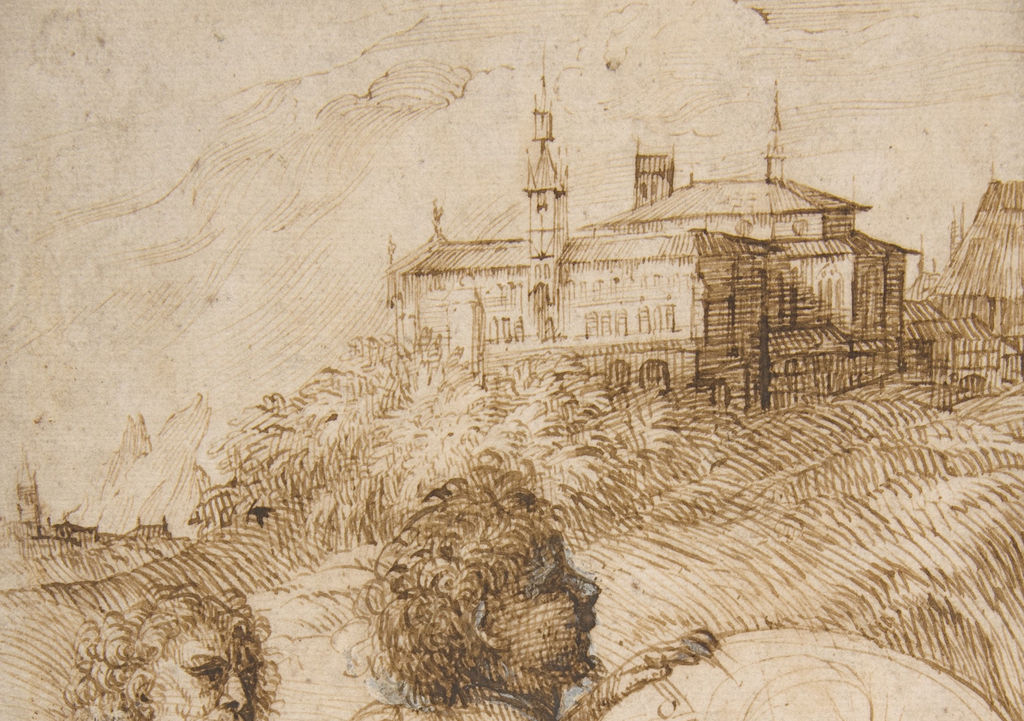
Two Satyrs Architecture
Two Satyrs Figures and Astrological Disk
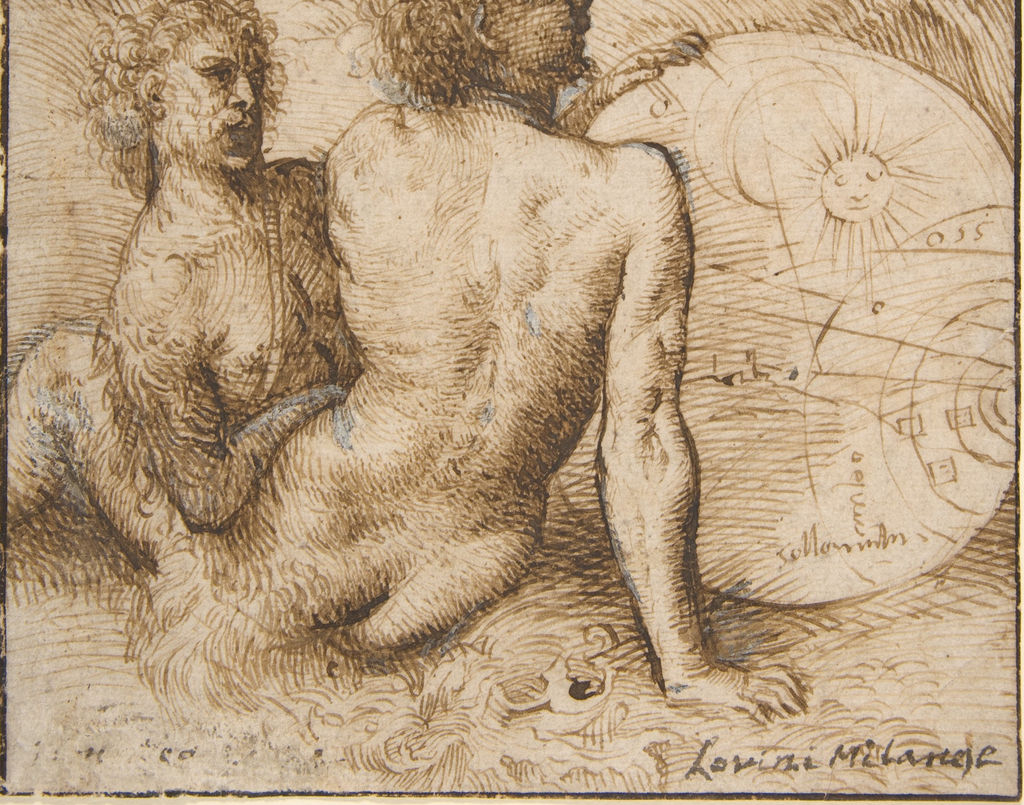
Image: The Metropolitan Museum of Art. Open Access, CC0. Cropped and resized. Image source · Reuse licence
Contents
- Two bodies, several directions
- The hill and the buildings
- Drawing with ink and white
- What does the disk show?
- A rare surviving drawing
Two bodies, several directions
The left figure has curled hair, a bearded face and a visibly shaggy lower body. He looks out from under a heavy brow. The figure in front presents his back and right shoulder, with a more human-looking torso shaped by short ink strokes. His head turns towards the disk, and one arm extends into that part of the scene. The two share space at the hip and lower body, but their gazes do not meet. Their closeness is plain; the nature of their relationship is left open by the drawing.[1]
Titian makes the central back especially legible. The shoulder blades and spine gather strength from changes of tone rather than from a single continuous contour. Darker hatching presses into the recess at the left of the torso; broader light areas allow the shoulder and upper arm to stand forward. A hand plants itself near the lower right, helping the figure sit. The pose gives the group physical weight. These are not symbols inserted into a decorative landscape: they appear to occupy its ground.
At the bottom, fur and grasses become difficult to separate. The left figure’s animal covering trails into the worked vegetation, while small plants and flowers interrupt the earth near the central figure’s hand. Art historian Jodi Cranston has drawn attention to that merging of satyr and landscape: the hybrid body seems to belong to the natural world in the very way it is drawn. Her reading does not identify a particular myth, but it helps explain why the foreground feels rooted rather than placed on top of the scene.[3][4]
The disk at right is conspicuous. A radiating circle near its upper part resembles a sun, and smaller marks are scattered across the surface. The image is clear enough to show that the object is marked and deliberately displayed; it is not clear enough on its own to decode every sign. One hand reaches towards it, so the disk becomes a point of attention for the figures and for us. It interrupts the easy assumption that this is merely a pair of creatures resting in a pastoral setting.
The hill and the buildings
Look above the satyrs and the density of the scene changes. Titian draws a rising slope with clustered short marks for grasses and shrubs. Higher still, a group of buildings and slender towers stands along the hill. Roofs and walls have a crisp geometry that contrasts with the mixed fur, flesh and foliage below. Farther left, the land thins into a pale horizon, while long, light arcs suggest clouds in a largely open sky.[1]
The buildings are more than a background label. They set human-made order against the figures’ ambiguous mixture of human and animal. Yet they are not mapped as a securely identified town or patron’s property. The sheet supplies no documented place-name. Their detail gives the pastoral world depth and a hint of inhabited life without turning the drawing into a topographic record.
The Met’s curator Carmen C. Bambach describes Titian’s landscape drawing as pictorial: varied ink strokes shape foreground bodies while buildings and natural forms dissolve towards the horizon. We can see the change of pace directly. The satyrs are dark and tactile; the distant air is lighter and less insistent. The pen, a tool of lines, is made to produce the effect of changing atmosphere. The result is a landscape that is not just scenery around an action. It is part of how the action—or the pause before one—feels.[1]
This early sheet has often been placed near Titian’s pastoral painting of the same period, especially the Louvre’s Concert Champêtre, dated around 1509 by the Met’s essay. The comparison concerns a shared poetic interest in figures and landscape. It does not mean the satyrs were drawn to prepare that particular canvas. The Met also groups this sheet with its Landscape with a Goat as a related early pastoral drawing. Each is a distinct object with its own subject and attribution history.[1][5]
Drawing with ink and white
Brown ink can make a sharp edge, but Titian uses it at many strengths. Tightly repeated marks turn the seated bodies into compact masses; more open lines describe slopes and sky. Hatching builds shadow over the central back and across the rougher body at left. Where that network relaxes, the paper itself supplies light. The contrast allows a tiny sheet to feel broad, from a hand touching the ground to a hill receding behind buildings.
The Met records white gouache as a highlight. Its 1999 acquisition notice adds that white was used for both highlighting and correction. That distinction matters: a pale stroke may brighten a surface, but it may also revise a previous decision. A reproduction does not let us confidently assign every light touch to one purpose. What can be said securely is that Titian did not rely only on untouched paper and ink. He worked back into the drawing with an opaque white medium.[1][2]
The object record’s support description is equally specific: fine off-white laid paper. It is neither a blue-paper chalk study nor an oil sketch. The satyrs’ furry edges, the central figure’s anatomy and the hill’s thin distance emerge from pen work on this particular support. Attention to the medium helps keep this drawing separate from later reproductions of it, where line thickness and paper colour may change.
The Met’s publication places the sheet within a new Venetian interest in figures set in a bucolic landscape. Its claim is historical rather than a request to find one literary text behind every detail. The drawing can evoke a learned, poetic setting without illustrating a known passage line by line. Indeed, the pause between the figures and the disk may be more compelling because the exact story is unresolved.[2]
What does the disk show?
The 1999 Met bulletin records several interpretations. Some readers proposed that the disk shows an astrological configuration associated with 1512 or 1513; another explanation sees a simple eclipse. The museum did not declare either solution certain. The current collection essay calls it an astrological disk, while keeping the scene’s meaning elusive. We should therefore describe the visible object and report the proposals without turning its marks into a proven horoscope.[1][2]
An astrological reading could also be used too confidently as a dating tool. If the marks refer to a configuration in 1512 or 1513, that may bear on when someone thinks the drawing was made or what event it evokes. But the Met’s current catalogue dates the sheet about 1505–10, while its 1999 bulletin offered about 1509–15. The two records reflect different approximate scholarly judgments. Neither a proposed sky reading nor one narrow date range erases the other. The sensible public account is that this is an early Titian drawing with a genuinely debated date and disk.[1][2]
The figures’ own identities are uncertain too. The older museum discussion suggested that they might be Pan and Silvanus, figures associated with woods and fields. The current title stays with two satyrs. No secure attribute in the sheet forces those personal names. The drawing’s power does not depend on identifying them as two named gods. Their hybrid appearance, physical closeness and different directions of attention already make the scene unusual.[1][2]
Cranston’s interpretation takes the disk and the bodies together. The satyrs are connected to the earth through fur and grass, but they confront a sign of the sky. Her reading sees nature as active in the making of these figures, rather than as a setting they merely occupy. This is one scholarly account of the image’s implications, not a translation of an inscription on the disk. It expands the questions a viewer can ask while leaving the visible uncertainties intact.[3][4]
A rare surviving drawing
Titian was a prolific painter, but relatively few drawings accepted as his survive. Bambach’s Met essay gives an estimate of 35 to 40 attributable sheets. That number is an expert estimate, not a fixed total that every catalogue will share. It explains why a small independent drawing such as this carries unusual weight in understanding his early practice. It shows him constructing volume, atmosphere and imaginative subject matter with a pen before any claim can be made about a particular finished canvas.[1]
The drawing entered the Met in 1999 through the Rogers Fund. Its catalogue image is marked Public Domain, and the museum makes open-access images available for commercial and noncommercial use. The museum object number, 1999.28, should be used when distinguishing the physical sheet from images, reproductions and drawings with similar pastoral titles.[1]
What remains most memorable is the arrangement itself. One satyr looks towards us; the other looks across to the disk. Their bodies overlap as their attention splits. Ink gives the figures a heavy presence, then thins into the high air behind the buildings. The scene can be called pastoral or astrological, but neither word settles what the figures know or what they will do. Titian leaves the viewer inside that moment of suspended interpretation.
Researched Titian and related works
Frequently Asked Questions
No. It is a drawing in pen and brown ink with white gouache on off-white laid paper. The sheet is 21.6 × 15.1 cm.[1]
It is a marked, radiating disk. The Met records proposals that its signs show a 1512/13 astrological configuration or an eclipse, but neither meaning is established as certain.[1][2]
The Met’s 1999 publication raised those names as possibilities. Its current title identifies them more cautiously as two satyrs.[1][2]
The Met’s current record says about 1505–10; its 1999 acquisition bulletin proposed about 1509–15. Both place it early in Titian’s career.[1][2]
It belongs to the Metropolitan Museum of Art, New York, object 1999.28. The museum currently lists it as not on view.[1]
Discussion
What do you notice when you look closely at Titian’s Two Satyrs in a Landscape?
Share a specific observation or a source that adds context.
Reader Insights
Which detail changes your reading?
How does its original setting affect what we see?
Which part of the evidence remains uncertain?
Join the Conversation
Add your observation below.
References
- Metropolitan Museum of Art, object record and Carmen C. Bambach’s 2014 essay for Two Satyrs in a Landscape, 1999.28. View source.
- Carmen C. Bambach, entry for Two Satyrs in a Landscape in Recent Acquisitions: A Selection, 1998–1999, Metropolitan Museum of Art Bulletin 57, no. 2 (1999), p.26. View source.
- Jodi Cranston, Green Worlds of Renaissance Venice (Pennsylvania State University Press, 2019), discussion of the satyrs, nature and the celestial disk. View source.
- Karen Goodchild, review of Cranston’s Green Worlds of Renaissance Venice, Renaissance Quarterly 75 (2022), summarizing the fur-and-grass observation. View source.
- Metropolitan Museum of Art, essay on Titian and his early pastoral drawings. View source.


