



 by Tom Gurney
Tom Gurney BSc (Hons) is an art history expert with over 20 years experience
Published on June 19, 2020 / Updated on October 15, 2026
Email: tomgurney1@gmail.com / Phone: +44 7429 011000
Titian's Portrait of Cardinal Alessandro Farnese at Capodimonte: Introduction
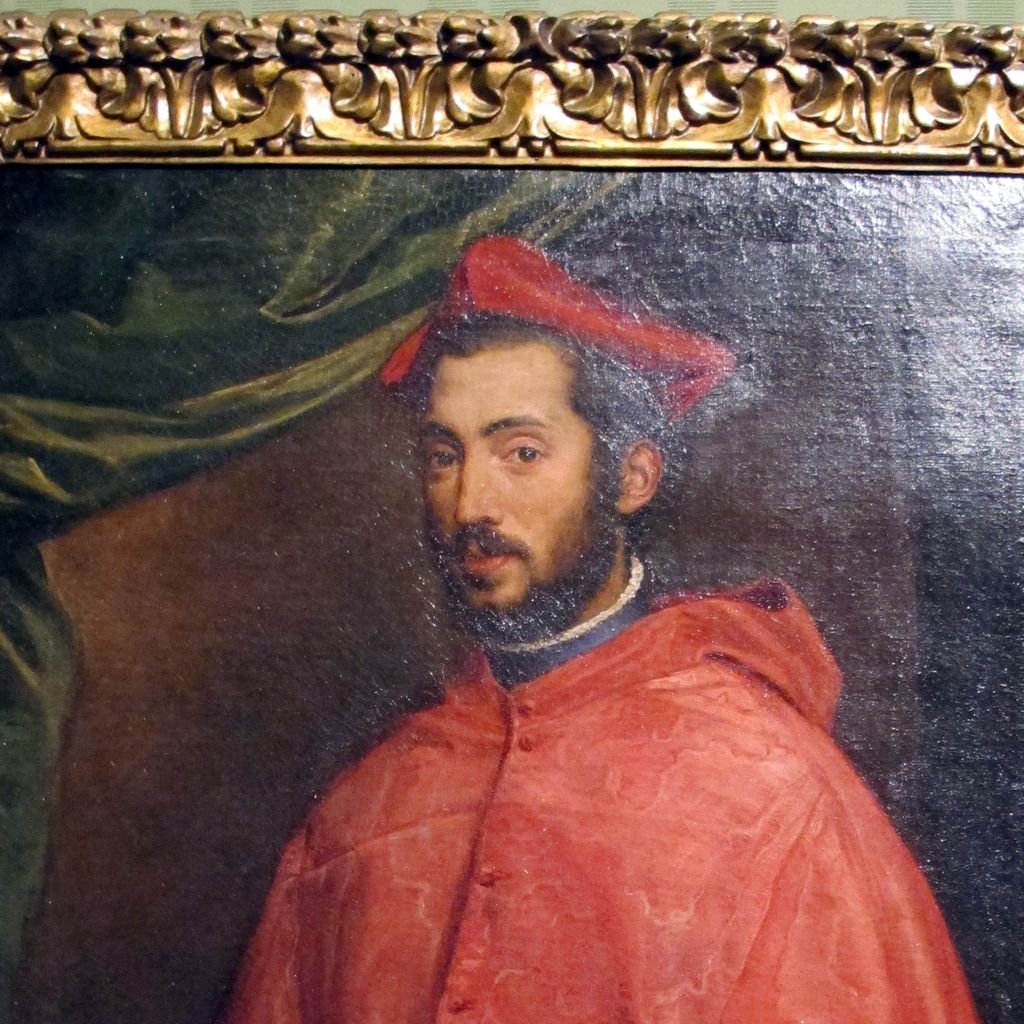
A young bearded cardinal turns his head toward the viewer while his shoulders angle away. His red cap and broad red habit fill most of the canvas; a pale sleeve and a pair of gloves draw attention to his hands below. Titian's Portrait of Cardinal Alessandro Farnese is an oil painting on canvas dated about 1545–46. It measures 97 × 73 centimetres and belongs to the Farnese collection at the Museo e Real Bosco di Capodimonte, Naples, inventory Q133.[1][2]
The sitter's name is an immediate source of confusion. Pope Paul III was born Alessandro Farnese; the man here is his grandson, Cardinal Alessandro Farnese. He appears again in Titian's group portrait of Paul III and two grandsons, but Q133 is a separate single-figure painting. Its own size, inventory trail and reverse mark help identify the physical canvas rather than simply one more reproduction of a Farnese face.[1][3]
At a Glance
- WorkCardinal Alessandro Farnese
- Research recordcapodimonte.cultura.gov.it
Annotated details from Cardinal Alessandro Farnese
Select a numbered area to find its detail below. Open a detail image to view it larger.
Details from CARDINAL ALESSANDRO FARNESE
Cardinal Alessandro Farnese Face and Cap
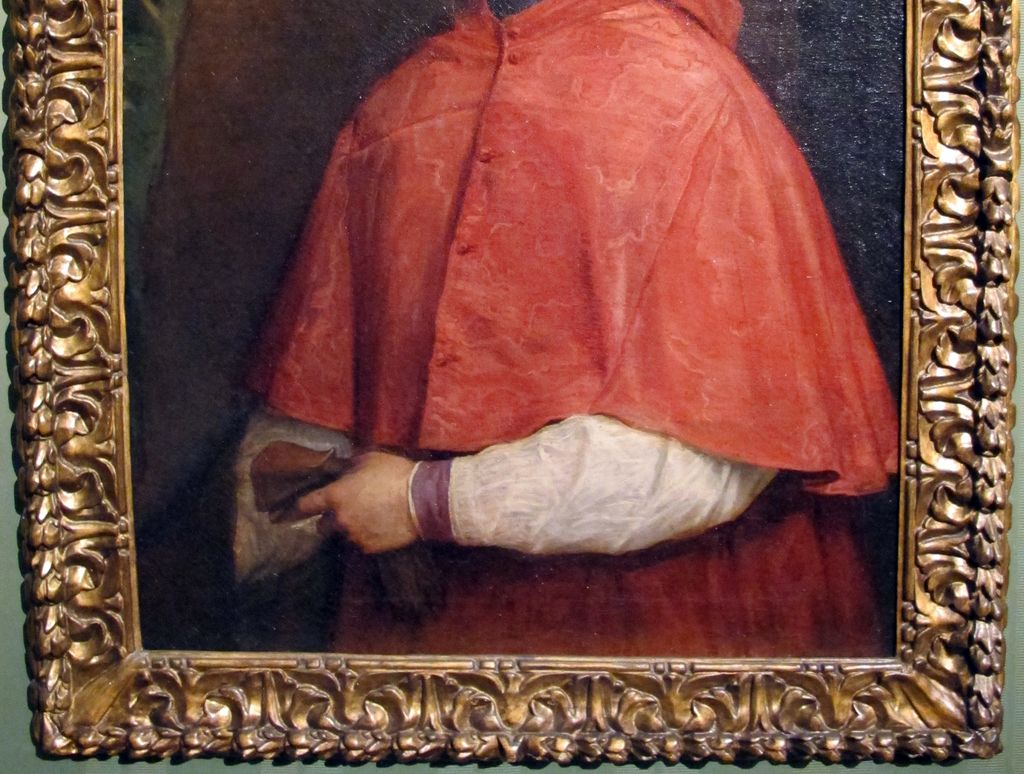
Cardinal Alessandro Farnese Hands and Vestments
Cardinal Alessandro Farnese Framed View
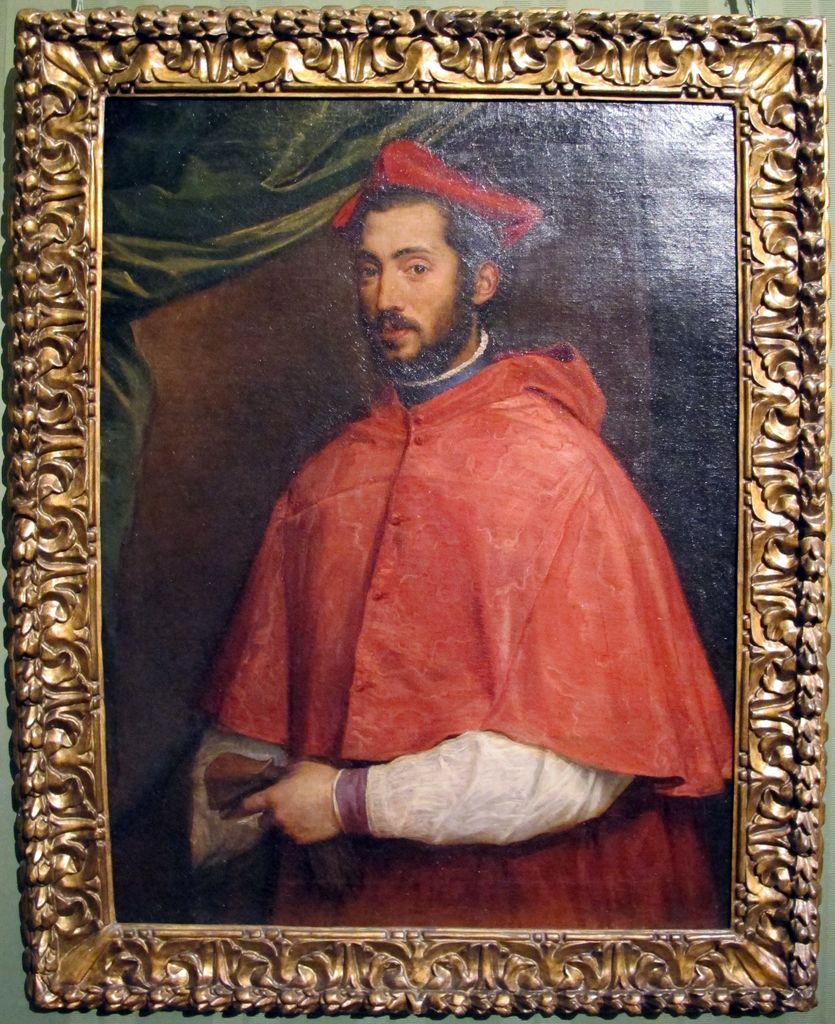
Photo: Sailko, CC BY 3.0. Cropped and resized for the splash and details. Image source · Reuse licence
Contents
- The cardinal and the commission circle
- Turning toward the viewer
- A distinct Farnese portrait
- The canvas as a recorded object
- Why the portrait matters
The cardinal and the commission circle
Capodimonte's account identifies the younger Alessandro as the eldest son of Pier Luigi Farnese and says that he became a cardinal in 1534, at fourteen, with his grandfather's influence. He was about twenty-five or twenty-six when Titian made this portrait. The contrast between youthful features and an already eminent church office is visible in the image: the face is young, while the red hat and costume announce a rank conferred much earlier.[2]
The portrait belongs to Titian's sustained contact with the papal family. The National Gallery of Art traces that relationship from his likeness of Alessandro's younger brother Ranuccio Farnese, delivered in 1542, to a sitting with Paul III in Bologna in 1543 and then the painter's Roman visit in 1545–46. Capodimonte places Q133 in the latter period. This chronology gives the individual canvas a plausible commission setting. It does not supply an exact day of sitting or prove that all the Farnese portraits were made together in one room.[2][4]
Capodimonte's history of the collection presents both the pope and the cardinal as important art patrons. The older Alessandro called artists to portray him and work for his Roman court; the younger Alessandro added to the family's holdings. The portrait can therefore be seen within a household that valued painting as both collection and representation. Yet the museum's general collection history is not a contract for Q133. The public record used here does not say precisely where the cardinal first displayed this likeness or who determined every feature of the pose.[3]
Turning toward the viewer
The cardinal is shown to approximately the upper legs rather than as a detached head. His body turns across the field, while his face looks outward. This difference between shoulder direction and gaze makes the figure feel briefly encountered, although nothing in the picture proves that Titian caught a spontaneous moment. The three-quarter arrangement gives the red habit room to spread across the canvas. It also leaves the face prominent above a large field of cloth.[2]
A dark background sharpens the silhouette. At the upper left, green drapery folds into the shadow, creating a quieter colour beside the cardinal's red. The pale sleeve across the lower part of the picture interrupts the red mass and points toward the gloves. Those are carefully chosen accessories for a public likeness: the sitter is equipped with the clothing of office and an object held in the hand, yet he is not shown performing a church ceremony. The visual effect depends on stillness and controlled movement rather than an elaborate narrative setting.[2]
The museum's partner record describes Alessandro as turning his shoulders and holding elegant gloves in his left hand. It also calls his expression confident. The gloves and turn are visible facts; “confidence” is a reading of the face. A viewer may find the gaze assured, reserved or questioning. The painting cannot verify which private feeling he had during the sitting. Separating what the image shows from what it invites us to imagine makes the portrait more interesting, because Titian gives institutional costume and individual presence equal attention.[2]
The hands have a different job from those in the bareheaded Paul III. The pope's hands help establish the seated body and chair. Alessandro's hands gather an accessory beneath a bright sleeve. This difference suits the two compositions: the aged grandfather sits within a broad papal cape; the young cardinal stands and turns. It would be misleading to describe Q133 as a reduced copy of either the single pope or the larger three-person image, even though all three belong to the same patronage circle.[1][3]
A distinct Farnese portrait
Capodimonte's display notice lists three Titian works side by side: the bareheaded pope, dated 1543; Paul III with grandsons Alessandro and Ottavio, dated 1545–46; and the single Cardinal Alessandro, likewise dated 1545–46. Their subjects overlap, but the objects answer different portrait problems. Q130 presents a pope alone; Q129 stages an encounter among relatives and is recorded as unfinished; Q133 isolates the cardinal's youthful rank and presence.[3][5]
In the group canvas, Cardinal Alessandro stands behind the pope on the viewer's left, part of an arrangement of age, office and family access. In this individual canvas there is no grandfather to anchor the space and no brother bending in from the right. Alessandro has the whole frame. He meets the viewer through a turning pose rather than through his place in an interlocking family group. Comparing the paintings this way keeps identity clear without treating one as mere preparation for the other.[3][5]
The unfinished status of Q129 should not migrate to Q133 by association. The Italian catalogue's full sheet for the cardinal portrait calls its overall condition good and does not make the group portrait's specific claim that Titian left it unfinished. This does not establish that every square centimetre reached a uniformly polished endpoint; it means the published object records make different statements. Technical conclusions about missing glazes on Q129 cannot be assigned to Q133 without examination of Q133 itself.[1][5]
The canvas as a recorded object
The full Italian national catalogue sheet supplies details that a short label often omits. It records the painting as Q133 in a 1930 inventory, with earlier numbers SG236E in 1852 and S83919 in 1870. These identifiers follow the same physical painting through successive cataloguing systems. They should not be mistaken for three paintings or three Titian versions.[1]
The sheet also records a grey wax stamp on the reverse, impressed with a Farnese lily and bearing an incised 66. This is stronger object-specific evidence of a Farnese association than a general claim that the family collected many works by Titian. The mark does not, on its own, reveal the painting's first room, original frame, or all subsequent owners. The national catalogue names the Farnese collection at Capodimonte but does not provide a complete, continuous room-by-room itinerary for Q133. Those distinctions keep provenance grounded in what is actually recorded.[1][3]
Reproductions of Q133 can include the frame and visible reflections on the surface. Reflections can alter how dark passages and details appear on a screen. They are no basis for asserting a particular pigment, varnish condition or retouching campaign. The catalogue's oil-on-canvas description and condition assessment are firmer evidence for material facts than impressions drawn from a compressed photograph.[1]
Why the portrait matters
Q133 shows a young man whose office was already part of his public identity. Titian does not suppress his face beneath insignia, nor remove the red insignia to make a purely private study. The angled shoulders, outward gaze, dark setting, green drapery and white sleeve make the person and costume work together. The painting can be read alongside the other Farnese portraits as an image of an influential family; it also rewards attention as a distinct, closely observed likeness.[2][3]
The paintings guide places it among Titian's portraits for rulers and powerful patrons. The simplest way to begin is with the correct sitter and object: Cardinal Alessandro, the pope's grandson, in Capodimonte's Q133 canvas. From there the viewer can compare the pope's individual portrait and the unfinished family group without conflating their dates, gestures or physical histories.[1][3]
Researched Titian and related works
Frequently Asked Questions
The younger Alessandro Farnese, a cardinal and grandson of Pope Paul III. The pope himself had been born Alessandro Farnese.[2][3]
At the Museo e Real Bosco di Capodimonte, Naples, in the Farnese collection as inventory Q133.[1]
Capodimonte identifies the objects in his left hand as gloves.[2]
Discussion
What do you notice when you look closely at Titian's Portrait of Cardinal Alessandro Farnese at Capodimonte?
Share a specific observation or a source that adds context.
Reader Insights
Which detail changes your reading?
How does its original setting affect what we see?
Which part of the evidence remains uncertain?
Join the Conversation
Add your observation below.
References
- Catalogo Generale dei Beni Culturali, “Ritratto del cardinale Alessandro Farnese,” object 1500625162, with full catalogue sheet. View source.
- Museo e Real Bosco di Capodimonte, partner object record, “Portrait of Cardinal Alessandro Farnese.” View source.
- Museo e Real Bosco di Capodimonte, Farnese collection history and display announcement. View source; display announcement.
- Peter Humfrey, National Gallery of Art, “Ranuccio Farnese, 1541–1542,” scholarly catalogue on Titian's early Farnese contacts. View source.
- Catalogo Generale dei Beni Culturali, Q129 group portrait of Paul III with his grandsons, object 1500625152. View source.


