



 by Tom Gurney
Tom Gurney BSc (Hons) is an art history expert with over 20 years experience
Published on June 19, 2020 / Updated on October 15, 2026
Email: tomgurney1@gmail.com / Phone: +44 7429 011000
Titian’s Girl with a Platter of Fruit: Introduction
The young woman carries a dish high above her shoulder, yet turns to meet the viewer’s eyes. Her raised arms and the heavy fruit make the action look momentary, while the gleam of silk, pearls and metal invites a slower inspection. That contrast is at the heart of Titian’s Girl with a Platter of Fruit: it is a picture about display and looking, but it has often been asked to serve as a portrait of a named person as well. Berlin’s Gemäldegalerie, which owns it, titles the painting Mädchen mit Fruchtschale—Girl with a Platter of Fruit—and does not identify the sitter as Titian’s daughter Lavinia.[1]
The canvas is Gemäldegalerie inventory 166, dated about 1555, and measures 106.2 × 84.8 centimetres. Berlin attributes it to Titian. These object details matter because numerous similar pictures exist. A fruit-bearer in another collection, a woman holding a severed head, and a later copy may resemble this painting while having separate histories and attributions. The safest way into the Berlin work is through its own inventory number and what is actually visible on its surface.[1][2]
At a Glance
- WorkGirl with a Platter of Fruit
- Research recordsearch.smb.museum
Annotated details from Girl with a Platter of Fruit
Select a numbered area to find its detail below. Open a detail image to view it larger.
Details from GIRL WITH A PLATTER OF FRUIT
Girl with Fruit Face and Dress
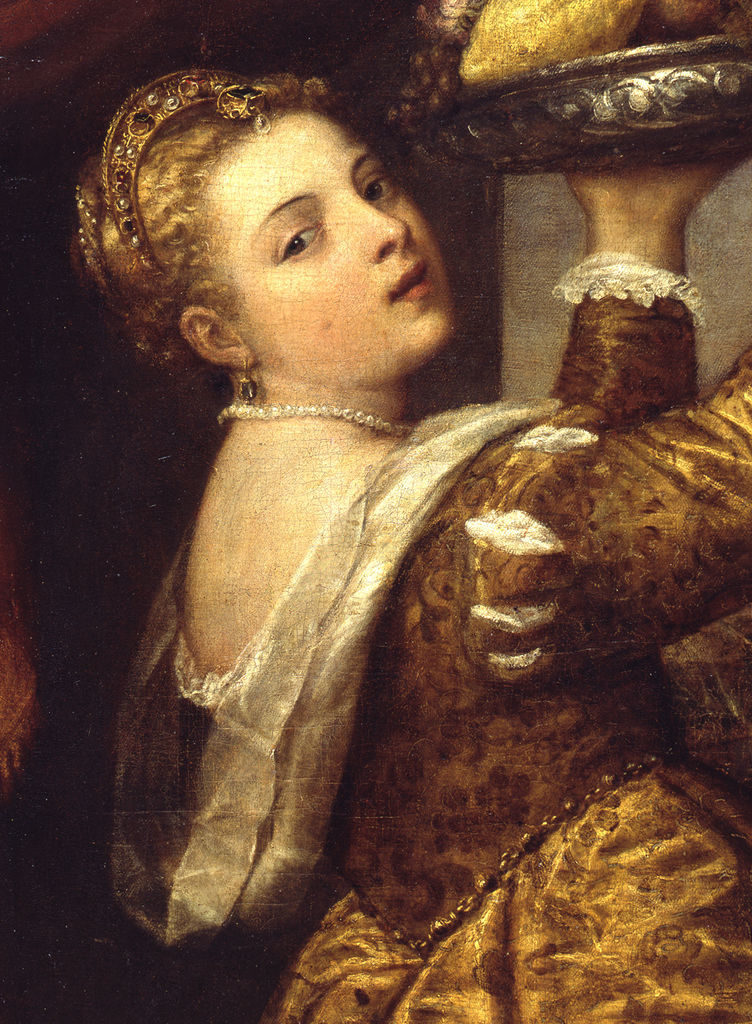
Girl with Fruit Platter
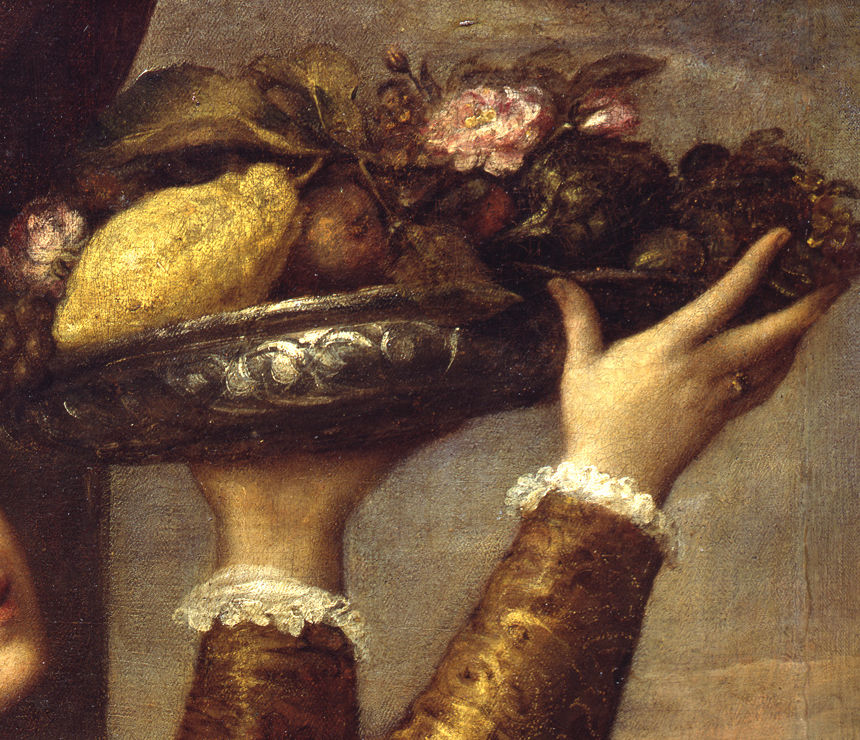
Photo: Staatliche Museen zu Berlin, Gemäldegalerie / Jörg P. Anders. Public Domain Mark 1.0. Cropped and resized. Image source · Reuse licence
Contents
- A turn that brings us into the scene
- Why the old “Lavinia” title persists
- The painting beneath the painting
- Berlin’s fruit-bearer and Madrid’s Salome
- A Berlin object with a later collecting history
A turn that brings us into the scene
Her body appears to move across the picture, but her head turns back. The face, pale against dark red drapery, looks directly toward us. A jeweled ornament holds back the hair; pearls trace the line of the neck. The white fabric falling behind her shoulder catches light before it descends into the darker gown. Titian uses this head turn to join an outward action—carrying the platter—with a private encounter between figure and viewer. The picture never explains why she has turned. Her glance keeps that question alive.
The raised arms make a striking frame for the face. One forearm rises behind the shallow metal vessel, while the other hand reaches towards its far edge. The silver-toned rim gleams where light catches it, and the large yellow fruit rises above the platter’s nearer side. Darker fruit and foliage gather behind. The object has physical width and weight: it is not a little basket tucked into an elbow. Berlin’s title describes a platter, correcting the “basket” wording that has followed this picture in some older captions.[1]
Below the dish, the woman’s costume takes up much of the canvas. The figured golden-brown sleeves are cut to reveal pale fabric beneath, and the broad skirt expands towards the lower edge. A bracelet and patterned textile repeat the small flashes of brightness established by her jewelry and the dish. This luxury is part of the picture’s appeal, though it cannot by itself tell us who she is. Expensive dress can belong to a portrait, an ideal figure, or a mythological interpretation; clothing alone is not a birth certificate.
The background balances two different kinds of space. The red curtain on the left makes the figure stand out almost theatrically. At the right, a narrow view opens to a subdued landscape and distant hills. Her turn takes place between a contained, staged interior and an exterior world glimpsed beyond it. The setting makes the platter and face conspicuous without supplying a clear narrative location. It does not tell us whether the fruit is being brought to a guest, displayed as an emblem, or carried for some other purpose.
Why the old “Lavinia” title persists
Several titles have attached themselves to this composition. Berlin’s present catalogue uses a descriptive one and leaves the woman unnamed. An older Foto Marburg caption preserved in the Fondazione Zeri archive explicitly calls Berlin inventory 166 the artist’s daughter Lavinia. That is useful evidence of how the painting was once presented; it is not independent documentation of the sitter. The difference between a historical caption and a verified identity is especially important for a picture repeated in several forms.[1][3]
Traditional identification often worked by comparing a woman’s face here with other paintings believed to show Lavinia Vecellio. A Christie's catalogue for a later work after Titian explains that chain of comparison through a supposed bridal portrait. Each link depends on the identification of the next. The Prado, discussing its related Salome, explicitly rejects a Lavinia reading based on differences from the supposed Dresden portrait. That museum’s argument concerns the Prado figure, but it shows why a family name cannot simply be carried across this whole pictorial type.[2][4]
Other names, especially Pomona, have been proposed because a woman bearing fruit can evoke the Roman figure associated with orchards and plenty. Fruit could also suggest abundance, fertility or a marriage celebration. The Prado calls Berlin’s fruit version a possible allusion to marriage; an auction catalogue of a later follower’s version notes that Pomona remains uncertain. None of these readings is the same as a documented commission, an inscription naming the figure, or a secure account of what Titian intended every viewer to see.[2][5]
The picture is richer if we keep these possibilities visible without choosing a false certainty. Her face has the immediacy we often seek in a portrait, and her jewelry makes her seem socially particular. Yet the raised platter and repeated design invite allegorical or mythological readings. A descriptive title allows a reader to hold those two experiences together. It also avoids using “Lavinia” as though the museum had established her identity, or “Pomona” as though an attribute alone had proved a mythological subject.[1][2]
The painting beneath the painting
Berlin reports an unusually consequential revision: the visible fruit-bearer was painted over a largely laid-in portrait of a seated woman. This does not mean a finished portrait was cut out and pasted under the current design. It means Titian began another image on the same canvas and redirected the support towards the composition we now see. The buried figure is part of the object’s history even though it is not legible as a second scene in ordinary viewing.[1]
The change makes the idea of a fixed sitter more complicated. We do not know from Berlin’s short record whether the seated woman and fruit-bearer were conceived as the same person, what prompted the new design, or whether the original portrait had a patron. It would be attractive to turn the underpainting into a story about Lavinia changing costume, but the technical statement does not provide such a name or motive. It establishes a different first conception and a substantial reworking, and that is already a remarkable fact.[1]
The Berlin picture has also been examined through neutron autoradiography, according to a research notice from Helmholtz-Zentrum Berlin. In that method, different subsurface pigment distributions can become visible and can help investigators study revisions. The short notice confirms that this painting was part of the research, but it does not itself interpret a particular hidden feature. The museum’s statement about the seated portrait remains the direct source for that description; a general explanation of an imaging method should not be made into a painting-specific finding.[1][6]
This layered beginning sharpens a close reading of the present surface. The alert turn, the lifted vessel and the costly cloth look effortlessly coordinated, yet they belong to a design achieved after an earlier one had already been laid in. Titian’s solution is not a transparent report of his first plan. The surface shows the result of choices and revisions, while the technical record makes some of that otherwise invisible process known.
Berlin’s fruit-bearer and Madrid’s Salome
The most important comparison is a separate canvas in the Museo del Prado, inventory P000428, showing Salome lifting the severed head of John the Baptist. Its raised dish and turning female figure are closely related to Berlin’s arrangement, but the change from a head to fruit transforms the subject. Berlin’s catalogue describes its painting as the prototype of the composition and lists later variants, including the Prado Salome. This is one museum’s reading of the sequence.[1]
The Prado gives a different chronology. It dates its Salome to about 1550 and describes Berlin’s fruit version as a 1555–58 variant in which the Baptist’s head has been replaced by fruit. The Prado therefore reads its picture as the earlier design, while Berlin calls its fruit painting the prototype. These are genuinely different accounts from the two owning museums. We cannot resolve them by pretending the figures are identical or by using one collection’s catalogue as a caption for the other.[1][2]
The Prado’s technical discussion should also stay with the Prado painting. It reports changes to the placement of Salome’s eyes and arms, visible in X-rays, and summary preparatory drawing detected with infrared reflectography. Those findings do not describe Berlin’s underpainting. Berlin’s seated portrait and Madrid’s adjusted Salome are separate technical stories belonging to separate canvases. Together they show that Titian could revisit a turning, dish-bearing figure at more than one stage, but they do not establish a single, settled order of invention.[1][2]
Versions made by Titian, his workshop and later followers complicate the family further. The Prado notes many replicas of uneven quality, and the Berlin record mentions other variants associated with London collections. A follower’s version sold at Sotheby’s changes the dish to fruit and discusses the uncertain Pomona and Lavinia labels. Such pictures help trace the popularity of the design; their catalogue descriptions should not be silently transferred into the biography of Berlin inventory 166.[1][2][5]
For a useful comparison, see the site’s Salome guide while keeping its Doria Pamphilj painting distinct from both Madrid P000428 and Berlin 166. Titian made more than one Salome subject. Similar names in search results are therefore an invitation to check collection and inventory, not proof that two images are the same canvas.
A Berlin object with a later collecting history
The Gemäldegalerie records its acquisition in 1832 from the collection of Abate Luigi Celotti in Florence. That is a documented point in the canvas’s later history; it does not tell us who first owned the painting in Titian’s lifetime. Its current museum title, dimensions and inventory make it possible to distinguish the Berlin object from the copies and variants around it.[1]
The picture’s enduring appeal may lie in the way it refuses a single quick reading. The woman’s turn feels personal, the platter feels ceremonial, and the costly clothing makes both seem deliberately staged. Technical evidence shows an earlier seated portrait beneath that fluent surface. Competing museum accounts leave the direction of the design’s relation to the Prado Salome unsettled. A careful viewer can enjoy the painting’s brilliance while recognizing those unresolved questions as part of its history, not gaps to fill with an unsupported name.
Researched Titian and related works
Frequently Asked Questions
Berlin does not identify the woman as Lavinia. Historical captions used that name, but the comparison with other supposed portraits does not securely establish the sitter.[1][3][4]
The shallow metal vessel is a platter. Berlin’s title is Girl with a Platter of Fruit; “basket” is an inaccurate older wording for this object.[1]
Berlin says Titian painted the fruit-bearer over a largely laid-in portrait of a seated woman. The museum’s short description does not name that earlier sitter or explain why the design changed.[1]
The owning museums differ. Berlin calls its fruit picture the prototype; the Prado dates its Salome earlier and treats Berlin as a later fruit-bearing variant. Their records do not provide an agreed sequence.[1][2]
It belongs to the Gemäldegalerie, Staatliche Museen zu Berlin, inventory 166. Consult the museum’s current record for display information before visiting.[1]
Discussion
What do you notice when you look closely at Titian’s Girl with a Platter of Fruit?
Share a specific observation or a source that adds context.
Reader Insights
Which detail changes your reading?
How does its original setting affect what we see?
Which part of the evidence remains uncertain?
Join the Conversation
Add your observation below.
References
- Staatliche Museen zu Berlin, Gemäldegalerie, object record for Mädchen mit Fruchtschale, inventory 166. View source.
- Museo Nacional del Prado, Miguel Falomir Faus, object record for Titian’s Salome, P000428, including the Berlin variant comparison. View source.
- Fondazione Federico Zeri, Foto Marburg archival caption for Berlin inventory 166, recording the historical Lavinia title. View source.
- Christie's, 1998 catalogue entry for a painting after Titian and the history of the Lavinia comparison. View source.
- Sotheby’s, 2013 catalogue entry for a follower’s Pomona/fruit-bearing variant and its qualified iconography. View source.
- Helmholtz-Zentrum Berlin, research notice on neutron autoradiography of Girl with a Platter of Fruits and another painting, 2001. View source.


