



 by Tom Gurney
Tom Gurney BSc (Hons) is an art history expert with over 20 years experience
Published on June 19, 2020 / Updated on October 15, 2026
Email: tomgurney1@gmail.com / Phone: +44 7429 011000
Titian’s Pesaro Madonna at the Frari: Introduction
Titian’s Madonna di Ca’ Pesaro, usually called the Pesaro Madonna, is an altarpiece made for a side altar in Santa Maria Gloriosa dei Frari, Venice. The Virgin and Child sit high on a stepped throne toward the right of the canvas rather than in the centre. Saints introduce the kneeling Pesaro family, while a red banner and an armoured figure bring a military memory into their prayer. Towering columns rise beyond the picture’s upper edge. The arrangement can look unexpectedly off balance in a cropped reproduction. At the altar, approached obliquely from the church’s nave, its figures and architecture invite the viewer to move across and up.[1][2]
Jacopo Pesaro acquired an altar for his family’s worship and burial in 1518 and commissioned Titian soon after. The painter worked on the oil-on-canvas picture between 1519 and 1526. It measures 478 × 266.5 cm and remains at its Frari altar after conservation and reinstallation in September 2017. This was both a family’s devotional image and a public statement in a major Franciscan church. To understand it, the family members, saints, Virgin and setting need to be read in relation to one another.[1][2]
At a Glance
- WorkPesaro Madonna
- Research recordbasilicadeifrari.it
Annotated details from Pesaro Madonna
Select a numbered area to find its detail below. Open a detail image to view it larger.
Details from PESARO MADONNA
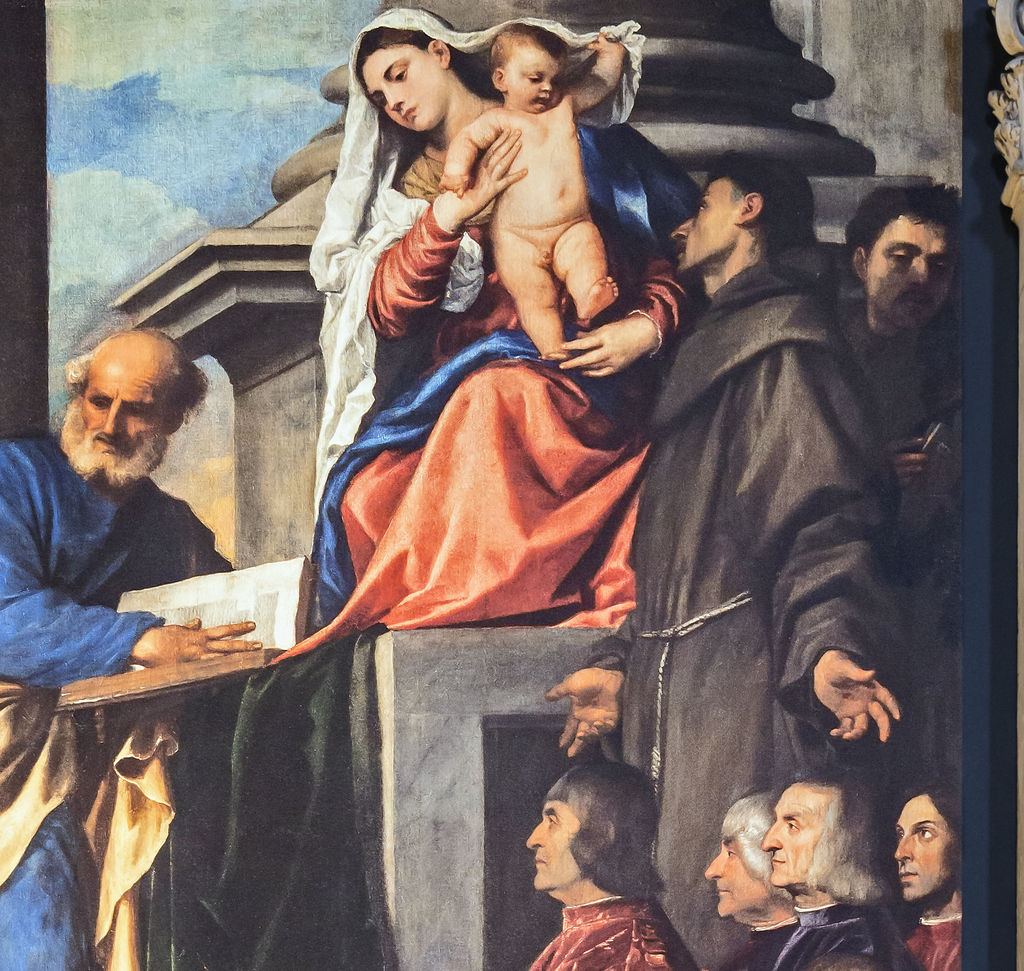
Virgin and saints
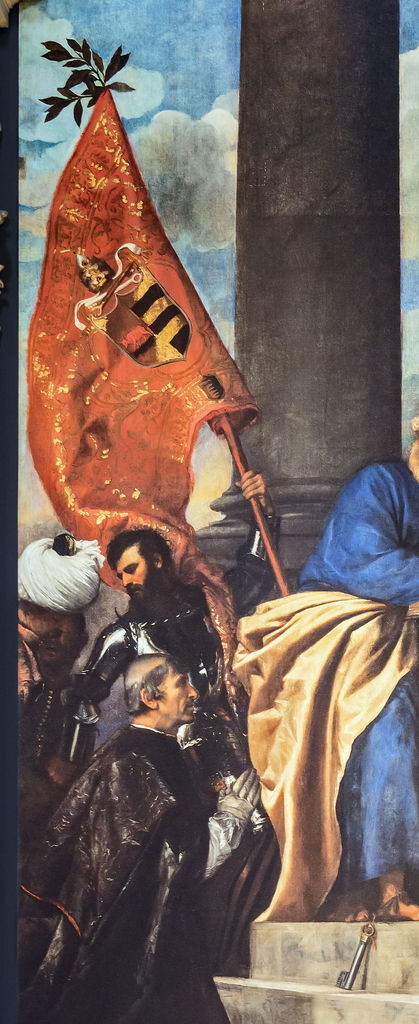
Flag and Jacopo Pesaro
Pesaro family portraits
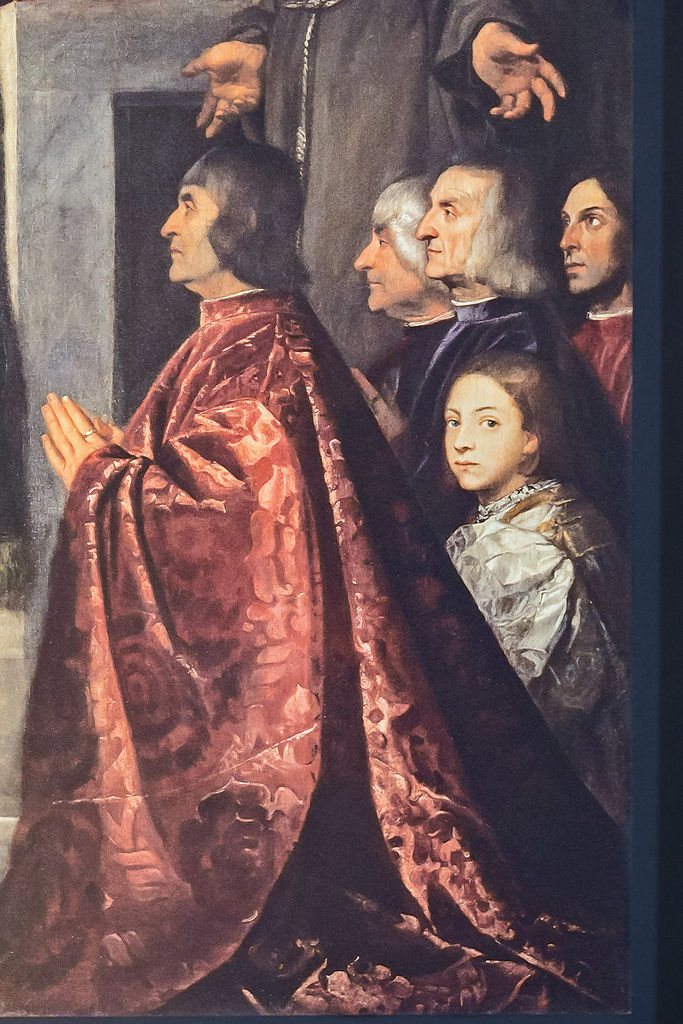
Photo: Didier Descouens / Archaeodontosaurus, CC BY-SA 4.0. Cropped and resized; derivative images CC BY-SA 4.0. Image source · Reuse licence
Contents
- What did Jacopo Pesaro commission?
- Who is represented?
- Why is the Virgin off-centre?
- Family memory within a sacred image
- Colour, light and scale
- Why was it removed in 2012?
- Why this altarpiece matters
What did Jacopo Pesaro commission?
The painting belongs to the tradition of the sacra conversazione, a Virgin and Child brought into a shared pictorial space with saints and worshippers. Here that gathering also contains donor portraits. The Pesaro kneel at the lower edges of the sacred scene, asking to be represented before Mary and Christ through holy intercessors. Their altar gave the family a place for worship and burial, so the picture’s promise of remembrance was tied to a physical site. The figures need not be imagined as taking part in a literal meeting; the composition makes spiritual relations visible.[1][3]
Jacopo’s civic and military past adds another layer. Save Venice identifies him as commander of the papal fleet in a 1502 victory by allied Christian forces over Turkish opponents. The red family banner on the left, the armoured figure and the turbaned man beneath it allude to that history. They do not turn the work into a documentary painting of a sea battle. Jacopo is not shown in a ship or at the instant of combat. His earlier public achievement is brought into a devotional encounter at the family altar.[1]
The placement of the banner is visually clever. It lifts a brilliant red triangle against sky and stone at the left, countering the Virgin’s red clothing high on the right. A viewer who first notices the Madonna may then move left to Jacopo’s group; another arriving from the nave may meet the banner before following the sacred figures upward. The family emblem is neither hidden nor the final focus. It opens a path through the image toward the Virgin and Child.[1]
Who is represented?
Jacopo and members of the Pesaro family kneel in the foreground. Their heads form a group of distinct portraits rather than anonymous worshippers. Save Venice notes that most donors are shown in profile, in the manner of donor portraits, while a boy on the right turns outward and looks at the viewer. He is a small figure in a large altarpiece, but that gaze creates a bridge from the family’s painted devotion to the person standing before the real altar. His place among the kneeling relatives makes the family’s hope of continued remembrance visible across generations.[1]
Saint Peter stands centrally on the steps, with a book and a key at his feet. He links Jacopo’s side of the picture to the raised throne. An armoured saint near the banner may be Saint George, but Save Venice leaves the identification qualified. Armour makes a warrior saint plausible; it does not supply an unambiguous name. At the right, Saint Francis and Saint Anthony of Padua accompany the Pesaro before Mary. Their presence speaks directly to the Franciscan Frari and helps bring the family’s chapel into the wider religious identity of the church.[1][2]
The Virgin is elevated but not remote. She bends toward the Child, who plays with or shares her veil. The small exchange of cloth gives life to the devotional summit. It also keeps attention on their relationship amid the grand columns and the ceremony below. Mary is the painting’s focus according to Save Venice: the saints and donors lead toward her, and the Christ Child’s gesture points beyond family status to his role in salvation.[1]
Above the group, two small winged figures carry a cross. Their placement invites a viewer to look higher than the Child’s present playfulness and toward his future Passion. The image thus includes both an immediate maternal moment and a longer Christian story. That detail is easily lost when the canvas is seen only at thumbnail size; at the altar, the upward extension of the columns and arch provides a route toward it.[1]
Why is the Virgin off-centre?
Save Venice connects the Madonna’s displaced position and the columns to the oblique angle of approach from the nave. A viewer coming along the church does not first meet a flat, frontal diagram. The picture’s rightward focus, diagonal steps and tall architectural elements make sense as a response to a real route through the interior. Its asymmetry is therefore purposeful in relation to a side altar. Titian could use the canvas to extend the viewer’s space rather than placing every participant beneath one central axis.[1]
The movement across the painting can be followed in more than one way. From the banner and kneeling Jacopo, the eye reaches Peter in blue on the steps, then climbs toward Mary and the Child. It may pass down through Francis and Anthony to the kneeling relatives at right. The boy’s direct gaze then returns it to the viewer. This is not a fixed instruction for how everyone must look; the red fabrics and pale sky offer other routes. The important point is that donor, saint and Madonna occupy a connected space despite their differing ranks and scales.[1]
Two immense columns stand behind the action and continue beyond the painted top. They make the sacred gathering feel housed in a space larger than the visible canvas. At the same time, the open sky between and beside them prevents the architecture from becoming a closed room. The steep steps lift the Virgin; the columns give vertical grandeur; the figures’ gestures keep the relationships human. The picture uses architectural illusion to support its devotional hierarchy rather than to show off perspective as an isolated trick.[1][2]
The Frari’s Assumption of the Virgin makes the contrast clear. Installed in 1518 over the high altar, it is meant to be seen on the church’s central axis, with Mary rising above the apostles. The Pesaro canvas followed soon after for a side altar and a named family. Both are large Marian pictures by Titian in one building, yet their different positions produced different solutions for composition and viewing. The paintings guide places them among his Venetian public works.[2][4]
Family memory within a sacred image
The family’s presence is more than a signature. Kneeling portraits ask for the prayers and memory of people who use the chapel. The banner brings Jacopo’s martial past into that act. Francis and Anthony bring the Franciscan setting into the same field, while Peter forms a connection on the other side. Titian allows the Pesaro to be recognisable people within a sacred hierarchy: they are not made the equals of Mary, but neither are they reduced to tiny figures outside the scene.[1]
The boy’s gaze is particularly effective in this context. Most of the painted adults direct themselves toward the Madonna or appear in profile. The child faces the person in front of the altar. We cannot infer his private thoughts or even a secure name from that visual fact. We can say that Titian has made a point of contact between the picture and its audience at the level of a family member rather than a saint. This invites the viewer to notice the donors again after following the rise toward Mary.[1]
The martial imagery also needs careful wording. The 1502 victory involved conflict with Ottoman forces, and the turbaned figure participates in the picture’s celebration of Jacopo’s role. Today that image should be described as part of the commission’s historical rhetoric, not accepted uncritically as a neutral portrait of an adversary. The altarpiece expresses how its patron wanted public achievement, religious duty and family status to be seen together. Its visible evidence is the standard, figures and their place in a Christian family altar.[1]
Colour, light and scale
The red banner at left, Mary’s red robe and the rich clothing at right balance the picture across a wide field of blue sky, pale stone and dark columns. Peter’s blue robe helps connect the military group and the throne. White fabric around the Virgin and Child concentrates light at the sacred centre, although that centre is shifted from the canvas’s midpoint. Colour works alongside perspective to carry a viewer from one group to another. The Frari guide singles out the work’s perspective, colour, drawing and portrait expression as reasons for its importance.[1][2]
The painting is nearly five metres tall. Its faces are large enough to register from some distance in the church, while attributes such as Peter’s key and the Child’s veil reward closer attention. A reproduction can make the whole picture easy to scan at once, but it cannot reproduce the effort of looking up at the columns or approaching from the nave. Titian designed a public image for a moving spectator. That difference between screen and site is central to the composition, not a minor inconvenience for modern visitors.[1][2]
The visible painted surface is also a historic surface. Its colours and details have been affected by age, humidity, earlier treatments and recent conservation. Describing strong reds and blues is a matter of looking at the current object; assigning each visible passage a pigment or claiming a particular underdrawing sequence would require an object-specific technical publication. The public Frari and Save Venice accounts provide detailed evidence about condition and treatment, but do not publish such a pigment map.[1][5]
Why was it removed in 2012?
An earthquake in May 2012 damaged the Pesaro altar and the wall and window above it. Conservators feared stone from the unstable structure could fall onto the painting, so it was taken down and moved within the Frari for examination. Save Venice reports that the painted surface was unstable and at risk of flaking. Investigation linked the problem partly to high humidity and sharp changes in humidity and temperature. The danger concerned both the altarpiece and the church fabric around it; safe treatment required attention to each.[1]
The object had been treated before: Save Venice records a restoration in 1978. The later campaign therefore had to distinguish Titian’s paint from layers added during earlier care. The Frari’s Italian update reports that old consolidants and varnishes had aged and stiffened, contributing to risk. Conservators gradually removed non-original materials under magnification after scientific examination, with a stated aim of minimal intervention. That record gives a concrete reason for cleaning; it does not imply that all marks of age can or should be erased.[1][5]
From 2013 to 2014, the canvas and altar area were examined and stabilised, with the painting in a temporary laboratory inside the church. A later two-part treatment began in 2016. Save Venice describes small applications of sturgeon glue to secure lifting paint, modern solvents for carefully selected surface work and an adjustable tension system added to the stretcher. A layer of organic wool at the back helps insulate the canvas from the exterior brick wall behind the altar. These are conservation measures for a vulnerable oil painting; none should be mistaken for Titian’s own materials or process.[1]
The marble altar elements and damaged window and wall were also restored. The altarpiece returned to its family altar in September 2017. That reinstallation is important for more than continuity of location: the sideward approach and relationship of image to stone can again be experienced where they matter. Conservation addressed both the material risks and the possibility of seeing the composition as Titian intended it to function in the church.[1]
Why this altarpiece matters
The subject of the Virgin and Child with saints was familiar. Titian’s solution joined it to an unusually specific site and patronage. A family chapel required recognizable donors and an enduring memorial; a Franciscan church gave Francis and Anthony particular significance; the patron’s naval past called for a visible banner; the side altar invited a slantwise composition. Titian brought those demands together without losing Mary and the Child as the devotional goal. The painting’s originality is easiest to understand when the physical altar and the painted relationships are considered together.[1][2][3]
The work also shows Titian continuing to rethink large-scale sacred painting after the Assunta. The earlier high-altar image sends Mary upward through a central column of figures. The Pesaro Madonna draws worshippers across a space with steps, patrons, saints and columns before lifting them toward an off-centre throne. One church thus preserves two different answers to how an altarpiece can guide devotion. Both remain in the Frari, where their distinct viewing positions can still be tested.[1][2][4]
Researched Titian and related works
Frequently Asked Questions
Titian painted it in 1519–26 after Jacopo Pesaro acquired the family altar in 1518. The National Gallery of Art also gives 1526 as its completion date.[1][4]
On the Pesaro family altar in the Basilica di Santa Maria Gloriosa dei Frari, Venice. It was reinstalled there in September 2017 after conservation.[1]
Save Venice connects her off-centre placement and the columns to the oblique view from the nave toward this side altar.[1]
Jacopo Pesaro and family members are shown as donors. Most are in profile; a boy at the right looks toward the viewer.[1]
Possibly. Save Venice identifies him as a warrior saint, possibly Saint George; the exact name should remain qualified.[1]
The altar area, wall and window above the painting were damaged, creating a risk from falling stone. The picture was removed for examination, treated and returned in 2017.[1]
Discussion
What do you notice when you look closely at Titian’s Pesaro Madonna at the Frari?
Share a specific observation or a source that adds context.
Reader Insights
Which detail changes your reading?
How does its original setting affect what we see?
Which part of the evidence remains uncertain?
Join the Conversation
Add your observation below.
References
- Save Venice, “Titian’s Madonna di Ca’ Pesaro Altarpiece in the Basilica dei Frari,” commission, iconography, dimensions and conservation history. View source.
- Basilica di Santa Maria Gloriosa dei Frari, official Italian visitor guide (2023), Pesaro and high-altar works. View source.
- Metropolitan Museum of Art, “Venice and Northern Italy, 1400–1600,” Heilbrunn Timeline of Art History, on the Pesaro commission and sacra conversazione. View source.
- National Gallery of Art, Washington, “Titian,” artist biography, Frari sequence and completion date. View source.
- Basilica di Santa Maria Gloriosa dei Frari, “Madonna di Ca’ Pesaro: aggiornamento sui lavori di restauro,” Italian owner conservation update. View source.


