 by Tom Gurney
Tom Gurney BSc (Hons) is an art history expert with over 20 years experience
Published on June 19, 2020 / Updated on October 15, 2026
Email: tomgurney1@gmail.com / Phone: +44 7429 011000
Titian’s Adam and Eve: The Fall of Man in the Prado: Introduction
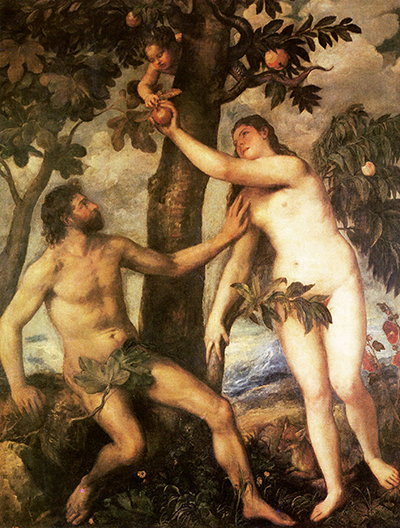
Eve reaches toward a fruit offered from a tree by a strange figure with a child’s body and a serpent’s tail. Adam sits below, his hand pressing toward her as if to interrupt the exchange. Titian’s Adam and Eve, also called The Fall of Man, is in the Museo Nacional del Prado, Madrid, inventory P000429. The museum dates its oil-on-canvas painting about 1550 and gives its size as 240 × 186 centimetres. Its precise year and first owner are not established. The Prado also owns a separate adaptation by Peter Paul Rubens, inventory P001692, made in 1628–29. These two large canvases can be compared, but their artists, paint layers and histories must remain distinct.[1][3]
Titian has chosen a moment of decision rather than the expulsion from Eden. The fruit has reached Eve’s hand but is not shown being eaten. The seated and standing bodies, the tree between them and the small child-serpent make temptation a tightly organized encounter. The Prado’s technical study reveals that this was not Titian’s first arrangement. He changed how Eve received the fruit while working on the canvas, giving the serpent a more explicit role in the action.[2]
At a Glance
- WorkThe Fall of Man
- Research recordMuseo Nacional del Prado
Contents
- An exchange among three figures
- What Genesis says, and what Titian adds
- What the X-ray reveals
- Date, Pérez and the royal collection
- Rubens’s answer to Titian
- How to look at the Prado original
An exchange among three figures
Adam’s seated body occupies the left and lower part of the painting. He looks up toward Eve, who stands at the right and stretches one arm above her head. The child-serpent leans down from the tree and presents the fruit between them. The tree trunk makes a dark central division, yet the reaching arms cross that division. The eye moves from Adam’s restraining hand through Eve’s body to the raised fruit. Titian places the choice at the intersection of those movements.[1]
The hybrid tempter is not a snake merely curled around a branch. It has a childlike upper body and a forked serpentine tail. Its visible hand makes the offering almost human, while the tail denies a fully human identity. That mixture gives the act of persuasion a face and gesture. The Prado emphasizes the child-serpent because it changes the drama: Eve is no longer simply picking something within reach; she is accepting what a tempter places before her.[2]
A small fox appears near Eve’s feet, according to the museum’s iconographic account. It is easy to miss beside the two large human bodies. In the Prado’s reading, the animal belongs to a set of symbols of deceit and lust; it is not named in Genesis. The fig leaves around the figures offer a different kind of clue. The biblical story says Adam and Eve use fig leaves to cover themselves after eating. Titian brings that later consequence into the same image as the fruit’s offer, letting the viewer see the decision and its anticipated result at once.[1][4]
The landscape is vivid around the figures. Foliage frames the high exchange, with openings of light beyond. Titian’s darkening of Eve’s face at the decisive moment also matters. The Prado relates this dramatic device to a practice visible earlier in his work. Her body is strongly illuminated, but the face is not presented as a bright, easy-to-read portrait. That difference can keep attention on her act of reaching and on the moral tension it carries rather than on a simple account of her expression.[2]
Adam and Eve are monumental, nearly filling the picture’s height. The Prado notes that the figures are clearly modelled and compares Adam’s body with the antique sculpture known as the Dying Gaul. It also mentions possible relationships to Raphael’s seated-Adam/standing-Eve design, Dürer’s 1504 engraving and the Farnese Bull. These are art-historical proposals about sources Titian may have studied or remembered. The viewer can follow the bodily arrangement without treating any one comparison as a documented act of copying.[1][2]
What Genesis says, and what Titian adds
Genesis 3 describes the woman taking fruit from a tree, eating it and giving it to the man, who also eats. The passage calls it fruit; it does not say apple. Titian follows a later, familiar visual convention by painting an apple. The Prado explicitly notes that distinction. Genesis then says the pair recognize their nakedness and make coverings from fig leaves. Titian’s picture does not need to show the entire sequence in separate scenes: the apple, fig leaves and poised gestures let a viewer understand both the imminent action and its consequence.[1][4]
Neither the fox nor the childlike body of the serpent is specified by the biblical passage. Those are pictorial decisions that intensify the story’s moral terms. The small animal can be read symbolically; the hybrid figure makes temptation active and visible. Calling every detail a literal quotation of Genesis would miss Titian’s work as a painter. He turns a written exchange into an arrangement of bodies, props, looks and oblique signs.[1][2][4]
The central moment is therefore slightly earlier than Genesis’s report of eating. Eve holds or receives the apple, while Adam’s reach suggests resistance. This distinction guards against an overly simple description in which both have already eaten. Titian uses the threshold before consumption to make the viewer dwell on choice. Yet the fig leaves already disclose the outcome. The painting holds future consequence close to present action.[1][4]
What the X-ray reveals
The Prado’s Spanish-language account gives a detailed description of the painting beneath its visible surface. X-radiography shows Adam more upright and differently turned in an earlier stage. His right leg stood closer to the left, and his right arm was less sharply angled. Eve’s face and hip were slightly differently placed, while her forward-reaching arm lay lower. These are physical observations about P000429, not a speculative reconstruction based only on stylistic resemblance.[2]
The most consequential revision concerns the fruit. The Prado says Titian first painted Eve taking an apple directly from a lower branch. He then introduced the child-serpent to offer it from a higher position, raising Eve’s arm to meet the new exchange. The two branches of the earlier design were reused in the tempter’s forked tail. This is a rare case in which a technical image helps explain a change of narrative emphasis: Titian gave the tempter a more explicit role between fruit and woman.[2]
The museum is frank about what it considers an awkward outcome. It argues that Eve’s wrist twists unnaturally to keep the apple visible and that Adam’s anatomy is overly tied to a sculptural model. Those are the Prado author’s aesthetic judgments, not facts as certain as the existence of an underpainted arm. The contrast between an admired landscape colour and less convincing bodily passages is part of the museum’s interpretation. A reader can examine the final painting while understanding that even a celebrated Titian may prompt critical disagreement about individual forms.[2]
The X-ray also gives a useful warning about artistic process. The final arm and child-serpent are not simply “corrections” toward a preordained right answer. They are choices with gains and costs. The new design makes temptation explicit; the raised reach produces a more complex bodily twist. The guide to Titian’s technique discusses how such imaging evidence can reveal revision while leaving the visible canvas as the work that Titian ultimately presented.[2]
Date, Pérez and the royal collection
The Prado dates the canvas about 1550, while acknowledging that no exact date or original owner is known. It usually identifies the painting with a large Titian Adam and Eve listed among the possessions of Antonio Pérez. The English object essay dates that inventory to 21 May 1585. The Spanish essay unexpectedly prints 21 May 1558 for the same entry. The museum also states in both languages that the painting passed from Pérez to Philip II in 1585. Without the original inventory before us, the bilingual discrepancy should be left visible rather than silently changed to whichever year appears more convenient.[1][2]
The museum notes that Titian painted for Antonio’s father Gonzalo Pérez from the 1530s and that Gonzalo still received works by Titian in 1573. This contact makes a family connection plausible but does not reveal which Pérez first acquired P000429 or when. A known professional relationship is not a commission document for this canvas. The painting’s large scale and royal destination are secure parts of its later history; its first transaction remains uncertain.[1][2]
After the 1585 transfer, the work belonged to Philip II. It hung in the Madrid Alcázar, initially in a sacristy according to the Prado’s account. Before 1636 it moved to the so-called Titian vaults, rooms that displayed valued nudes from the royal collection. This move from a sacred to a more secular setting changed the company in which viewers saw Adam and Eve, even though the canvas itself stayed in the same palace.[2]
Rubens saw it during his second Spanish stay in 1628–29 and made his adaptation there. Titian’s original remained in the Alcázar until the 1734 fire. The Prado records it at the Buen Retiro in 1746, later in the new Royal Palace, and in the Prado from 1827. Each step belongs to Titian’s P000429. Rubens’s P001692 has a different ownership path after it left his hands.[1][2][3]
Rubens’s answer to Titian
The Prado’s Rubens canvas is nearly the size of Titian’s, at 238 × 184.5 centimetres, but it is not a mechanical duplicate. Rubens intensified the colours, gave Adam a more muscular body and changed his pose. He also added a parrot absent from Titian’s painting. The Prado reads that bird as a sign of good or redemption, set against the fox associated with evil and lust. These changes make the later canvas an interpretation of the earlier one.[3]
Rubens’s Adam is especially revealing. The Prado says his altered pose comes closer to an underpainted earlier position of Adam in Titian’s original. That resemblance does not mean Rubens saw an X-ray; none existed for him. He saw the surface painting and worked out his own solution to the figure. Later technical imaging lets us compare his solution with a stage Titian had covered. The relationship is visually and historically striking without requiring an impossible direct borrowing from a hidden image.[1][2][3]
The Prado connects Rubens’s more forceful Adam to the Belvedere Torso, a classical sculpture he studied. Titian’s Adam had been compared with the Dying Gaul. This is an instructive contrast in artistic models: two painters used antique bodies in their own ways to rethink the same biblical pair. The Prado’s Spanish essay even judges Rubens’s adaptation to surpass Titian’s original. That is a curatorial evaluation, not a requirement that every viewer prefer the copy.[2][3]
One further technical finding concerns Rubens’s copies, not Titian’s picture. A Prado study of the canvases for Rubens’s Adam and Eve and his adaptation of Titian’s Rape of Europa found related textile evidence consistent with both having been painted in Madrid. It supports the location of Rubens’s copying activity. It does not describe the weave, ground or condition of Titian’s P000429.[5]
The later painter’s work helps us look back at Titian more carefully. Rubens keeps the fundamental encounter of seated man, standing woman and offered fruit, yet asks how Adam’s body and the moral signs might work differently. Seeing P000429 beside P001692 makes copying visible as analysis carried out in paint. Returning to Titian after the comparison, Eve’s raised arm and Adam’s restraint become choices within a developing composition rather than features that could never have been otherwise.[1][2][3]
How to look at the Prado original
Begin at the fruit and follow the exchange in both directions: up to the child-serpent, down Eve’s arm and toward Adam’s outstretched hand. Look for the fox and fig leaves near the bottom, where the consequence of the choice is hinted before it occurs. Then consider the hidden design reported by the Prado. Eve once reached to a lower branch herself; Titian changed that by adding a figure who gives her the fruit. The final image makes temptation a visible intervention between the two humans and the tree.[1][2]
The museum’s records give this painting a precise identity despite unresolved beginnings: P000429, about 1550, oil on canvas, in the Prado after a long Spanish royal history. Genesis supplies the story; Titian supplies its particular bodies, symbols and revised gestures; Rubens supplies a later, separate response. Keeping those layers of evidence apart allows the painting to be read as both a biblical image and a material work whose composition changed while it was made.[1][2][3][4]
Researched Titian and related works
Frequently Asked Questions
It is in the Museo Nacional del Prado, Madrid, as Adam and Eve, inventory P000429. The museum dates it about 1550 and records an oil canvas measuring 240 × 186 centimetres.[1]
No. Genesis 3 says fruit. The Prado notes that Titian followed visual tradition by making it an apple.[1][4]
The Prado’s X-ray shows that Eve originally took fruit from a lower branch herself. Titian then added the child-serpent to offer it and repositioned her arm. Adam’s pose also changed substantially.[2]
The Prado says the first owner is unknown and identifies it only probably with an Antonio Pérez inventory entry. The English and Spanish object texts disagree on that entry’s printed date; the later transfer to Philip II in 1585 is separately recorded.[1][2]
No. Rubens made a separate adaptation in 1628–29, Prado P001692. He changed Adam’s body and pose and added a parrot.[3]
Discussion
What do you notice when you look closely at Titian’s Adam and Eve: The Fall of Man in the Prado?
Share a specific observation or a source that adds context.
Reader Insights
Which detail changes your reading?
How does its original setting affect what we see?
Which part of the evidence remains uncertain?
Join the Conversation
Add your observation below.
References
- Museo Nacional del Prado, “Adam and Eve,” Titian, collection record P000429, English. View source.
- Museo Nacional del Prado, “Adán y Eva,” Titian, Spanish collection essay P000429, with detailed X-ray findings and provenance. View source.
- Museo Nacional del Prado, “Adam and Eve,” Peter Paul Rubens after Titian, collection record P001692. View source.
- The Holy See, New American Bible, Book of Genesis, chapter 3. View source.
- Museo Nacional del Prado, “Aracne: estudiando los lienzos de los cuadros,” textile study of Rubens’s Titian copies. View source.