 by Tom Gurney
Tom Gurney BSc (Hons) is an art history expert with over 20 years experience
Published on June 19, 2020 / Updated on October 15, 2026
Email: tomgurney1@gmail.com / Phone: +44 7429 011000
Titian’s Venus with an Organist and a Dog: Introduction
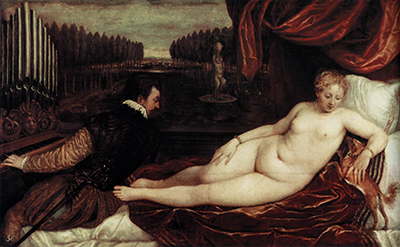
A woman reclines on a red velvet bed before a garden view. At her feet a musician turns from a small organ to look at her; she looks instead toward a little dog at the right edge of the bed. Titian built this large, horizontal canvas around those different directions of attention. The Museo Nacional del Prado identifies it as Venus with an Organist and a Dog, about 1550, oil on canvas, 138 × 222.4 centimetres, inventory P000420. It is also called Venus with an Organist and a Little Dog. The Prado’s inventory number keeps it separate from a second Venus and organist canvas in the same museum.[1][2]
The scene joins a mythological name, an individualized woman, a player absorbed by her beauty, and the domestic sign of a lap dog. The Prado argues that this particular variation may have been made in a marital context, while also recording wider scholarly debate about erotic and philosophical meanings in Titian’s Venus-and-musician pictures. It does not name a bride, groom or first commissioner. The painting rewards close looking precisely because its sensual appeal and possible social purpose are intertwined rather than neatly explained by a single symbol.[1]
At a Glance
- WorkVenus with an Organist and a Dog
- Research recordMuseo Nacional del Prado
Contents
- Reading the exchange of looks
- What the X-ray shows
- Is she Venus, or a contemporary woman?
- A variation, not a single five-part commission
- The reclining Venus tradition
- Ownership and travel
Reading the exchange of looks
The organ occupies the far left; the musician sits beside it in dark clothing. His body faces the keyboard, but his head turns toward the reclining woman. The woman’s body lies across the foreground, one arm along the bed and the other near the dog, while her head turns away from the player. The spectator can follow a path from instrument to musician to woman to animal, but the gaze does not loop back to the man. The apparently minor dog gives the encounter its final direction.
The garden opens beyond the bed and organ. A fountain, tall trees and small figures in the landscape set the indoor exchange against an ordered outdoor space. A heavy curtain falls at the upper right, making the foreground feel like a private chamber or sheltered pavilion. The exact architecture is less important than the contrast: within, a close and bodily encounter; beyond, a social landscape in which other people move.[1][2]
The player’s hands and the organ’s pipes make music visible without letting the viewer hear a note. The Prado’s musical-object description identifies a small positive organ and observes that the musician plays with his left hand while he looks toward the woman. The instrument is cut off at the edge of the canvas; what we see is enough to recognize the pipes, keyboard and decorated case. The musical act is therefore present, but looking increasingly seems to compete with playing.[3]
Venus herself does not return the player’s gaze. She turns to the dog, and the animal’s presence may make the moment seem affectionate or domestic rather than purely confrontational. Yet the musician and the viewer still look at her exposed body. Titian arranges an asymmetry between the person who sees and the person seen. The work’s pleasure in rendering flesh, velvet and music does not remove that imbalance; it makes it one of the scene’s central tensions.
What the X-ray shows
The Prado’s account of X-radiographs makes the current exchange of looks even more significant. Titian first placed the woman differently, reclining more openly and meeting the musician’s gaze. He later changed her head so that she looks toward the small dog, which was added to the composition. These are technical findings about changes during execution, not merely a modern guess prompted by the finished image.[1]
The museum suggests that Titian or a client may have considered the original arrangement too provocative. That is an interpretation of motive; no surviving statement from either person proves why the revision was made. What the material evidence securely establishes is that the relationship between the two central figures changed. The final picture redirects the woman’s attention away from the musician and gives the viewer a more complex sequence to read.[1]
The dog is therefore more than an accessory inserted to fill a corner. Its addition gave the woman a new focus and changed the emotional tone of the scene. The Prado calls P000420 the prime version among these related compositions in part because its technical evidence shows Titian reworking the idea on the canvas. A later painting may closely repeat an image, but this one preserves a visible history of invention beneath its surface.[1][2]
There is an ethical and interpretive difference between describing that alteration and claiming to know that it made the woman “modest.” The Prado proposes a shift away from a more daring mutual gaze; viewers can also observe that she is still displayed for the organist and for us. The revision has changed the narrative balance rather than removing the image’s erotic character.
Is she Venus, or a contemporary woman?
The Prado retains the conventional title Venus with an Organist and a Dog, placing the canvas in Titian’s group of paintings of the reclining goddess with a musician. But the museum also points out that the woman in P000420 lacks Cupid, the clearest attribute that names Venus in related versions. Both principal figures have more individualized features than the corresponding pair in the Prado’s later Cupid version. The woman wears a wedding ring on her right hand. Taken together, those details lead the Prado to propose a particular matrimonial setting for this painting.[1][2]
This does not mean that a documented portrait sitter has been identified. The ring and individuality support the hypothesis of a painting made for or connected with marriage, not the names of the couple. It is also possible for an image to invoke Venus while drawing on the features and expectations of living people. Renaissance mythological paintings often allow a mythic role and a contemporary social reading to coexist.
The Prado reads the dog as a sign of fidelity. It also interprets the donkey and peacock in the garden within a language of enduring love and fertility. Those meanings are part of the museum’s explanation of a marriage reading. They should be treated as iconographic proposals, not as labels Titian wrote onto each animal. The garden can simultaneously be enjoyed as a landscape and read as a setting rich in suggestions about union and household life.[1]
Another body of scholarship reads the Venus-and-musician pictures as reflections on the senses. An organ supplies hearing; the musician’s look and the spectator’s experience foreground sight. The Prado summarizes this line of interpretation alongside more direct erotic readings and warns against applying one formula to all five known Venus-and-music canvases. Their owners differed, and Titian and his studio varied the figures and details. P000420’s ring, individualized couple and altered gaze make it especially important to consider on its own terms.[1]
A variation, not a single five-part commission
The Prado identifies five paintings by Titian on the Venus-and-music idea: three with an organist and two with a lute player. The organist pictures are in Madrid and Berlin; the lute-player versions are in New York and Cambridge. The goddess turns toward a dog or Cupid according to the version. These are related inventions, but the museum emphasizes that they were not created as a unified commission for one patron or intended to hang together.[1][2]
P000420 is the Prado’s dog version. The same museum’s P000421, Venus with an Organist and Cupid, is a different canvas dated about 1555. The Prado says Titian transferred the main outlines and many setting elements from the earlier version, then made telling changes. Cupid replaces the dog, clearly identifying Venus. Her upper body, head and left hand change to accommodate him; the musician’s face, curtain, landscape and velvet folds also vary. The later work is thus a reworking of the model, not a second photograph of P000420.[2]
The Berlin Venus with the Organ Player, inventory 1849, is another distinct object. Berlin’s collection record dates it to around 1550 and discusses Titian’s habit of developing successful inventions with varying degrees of workshop involvement. Its record notes changes in the Berlin painting itself as evidence relevant to its authorship. None of those Berlin-specific findings should be transferred to the Prado’s dog canvas. They help establish how Titian’s shared theme could generate physically separate works with different histories.[4]
Two other versions exchange the organist for a lute player. The Metropolitan Museum of Art holds a Venus and the Lute Player in New York, while the Fitzwilliam Museum holds another in Cambridge. Their instruments, companion figures and individual object histories belong to those paintings. The Titian paintings guide links the wider sequence, and the local Venus and Cupid with an Organist page concerns the Berlin object. The inventory numbers and museums prevent related titles from becoming interchangeable.[1][4][5]
The reclining Venus tradition
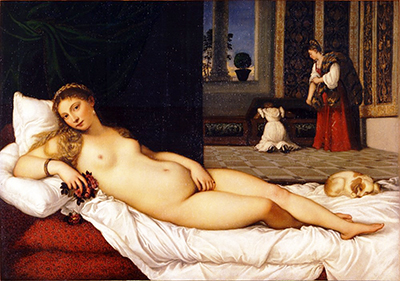
The Prado situates this series within a longer line of reclining female nudes, reaching back through the Sleeping Venus associated with Giorgione and Titian and Titian’s Venus of Urbino. Here the addition of a musician changes the structure. A solitary or sleeping figure becomes part of an encounter, and the act of looking is represented inside the picture as well as experienced by the viewer.[1]
The bed and rich fabrics are important to that encounter. Warm red velvet forms a long base for the pale figure. A white sheet picks out the contours of the body, while the curtain frames the upper right. Titian makes the figure stand forward against a darker, complex background. These visible choices join flesh, textile and landscape in a single field, a quality for which his Venetian colour painting was celebrated. Yet the painting also turns on something small: the direction of two heads and the added dog.[1]
The musical instrument can suggest harmony, but the scene is not a straightforward illustration of harmony achieved. The player diverts his attention from the keyboard; the woman looks elsewhere. The viewer is placed between their sensory experiences and invited to notice the gap. This is one reason the philosophical account of sight and hearing is helpful without being sufficient: the visible gazes and the unheard music do not simply resolve into an allegorical equation.[1][3]
Ownership and travel
The Prado traces this painting to Francesco Assonica, a Venetian lawyer, in 1622. Anthony van Dyck copied it in his Italian sketchbook while it was in Venice. It then passed into the collection of Charles I of England and was dispersed after his death. The Prado’s detailed provenance records Colonel John Hutchinson in 1649 and Luis Méndez de Haro before the Spanish Royal Collection.[1]
Spanish royal inventories place it in the Madrid Alcázar in the later seventeenth century and in later palace settings. The Prado’s object record includes a stay in the reserved room of the Royal Academy of Fine Arts of San Fernando from 1817 to 1827. The museum gives 1827 as its Prado entry. That itinerary is more precise than saying only that it “came from the royal collection,” and it distinguishes this picture from the later Prado Cupid version, whose early documented history differs.[1][2]
The record does not identify the person who first ordered P000420 from Titian. Assonica is a documented seventeenth-century owner, not automatically the original patron of a painting made around 1550. The marital interpretation belongs to the object’s imagery and Prado scholarship; the provenance does not yet supply names for an original couple.[1]
Researched Titian and related works
Frequently Asked Questions
No. P000420 is the dog painting, dated about 1550. P000421 is a separate canvas with Cupid, dated about 1555. Titian reused and altered the design.[1][2]
X-radiographs show that Titian changed her earlier mutual gaze with the musician and added the dog. The Prado proposes that the first arrangement may have seemed too provocative, though the motive cannot be proved.[1]
The Prado argues for a marital setting from the woman’s ring, the individualized figures and details in the garden. No first patron or named bride and groom are securely identified in its record.[1]
In the Museo Nacional del Prado, Madrid, as inventory P000420. It is an oil painting on canvas, 138 × 222.4 centimetres.[1]
Discussion
What do you notice when you look closely at Titian’s Venus with an Organist and a Dog?
Share a specific observation or a source that adds context.
Reader Insights
Which detail changes your reading?
How does its original setting affect what we see?
Which part of the evidence remains uncertain?
Join the Conversation
Add your observation below.
References
- Museo Nacional del Prado, “Venus with an Organist and a Dog,” collection record P000420, essay and provenance. View source.
- Museo Nacional del Prado, “Venus with an Organist and Cupid,” separate collection record P000421. View source.
- Museo Nacional del Prado, P000420 musical-object record for the depicted positive organ, within the collection entry. View source.
- Staatliche Museen zu Berlin, “Venus mit dem Orgelspieler,” Gemäldegalerie inventory 1849. View source.
- The Metropolitan Museum of Art, “Titian, Venus and the Lute Player,” object 36.29. View source.