



 by Tom Gurney
Tom Gurney BSc (Hons) is an art history expert with over 20 years experience
Published on June 19, 2020 / Updated on October 15, 2026
Email: tomgurney1@gmail.com / Phone: +44 7429 011000
Titian’s Ecce Homo in Dublin: A Close Look at Christ Shown to the People: Introduction
Christ lowers his head beneath a crown of thorns. His eyes are cast down, his wrists are bound, and a reed crosses the narrow space beside him. These are the first things to look for in Titian’s Ecce Homo at the National Gallery of Ireland, Dublin. The painting does not show Pontius Pilate or the crowd that condemned Jesus. It brings the injured figure close enough for the viewer to see the consequences of their actions. The gallery dates this oil on canvas to 1558–1560; it measures 73.4 × 56 centimetres and is numbered NGI.75.[1]
The title comes from Pilate’s presentation of Jesus in the Gospel of John, chapter 19: “Behold the man.” The purple robe, thorn crown and reed were part of a cruel imitation of royal insignia. Titian retained these signs of humiliation while leaving the people who inflicted it outside the picture. The result is neither a full biblical crowd scene nor a neutral portrait of an individual. It is an image designed to make the viewer attend to suffering, and possibly to meditate on its religious meaning. The gallery’s Irish-language account suggests that the work may have been painted for private devotion; no identified original patron or room follows from that suggestion.[1][2]
At a Glance
- WorkEcce Homo (Dublin)
- Research recordonlinecollection.nationalgallery.ie
Annotated details from Ecce Homo (Dublin)
Select a numbered area to find its detail below. Open a detail image to view it larger.
Details from ECCE HOMO (DUBLIN)
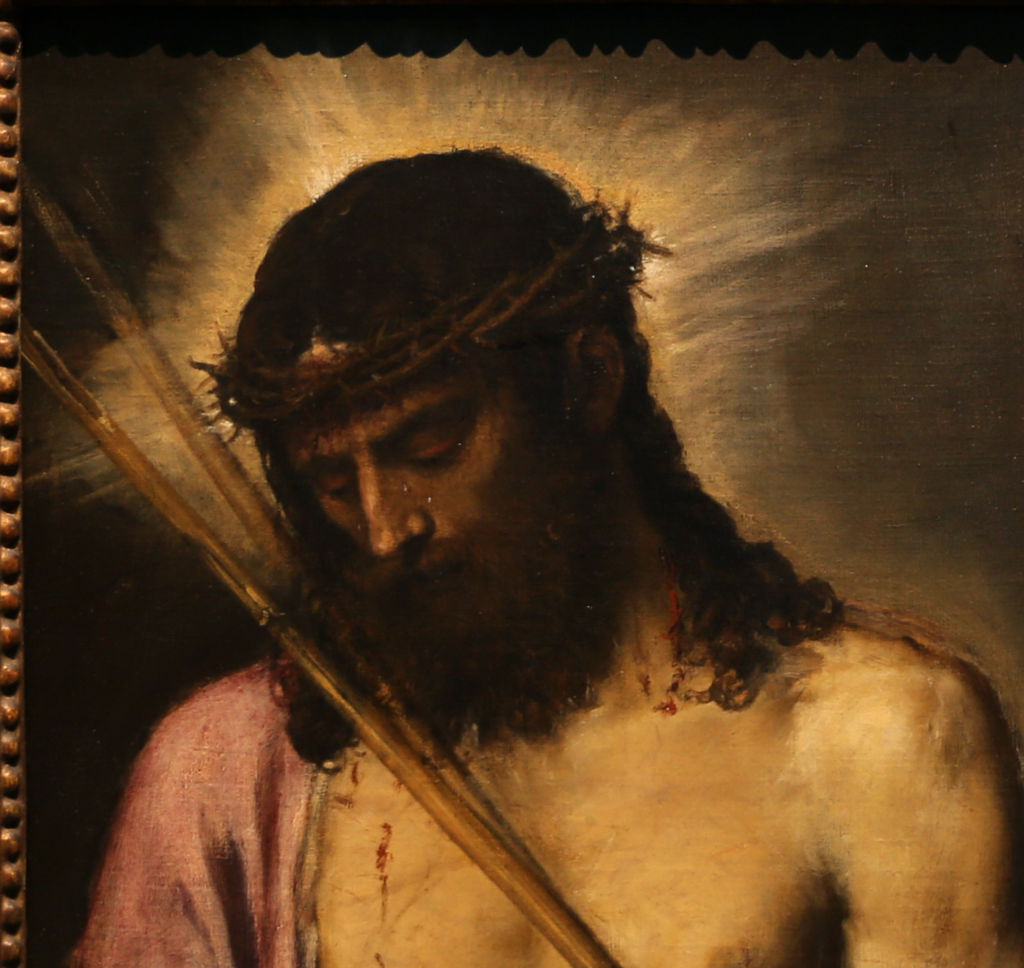
Ecce Homo Face and Reed
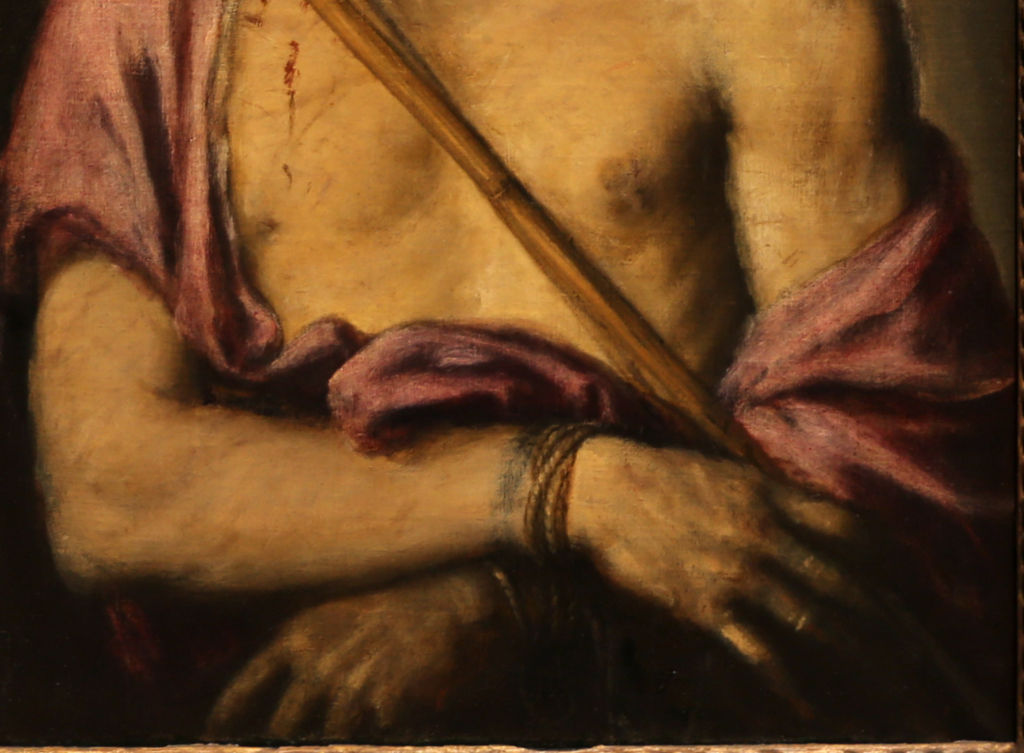
Ecce Homo Bound Hands
Ecce Homo National Gallery of Ireland Frame
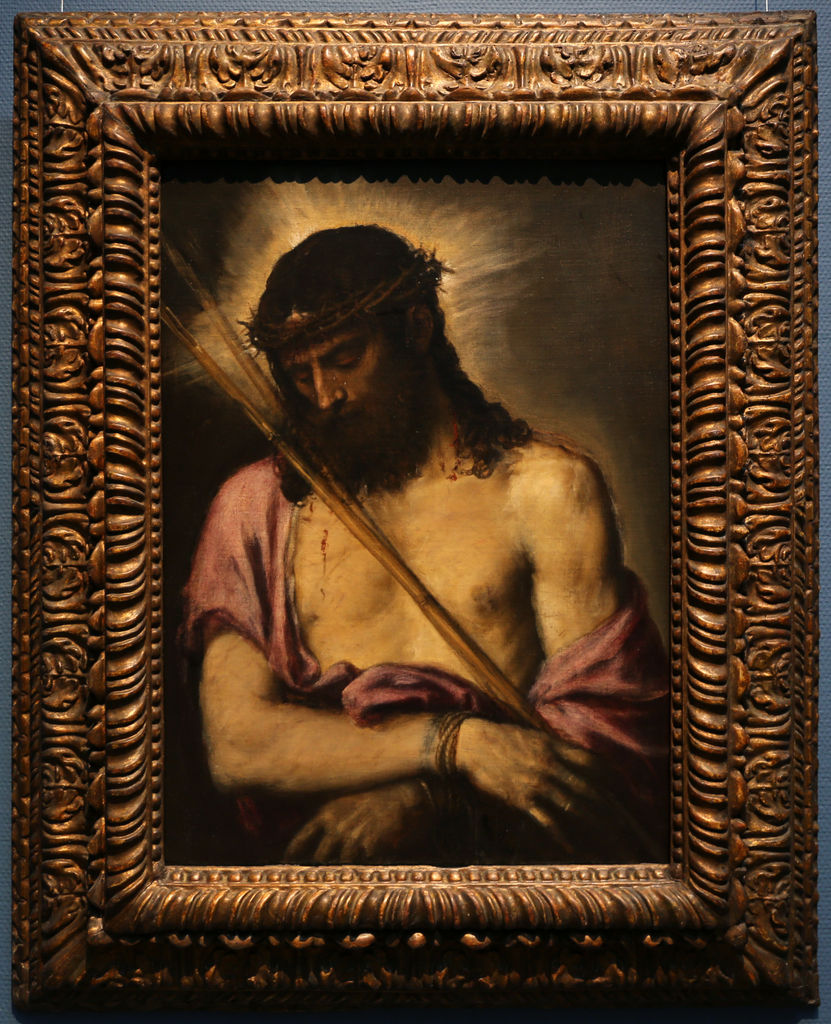
Photo: Sailko, CC BY 3.0. Cropped and resized for the splash and details. Image source · Reuse licence
Contents
- What the painting actually shows
- The moment behind “Behold the man”
- Titian’s handling and his changes
- Titian painted more than one Ecce Homo
- From a queried early owner to Dublin
- How to look at the Dublin painting
What the painting actually shows
Christ’s figure occupies most of the vertical canvas. His exposed torso, purple-red drapery, bowed face and hands make a sequence that the eye can follow downward. Against the dark surrounding field, the lighter flesh and the area around his head remain legible even in a relatively small reproduction. Blood and tears are part of the image, as the owning gallery emphasizes, but the painting does not make injury its only subject. The pose, the constrained hands and the contrast of light and darkness also ask how this person meets humiliation.[1][2]
The lowered gaze is especially important. Christ does not stare out at us. His head bends, and his eyes turn down. That refusal or inability to meet another gaze changes the relationship between painting and viewer. We see him at close quarters, but he does not perform an appeal through direct eye contact. The viewer must decide how to respond to a body that appears both present and inwardly withdrawn. The National Gallery of Ireland describes him as powerless and tearful; the direct visual evidence supports that description more strongly than any claim of an assertive frontal confrontation.[1]
The bound wrists draw attention to an action done to Christ rather than an action he performs. The reed is the mock sceptre given to him in the Passion story. In the picture it also makes a conspicuous diagonal among the softer turns of body and cloth. The thorns interrupt the head’s outline and identify the episode even though there is no architectural setting or group of guards to explain it. Those few objects carry much of the narrative information that a larger painting could distribute among many figures.[1][2]
It is worth looking at the robe as part of the same visual argument. Purple is the colour named in John’s account of the soldiers’ mockery, an imitation of royal dress. Here the drapery crosses the injured body without concealing it. The sign of supposed kingship and the visible wounds occupy the same small space. That conjunction gives the word Ecce—an instruction to look—particular force. We are asked to look at what the mock ceremony has done to its subject, although the ceremony itself is largely absent.[1][2]
The moment behind “Behold the man”
In John 19, Pilate has Jesus scourged; soldiers place the thorn crown and purple garment on him and mock him. Pilate then presents him outside and says the words from which the painting takes its title. Titian’s canvas does not illustrate every detail of that sequence. Pilate is invisible, as are the soldiers and the gathered people. The reed, crown, robe, wounds and binding supply a condensed account of what has already happened. The title locates this solitary figure within the public episode.[1][2]
That distinction matters because an Ecce Homo image can use the same title for different compositions. A viewer might expect to see a ruler speaking from a platform or a crowd reacting in anger. Dublin’s picture offers neither. It holds the figure at a scale suitable for sustained close looking and turns the public presentation into a concentrated encounter. Calling it “a scene with Pilate” would obscure the unusual choice Titian made here: Pilate’s words survive, but the speaker does not appear.[1][3]
The National Gallery of Ireland’s Irish text suggests a devotional use. That is plausible given the modest dimensions, the isolated figure and the subject’s invitation to compassionate attention. Yet size alone cannot establish where the canvas first hung or who commissioned it. A private viewer could contemplate it, but a church or collection setting cannot be excluded by visual reasoning. The useful point is what the painting permits: repeated looking without the distraction of a busy narrative setting.[2]
The same gallery reads the light around Christ’s head as a sign of hope of salvation. That is an institutional interpretation of a visible effect, not an inscription explaining Titian’s intention. It helps account for the painting’s balance: injury is unmistakable, while the light resists reducing the figure to damaged flesh alone. The work allows pain and spiritual significance to remain together. A viewer need not overlook the blood to understand the museum’s reading of hope.[1][2]
Titian’s handling and his changes
The owning museum says that some parts were painted rapidly, with short dabs of paint. That description should direct our attention to the surface rather than invite a general claim that every late Titian painting looks the same. Marks can build the change from illuminated flesh to dark ground, or give a wounded area a different texture from the cloth around it. The sense of immediacy arises from how the strokes work together at this particular scale. The guide to Titian’s technique places such handling in a wider account of his materials and working methods.[1]
The Dublin canvas also records revision. The gallery identifies a repositioned reed, or sceptre, and changes around the binding at Christ’s wrists. These are pentimenti: traces of a previous decision that remain visible in the completed painting. They show Titian adjusting parts of the composition while he worked. They do not disclose an exact sequence of every brushstroke, nor prove that a second painter took part.[1]
The gallery adds a material caution. Some earlier marks have become easier to see as the paint has grown more transparent with age. The surface visible now is therefore a record both of Titian’s making and of later change in the painting’s materials. We can infer that he considered another position for the reed or rope. We cannot infer that the original audience saw each abandoned line as clearly as a viewer does today. A pentimento is especially valuable when that difference between production and later visibility is kept in mind.[1]
The museum’s 2009 annual report records de-stretching and strip lining of NGI.75, along with treatment of its frame for infestation. This tells us something specific about the object’s modern care and the continuing material life of the canvas. It does not describe a complete repainting, a change of attribution or the painting’s appearance in the sixteenth century. Conservation records are most useful when the action they document is stated precisely.[5]
Titian painted more than one Ecce Homo
The Dublin canvas is easier to understand when placed beside other Ecce Homo works without merging their histories. At the Kunsthistorisches Museum in Vienna, Titian’s 1543 painting is a very large composition with multiple figures. The public drama and its crowd occupy an expansive field. Dublin’s narrow picture removes that supporting cast, bringing the focus to Christ alone. The same biblical phrase can therefore generate a staged historical scene or a close image for meditation.[3]
Another crucial comparison is the Museo del Prado’s P000437, dated 1546–1547. It is also a relatively small image of Christ, but Titian painted it on slate, not canvas. The Prado calls it his earliest surviving Ecce Homo and describes the figure angled rather than presented as a conventional frontal bust. According to the museum, the work belonged to Charles V, who took it to Yuste, and its presentation encouraged a compassionate response. These facts concern the Madrid slate. They are not evidence that the Dublin canvas belonged to Charles or had the same intended destination.[4]
The Prado also cites a devotional Ecce Homo kept by the writer Pietro Aretino in his bedroom. Its discussion treats the possible identification of that picture with a work in Chantilly as uncertain. That testimony helps show how such images could be contemplated in private, yet it does not identify Aretino as the owner of the painting now in Dublin. The distinction is important: a contemporary response to the subject can illuminate what a single-figure image was capable of doing without supplying a missing provenance for NGI.75.[4]
At the other end of Titian’s career, the Saint Louis Art Museum owns Christ Shown to the People (Ecce Homo), dated about 1570–1576. Its Pilate, Christ and page form another narrative arrangement; the museum considers parts of the painting unfinished. The Saint Louis collection also cautions that a sixteenth-century reference to an unspecified picture of “Christ” is insufficient to prove a particular commission for its canvas. That caution applies in principle to Dublin too: a familiar title or a vague archival description cannot by itself identify one surviving painting among several.[6]
These comparisons reveal a persistent choice in Titian’s treatment of the subject. He could show the event as a public confrontation, or he could leave its agents outside the frame and concentrate on the body exposed by it. The Dublin painting belongs to the latter approach. Its 1558–1560 date places it after the Prado’s slate work and before the later Saint Louis canvas, but chronological position does not prove that it was a direct copy, preparatory study or commission linked to either one.[1][4][6]
From a queried early owner to Dublin
The National Gallery of Ireland records a possible association with Anthony van Dyck, but marks it with a question. It would be misleading to turn that qualified entry into a firm statement that Van Dyck owned NGI.75. The secure modern anchor is the Sir William Knighton sale at Christie’s in London on 21 May 1885, where the gallery’s record identifies the painting as lot 520. The gallery purchased it in that year.[1]
The object has since appeared in exhibitions devoted to Venetian painting and late Titian, including Renaissance Venice and the North in 1999–2000 and the late Titian exhibition shown in Vienna and Venice in 2007–08. These appearances show how the Dublin picture has entered modern study and public viewing. They do not resolve its original commission or the uncertain Van Dyck link. Provenance, exhibition history and interpretation answer different questions.[1]
The painting’s present identity is much firmer than the speculative beginning of its ownership history. It is the National Gallery of Ireland’s Titian Ecce Homo, NGI.75: a small oil painting on canvas, dated 1558–1560, showing a bowed, wounded and bound Christ. The question mark over an early owner does not diminish what the object itself and the museum’s material observations let us examine.[1]
How to look at the Dublin painting
Begin with the bowed head rather than looking for a stare that is not there. Follow the thorns and lowered eyes into the lighter area around the face; then trace the reed and the binding down to the hands. Notice how little of the original crowd is needed to establish the episode. The title and the mock royal signs provide the story; Titian’s concentration on the single body supplies the emotional and devotional pressure.[1][2]
Next, look at the surface as something made and subsequently changed. Rapid paint marks coexist with adjustments to the sceptre and wrist rope. Increased transparency has made some of that working process more apparent over time. The image is powerful as a representation of suffering, but it is also a material object whose visible state has a history. Holding those two ways of looking together makes this particular Ecce Homo more intelligible than treating it as a generic illustration of the Passion.[1]
Researched Titian and related works
Frequently Asked Questions
It is in the National Gallery of Ireland, Dublin, with inventory number NGI.75. The museum dates it 1558–1560 and records it as oil on canvas measuring 73.4 × 56 centimetres.[1]
No. His head is bowed and his eyes are cast down. The painting brings him close to the viewer without giving him a direct outward gaze.
The gallery records visible adjustments to the reed sceptre and the rope at Christ’s wrists. Earlier positions have become more evident partly because the paint has grown more transparent with age.[1]
The National Gallery of Ireland says it may have been. The compact single-figure composition is consistent with that use, but an original patron and setting are not established by the gallery’s statement.[2]
Discussion
What do you notice when you look closely at Titian’s Ecce Homo in Dublin: A Close Look at Christ Shown to the People?
Share a specific observation or a source that adds context.
Reader Insights
Which detail changes your reading?
How does its original setting affect what we see?
Which part of the evidence remains uncertain?
Join the Conversation
Add your observation below.
References
- National Gallery of Ireland, “Ecce Homo,” collection record NGI.75, including object description, provenance and exhibition history. View source.
- National Gallery of Ireland, “Ecce Homo, le Titian,” Irish-language object account NGI.75. View source.
- Kunsthistorisches Museum Wien, Rubens: The Power of Transformation press materials, identifying Titian’s 1543 Vienna Ecce Homo, GG 73. View source.
- Museo Nacional del Prado, “Ecce Homo,” collection record P000437, with object essay and provenance. View source.
- National Gallery of Ireland, Annual Report 2009, paintings treated, listing NGI.75. View source.
- Saint Louis Art Museum, “Christ Shown to the People (Ecce Homo),” collection record 10:1936 and provenance notes. View source.


