



 by Tom Gurney
Tom Gurney BSc (Hons) is an art history expert with over 20 years experience
Published on June 19, 2020 / Updated on October 15, 2026
Email: tomgurney1@gmail.com / Phone: +44 7429 011000
Titian’s Supper at Emmaus in the Louvre: Introduction
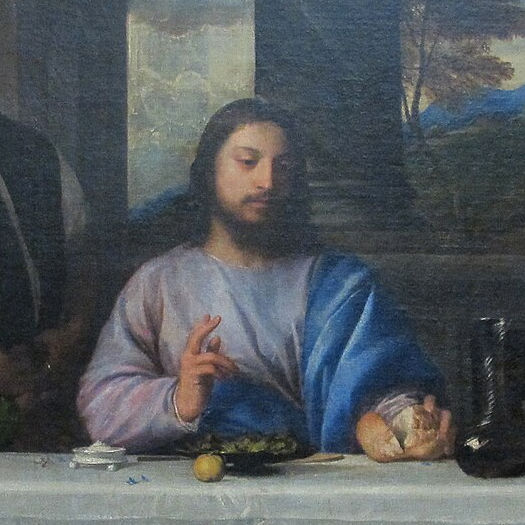
Christ sits behind a long white table, bread in his hands. The man at one side turns outwards in surprise; the other leans towards Christ with his hands together. A servant enters with a dish, another figure watches from behind, and a dog moves beneath the table. Titian makes recognition the centre of a crowded meal. The scene could be ordinary hospitality for a moment, until the gestures around the bread reveal that the guest is the risen Christ.[1][2]
The painting belongs to the Musée du Louvre, which titles it Les Pèlerins d’Emmaüs—The Pilgrims at Emmaus. Its inventories are INV 746 and MR 517. It is an oil painting on canvas, measuring 169 × 244 centimetres in the Louvre’s present record. The Supper at Emmaus is another title for the same object. Keeping the inventory visible helps distinguish it from works by Veronese, Bassano, Rembrandt and later copyists that also represent the meal.[1][3]
At a Glance
- WorkThe Supper at Emmaus
- Research recordMusée du Louvre
Annotated details from The Supper at Emmaus
Select a numbered area to find its detail below. Open a detail image to view it larger.
Details from THE SUPPER AT EMMAUS
Emmaus Christ and Bread
Emmaus Disciples and Table
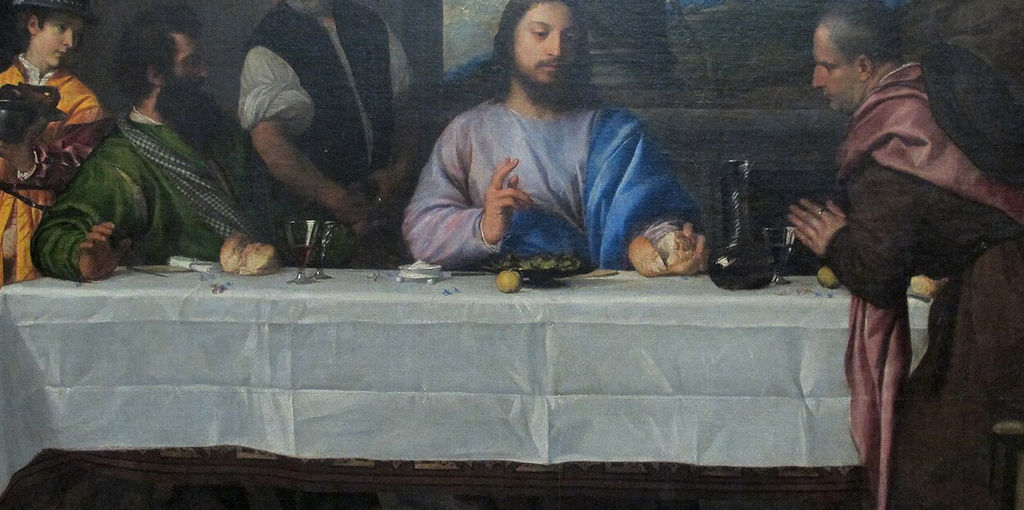
Photo: Sailko, CC BY 3.0; frame cropped and details resized. Painting: Titian, The Pilgrims at Emmaus, Musée du Louvre INV 746. Image source · Reuse licence
Contents
- The moment in Luke’s story
- A Mantuan patron within the biblical meal
- Looking again at the company
- From Maffei’s Mantua to the Louvre
- Why this picture holds the event
The moment in Luke’s story
In Luke 24:13–35, two travelers leave Jerusalem after Jesus’s death. A stranger joins them on the road, explains the scriptures, and accepts their invitation to stay when evening comes. At the meal he takes bread, blesses and breaks it; their eyes are opened and they recognize him. He then vanishes. The story moves from failed recognition to sudden understanding through an everyday act of sharing food.[4]
Titian chooses the point at which a gesture at the table becomes decisive. Christ occupies the centre, calmly raising a hand over the bread. The two pilgrims do not react in identical ways. One extends his arm and twists outward, opening the group towards the viewer; the other inclines his body and joins his hands. The contrast makes recognition legible in two registers—astonishment and reverence—without requiring a painted inscription to announce the event. The Louvre’s exhibition material reads the painting as showing both men grasping who their companion is.[2]
The figures around them are not a literal checklist of people named in Luke. A boy at the far left carries food; an adult behind the table watches; the dog under the cloth seems occupied with the immediate world of the room. Those additions make the inn feel inhabited. They also give the central sacred event a setting of service, eating and movement. The Gospel supplies the narrative; Titian supplies visual witnesses and ordinary details that allow the moment to unfold as a large painting.[2][4]
The table acts almost like a stage across the foreground. Its white covering draws a long horizontal line, but folds, shadows and the carpet beneath complicate that simple shape. Bread sits close to hands; vessels and small items punctuate the expanse. The Louvre singles out the cloth, carpet, saltcellar, decanter, glasses and bread in its account of Titian’s descriptive care. These objects make the meal tangible while directing attention back to the action at its centre.[2]
An opening behind Christ reveals trees, distant mountains and sky. The bright landscape separates his head from the darker interior figures, yet the eye is held at the table by the white cloth and the opposed movements of the pilgrims. The Louvre has compared the long table, frontal Christ and architectural divisions with Leonardo’s Last Supper. That is a compositional comparison between paintings of different Gospel meals. The Emmaus travelers meet Christ after the Resurrection, whereas the Last Supper occurs before his arrest.[2][4]
A Mantuan patron within the biblical meal
The Louvre’s current collection history says Titian painted the work for Count Nicola Maffei of Mantua in 1533–34. That account cites a 1581 letter and a 1589 inventory. The online record’s general date field is much broader—sixteenth century—so the precise 1533–34 range comes from the documented history of this commission. It is more useful than treating the museum’s broad database field as the best possible date.[1]
The Louvre’s exhibition interpretation identifies one of the disciples as Maffei himself, a chief minister to Federico II Gonzaga. If correct, a living patron participates in the biblical story, making the supper a place where devotion and contemporary identity meet. The figure is painted in the role of a pilgrim, not standing apart as a donor in a modern portrait. The claim is a scholarly identification in the Louvre’s own interpretation, rather than a label written beside the figure on the canvas.[2]
There is material evidence relevant to that reading. The Institut national d’histoire de l’art database reports that radiography revealed Maffei’s coat of arms on a seat beneath later overpaint. Such evidence is more specific than noticing a resemblance between faces. It connects a hidden element of this physical painting with the family named in the commission history. It does not, by itself, tell us exactly when the overpaint was applied or settle every proposed identity in the scene. The INHA record also transcribes a signature on the lower-left foot of the table support.[3]
The same national database gives the canvas as 169 × 247 cm, compared with the Louvre’s 169 × 244 cm, and notes additions at the top, bottom and left edges. These are measurements and condition statements in two institutional records, not two different Louvre paintings. The Louvre’s current dimensions are used for the object description here. The discrepancy is worth preserving for a reader consulting technical literature or comparing older catalogues; it should not be silently harmonized with invented precision.[1][3]
Looking again at the company
The boy with a dish, the adult behind the pilgrims and the dog broaden the painting beyond its three biblical principals. The boy’s bright clothing catches attention at the left; the darker standing figure acts as a visual bridge towards Christ. Under the table, the dog creates a second, low zone of activity beneath the disciples’ hands. The picture can be read from top to bottom as well as from side to side: an open landscape, faces and gestures, bread on a white cloth, and ordinary animal life near the floor.
That arrangement slows the instant of revelation. Luke’s narrative moves quickly from breaking bread to recognition and disappearance. A painting cannot show those successive moments in the same way. Titian holds Christ visibly present while allowing different responses to gather around him. One pilgrim seems more outwardly startled, while the other makes a quieter gesture. The helpers are near enough to witness something unusual but remain outside the same clear exchange of recognition. These differences give the event a social range rather than a single synchronized reaction.[2][4]
A 1676 lecture by painter Jean-Baptiste de Champaigne shows how powerfully these differences impressed later viewers. Speaking to the French Royal Academy after the painting had entered the king’s collection, he described the pilgrim in green as surprised and the other as reverent. He noticed the server, the standing figure, the patterned cloth and the landscape, using the painting to teach students how to look at a complex work. That is a valuable record of seventeenth-century reception, even when its explanations are not accepted as present-day object facts.[5]
Champaigne also guessed that the picture had been made for Emperor Charles V, interpreting a heraldic form accordingly. The Louvre’s current provenance instead identifies Maffei as the original patron, and INHA reports the Maffei arms found beneath overpaint. The old imperial claim therefore belongs to the painting’s interpretation history. It shows how a famous royal-collection picture could attract confident but conflicting stories long after it left its first owner.[1][3][5]
From Maffei’s Mantua to the Louvre
The Louvre traces the painting from Maffei to Vincenzo I Gonzaga, duke of Mantua, who acquired it from the Maffei family around 1593. By 1627 it was in the collection of Charles I of England at Whitehall. After Charles’s death, the painting was sold in London on 23 October 1651, lot 333, and passed through R. Houghton to the Paris collector Everhard Jabach. Jabach’s ownership is especially visible in the record because François Chauveau engraved the painting in 1656. Louis XIV acquired the original from Jabach in 1662.[1]
This sequence explains why Champaigne could call it a picture in the king’s cabinet in 1676. It had travelled from a private Mantuan commission through Gonzaga and Stuart collections before entering the French royal collection. Each move changed the audience and the stories told about it. The documented transfers are more secure than a claim that we know exactly how Nicola Maffei first displayed the painting in his residence.[1][5]
The Louvre now lists the work in its Denon wing, room 711; room assignments can change. Its online catalogue also records several later exhibitions and an extensive bibliography. A reader looking for the original should use the Louvre inventories rather than a familiar title alone. The national art-history database notes copies after this composition and a reported separate variant at Brocklesby Park. Those records are reminders that resemblance to the Louvre design is not sufficient to identify a photograph as INV 746.[1][3]
The same subject was attractive to many Venetian painters. The Louvre’s exhibition contrasts Titian’s broad horizontal arrangement with a Veronese Supper at Emmaus in its own collection, INV 146. It also discusses Tintoretto and Bassano treatments. Those pictures do not supply missing sections of Titian’s canvas or replace its Maffei history. They show how differently the same recognition story could be staged through architecture, table, figures and light. The Titian paintings guide places the Louvre canvas among his religious works.[2]
Why this picture holds the event
The bread is a small object in a painting nearly two and a half metres wide, yet it organizes the scene. Christ’s hand, the pilgrims’ different movements, the nearby tableware and the long cloth all lead back to it. The landscape opens the room to a wider world, while the servers and dog keep the meal grounded in daily life. Titian lets the sacred event happen among people who do not all understand it in the same way at the same moment.[2][4]
The work also carries unusually layered evidence about its making and afterlife: a documented Mantuan patron, a heraldic trace beneath paint, a recorded seventeenth-century collecting route, an engraved reproduction and an Academy lecture that preserves an early but mistaken patron theory. Each source answers a different question. Together they allow us to read the Louvre canvas as a visual account of recognition and as a physical object whose meaning and ownership changed over centuries.[1][3][5]
Researched Titian and related works
Frequently Asked Questions
Yes. Both titles refer here to Titian’s Louvre canvas INV 746 / MR 517.[1]
The Louvre’s provenance says it was painted for Nicola Maffei in 1533–34. Its generic database date field says sixteenth century.[1]
The Louvre’s exhibition identifies him as one of the pilgrims. INHA records a Maffei coat of arms visible beneath overpaint on a seat, supporting the commission context. The portrait identification is a curatorial reading, not a name written beside the figure.[2][3]
It passed from the Maffei family to the Gonzagas, Charles I of England, the collector Everhard Jabach, and finally Louis XIV in 1662.[1]
It belongs to the Musée du Louvre, Paris, and its current online record lists it in the Denon wing, room 711. Check the museum’s record for current display details.[1]
Discussion
What do you notice when you look closely at Titian’s Supper at Emmaus in the Louvre?
Share a specific observation or a source that adds context.
Reader Insights
Which detail changes your reading?
How does its original setting affect what we see?
Which part of the evidence remains uncertain?
Join the Conversation
Add your observation below.
References
- Musée du Louvre, collection record for Titian’s Les Pèlerins d’Emmaüs, INV 746 / MR 517, with object data and provenance. View source.
- Musée du Louvre, Titian, Tintoretto, Veronese: Rivals in Renaissance Venice, “Supper at Emmaus and biblical feasts,” with composition and Maffei identification. View source.
- Institut national d’histoire de l’art, AGORHA/RETIF record for Titian’s Louvre Les Pèlerins d’Emmaüs, including signature, radiographic arms, measurements and variant records. View source.
- Gospel of Luke 24:13–35, the Emmaus narrative. View source.
- Jean-Baptiste de Champaigne, lecture on Titian’s Pilgrims at Emmaus delivered to the French Royal Academy on 3 October 1676; transcription published in 1903. View source.


