 by Tom Gurney
Tom Gurney BSc (Hons) is an art history expert with over 20 years experience
Published on June 19, 2020 / Updated on October 15, 2026
Email: tomgurney1@gmail.com / Phone: +44 7429 011000
Titian's Mater Dolorosa with Clasped Hands: Introduction
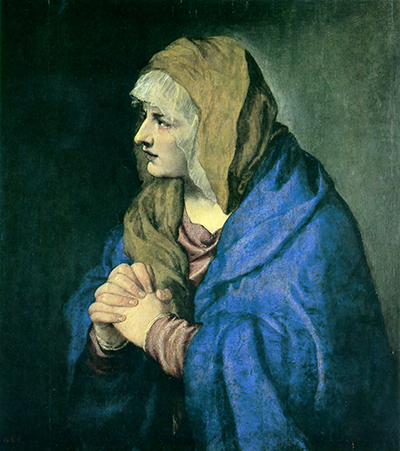
Mary stands alone against a dark ground, her hands pressed together and her face turned to the left. She wears a brilliant blue mantle over softer brown and pale cloth. Tears are visible in the painting, according to its owner, the Museo Nacional del Prado. Titian made this Mater Dolorosa with Clasped Hands for Emperor Charles V in 1554. It is an oil painting on panel, 68 × 61 cm, now Prado P000443. The title means the sorrowful Mother: the subject is Mary's grief over Christ's suffering, presented without the narrative scene of the Crucifixion around her.[1]
The precise title and number matter. The Prado owns another Titian Virgin Dolorosa, P000444, whose hands are apart and whose support is marble. That later painting was made in 1555 after a separate request from Charles. In P443, the clasped fingers and broad blue robe identify the earlier work. Material, gesture and date all distinguish it from the hands-apart picture.[1][2]
At a Glance
- WorkMater Dolorosa
- Research recordMuseo Nacional del Prado
Contents
- An image for Charles V
- Grief expressed through hands and colour
- Northern devotion in Venetian painting
- From Yuste to the Prado
- How to look at it
An image for Charles V
A letter from the Spanish ambassador in Venice, dated 30 June 1553, says Titian was awaiting the emperor's directions for a panel of Our Lady corresponding to an Ecce Homo already in Charles's possession. The Prado identifies the completed 1554 panel with the clasped-hands Mater Dolorosa. This is unusually direct evidence for a devotional image: it connects a contemporary request, the intended material and the imperial patron to the surviving painting.[1]
The letter does not explain every decision Titian made in paint. The Prado interprets the desired relationship to the Ecce Homo as part of Charles's interest in closely observed images of Christ's suffering and Mary's grief. A viewer could contemplate the two subjects together, considering the Mother in response to the suffering Son. But an idea of correspondence in a letter is not, by itself, proof of a fixed surviving pair of panels that always hung side by side. The later history of the different Dolorosa and Ecce Homo pictures needs to be kept distinct.[1][3]
In another letter, dated 1554, Charles requested a second Virgin Dolorosa on stone. The Prado connects that request to the hands-apart P444, painted on marble. Titian had difficulty obtaining the required support through March 1555. In May of that year Charles said he would send a pattern or model for the image. The Prado suggests that the model may have been a Flemish painting, given the emperor's knowledge of northern devotional works. That later correspondence should not be turned into a claim that the 1554 panel copied a known model arriving in 1555. It documents how closely Charles could specify a work's physical support and visual type.[1][2]
Grief expressed through hands and colour
The painting draws attention first to Mary's face and clasped hands. Her eyes turn away from the viewer; the fingers knot together beneath her chin. Her grief is inward and concentrated rather than acted out by a crowd. The dark space removes any account of where she stands, leaving the devotional observer to attend to her response to Christ. The robe makes a broad blue shape around the smaller, exposed areas of face and hand. Titian used lapis lazuli for its blue, as the Prado records, giving this private image a costly material presence.[1]
The museum notes Mary's tears as a striking feature. Its catalogue finds them absent from Titian's earlier paintings of the Virgin and reads them within a religious visual culture close to northern Europe. A tear can show a mother's sorrow, but in such images it also invites the worshipper's prayer. The Prado interprets these tears as signs of grief and intercession for the devout viewer, initially Charles himself. That second meaning belongs to the museum's historical reading; the eye can observe the painted face and hands without pretending that the image comes with a written label of its intended effect.[1]
The blue robe and sorrowful face can look familiar because later devotional images often bring a solitary Mary close to the viewer. Titian's own version, however, was made under particular conditions. It was a panel, ordered by an emperor who already owned an Ecce Homo, and it used a valued blue pigment. Its emotional directness is supported by the record of Charles's interest in the subject. The painting does not need an invented narrative setting or a named model to become more meaningful.[1][3]
The gesture gives it its most practical identity. In P443 the hands remain joined at the front of the figure. In P444 the hands are apart, a conspicuous compositional difference reinforced by marble rather than wood beneath the paint. Because both works are in the Prado, their similarity can tempt an inattentive writer to exchange dimensions, dates and documents. The 1553 request for a panel pertains to the clasped-hands work; the later stone request pertains to the hands-apart version.[1][2]
Northern devotion in Venetian painting
The Prado sees a deliberate meeting of Titian's Venetian art with northern devotional forms familiar to the Habsburg court. Charles knew paintings by Quentin and Jan Massys, and the museum suggests that a Flemish model may have informed the later requested Virgin. The accent on tears and individual sorrow is part of the connection it identifies. This does not require us to name a specific lost original for P443 or assume Titian merely copied another painting. He adapted a type of emotional address within his own treatment of form, cloth and colour.[1]
The museum also traces an afterlife for these images. It says Titian's reworking of the sorrowful Virgin influenced Jacopo Bassano in Venice and Luis de Morales in Spain. Those are broad art-historical relationships, not evidence that either artist studied P443 in the room where Charles kept it. The image's portability as a devotional type helps explain why a compact Madonna of grief could resonate beyond its first owner. The Titian paintings guide sets this panel beside the artist's wider religious and courtly commissions.[1]
From Yuste to the Prado
Both of Titian's Dolorosa paintings went with Charles V to Yuste, according to the Prado. After Charles's death, their histories diverged. Philip II sent the clasped-hands P443 to El Escorial in 1574. It remained there until its entry into the Prado in 1839. The museum's technical record lists its provenance as the Royal Collection.[1]
The hands-apart P444 followed a different course and was later paired with Titian's Prado Ecce Homo P437. The Prado's Ecce Homo record also describes an earlier association at Yuste with a lost Dolorosa by Michiel Coxcie. This complicated history is a reason to use exact inventory numbers whenever discussing “the Dolorosa” and “the Ecce Homo.” Charles's 1553 request indicates that a Virgin image was intended to correspond with a Christ image, but the current historical evidence should not be flattened into an assertion that P443 is the unique, continuously paired survivor of every arrangement.[1][2][3]
The painting's later travels can also change how it is seen. An imperial devotional panel at Yuste became a work in the Escorial and then a museum painting. The private address of Mary's gaze and hands survives those changes, while records of place and ownership supply the context the dark background withholds. The format is modest enough for close looking; the documented patronage and materials show how carefully that intimacy was made.[1]
How to look at it
Begin with the face turned away from you. Find the tears, then follow the angle of the head down to the clasped hands. Notice how the blue mantle wraps the figure, and how little space is given to objects or a setting. Finally compare the Prado's title and inventory with the hands-apart marble P444. The comparison clarifies both what this panel depicts and why its 1554 document matters.[1][2]
Titian's picture makes grief legible through small changes in expression, the pressure of two hands and a concentrated field of colour. The emperor's letters explain the work's origin without exhausting its meaning. The best reading keeps the physical panel, the 1553–54 commission and the viewer's encounter with Mary's sorrow together, while letting the second Dolorosa retain its own history.[1][2]
Researched Titian and related works
Frequently Asked Questions
At the Museo Nacional del Prado, Madrid, inventory P000443.[1]
In 1554, following correspondence about Charles V's request for a panel of the Virgin.[1]
No. P443, the clasped-hands work, is oil on panel. The separate hands-apart P444 is oil on marble.[1][2]
The Prado reads her tears as grief for Christ and as an appeal or intercession for the devout viewer, initially Charles V.[1]
Yes. Philip II sent this clasped-hands painting there in 1574; it entered the Prado in 1839.[1]
Discussion
What do you notice when you look closely at Titian's Mater Dolorosa with Clasped Hands?
Share a specific observation or a source that adds context.
Reader Insights
Which detail changes your reading?
How does its original setting affect what we see?
Which part of the evidence remains uncertain?
Join the Conversation
Add your observation below.
References
- Museo Nacional del Prado, “Mater Dolorosa with Clasped Hands,” P000443, collection essay after Miguel Falomir and technical record. View source.
- Museo Nacional del Prado, “The Virgin Dolorosa with her Hands apart,” P000444, record of the separate painting on marble. View source.
- Museo Nacional del Prado, “Ecce Homo,” P000437, account of Charles V's devotional picture and its later pairings. View source.