



 by Tom Gurney
Tom Gurney BSc (Hons) is an art history expert with over 20 years experience
Published on June 19, 2020 / Updated on October 15, 2026
Email: tomgurney1@gmail.com / Phone: +44 7429 011000
Titian's Vendramin Family and the Relic of the True Cross: Introduction
Nine male members of a Venetian household gather before a cross held high above a stone altar. At one side, a man in red draws attention with his open hand; at the other, a child turns toward his brothers while holding a small dog. Titian's The Vendramin Family venerating a Relic of the True Cross joins individual likenesses to an account of family ancestry and public devotion. It is his largest group portrait and now belongs to the National Gallery, London, as NG4452.[1]
The canvas measures 206.1 × 288.5 centimetres. The Gallery's public object record dates it about 1540–45, while a detailed 2008 catalogue proposed that it was begun about 1540–43 and finished as late as 1550–60. A later Gallery technical study disputes a long delay and argues that the painting was probably completed before Titian's departure for Rome in 1545. The difference is central to understanding the seven sons and the passages sometimes assigned to Titian's workshop. No simple label should turn this developing scholarly judgment into a documentary completion date.[1][2][3]
At a Glance
- WorkThe Vendramin Family, venerating a Relic of the True Cross
- Research recordNational Gallery, London
Annotated details from The Vendramin Family, venerating a Relic of the True Cross
Select a numbered area to find its detail below. Open a detail image to view it larger.
Details from THE VENDRAMIN FAMILY, VENERATING A RELIC OF THE TRUE CROSS
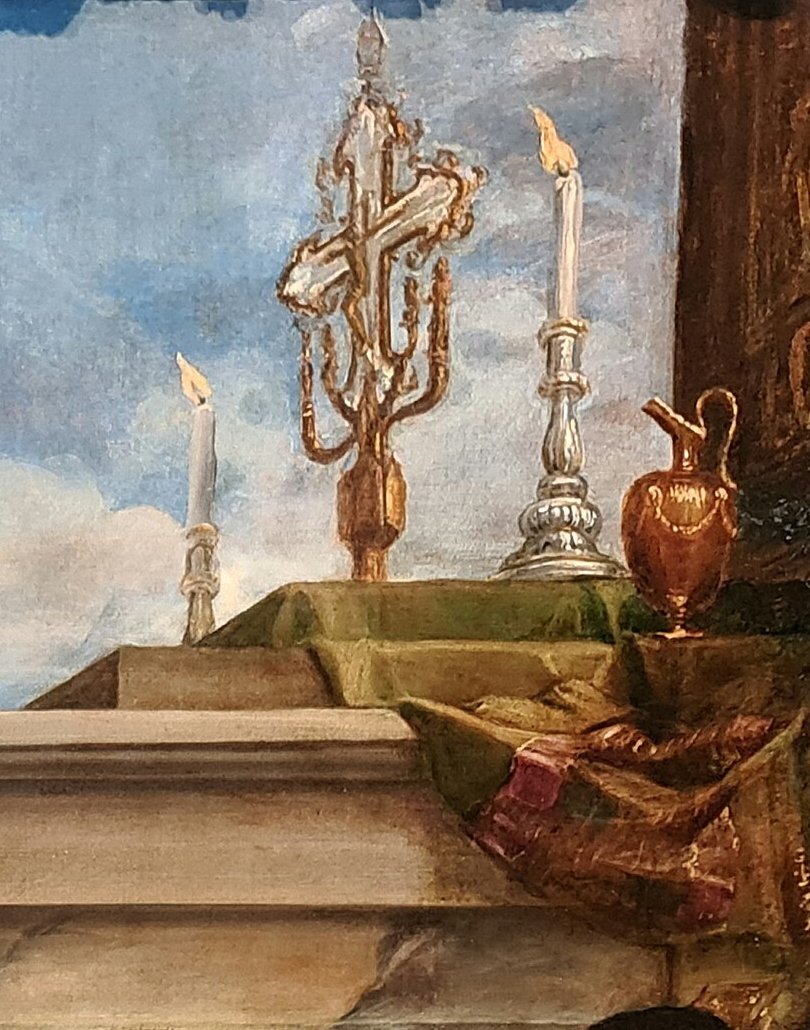
The Reliquary of the True Cross
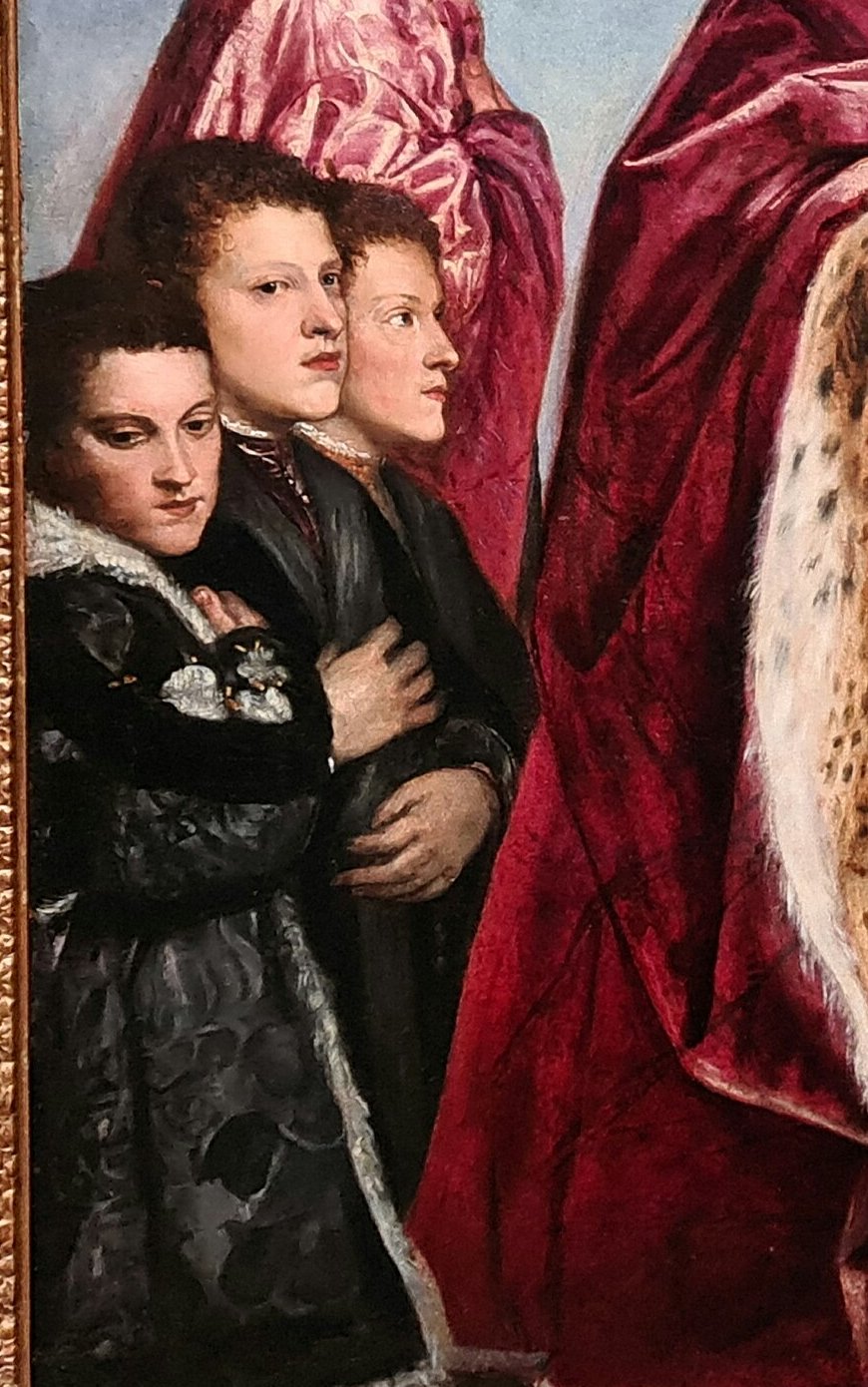
The Sons at the Left
Federigo and the Sons at the Right
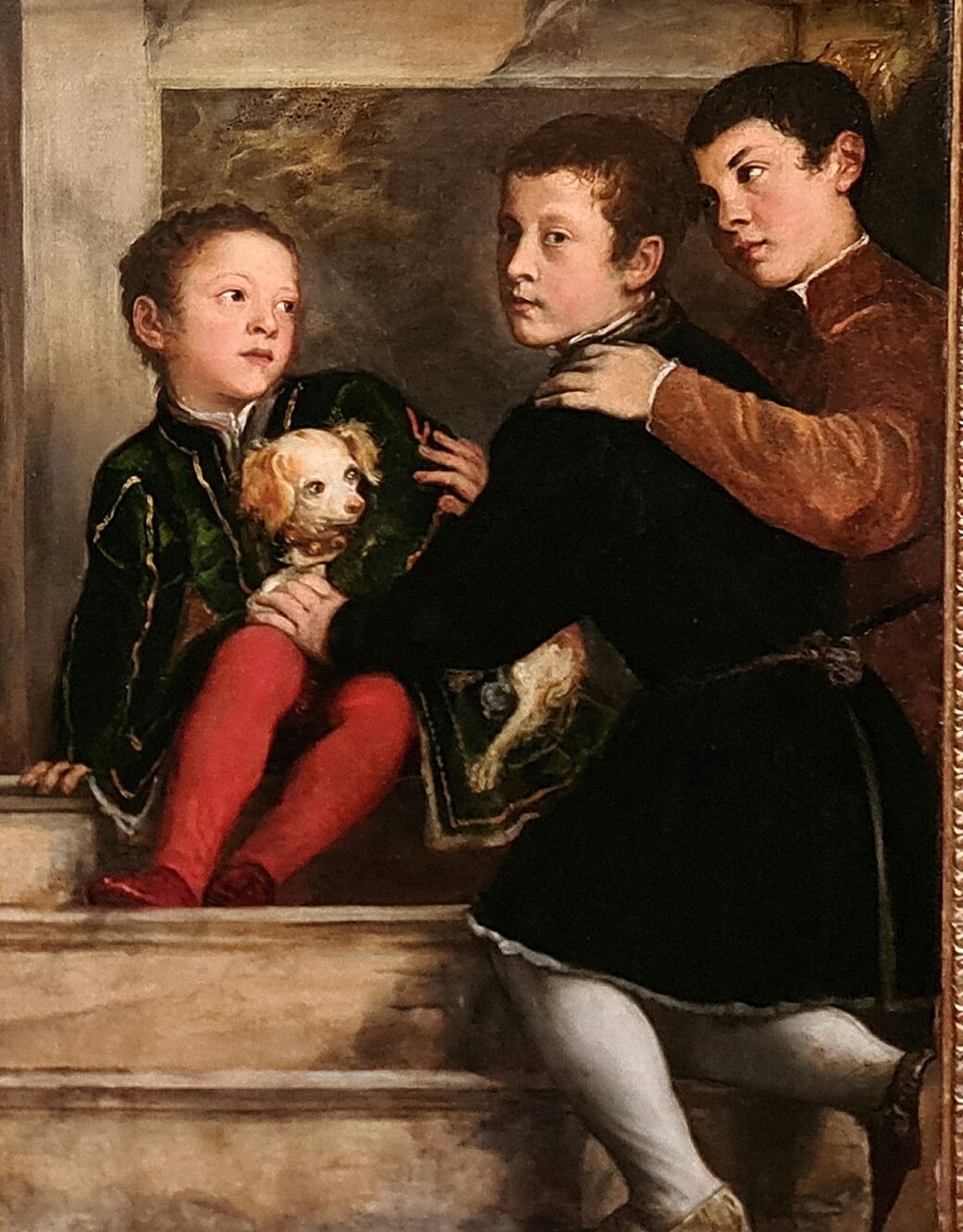
Photo: Ricardalovesmonuments, 2022, CC BY-SA 4.0. Cropped to the painting and resized; numbered details are further crops from the same photograph. Image source · Reuse licence
Contents
- Who are the people in the portrait?
- Why is the cross on the altar?
- How the composition directs attention
- What changed as Titian worked?
- Materials, dates and original setting
- From Venice to the National Gallery
Who are the people in the portrait?
The two large adult figures are generally identified as brothers Andrea Vendramin and Gabriel Vendramin. Andrea was born in 1481 and Gabriel in 1484. The seven younger figures are Andrea's sons by Lucrezia Pasqualigo. A 1569 Vendramin inventory names Andrea, his seven sons, Gabriel, the miraculous cross and Titian in its description of the large painting. This contemporary record anchors the family's identity far more firmly than differences in beard colour or costume could do alone.[1][2]
Which brother occupies which position is still discussed. The National Gallery's public account says that the man in red is probably Gabriel and that the grey-bearded man near the altar may be Andrea. Andrea would be the father leading his sons and, as the elder brother, an obvious figure to place nearest the family relic. Yet the grey beard makes him look much older than a brother only three years Gabriel's senior. Titian was arranging a family statement, not merely recording a moment when everyone stood still in a room.[1][2][3]
The eldest son, Lunardo, stands at the far left behind the red-clad man. Other boys are pressed into the lower left corner. On the right, a younger group sits or kneels on the steps; the smallest boy, Federigo, holds a white spaniel. These names and relationships turn the varied faces into generations of a specific household, but they need not imply that every child was portrayed on the same day. Age and genealogy help scholars estimate when the picture was designed, while the painted surface tells a more complicated story of rearrangement.[2][3]
Andrea and Lucrezia also had six daughters, none included. The Scuola Grande di San Giovanni Evangelista, whose reliquary appears on the altar, restricted its membership to men. The Gallery proposes that this may help explain the daughters' absence, but it does not prove the only reason for it. The canvas deliberately represents a male line and the family's relationship to a male confraternity; it is not a complete record of the children in Andrea's home.[1][2]
The Vendramin were wealthy Venetian patricians whose business included making, selling and exporting soap. An uncle of the brothers had served as Doge Andrea Vendramin. Those facts give the portrait's formal robes and costly scale a civic dimension, but the figures do not simply display wealth. Their bodies face an object that belonged to a religious institution, and their hands and glances make inherited service to that institution part of their public identity.[1][2]
Why is the cross on the altar?
The high, intricate cross is a silver-gilt and rock-crystal reliquary containing two fragments held to come from the True Cross. It has belonged to the Scuola Grande di San Giovanni Evangelista in Venice since 1369; the confraternity still identifies it as one of its treasures. The cross and its fine architectural supports are not a generic symbol invented for the portrait. Titian represents a particular object that the family and its Venetian audience could recognize.[2][4]
An earlier Andrea Vendramin, the brothers' great-great-grandfather, received the relic on behalf of the Scuola from Philippe de Mézières, the Grand Chancellor of Cyprus. The distinction between receiving it for the confraternity and owning it privately matters. The descendants kneel in relation to an institution their ancestor served, rather than around a family possession. In the National Gallery catalogue, the Gothic container, its rock-crystal sections and figures around the cross explain why this comparatively small object deserved the painting's elevated place.[1][2]
A second story deepened the connection. In 1374, according to the tradition examined in the Gallery's catalogue, the reliquary slipped during a procession near the church of San Lorenzo. It eluded those who tried to recover it from the canal until Andrea Vendramin rescued it. Gentile Bellini later depicted that miracle for the confraternity. The 1369 presentation and the 1374 rescue are separate events. Titian does not paint the canal incident; he brings the same object into a later family portrait, where the old story can be remembered without being illustrated.[2]
Above the stone altar, candles rise on either side of the cross against a bright sky. Below, a green cloth and a small devotional painting or panel partly visible behind the altar enrich the shrine-like setting. These details help distinguish the scene from an ordinary domestic conversation. Yet the architectural space does not become a church interior with a known location. It is a constructed setting that places family likenesses in a sustained act of veneration.[2][3]
How the composition directs attention
The relic sits high at the right, but the largest human figures occupy the left and centre. Titian makes the viewer travel between them. Gabriel's red garment opens into broad folds; his hand approaches his chest, while the other reaches outward. The grey-bearded figure rests a hand on the altar. Behind them, the blue sky separates heads from stone and allows the small cross to stand visibly above the gathering. Across the lower edge, the sons fill the steps, with Federigo and his dog providing a livelier counterpoint to the adults' solemnity.
The groups do not form an even row. Lunardo and the boys at the left are crowded near the edge; the younger boys on the right have space to turn toward each other. The open expanse of altar between the two sets of children gives the reliquary a platform and a visual pause. Some figures seem absorbed in prayer, while others glance sideways or at the viewer. A portrait spanning seven sons could present a rigid family tree; Titian instead gives it the small differences of posture and attention that make each sitter feel present.
The lighting comes from the right, which the Gallery's later technical authors identify as unusual in Titian's production. They see it as evidence that the painting was planned for a particular wall. The viewpoint and perspective of the altar were also revised. Such choices show that the canvas was designed for viewers moving through a real palace space, even though the painting itself does not reveal precisely which wall Titian first had in mind.[3]
What changed as Titian worked?
Infrared reflectography and X-radiography reveal major revisions. Titian initially planned the two brothers with different beards: the figure at the left had a long grey beard, and the figure nearer the altar a shorter dark one. The later technical study says the change makes the identification of the finished red-clad man as Gabriel, and the grey-bearded man as Andrea, more plausible. It does not make the identification certain. The authors suggest that the brothers' roles and gestures were reconsidered during painting, not merely copied from a settled drawing.[2][3]
The left side changed again when part of the canvas was cut away during its making. An earlier head for Lunardo survives beneath the sky paint and can be found in technical images. He had to be moved forward, and the three boys beside him were fitted into a tighter area. The altered layout makes their crowding intelligible. Other changes concern the height and perspective of the altar, its cloth, and details of arms and clothing. The visible picture is the outcome of repeated adjustments rather than the first design simply filled with colour.[1][3]
This technical evidence changes how the children's ages are read. The Gallery's 2008 catalogue allowed a scenario in which the canvas began in the early 1540s but some boys were added years later, perhaps by assistants. The 2015 technical authors examined paint layers and drying cracks in the crowded left group. They found layers put over one another before the lower paint was fully dry and no clear break suggesting an insertion a decade later. They concluded that the painting was probably executed over a relatively short period before 1545. That finding does not rule out workshop help, but it challenges the idea that all less polished heads must be late additions.[2][3]
The surface's condition complicates hand attribution too. Some of the left boys have losses and retouching, while the figures on the right also have damaged passages. The 2008 catalogue judged the portraits of some sons less assured than Titian's adult heads and allowed for an assistant, especially at the edges. The later technical study urges caution because awkward placement and later damage can make a painted head look weaker. “Titian and Workshop” therefore remains a useful scholarly qualification, but neither scientific imaging nor visual style labels every stroke with certainty.[2][3]
Materials, dates and original setting
The painting uses a large piece of point-twill canvas, a textile with a distinctive patterned weave. Gallery researchers counted 22 warp and 17 weft threads per centimetre and noted that the wider textile could support this unusually large painting without a central seam. A light gesso ground lies beneath paint. Infrared study found free, brushed drawing as Titian established figures and then altered them. Pigment analysis found indigo beneath the blue sky and examined red lake layers in Gabriel's cloak. These are findings from the object's material record, not conclusions a digital reproduction can independently demonstrate.[3]
The same analysis helps date the work. The later Gallery team found its materials and rapid, overlapping revisions compatible with about 1540–45, and argued that the canvas was almost certainly finished before Titian left for Rome in 1545. Penny's earlier catalogue proposed a start around 1540–43 and completion around 1550–60. A visitor should know that these are different interpretations of a single painting, not two separate versions. The publicly displayed date remains about 1540–45, while some passages may still have involved assistants.[1][2][3]
Its first position in the Vendramin palace also needs qualification. The 2008 catalogue proposed the portego, the central hall of a Venetian palace. The later technical study cites a newly published 1602 inventory that places the painting in the ground-floor entrance hall of the family palace at Santa Fosca. That document proves a location in 1602, not necessarily the first place planned decades earlier. Changes to the canvas width, lighting and altar viewpoint support a site-specific commission but leave open whether the intended wall shifted during production.[2][3]
The picture was relined in 1961 and cleaned and restored in 1973–75, according to the Gallery's technical account. The history of treatment is relevant when comparing photographs or judging exposed weave, cracks and repainted losses. It does not erase the evidence of Titian's changes, which researchers investigated with imaging and cross-sections as well as visual examination.[3]
From Venice to the National Gallery
The March 1569 Vendramin inventory recorded the portrait during Titian's lifetime and named him as its maker. In later centuries it travelled to England. It was in Anthony van Dyck's collection by 1641, then passed through Sir John Wittewronge, who sold it to Algernon Percy, 10th Earl of Northumberland, on 4 October 1645. It remained in the Northumberland collection for generations. The National Gallery purchased it in 1929, with special grant and donor support.[1][2][5]
For much of that later history viewers called it a portrait of the Cornaro family or of Venetian senators. An engraving of 1732 helped establish the Cornaro name, although there was no firm reason to assign those sitters. The Vendramin identification was recovered in 1925, after which the 1569 inventory and the recognizable Scuola reliquary could be brought together. The change of title is a reminder that a celebrated portrait can retain its artistic reputation while losing the identity of its original subjects.[2][5]
The Titian paintings guide offers other examples of his portraits and religious works. Here those categories overlap: an identifiable family appears before a real devotional object whose history belonged to a Venetian confraternity. The canvas speaks about lineage, piety and civic standing through particular faces, gestures and material things. Its revisions let us see how Titian shaped that statement, while the conflicting catalogue dates and qualified workshop attribution show where the evidence still leaves room for judgment.
Researched Titian and related works
Frequently Asked Questions
It is in the National Gallery, London, as NG4452. The Gallery's collection record gives its current room and visitor information.[1]
They are generally identified as brothers Andrea and Gabriel Vendramin. The man in red is probably Gabriel, and the grey-bearded figure by the altar may be Andrea; their precise placement remains qualified.[1][3]
No. The reliquary belongs to the Scuola Grande di San Giovanni Evangelista. An ancestor of the family received it for that confraternity in 1369 and was later associated with a rescue miracle.[2][4]
The Gallery's public date is about 1540–45. Its 2008 catalogue suggested completion in the 1550s, but a 2015 technical investigation argued for completion before Titian's 1545 journey to Rome.[1][2][3]
Discussion
What do you notice when you look closely at Titian's Vendramin Family and the Relic of the True Cross?
Share a specific observation or a source that adds context.
Reader Insights
Which detail changes your reading?
How does its original setting affect what we see?
Which part of the evidence remains uncertain?
Join the Conversation
Add your observation below.
References
- The National Gallery, London, “The Vendramin Family,” collection record NG4452. View source.
- Nicholas Penny, National Gallery, “The Vendramin Family,” The Sixteenth Century Italian Paintings, volume II, 2008. View source.
- Jill Dunkerton and colleagues, National Gallery, “Titian's Painting Technique from 1540,” National Gallery Technical Bulletin 36, catalogue 1, 2015, pp. 40–51. View source.
- Scuola Grande San Giovanni Evangelista, Venice, museum account of the reliquary in its collection. View source.
- The National Gallery, London, acquisition archive NG14/60, purchase from the Duke of Northumberland, 1929. View source.


