 by Tom Gurney
Tom Gurney BSc (Hons) is an art history expert with over 20 years experience
Published on June 19, 2020 / Updated on October 15, 2026
Email: tomgurney1@gmail.com / Phone: +44 7429 011000
Titian's Venus and Adonis for Philip II: the Prado painting: Introduction
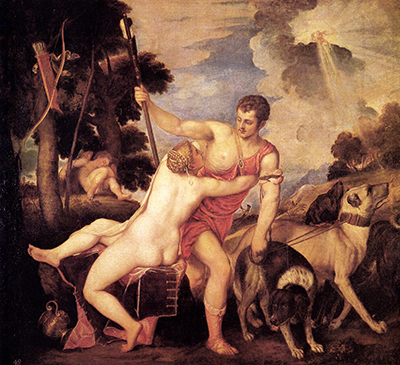
Venus catches Adonis in an embrace as he turns toward his hounds and the hunt. She is seated with her back to us; he stands, spear raised, already moving away. Cupid appears under a tree at the left, while a break in the cloud brightens the landscape beyond the dogs. Titian painted this Venus and Adonis for Prince Philip, later Philip II of Spain, in 1554. The Museo Nacional del Prado owns the oil canvas as P000422, measuring 186 × 207 centimetres. It is one of Titian's six mythological poesie for the royal patron.[1][2]
Many versions of the design survive, so the object anchor is essential. This page concerns the Prado picture sent to Philip, not the Dulwich workshop canvas, London's National Gallery workshop version or a different painting in Washington. Repeated figures do not establish common authorship, date or first owner. The Prado's technical study gives P000422 its own material history: a transferred design, adjustments during painting and unusually thin passages in the sky.[1][3][4]
At a Glance
- WorkVenus and Adonis (Prado poesie)
- Research recordMuseo Nacional del Prado
Contents
- The story before the fatal hunt
- Looking through the composition
- The first royal pair
- From earlier design to royal canvas
- Other versions and a lost Farnese question
- Early viewers and later collection history
The story before the fatal hunt
Ovid's Metamorphoses tells how Venus loves the beautiful hunter Adonis and warns him away from dangerous animals. He later attacks a boar, is fatally wounded, and Venus finds him dying. Titian does not show the attack or the death. He stages a last departure, with Venus physically trying to prevent Adonis from going and the hounds pulling him toward the future she fears. The death is present as foreknowledge in the viewer's mind, not as a visible event on the canvas.[1][3]
This precise struggle is a major departure from Ovid. In the poem Venus warns Adonis, then she leaves; Ovid does not narrate his escape from her clinging arms in the way Titian paints it. The Prado treats the invented action as central to the picture. It makes the tragic outcome emotionally immediate before it occurs. The viewer sees contrary movements at once: Venus pulls inward and down, Adonis rises and turns outward, and the animals strain in the same direction as the hunter.[1][3]
Scholars have sought other literary sources for the farewell, including works by Diego Hurtado de Mendoza and Lodovico Dolce. The Prado and the National Gallery of Art note a chronological complication: Titian's first conception of the subject may go back to the late 1520s, before some of those texts were written or published. The relationship could run from painting to poetry, from poetry to painting, or through shared visual and verbal motifs. The public evidence does not support naming one of these writers as the certain source for the exact embrace in P000422.[1][4]
The invention attracted criticism as well as admiration. The Florentine writer Raffaello Borghini later faulted Titian's departure from the ancient text in 1584. His objection shows that viewers understood the discrepancy. It does not make the painted scene a mistake: Titian chose an image that could compress warning, desire, resistance and loss into one moment.[1]
Looking through the composition
Venus's back is a large, bright form against darker trees. She reaches around Adonis's torso, and his body twists toward the right. His raised spear and the hounds' tense shapes extend that turn. The cloth under Venus and her planted legs hold the left side of the picture in place while the standing figure and dogs give the right side forward energy. The image is legible as a struggle even before a viewer knows the myth.[1]
Cupid sits in shade beneath the trees. He is easy to miss at small scale, but his position matters: the god of love is near the lovers without stopping the departure. A brighter opening in the upper right draws the eye beyond Adonis toward the morning world in which the hunt will unfold. That light is not simply decorative landscape. It offers a direction for his movement while the darker foreground keeps the emotional encounter close.[1][3]
The hounds are not background props either. They explain why Adonis's body is under competing pressure. His arm and spear belong to the hunt; Venus's arms hold him in the present. Even if the viewer does not see the boar, the dogs make the coming danger plausible. Titian uses the animals to turn a myth known from words into physical, directional action.[1][3]
Venus is active rather than an ornamental nude placed beside a hero. She initiates the embrace, trying to change his course. Her exposed back was also a deliberate visual problem for a painter: how to make a turned body expressive without showing the full face. The Prado sees the view as a counterpart to Danaë, whose body faces the viewer in the canvas Titian sent to Philip the previous year. The contrast invokes contemporary debate about whether painting could offer the variety of viewpoints associated with sculpture. Here that display of skill serves a story of someone struggling against an imminent loss.[1][3]
The first royal pair
The first of Philip's mythological poesie was the 1553 Danaë now in the Wellington Collection at Apsley House. Venus and Adonis followed in 1554. Titian had treated both subjects before, but their royal pairing gave them a new relation: an arrival of a god as gold in one picture and the departure of a mortal lover in the other. The Prado's later Danaë P000425 is a separate painting made about 1560–65. It was not the object that arrived before Philip's Venus and Adonis.[1][2]
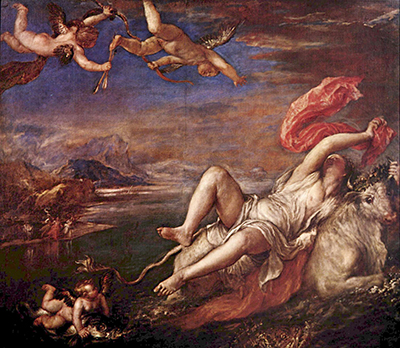
The Prado places the pair at the start of a six-picture programme that later included Perseus and Andromeda, the two Diana canvases and The Rape of Europa. Titian's 23 March 1553 letter refers to the poesie as a project already known to the prince. In a 10 September 1554 letter he speaks of works intended to hang together in a camerino. These documents establish a programme and a wish for joint display, but not an exact wall plan. Philip did not yet have a fixed room for the series as Alfonso d'Este had provided for Titian's earlier Ferrara mythologies.[1][2]
The Prado suggests that working without a known site may help explain the relatively even lighting of the royal pictures. That is an interpretation, not a document in which Titian specifies the light of the future room. It is more secure to say that the six works were meant to form a group even though their first precise arrangement cannot be reconstructed from the surviving material used here.[1]
From earlier design to royal canvas
The Prado says Titian had devised an earlier Venus and Adonis in the late 1520s, now lost but known through copies. Another important composition, now in a Moscow private collection and dated about 1542–46, served as a model for P000422. Infrared reflectography of the Prado picture shows transferred outlines for the two human figures and main elements that align closely with the Moscow version. This is unusually concrete evidence for how a painter could carry a design forward into a new commission.[1]
Transfer did not end the work. The Prado's X-radiograph shows a different earlier position for Adonis's hunting spear. Other changes are visible at the surface, especially to Venus's profile and Adonis's torso. Titian could use an established arrangement and still refine the bodies and their interaction in paint. A tracing is one stage of making; the final force of the royal canvas depends on execution and adjustment as well as the inherited pattern.[1]
The Prado values P000422 above the many repetitions for the quality of its painted surface, while recognising its debt to earlier designs. That evaluation avoids a false choice between invention and repetition. A celebrated royal painting could grow from a design Titian had used before and become a distinctive object through new handling. Technical findings on London's workshop canvas cannot be substituted for the Prado's infrared and X-ray evidence merely because both show Venus holding Adonis.[1][3]
The Prado also identifies very thin layers of paint in this canvas. In parts of the sky, the preparation below remains visible and helps create an airy effect. The observation concerns P000422's actual surface. It is not proof that the sky is damaged or that Titian left the whole painting unfinished. The distinction among chosen thinness, alteration during painting and later loss matters whenever a reproduction makes all three look like uneven coverage.[1]
Other versions and a lost Farnese question
The Prado painting became a point of departure for further versions by Titian and his workshop. London's National Gallery attributes its NG34 to a workshop painter; the Dulwich canvas is another separate object. Washington's National Gallery of Art discusses two broad compositional types in the surviving family of works. Differences include format, Cupid's position and the number of dogs. Such distinctions are useful for sorting reproductions, but no single visible detail should stand in for an object's full catalogue and provenance.[3][4]
The Washington scholarly entry also examines a lost Farnese Venus and Adonis recorded in historical inventories and later associated with the family's Danaë. Some scholars have argued that it could have been an early pendant to the Farnese picture, perhaps made during Titian's Roman connection with the family. Others treat its date and role more cautiously. Because the painting is lost, the inventory and later print evidence cannot prove every detail of its first commission. It is not the Prado P000422, which was made for Philip and survives in Madrid.[4]
These layers of repetition explain why the title alone causes errors. “Titian's Venus and Adonis” can refer to a lost invention, the Moscow version, the Prado royal picture, a workshop canvas, a Washington variant or another copy. Inventory P000422, the royal commission and the 1554 date identify this Prado work. The paintings guide places repeated mythologies within Titian's broader practice without merging them into one travelling canvas.[1][4]
Early viewers and later collection history
The Prado records a Spanish ambassador's response: he judged the painting excellent yet too sensual. Lodovico Dolce compared looking at Venus with the experience of an ancient nude statue. These comments belong to particular sixteenth-century male viewers and writers. They show that the exposed back and Venus's active embrace drew attention, but they do not exhaust the image. Her gesture is both physical closeness and an attempt to prevent a fatal departure.[1]
The painter's interest in what art could show from a turned viewpoint also had a visual precedent. London's National Gallery identifies a twisting female figure in an antique relief known as the Bed of Polyclitus as one possible model for Venus. The National Gallery of Art also discusses prints after Raphael among possible visual sources for the figures' action. These are proposed relationships of form, not surviving statements by Titian that he copied a particular antique or print for the royal canvas.[3][4]
The Prado traces P000422 through the Spanish Royal Collection. Later records place it at the New Royal Palace in 1747, in the study of Andrés de la Calleja in 1772, at the Casa de Rebeque in 1794 and in the Academy's reserved room by 1827. Some suggested earlier El Pardo identifications are marked with question marks in the museum record. This trail documents a durable royal and institutional ownership history while leaving its first precise camerino setting unproved.[1]
The painting can therefore be read through three kinds of evidence. Ovid supplies the fatal myth Titian altered; the image gives the embrace and counter-movement; the technical and inventory records identify what happened to this particular canvas as it was made and collected. None of those strands alone is the whole story. Together they explain why Philip's Venus and Adonis became a defining poesia and why the Prado painting must be distinguished from the many related versions.[1][2][4]
Researched Titian and related works
Frequently Asked Questions
In the Museo Nacional del Prado, Madrid, inventory P000422.[1]
The Prado dates the oil canvas 1554, after the Wellington Collection Danaë was sent to Philip in 1553.[1][2]
Ovid tells the larger story and Venus's warning, but Titian's image of Adonis pulling away from her embrace is an invention not narrated in that form by the ancient poem.[1][3]
The Prado's infrared study finds transferred outlines closely matching a Moscow composition. It also identifies changes Titian made in the royal canvas, including the position of Adonis's spear and adjustments to the two figures.[1]
Discussion
What do you notice when you look closely at Titian's Venus and Adonis for Philip II: the Prado painting?
Share a specific observation or a source that adds context.
Reader Insights
Which detail changes your reading?
How does its original setting affect what we see?
Which part of the evidence remains uncertain?
Join the Conversation
Add your observation below.
References
- Museo Nacional del Prado, “Venus and Adonis,” current owner record for P000422, with technical, literary and provenance discussion. View source.
- National Gallery, London, “Titian's poesie: The commission,” six-picture project and original first pair. View source.
- National Gallery, London, “Workshop of Titian: Venus and Adonis,” NG34 owner commentary on the myth, antique precedent and distinct workshop picture. View source.
- Peter Humfrey, National Gallery of Art, “Venus and Adonis,” scholarly catalogue essay on versions, visual sources and the lost Farnese composition. View source.
- Dulwich Picture Gallery, “Venus and Adonis,” separate workshop canvas DPG209. View source.