 by Tom Gurney
Tom Gurney BSc (Hons) is an art history expert with over 20 years experience
Published on June 19, 2020 / Updated on October 15, 2026
Email: tomgurney1@gmail.com / Phone: +44 7429 011000
Titian's Noli me Tangere: Christ and Mary Magdalene: Introduction
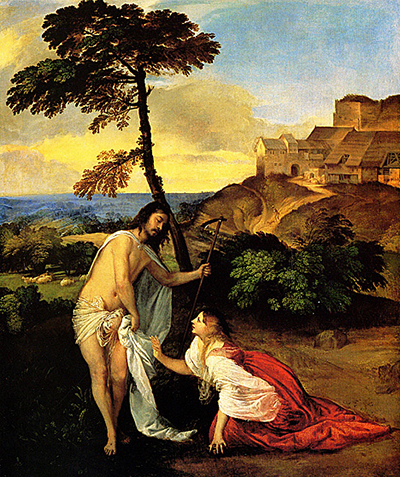
Mary Magdalene kneels and reaches toward the risen Christ. He turns toward her, yet shifts his body away from her hand. A tree rises between them, with dawn spreading across a landscape of fields and distant buildings. Titian's painting is usually called Noli me Tangere, Latin for “Do not touch me”; the descriptive title Christ and Mary Magdalene names its two figures. The National Gallery in London holds the canvas as NG270, dates it to about 1514, and measures it at 110.5 × 91.9 centimetres.[1]
The scene comes from John 20:14–18. Mary, grieving at the tomb, does not at first recognise Jesus and thinks he is the gardener. When he speaks her name, recognition comes; the words behind the painting's title then mark a change in their relationship. The Gospel proceeds to Mary's announcement to the disciples that she has seen the Lord. Titian concentrates the sequence into a pause before that departure: two people know who stands before them, but the old form of physical closeness cannot simply resume.[1][2]
At a Glance
- WorkNoli me Tangere
- Research recordNational Gallery, London
Contents
- Which garden is this?
- A gesture held just short of contact
- How the figures changed during painting
- A landscape revised around the encounter
- Fine cloth, red lake and the painting's surface
- An unknown first patron and a documented later journey
- What the painting holds together
Which garden is this?
John's narrative places the tomb in a garden near the place of crucifixion. The National Gallery describes Titian's setting as the Garden of Gethsemane, but John does not identify the resurrection encounter with the garden of Jesus's earlier arrest. The painting itself offers a garden landscape rather than a labelled map of Jerusalem. Calling it the garden by the tomb keeps the biblical location clear without assigning a place that the passage does not name.[1][2]
Titian also leaves out visual markers often added to the subject. The empty tomb is not shown, nor is Calvary in the distance. X-ray examination led the Gallery to conclude that neither feature seems to have appeared in earlier painted stages. The omission focuses attention on recognition and on the distance between hands. A viewer who knows the Gospel can supply the preceding visit to the tomb and the coming message to the disciples; the painting does not need to illustrate every stage around this one encounter.[1][3]
The Latin title is familiar, but it can sound harsher than the scene. The United States Conference of Catholic Bishops' note on John 20:17 renders the instruction as a command to stop holding on to Jesus. That reading fits an episode about changed presence and a task ahead, rather than a claim that Mary is being rejected or that all touch is forbidden. Titian's Christ turns his face toward her while his body creates space. Their gaze keeps the bond even as the hands do not meet.[1][2]
A gesture held just short of contact
Mary is low to the ground, one hand supporting her weight while the other reaches upward. Her body follows the line of the path and slope; her red mantle spreads across the earth behind her. Christ stands, a long vertical against the tree, but bends into a curved pose over her. His staff and loosely held burial cloth help make his movement readable. Their positions create a contrast between a person anchored to the ground and one rising away from it, while the turn of his head prevents the encounter from becoming a cold separation.[1]
The almost-touch is the work's main event. The interval between Mary's fingers and Christ's body is small enough to make contact feel possible, but large enough to be seen. Titian does not paint a firm grasp or a dramatic shove. The pause lets a viewer imagine recognition, longing and restraint at once. The National Gallery's 2022 interpretation emphasizes both Mary's earthly position and Christ's arching protection above her. That is a reading of their posture; the figures' exact emotional state is not documented in a patron's written programme.[1][4]
The image asks the eye to keep moving. From Mary's arm it rises to Christ's face, then follows the tree trunk and high branches. From the hill at right it descends back toward their gaze. The intersecting lines make the landscape an active part of the conversation rather than an attractive view placed behind two figures. The tree both separates and joins them: its trunk occupies the gap, while its canopy shelters the upper composition.[1]
How the figures changed during painting
Technical examination makes the near-touch still more interesting. Infrared reflectography shows fine, repeated drawing beneath the paint. Christ's twisting pose was planned early; there is no solid evidence that he was first shown walking away. Mary, however, was adjusted. Her face tilted and her eyes, nose and lips shifted so that her gaze lifted more directly to Christ. Her arm and hand were initially straighter and came closer to him; Titian drew them back in the painted state. He also moved Christ's arms slightly farther from her.[3]
These revisions concern the same narrow area on which the story depends. They cannot tell us exactly what Titian felt about Mary, but they show that he tuned the visible distance between the figures as he worked. An earlier arrangement might have made the approach more direct. The final one retains the reach while giving Christ more room to turn away. The museum's technical study also notes changes to Mary's hair and skirt and to Christ's facial drawing. Recognition is therefore not only a subject in the Gospel; the exchange of gaze and gesture became a compositional problem the painter revisited.[3]
Some older discussion of an X-ray mark imagined a radically different first version, with Christ already departing. The Gallery's investigators reject that as an unsupported reading of the evidence. A forked white shape around his legs may be paint wiped from a tool, while no corresponding drawn torso appears in the proposed position. Infrared examination finds Christ outlined in the pose we see now from an early stage. This is a useful example of why a technical image needs interpretation: a white shape in an X-ray is not automatically an earlier person.[3]
A landscape revised around the encounter
The hilltop village now sits to the right of the tree, above Mary. It draws the eye into depth while keeping the area around Christ comparatively open. Infrared and X-ray images reveal a substantial earlier plan: Titian first placed a hill and buildings at the left, above Christ. He then covered those forms with paint rich in lead white and developed the present right-hand hill. The technical study suggests that the original cluster made Christ's side too crowded. The revision balances the two figures and allows the dawn sky to open around him.[3]
Broad sweeps in the covering layer suggest a knife or similar tool may have spread the paint. That is a proposed account of the marks, not direct evidence of Titian's hand holding a named instrument at a recorded moment. What is secure is the relocation of the hill and the changed balance of empty sky, tree and buildings. The present landscape looks natural, yet its main recession was tested and moved during the painting's making.[3]
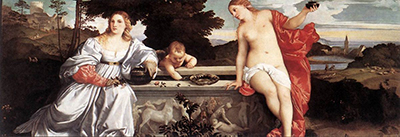
Small details support the sense of morning: mist across fields, distant grazing sheep and light gathering in the sky. The National Gallery finds the observation of dawn especially vivid here. The buildings on the right also connect the painting to Titian's Sacred and Profane Love, where a related group appears in reverse around 1514, and to the Dresden Sleeping Venus. These are comparisons of painted motifs, not proof that the hilltop is a portrait of one real village. Titian could reuse and reshape a design for different formats.[1][3]
The early date places the work near Titian's encounters with Giorgione's approach to figures and nature. Its high-key colour and closely integrated landscape belong to that Venetian setting. Yet the narrative is particularly concentrated. In the earlier Holy Family with a Shepherd, landscape and people are already joined; here, a tree, hill and two bodily movements all point back to the same fragile moment. The Gallery also suggests that study of works after Raphael and Michelangelo may have helped Titian devise Christ's twisting nude pose. That is a stylistic inference, not a surviving preparatory drawing for this specific canvas.[1][3]
Fine cloth, red lake and the painting's surface
The painting rewards looking at how its white fabrics differ. Mary has a light sleeve and a veil; Christ has a thin loincloth and a heavier burial shroud. The National Gallery's technical study distinguishes them materially. Raised paint shapes the denser folds in Mary's sleeve. Her veil was made with an almost dry brush dragged across paint below, leaving parts of the underlayer visible in its shadows. More fluid white in Christ's loincloth lets flesh colour show through, while the shroud reads as opaque and weightier. These differences help the figures feel bodily present without giving every fabric the same texture.[3]
Mary's red clothing is layered as carefully. The study found pale pink underpaint made with red lake and lead white, followed by richer red lake glazing. A sample from a deep fold contained mainly kermes dye, with a little madder also detected. The glazing pooled in low points of the canvas texture and brush marks, contributing to the dress's depth. Fading and abrasion may have changed some lighter areas, so the colour visible today is not a perfect record of every original contrast.[3]
The canvas itself is fine woven and retains its original dimensions. Beneath the visible paint, investigators found gesso and a pale preparatory layer. Infrared images reveal delicate contour drawing, finer than in some larger Titian pictures because the figures here are comparatively small. These findings show the painter planning and revising on a prepared fabric; they should not be used to claim a complete sequence for every mark on its surface.[3]
The large tree supplies another caution about colour change. It has sometimes been described as an originally bright green canopy that turned brown. The Gallery's samples and magnified examination give a subtler account: Titian used yellow-brown earth as an underlayer, put brown and greenish-brown leaves into shadow, and reserved brighter greens for nearer foliage. Some paint has darkened, but much of the muted colour appears intentional. A digitally “restored” uniformly green tree would therefore misrepresent the evidence. The measured relation of warm browns to dawn light belongs to the composition as Titian made it.[3]
An unknown first patron and a documented later journey
The National Gallery does not know who commissioned Noli me Tangere. Its intimate scale might suggest private devotion, but the object record does not name a patron, original home or original use. That gap should remain visible. We can describe the picture's capacity to prompt meditation on recognition and loss without inventing a specific owner's grief or religious programme.[1]
Its later collecting trail is more detailed. The Gallery's provenance account identifies it with a painting in the Muselli collection at Verona recorded by Carlo Ridolfi in 1648. It moved into French collecting through the Marquis de Seignelay and Pierre-Vincent Bertin, and by the eighteenth century belonged to the Orléans collection. When that collection was dispersed in the 1790s, the picture travelled to Britain. After later sales, the poet Samuel Rogers bought it in 1820; his 1856 bequest brought it to the National Gallery. These records locate the surviving canvas over two centuries but do not reach back to its first buyer around 1514.[1]
Conservation has also shaped what viewers see. The Gallery records cleaning, restoration and relining in 1957–58. More recent imaging and sampling have clarified Titian's revisions and materials. These studies do not replace the experience of looking at the painting, but they guard against two easy mistakes: reading every dark tone as deterioration and reading every X-ray mark as a lost first composition.[3]
The painting acquired a memorable public role in 1942. During the Second World War the Gallery's collection was stored in a Welsh slate mine for safety. Noli me Tangere was selected as the first work brought back for a monthly display in otherwise emptied London galleries. The Gallery's account links that choice with a public hunger for art amid loss. It is an episode in the painting's modern reception, far removed from Titian's unknown first patron, yet the encounter between grief and renewed presence helps explain its appeal.[4]
What the painting holds together
Titian places a moment of theological change in ordinary physical space: ground under Mary's knee, cloth around Christ, a tree between them and a village beyond. The biblical encounter requires recognition, distance and a message to carry away. The painter expresses those ideas through hands that nearly meet, faces that do, and a landscape that was revised to preserve their focus. The technical record makes that achievement more concrete. He moved lines, bodies and hills until the emotional pause became visible, while keeping the story open enough for a viewer to feel both Mary's longing and Christ's continuing attention.[1][2][3]
Researched Titian and related works
Frequently Asked Questions
It is Latin for “Do not touch me,” the traditional wording of Jesus's response to Mary in John 20:17. Some modern translations and notes emphasize “stop holding on to me,” which better conveys the move from recognition to Mary's new task.[2]
The National Gallery, London, holds it as NG270. It is an oil painting on canvas, 110.5 × 91.9 centimetres.[1]
John places the tomb in a garden near the crucifixion site and does not call the resurrection garden Gethsemane. Titian paints a garden landscape without enough topographical detail to identify a separate named site.[1][2]
The National Gallery's technical study finds no supporting torso or underdrawing for that proposed earlier pose. It does document smaller figure adjustments and the relocation of hilltop buildings from left to right.[3]
The original commissioner is unknown. Its documented later history begins with seventeenth-century collecting in Verona.[1]
Discussion
What do you notice when you look closely at Titian's Noli me Tangere: Christ and Mary Magdalene?
Share a specific observation or a source that adds context.
Reader Insights
Which detail changes your reading?
How does its original setting affect what we see?
Which part of the evidence remains uncertain?
Join the Conversation
Add your observation below.
References
- The National Gallery, London, “Noli me Tangere,” object record NG270, interpretive essay and provenance. View source.
- United States Conference of Catholic Bishops, Gospel of John chapters 19 and 20, with explanatory note on John 20:17. View source. Garden reference.
- Jill Dunkerton and Marika Spring, with contributors, “Noli me Tangere,” in National Gallery Technical Bulletin 34 (2013), pp. 62–67. View source.
- The National Gallery, London, “Picture of the month: October 2022,” reading of the painting and history of its 1942 display. View source.