 by Tom Gurney
Tom Gurney BSc (Hons) is an art history expert with over 20 years experience
Published on June 19, 2020 / Updated on October 15, 2026
Email: tomgurney1@gmail.com / Phone: +44 7429 011000
Titian's Saint Christopher at the Doge's Palace: Introduction
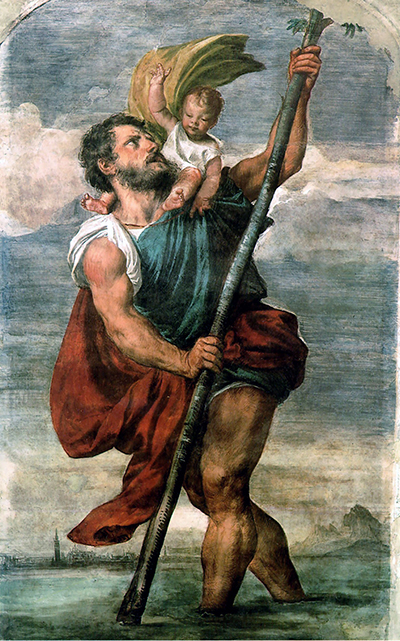
A giant figure wades through water with a child on his shoulders. His staff reaches upward, his legs push through the crossing, and the child rests lightly against him. Titian painted this Saint Christopher as a fresco for the Doge's Palace in Venice. The palace dates it to 1523 and names the newly elected Doge Andrea Gritti as its commissioner. It remains in the building for which it was made: a passage used between the doge's private apartments and the rooms where Venetian government met.[1]
That location is part of the picture's subject. Christopher carries someone through a dangerous passage; the doge crossed a palace threshold between private life and public office. The palace describes the saint as a guide and ferryman for Venetian civilization, an interpretation that connects the Christian image to the civic role of Gritti. The fresco asks to be considered as a wall painting encountered in movement, with its figures and setting close to the route of its original viewers.[1]
At a Glance
- WorkSaint Christopher
- Research recordpalazzoducale.visitmuve.it
Contents
The story behind the crossing
Christopher's most familiar legend appears in Jacobus de Voragine's medieval Golden Legend. A powerful man offers to carry travellers across a difficult river. One night a child asks for passage. As Christopher wades onward, the child grows impossibly heavy; when they reach land, he reveals himself as Christ, bearing the weight of the world. The story explains the saint's name, “Christ-bearer,” through the act shown in so many images. It is a legend about service and recognition, rather than an episode narrated in the Gospels.[2]
Titian uses the story's essential elements: the child, the large carrier, the staff and the water. The long staff runs almost the height of the painted field, visually linking Christopher's planted hand to his raised arm. His body occupies most of the space, and the child sits near the top. A viewer can grasp the unequal scale of the two figures immediately, then notice the care with which the man turns toward his passenger. The painted child gestures, while Christopher looks up. The account of overwhelming weight belongs to the legend; the fresco makes the exchange visible through pose and attention.[1][2]
The saint's name and the burden he bears would have been intelligible in many Christian settings. Titian makes the crossing specific to Venice. The Doge's Palace describes the water as lagoon water, and the distant low cityscape in the fresco locates the story near the city. The saint is no longer moving through an unspecified river of a medieval tale. He is placed in the watery setting on which Venice depended. The local setting does not change the child into an emblem or erase the Christian story; it lets that story address the people who ruled from this building.[1]
A figure scaled for a passage
The composition is simple enough to register while walking. Christopher's bare legs and broad body make him imposing, yet the staff and the slant of his movement suggest effort. Red and darker drapery wrap the figure, while lighter fabric and the child's skin stand out against the sky. Far below the main action, water and buildings open the image outward. The result is both a monumental saint and a view of the place that made the commission meaningful.[1]
A reproduction can isolate the painted surface, but it cannot recreate the approach to it. A canvas in a gallery can be moved, paired with other works and seen from many positions. This fresco was attached to a particular wall along a working route. The palace says the passage joined the doge's apartments to the council rooms and describes it as part of his daily movement. Christopher's crossing therefore faced a real crossing in the architecture. That relationship offers a reason for the subject's placement without requiring a claim that the doge identified himself literally with the saint.[1]
The medium matters too. A fresco is a wall painting whose support is the architecture itself. The work cannot be separated from the palace without changing the thing it is. Titian is widely associated with oil paintings on canvas, but here his image had to function across a fixed space and to remain readable to people on a staircase or in a passage. The large body, direct action and clear staff serve that setting. Claims about an exact number of days worked or a precise protective ritual need stronger documentary evidence than the palace's current description provides.[1]
Andrea Gritti and the palace
The fresco belongs to the start of Gritti's dogeship. Its commission was not an isolated private devotional object kept in a bedroom; it stood between spaces of residence and government. The palace's interpretation connects the saint's act of ferrying the child to the doge's duty to guide Venice. It is an attractive reading because the painting replaces the legend's anonymous river with a recognizable lagoon. Still, the museum's interpretation should be understood as an account of meaning, not as a surviving transcript of Gritti's instructions to Titian.[1]
Venetian images often joined Christian figures with the state's self-presentation. A related, earlier painting in London's National Gallery shows Doge Giovanni Mocenigo kneeling before the Virgin and saints, and the Gallery explains the tradition of a doge commissioning an image of himself in prayer for the republic. Titian's Christopher works differently: the doge is not painted into the scene. The comparison clarifies the fresco's civic dimension without turning it into a portrait of Gritti or assuming that it had the same function as every dogal votive picture.[3]
A separate Doge Antonio Grimani votive painting in this guide likewise concerns Venice's government and faith, but its patron, date, form and location differ. Titian's Christopher is unusual for how directly the action of a saint meets the architectural movement of the doge's own palace.[1]
Seeing it now
The fresco remains in the Doge's Palace. The institution includes it on its Doge's Hidden Treasures itinerary, which goes through areas beside the doge's apartments and chapel. Its virtual-tour collaboration also offers a way to explore the work digitally. That view is useful for detail, while the palace route supplies the architectural context.[1][4]
The palace dates the fresco to 1523; the museum-associated Google Arts & Culture record gives 1523–24. Both place it in the opening years of Gritti's rule. The difference is small, but worth preserving when a date is presented as more exact than the surviving evidence warrants.[1][5]
When looking, start with Christopher's planted staff and follow it to his raised hand. Then trace the weight of his body through the water and look up to the child. Finally, move to the distant lagoon. These shifts join strength, care and Venetian place. The story is ancient in its basic action; Titian's commission makes that action belong to one political building and one waterborne city.[1][2]
Researched Titian and related works
Frequently Asked Questions
It remains in the Doge's Palace, Venice, in a passage between former private dogal rooms and council rooms.[1]
The palace dates it to 1523. Its museum-associated digital object record gives the broader range 1523–24.[1][5]
The Doge's Palace names Doge Andrea Gritti as the commissioner.[1]
Titian placed the saint's crossing in lagoon waters. The palace interprets that local setting as a statement about the doge's duty to guide Venice.[1]
No. It is a fresco made for the palace wall and its passage.[1]
Discussion
What do you notice when you look closely at Titian's Saint Christopher at the Doge's Palace?
Share a specific observation or a source that adds context.
Reader Insights
Which detail changes your reading?
How does its original setting affect what we see?
Which part of the evidence remains uncertain?
Join the Conversation
Add your observation below.
References
- Palazzo Ducale / Fondazione Musei Civici di Venezia, “I tesori nascosti del Doge,” special itinerary description. View source.
- Jacobus de Voragine, “Saint Christopher,” The Golden Legend, in the Caxton translation hosted by the Christian Classics Ethereal Library. View source.
- National Gallery, London, “Italian, Venetian, The Virgin and Child with Saints,” collection essay. View source.
- Palazzo Ducale / Fondazione Musei Civici di Venezia, “Virtual tour.” View source.
- Doge's Palace / Google Arts & Culture, “St. Christopher.” View source.