



 by Tom Gurney
Tom Gurney BSc (Hons) is an art history expert with over 20 years experience
Published on June 19, 2020 / Updated on October 15, 2026
Email: tomgurney1@gmail.com / Phone: +44 7429 011000
Titian's Madonna and Child before a Coloured Cloth: Introduction
Titian's Madonna and Child before a Coloured Cloth of Honour brings the Virgin and the infant Christ close to the viewer while a broad landscape opens beside them. Mary looks down; the child stands upright on a low stone ledge, leaning into her support. A richly coloured hanging marks their status without enclosing them in a throne room. The painting is in the Kunsthistorisches Museum, Vienna, where its inventory number is GG 95. Its current object record dates it around 1510; a KHM exhibition booklet gives 1511. The wood panel measures 65.5 × 83.5 centimetres, and the booklet identifies its paint as oil. The old nickname Gypsy Madonna identifies this same work in many English books and searches; it is not a description of Mary's ethnicity.[1][2][6]
This quiet image is important for understanding how a young Titian worked with, and changed, a Venetian devotional formula. Giovanni Bellini had painted many half-length Madonnas near a parapet, curtain and landscape. X-radiography and infrared examination of Titian's panel show that its first design was closer to a specific Bellini picture, signed and dated 1509, now in Detroit. The visible Vienna painting is therefore evidence of a process of revision as well as a finished object. Titian's movement away from the borrowed arrangement matters more than a simple claim that he already had a wholly independent style.[3][4]
At a Glance
- WorkMadonna and Child before a Coloured Cloth
- Research recordKunsthistorisches Museum Vienna
Annotated details from Madonna and Child before a Coloured Cloth
Select a numbered area to find its detail below. Open a detail image to view it larger.
Details from MADONNA AND CHILD BEFORE A COLOURED CLOTH
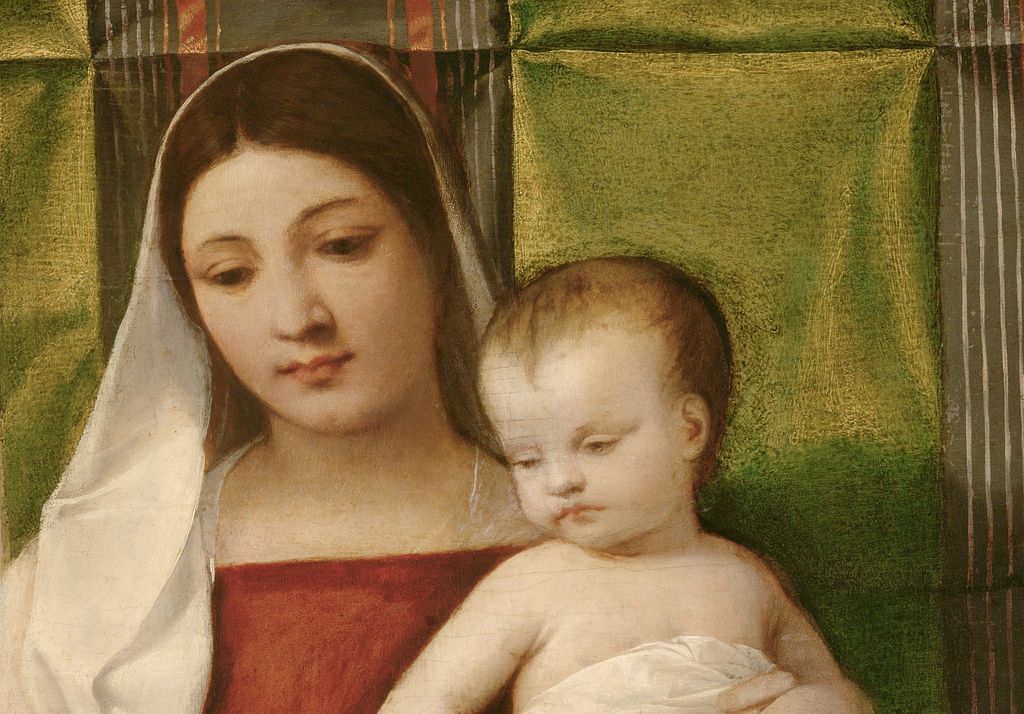
Mary and Christ before the cloth of honour
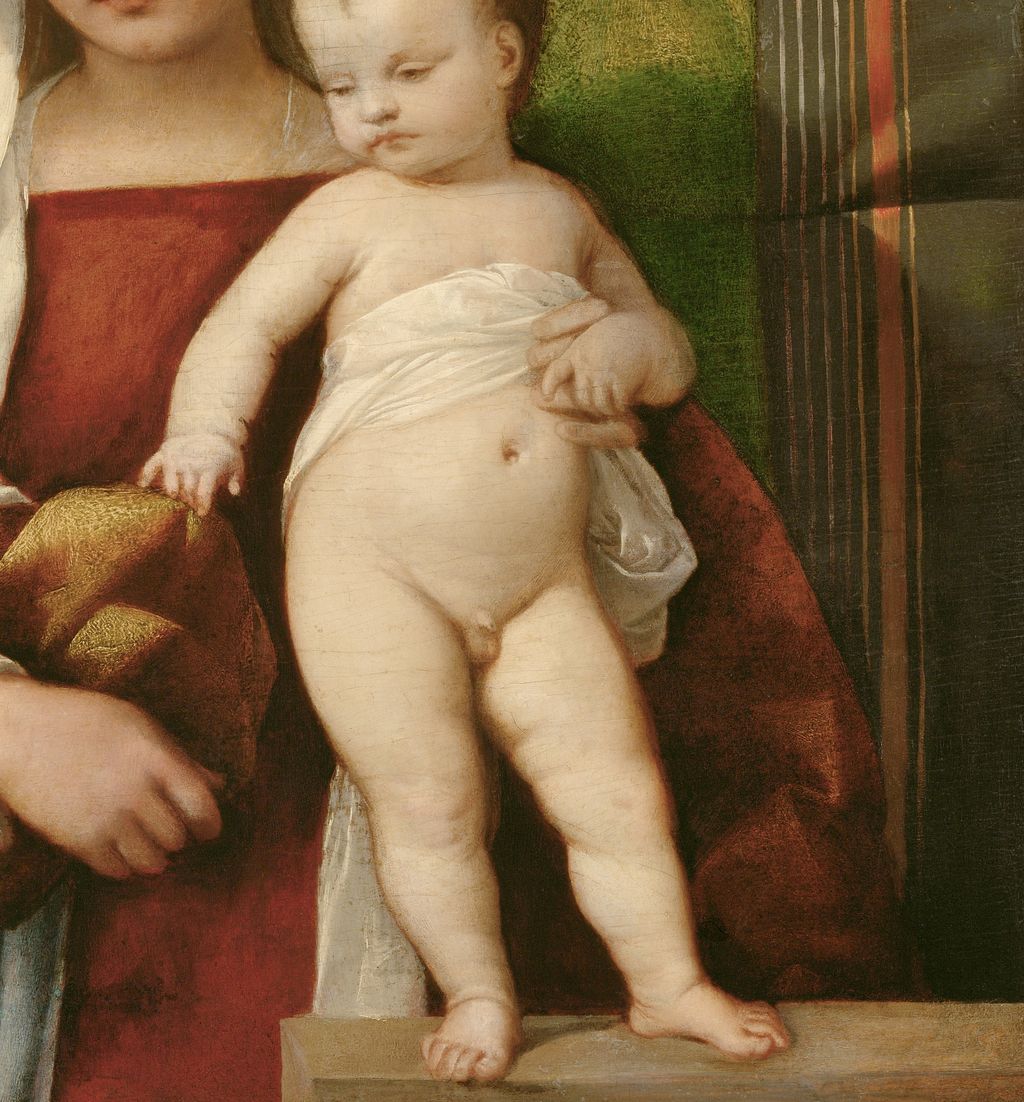
The standing child, Mary's hand and the ledge
The landscape beside the cloth
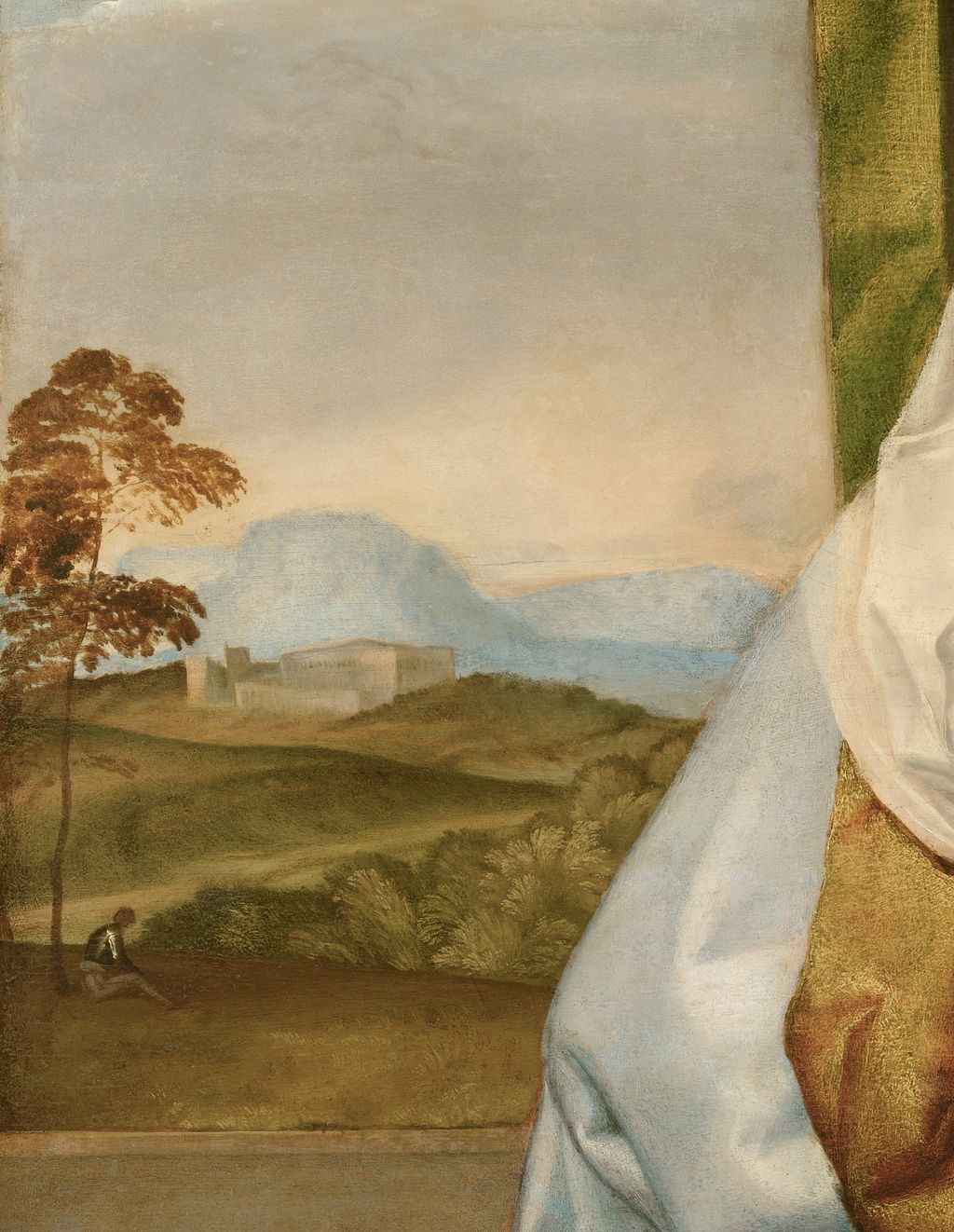
Image: Google Art Project via Wikimedia Commons. Public Domain Mark 1.0. Cropped and resized for details. Image source · Reuse licence
Contents
- What do we see in the Vienna panel?
- Why is a cloth of honour behind them?
- The Bellini connection and an earlier design
- An early Madonna and a later Vienna comparison
- What is known about its history?
What do we see in the Vienna panel?
Mary and the child occupy the right side of a horizontal painting. Her face turns down towards him under a pale veil. A red dress forms a strong vertical area at the centre of their group, while cooler blue and lavender drapery spreads around her. The child's almost bare body catches the light differently from her clothed figure. He stands rather than sits, and her arm and hand keep his changing balance secure. The low ledge gives him a footing close to the viewer's space. These are visible relationships between bodies and painted edges, not a documented account of the artist's model or the family's daily life.[1]
Behind them, a green cloth with coloured vertical bands hangs like a screen. It offers the holy pair a setting of honour, yet it is offset from the left-hand landscape rather than filling the entire background. The open side shows low hills, trees, light sky and a warm distant glow. A viewer can stay with the faces and touching arms or let the eye travel past the drapery into the countryside. The difference between the patterned near surface and the soft distant view gives depth to a composition that otherwise keeps its subjects very close.[1]
The child is small, but he makes the largest physical gesture. His standing legs, lifted arm and turn towards Mary interrupt the stable block of her clothing. Mary does not face the viewer as an aloof emblem. Her lowered gaze and supporting hold make the contact between them central. The KHM describes this as a humanising of the Virgin and Child. It also argues that the evening pastoral setting elevates the scene. These two effects work together: the figures appear bodily and immediate while the light and cloth retain the character of a devotional image.[1]
The painted parapet or ledge is more than a compositional rule. It separates the viewer's side from the figures' side while placing Christ's feet near that boundary. Mary seems set a short distance behind it, yet the child's body projects forward. The edge can therefore be read as a point of meeting between the domestic-looking pair and a worshipper before the panel. No original owner or precise display room has been identified in the consulted owner material, so this is an analysis of the image's address to a viewer, not a reconstruction of where it first hung.[1][3]
Why is a cloth of honour behind them?
The German title Madonna mit Kind vor buntem Ehrentuch describes Mary and Jesus in front of a coloured cloth of honour. Such a textile marks distinction and gives a figure a formal backdrop. Here it also supplies stripes and folds against which Titian can define the curved bodies. Mary's pale veil stands out from the darker green, and the child's illuminated skin has a different quality from both cloth and stone. The fabric is thus part of the picture's devotional language and part of its visual construction.[1]
Because the hanging is displaced to one side, the painting avoids strict bilateral symmetry. The KHM specifically singles out this break in symmetry, along with white highlights and shadow modelling, as signs of Titian's departure from Bellini's example. That judgement is easier to see by looking at the whole panel than by isolating Mary's face: landscape, curtain, ledge and figures do not line up around a single central axis. Their asymmetry makes the child's unstable standing position feel plausible within a balanced picture.[1]
The cloth and landscape should not be forced into an either-or reading of sacred symbol and ordinary scenery. The hanging gives honour; the landscape gives distance and atmosphere. Together they let a half-length mother and child inhabit a space larger than the room implied by the fabric. It is possible to describe this visible combination without claiming that every tree, hill or coloured stripe has an individually fixed theological meaning. The museum's booklet makes the larger interpretive point: the bucolic setting in evening light raises the scene even as Titian makes its human bond tangible.[1]
The Bellini connection and an earlier design
Giovanni Bellini's Madonna and Child in the Detroit Institute of Arts is an unusually useful comparison because the picture is signed and dated 1509. The Detroit museum describes its green curtain as creating an interior space that appears to extend towards the spectator; a landscape is visible as well. Bellini's picture is another oil painting on wood, though it is a different object with its own dimensions and history. The shared combination of holy figures, cloth, boundary and view makes the comparison concrete rather than a vague claim that all Venetian Madonnas looked alike.[4]
The technical evidence goes beyond visual resemblance. Jill Dunkerton and Marika Spring, writing in the National Gallery's Technical Bulletin, report that X-radiography and infrared reflectography of the Vienna painting revealed an initial design even closer to Bellini's Detroit composition than Titian's visible result. Their note cites an earlier object-specific study by Elke Oberthaler and Elizabeth Walmsley. The public note does not describe every hidden contour, so there is no basis here to draw a detailed reconstruction of the first scheme. Its secure point is the direction of change: Titian began nearer Bellini and revised away from him.[3]
That finding sharpens the date question. Since Bellini's comparator is dated 1509 on the work itself, the National Gallery authors regard Titian's related picture as likely later. The KHM's present catalogue says around 1510, while its 2021 exhibition booklet says 1511; both fit a short interval after Bellini's signed panel. Neither is a date inscribed on Titian's painting in the evidence consulted here. The technical comparison also does not prove when Titian entered, or whether he formally trained in, Bellini's workshop. Influence, access to a design and apprenticeship are different historical claims.[1][3][4][6]
The completed painting lets us see what the revision accomplished. Instead of aligning every element in a reassuring central order, Titian offsets the cloth and opens a larger adjoining view. Mary's form gains volume through light and shadow; the child stands with a convincing sense of shifting weight. Bellini remains a productive point of reference, but the Vienna composition does not simply repeat the Detroit panel. The older master's model is something Titian used and altered while resolving this particular image.[1][3][4]
Bellini's devotional type was widespread enough that other surviving works from his workshop also combine an intimate Virgin and Child with landscape. A Metropolitan Museum panel attributed to the workshop and dated around 1510 is one such example. That broader context helps explain why the Vienna work belongs to a living pictorial tradition. It should not turn every similar panel into a direct model for Titian: the Detroit comparison has the specific technical and chronological support, whereas the workshop panel is a contextual example.[3][5]
An early Madonna and a later Vienna comparison
The KHM calls GG 95 probably Titian's earliest important Madonna and Child. The word “probably” matters. Early Titian chronology is not so exact that one exhibition booklet can settle every contested ordering, and works made close together can be difficult to rank by a single stylistic feature. The KHM's description is nevertheless a strong reason to study the panel as an early sustained solution to a subject he would revisit throughout his career.[1]
The museum itself compares the composition with Titian's later Vienna Madonna of the Cherries, dated about 1516–18. In that picture Mary, Christ and the young John the Baptist are again arranged near a cloth and parapet, but additional figures and the children's active exchange put greater pressure on the stable triangular group. The comparison shows Titian returning to a useful relationship among figures, textile and ledge while changing its scale and movement. It does not make the two works versions of one commission.[2]
Their materials should be kept separate too. The KHM booklet identifies the early GG 95 as oil on wood. The later Madonna of the Cherries has its own complicated support history in the museum catalogue, including transfer from canvas to wood. That later history cannot be imported into the earlier painting. Object-level distinctions are necessary even when compositions invite comparison.[1][2]
What is known about its history?
The KHM's present object record gives a partial collection history. It lists Bartolomeo della Nave in Venice with a question mark, then the Hamilton collection from 1638 to 1649, followed by the collection of Leopold Wilhelm. The question mark prevents della Nave from becoming a certain first owner. Nor does this compact sequence identify Titian's patron, the first room where the panel hung or every transfer between collectors. It does, however, document a route from a possible Venetian owner through seventeenth-century collections into the Habsburg holdings from which the KHM collection developed.[6]
The strongest verified object facts are the KHM's attribution, GG 95 inventory, 65.5 × 83.5-centimetre dimensions, wood support and the closely related around 1510/1511 dates in its two publications. The technical comparison with Bellini provides a relative date after the Detroit picture's 1509 inscription. The limits of the provenance should remain open rather than be filled by assumptions about private devotion or by the history of another Titian Madonna.[1][3][4][6]
It is reasonable to discuss how a compact Madonna and Child image could address an individual worshipper at close range: Mary and Christ are near the parapet, and the Detroit museum explicitly explains this intimate effect for Bellini's related composition. But an apparent function is not proof of a named buyer or a particular domestic chapel for GG 95. The painting's present home is the Gemäldegalerie of the Kunsthistorisches Museum in Vienna, where its inventory number identifies the panel.[1][4][6]
The historic nickname also belongs to the painting's later reception, not to its subject matter. “Gypsy Madonna” reflects older descriptions of Mary's dark hair and appearance. It gives no evidence that the biblical Virgin is depicted as a Romani person or that Titian portrayed a named sitter. The KHM's present descriptive title directs attention to what is actually represented: Madonna, child and coloured cloth. Retaining the older phrase only as a searchable alias helps identify the object without repeating an unsupported ethnic claim.[1]
The Titian paintings guide sets GG 95 among the artist's early religious works. It can be compared with the Prado Virgin with Anthony of Padua and Roch as another Venetian Madonna subject, but the Prado object has different figures and its own attribution and dating questions. The Vienna panel's particular importance lies in the conjunction of intimate figure work, offset cloth and landscape, and an earlier design revealed by technical examination.[1][3]
Researched Titian and related works
Frequently Asked Questions
No. It is a historical English nickname for the Vienna Madonna and Child before a Coloured Cloth of Honour, inventory GG 95. The nickname is not an identification of Mary's ethnicity.[1][2]
The current KHM object record says around 1510, and its 2021 booklet says 1511. Technical comparison with Bellini's signed 1509 Detroit Madonna and Child supports a date after that picture, without fixing an exact year for Titian's work.[1][3][4][6]
The KHM's exhibition booklet specifies oil on wood. This is distinct from the material history of Titian's later Madonna of the Cherries.[1][2]
X-radiography and infrared reflectography showed that Titian's first design was closer to Bellini's Detroit picture than the final visible painting is. The published National Gallery note does not provide a full reconstruction of every change.[3]
Discussion
What do you notice when you look closely at Titian's Madonna and Child before a Coloured Cloth?
Share a specific observation or a source that adds context.
Reader Insights
Which detail changes your reading?
How does its original setting affect what we see?
Which part of the evidence remains uncertain?
Join the Conversation
Add your observation below.
References
- Kunsthistorisches Museum Vienna, Titian's Vision of Women exhibition booklet, “Madonna mit Kind vor buntem Ehrentuch,” p. 2. View source.
- Kunsthistorisches Museum Vienna, “Kirschenmadonna,” object record, including comparison with GG 95. View source.
- Jill Dunkerton and Marika Spring, “Titian's Painting Technique to c.1540,” National Gallery Technical Bulletin 34 (2013), notes p. 122, note 21, citing Elke Oberthaler and Elizabeth Walmsley, “Technical Studies of Painting Methods,” in Bellini, Giorgione, Titian, and the Renaissance of Venetian Painting (2006), pp. 296–98. View source.
- Detroit Institute of Arts, Giovanni Bellini, Madonna and Child, 1509, object 28.115. View source.
- The Metropolitan Museum of Art, Workshop of Giovanni Bellini, Madonna and Child, c.1510, object 49.7.2. View source.
- Kunsthistorisches Museum Vienna, “Madonna mit Kind vor buntem Ehrentuch,” current painting record, Gemäldegalerie 95. View source.


