



 by Tom Gurney
Tom Gurney BSc (Hons) is an art history expert with over 20 years experience
Published on June 19, 2020 / Updated on October 15, 2026
Email: tomgurney1@gmail.com / Phone: +44 7429 011000
Titian's Flaying of Marsyas at Kroměříž: Introduction
Marsyas hangs head downward from a tree. Two figures work on his exposed body, while a musician plays, an elderly man watches, and dogs crowd the foreground. Titian's Apollo and Marsyas, usually called The Flaying of Marsyas, does not show the musical contest that made the satyr famous. It places us among those who carry out or witness its punishment. The large canvas belongs to the Olomouc Archbishopric and hangs in the Archbishop's Palace picture gallery at Kroměříž in the Czech Republic.[1][2]
The painting is usually treated as a work of Titian's last years, but its date cannot be reduced to a single certain year. An Olomouc Museum of Art label gives after 1550 and measures it at 220 × 204 centimetres. The Metropolitan Museum of Art has dated it probably to the 1570s. The Met also states that the first patron is unknown and that we do not know whether Titian regarded the picture as finished. These gaps matter because both its disturbing subject and its varied surface have attracted explanations that outrun the surviving evidence.[1][3]
At a Glance
- WorkFlaying of Marsyas
- Research recordzamek-kromeriz.cz
Annotated details from Flaying of Marsyas
Select a numbered area to find its detail below. Open a detail image to view it larger.
Details from FLAYING OF MARSYAS
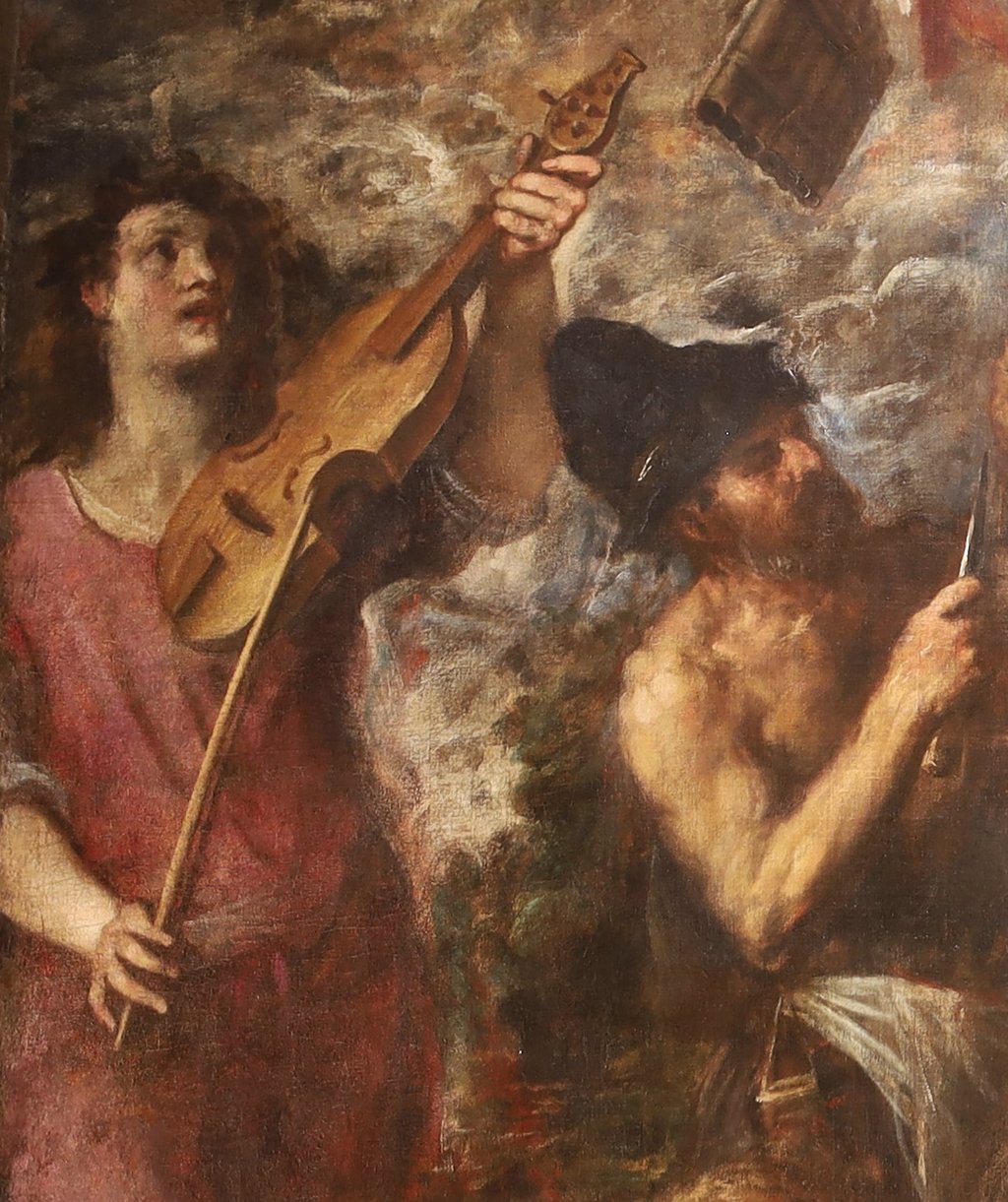
The Bowed Musician and a Cutter
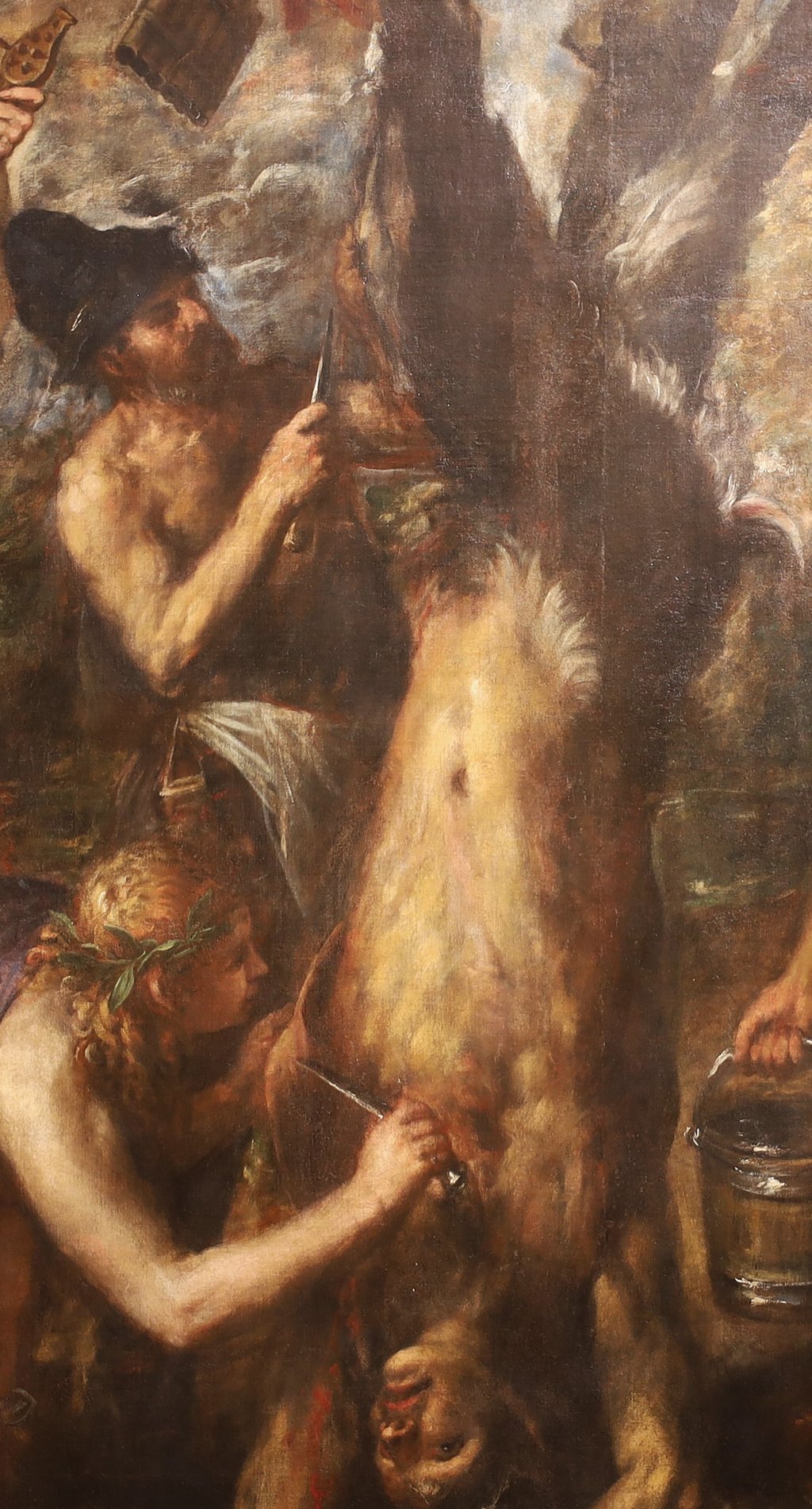
Marsyas and the Two Knives
Midas, the Bucket Carrier and the Dog
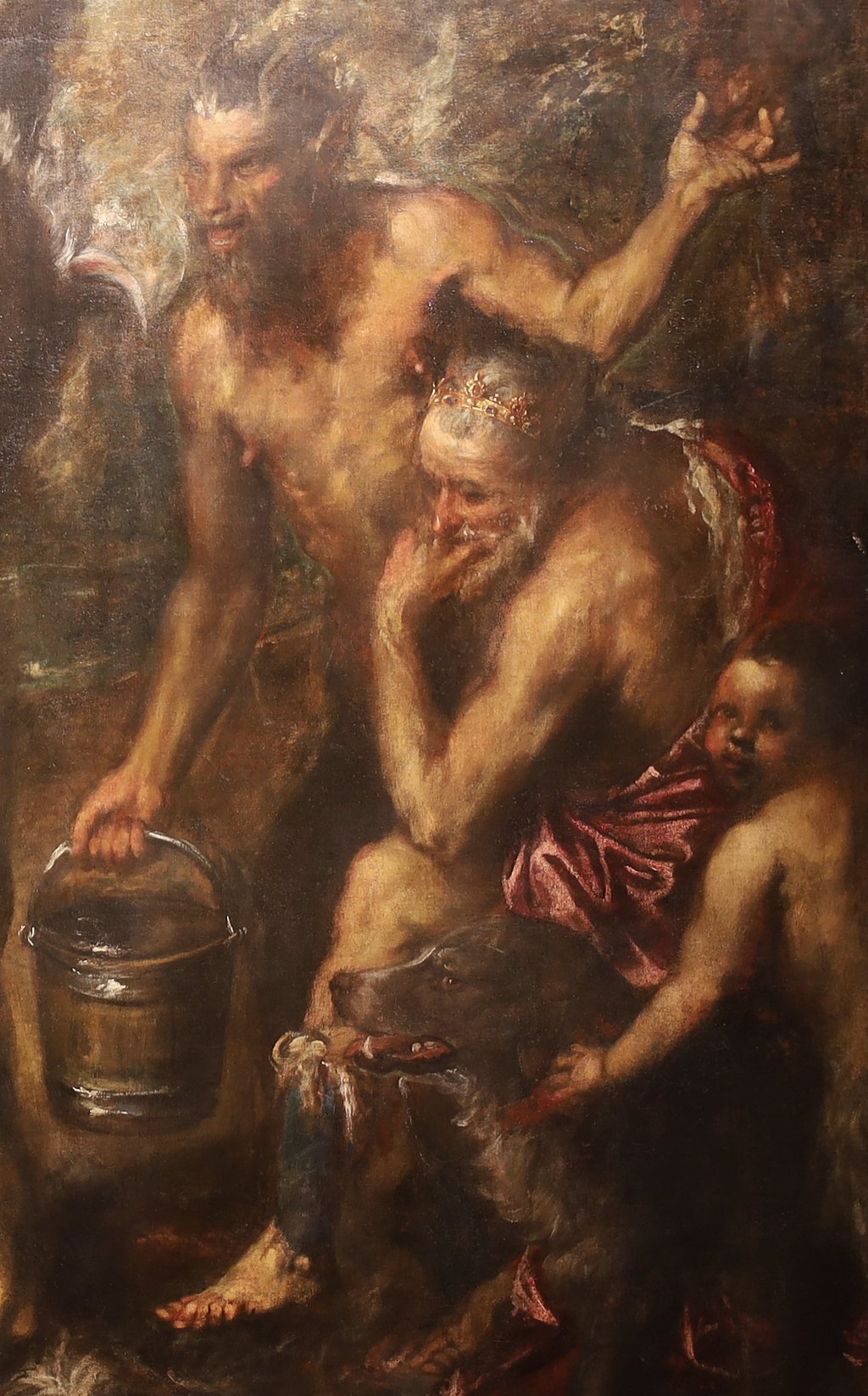
Photo: Ondraness, 2026, CC BY-SA 4.0. Full view resized; numbered details cropped and resized from the photograph. Image source · Reuse licence
Contents
- What happens in the myth?
- Looking through the crowded scene
- Music, instruments and Titian's revision
- A late surface and an unresolved finish
- How has the picture been interpreted?
- From Titian's studio to Kroměříž
What happens in the myth?
Marsyas was a satyr associated with the aulos, a reed instrument often translated too loosely as a flute. He challenged Apollo, god of music, to a contest and lost. Apollo's penalty was to strip the skin from Marsyas's living body. In Book VI of Ovid's Metamorphoses, the punishment is described briefly but intensely; after the death, tears shed by woodland beings become the river that bears Marsyas's name. Titian selects the moment of flaying rather than the contest or its aftermath.[4]
That Ovidian account does not provide a name for everyone Titian painted around the tree. The seated, crowned elder at the right is conventionally called Midas, although his story belongs especially to another contest: Apollo against Pan in Book XI of the Metamorphoses. There Midas favours Pan and receives ass's ears for his judgment. The National Gallery Prague notes that Titian brings elements of the two musical stories together. Midas's presence is thus a clue to the painter's imaginative combination of ancient material, not evidence that Ovid described Midas attending Marsyas's flaying.[5]
This distinction helps keep the picture open to close looking. A narrative label tells us the central event, but it cannot account for the varied pace of the surrounding actions. One person bends to cut, another seems absorbed in music, and Midas sits apart with his head lowered. The story supplies a victor and victim; Titian supplies a gathering whose individual roles and responses are harder to settle.[5][6]
Looking through the crowded scene
Marsyas occupies the centre. His legs rise toward the branch and his head descends nearly to the ground, reversing the usual upright human figure. His stretched torso forms a pale, exposed vertical against the dark trees. The inversion makes him at once the compositional support and the least free participant. His body organizes nearly every other movement: hands, tools, faces and animal heads turn toward it.
At lower left, a laurel-wreathed figure kneels and works near Marsyas's leg. The laurel identifies him in institutional descriptions as Apollo. Another cutter, higher at the left, reaches toward the satyr's upper body. Titian gives the two workers different positions and distances from us, making the violence a sustained task rather than one theatrical blow. Their lowered heads and concentrated hands can appear almost routine. It is precisely that ordinary concentration beside extraordinary suffering that makes the scene difficult to resolve into a straightforward celebration of divine victory.[5][6]
The left edge contains a standing player with a bowed string instrument. At centre right, a figure bears a bucket or pail; some descriptions call him Pan, though the identification is interpretive. The large seated elder on the right is called Midas. Near him, a child handles a dog; a smaller dog appears below the principal group. These are not decorative fillers. The player prolongs the music after the contest, the bucket suggests the practical work around the flaying, and the dogs bring the viewer's eye back to the ground beneath Marsyas. The child and elderly judge stretch the scene across generations of spectators.[5][6]
The scene is compact despite the many figures. Tree trunks close off a deep landscape, and brown, red, pale flesh and dark foliage repeatedly meet at the edges of bodies. It takes a moment to distinguish a limb from a neighbouring hand or cloth. The figures are not arranged in a clean semicircle around a single hero. They press into the same wooded space, so that the viewer must search through actions rather than read the painting as a neatly illustrated episode. This is an observation about the image, not a claim that Titian intended any one modern moral response.
Music, instruments and Titian's revision
The musical challenge is present through instruments even though no competition is being played. Marsyas's association with the reed aulos made the ancient story available as a comparison between kinds of music and, by extension, between different claims to artistic skill. But it is too simple to say that the painting merely shows refined strings defeating rustic pipes. The winning god handles a knife, while another string player remains at the edge of a punishment. Music persists without settling the justice of what we see.[4][5]
National Gallery Prague reports that technical investigation revealed a significant change to the standing musician. An earlier ancient lyre was changed to a lira da braccio, a bowed instrument familiar in Titian's own era. That reported revision is more informative than calling the object a violin without qualification. It inserts a contemporary musical medium into an ancient scene, connecting the myth to the artist's world without proving a precise allegorical message. The Prague account does not publish the full technical record on that page, so the revision should be credited to its account rather than embellished with imagined x-ray or pigment details.[5]
The change also cautions against treating every visible component as the expression of one fixed initial design. Titian could rethink how ancient and contemporary music meet within the image. The altered instrument does not identify the player or the first patron. It does, however, give a rare reported glimpse of an artistic decision made while the picture developed.[5]
Prague's essay relates parts of the composition to Giulio Romano and to ancient sarcophagus imagery. Those precedents help explain why a Renaissance painter might crowd a classical punishment with several workers and witnesses. They do not turn this painting into a copy of one prototype. The inverted body, the lower cutters and the watching figures form Titian's own large arrangement, while the revised musical instrument shows that inherited visual language could be adapted during painting.[5]
A late surface and an unresolved finish
The Marsyas is a useful work for looking at Titian's late paint because its passages do not all behave alike. Some heads and working hands hold together in comparatively specific forms. In other areas, short strokes and broad deposits of colour remain conspicuous, and contours seem to loosen into the neighbouring earth, foliage or flesh. From a distance, these strokes gather into bodies and atmosphere. At close range, the process of making the image remains visible.[3]
The Met's 2016 Unfinished exhibition made this distinction central. Its label describes the contrast between broadly worked areas and passages of greater finish, but declines to say whether Titian considered the canvas complete. It also leaves open the possibility of changes after his death. The work is signed, yet a signature by itself cannot tell us exactly when Titian stopped or whether every area now visible reflects his final intention. Calling the picture simply “unfinished” would make a disputed conclusion sound like an established object fact.[3]
Its chronological labels need the same care. The Olomouc exhibition label's “after 1550” is a broad catalogue date; the Met's probable 1570s date is a narrower scholarly judgment. A recent palace notice places the picture near the end of Titian's life. These formulations overlap but do not establish a dated commission or final brushstroke. Titian died in 1576, making the question of the picture's last state especially consequential, but not automatically answerable.[1][2][3]
Measurements vary in published records as well. Olomouc's 2016 label gives 220 × 204 centimetres, while some other descriptions give approximately 212 × 207. The difference should be noted when exact dimensions matter, rather than explained by an undocumented trimming, remounting or measurement convention. Both sets make clear that the work is close to human scale in height and broad enough for a dense group of figures.[1]
The surface also has a modern conservation history. Olomouc Museum of Art identifies František Sysel as the restorer who worked on the painting from 1962 to 1968. That span is securely documented in the museum's exhibition about his work. Without the treatment record, however, it would be unwarranted to describe particular layers he removed or to attribute every visible colour and brushstroke to the restoration. An image on a screen offers the composition and some surface information, but cannot substitute for technical examination of the canvas.[7]
How has the picture been interpreted?
One influential suggestion treats the bowed, seated Midas as a likeness of Titian contemplating suffering, age or the cost of artistic ambition. It is an evocative interpretation, particularly for a painting commonly assigned to the artist's last years. Yet the identification is not secured by a contemporary statement from Titian or by a known portrait study. The figure can be called Midas in the combined myth without presenting him as a documented self-portrait.[5]
Other readings look beyond personal reflection. The painting has been linked to an Ovidian decorative cycle for Mary of Hungary, although the first patron remains unknown. A political interpretation connects Marsyas's torment with the torture and death of Marcantonio Bragadin after the Ottoman capture of Famagusta in 1571. A National Gallery of Art account discussed that Venetian parallel while acknowledging that the painting's original circumstances are uncertain. The chronological association is possible only if one accepts a late date; it is not a commission document or proof that the scene depicts Bragadin in mythic disguise.[5][8]
Christian interpretations have also read the stripping of skin as purification or transformation. Such a reading may describe a later viewer's response to suffering and renewal, but the classical punishment remains the picture's identifiable subject. No surviving programme establishes that Titian meant the painting as a Christian devotional allegory. The interpretive range is itself important: the god's authority, the victim's pain, the working cutters and the detached witnesses pull the picture in different directions. A careful account lets those tensions remain visible instead of assigning the canvas one proven moral.[5]
From Titian's studio to Kroměříž
The earliest ownership is incomplete. National Gallery Prague places the painting with Thomas Howard, Earl of Arundel, before it entered the Olomouc collection. The Olomouc Museum describes Bishop Karel II Liechtenstein-Kastelkorn buying part of the Imstenraed collection in 1673, including works with earlier connections to the collections of Charles I and Arundel. The museum's 2016 label dates this painting's acquisition to 1673. These records support an Arundel association and a firm seventeenth-century arrival at Olomouc; they do not supply every hand through which the canvas passed.[1][5][9]
Kroměříž became the painting's enduring home. The palace's collection notice states that it is displayed in its picture gallery and that Titian's authorship gained acceptance in the 1960s. Its secure present location and later attribution history are distinct from the unknown first patron and unresolved original setting. A private or court commission, a decorative cycle and an independently made picture would each imply a different first audience, but the available documentation does not choose among them.[2][5]
Occasional loans made the canvas accessible to a wider public and to scholars. The National Gallery of Art records its appearance in London in 1983, its first journey abroad in about three centuries, followed by a Washington exhibition in 1986. It was also shown in New York in the Met's 2016 Unfinished exhibition. These displays help explain the intensity of modern debate over the work's surface and meaning, while its collection and regular display remain at Kroměříž.[3][10]
For comparison with Titian's other narrative works, see the paintings guide and the account of his mythological poesie. Marsyas shares their interest in ancient story, but its compressed gathering of witnesses and uncertain state of finish give it a particular force. Its documented history gives us a location, a seventeenth-century acquisition and a modern conservation and exhibition record. The first patron, exact date, final state and comprehensive meaning still require qualified answers.
Researched Titian and related works
Frequently Asked Questions
The painting belongs to the Olomouc Archbishopric and is displayed in the Archbishop's Palace picture gallery at Kroměříž, Czech Republic. Check the palace's current visitor information before travelling.[1][2]
Olomouc's published label says after 1550; the Met considers the 1570s probable. No cited document establishes an exact completion year.[1][3]
Midas belongs primarily to the Apollo–Pan contest in Ovid, whereas Marsyas challenges Apollo in another episode. Titian's painting combines figures and associations from those ancient musical myths.[4][5]
It has been proposed, but no known contemporary identification proves that the face is Titian's. It is best presented as an interpretation.[5]
That remains unsettled. The Met notes both broad and carefully finished passages, and says neither Titian's judgment of completion nor possible changes after his death are known.[3]
Discussion
What do you notice when you look closely at Titian's Flaying of Marsyas at Kroměříž?
Share a specific observation or a source that adds context.
Reader Insights
Which detail changes your reading?
How does its original setting affect what we see?
Which part of the evidence remains uncertain?
Join the Conversation
Add your observation below.
References
- Olomouc Museum of Art, “Memento Tiziani,” exhibition label for Apollo and Marsyas, 2016. View source.
- Archbishop's Palace, Kroměříž, collection and display notice, 2026. View source.
- Metropolitan Museum of Art, Unfinished: Thoughts Left Visible object label for The Flaying of Marsyas, 2016, PDF pp. 2–3. View source.
- Ovid, Metamorphoses, Book VI, Marsyas passage, text and translation via University of Virginia. View source.
- National Gallery Prague, “Tiziano Vecellio: Apollo and Marsyas,” object essay. View source.
- Vanderbilt University Special Collections, Contini-Volterra Photographic Archive, Titian Punishment of Marsyas catalogue description. View source.
- Olomouc Museum of Art, “Under Marsyas' Skin,” František Sysel restoration exhibition, 2017. View source.
- National Gallery of Art, Washington, 1986 annual report, discussion of the Marsyas loan and Famagusta interpretation. View source.
- Olomouc Museum of Art, “Paintings,” history of the Archbishopric collection. View source.
- National Gallery of Art, Washington, “Titian: The Flaying of Marsyas,” exhibition record, 1986. View source.


