



 by Tom Gurney
Tom Gurney BSc (Hons) is an art history expert with over 20 years experience
Published on June 19, 2020 / Updated on October 15, 2026
Email: tomgurney1@gmail.com / Phone: +44 7429 011000
Titian's Annunciation at the Scuola Grande di San Rocco: Introduction
Titian's Annunciation at the Scuola Grande di San Rocco in Venice is a wide painting of a meeting across an open architectural space. Gabriel flies in from the left while Mary receives the message at a desk on the right. Between them are a beam of light, patterned pavement, a marble balustrade and columns opening onto landscape. The canvas entered the confraternity through a 1555 bequest and now hangs high over an arch on the landing of its Grand Staircase. It is oil on canvas, 166 centimetres high and 266 wide.[1][2]
The location is essential to this painting's identity. Titian painted other Annunciations, including a tall work at San Salvador. Tintoretto later painted an Annunciation for the ground-floor hall of the very same Scuola. Neither is this horizontal canvas. Its bequest, donor-crested frame, revised surface and long display history all belong specifically to the San Rocco painting.[1][2][4]
At a Glance
- WorkAnnunciation at San Rocco
- Research recordscuolagrandesanrocco.org
Annotated details from Annunciation at San Rocco
Select a numbered area to find its detail below. Open a detail image to view it larger.
Details from ANNUNCIATION AT SAN ROCCO
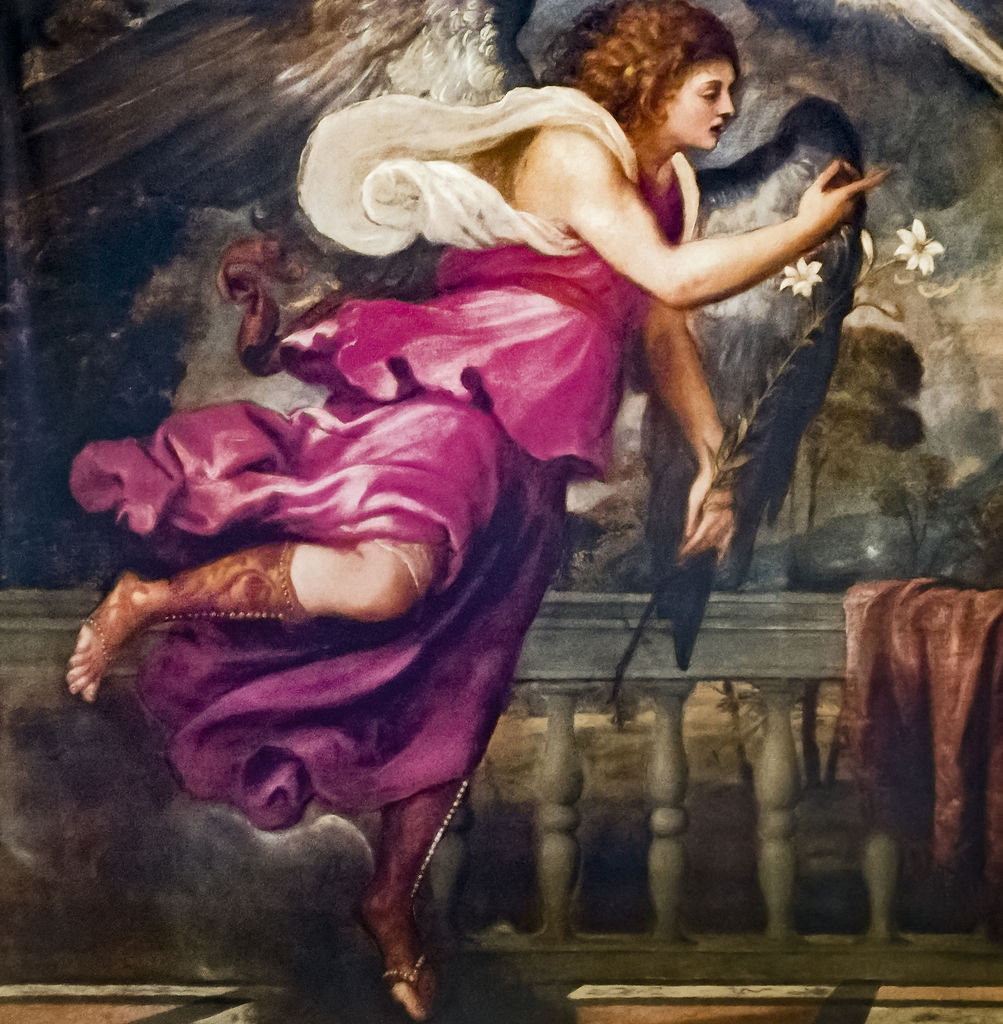
San Rocco Annunciation Gabriel and Lilies
San Rocco Annunciation Mary and Symbols
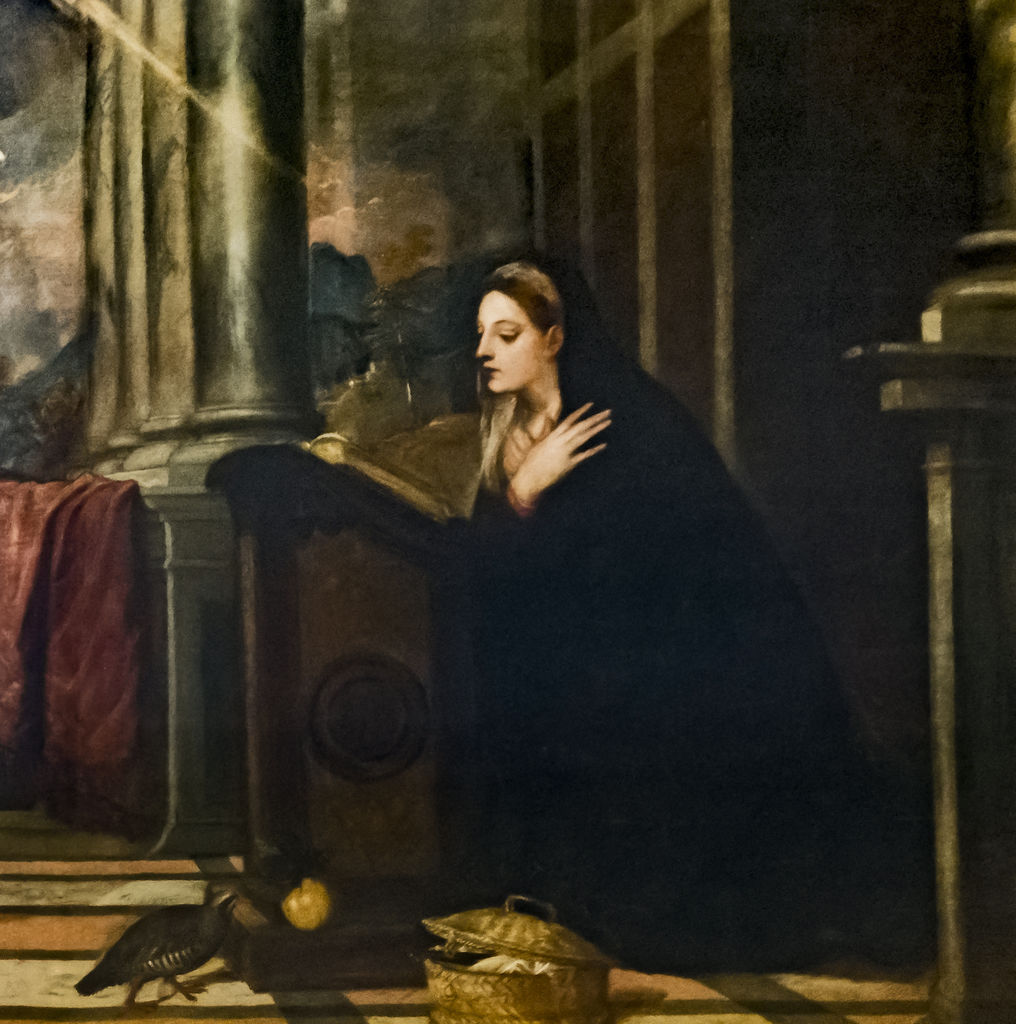
Photo: Didier Descouens / Archaeodontosaurus, CC BY-SA 4.0. Cropped and resized; derivative images CC BY-SA 4.0. Image source · Reuse licence
Contents
- Gabriel and Mary across an open atrium
- What lies beside Mary's desk?
- A date made in phases
- From Melio da Cortona to the Grand Staircase
- Conservation and the appearance of Mary's mantle
- Three Annunciations to keep apart
- Why this picture matters
Gabriel and Mary across an open atrium
The Archangel Gabriel is suspended in flight rather than standing before Mary. His drapery spreads behind him in a vivid arc; his extended hand sends the message across the open floor. Save Venice likens his appearance to a classical Victory, an interpretation that draws attention to the figure's forward motion and winged form. Mary is comparatively still. She crosses her arms at her chest and lowers her gaze by the desk, an attitude the conservation project reads as acceptance of the announcement.[2]
The gap between the figures is central to the composition. It gives Gabriel room to arrive and Mary room to respond. A diagonal ray linked to the dove of the Holy Spirit connects them through light. The painting makes the moment both spatial and spiritual: an event unfolds in an imagined room, while the ray carries its meaning across that room. The reader need not supply additional figures or a crowded heavenly court to understand the encounter.[2]
The setting is grand but open. A low balustrade runs behind the figures; a row of columns recedes at the right; beyond are trees, rock and distant mountains. Save Venice compares those mountains to the Cadore region where Titian was born. That geographical echo is a curatorial visual comparison, not evidence that the painted scene literally takes place in northern Veneto. The architecture establishes order and depth, while the landscape keeps the horizon open behind the sacred event.[1][2]
Across the foreground, large light and dark rectangles of pavement pull the eye laterally. A draped cloth hangs over the balustrade between Gabriel and Mary, and the lilies carried by the angel stand out against the darker space. These details help join two otherwise separate halves of the picture. The broad format and relatively few figures give the viewer time to follow gesture, light and distance rather than a complex procession.[2]
What lies beside Mary's desk?
Small objects near Mary's feet matter more than their scale first suggests. Save Venice identifies an apple, a red-legged partridge and a sewing basket at the base of her prie-dieu, or prayer desk. The apple can invoke Mary as the New Eve: the Annunciation begins a new history that answers the disobedience traditionally associated with Eve and the first fruit. This reading comes from Christian visual tradition and the conservation project's account; the object itself is simply a small painted apple until that context is supplied.[2]
The partridge carries a less familiar association. Save Venice explains a medieval belief that the bird could conceive at the sound of a male's call. In the Annunciation this made it a possible symbol of the Incarnation through the angelic greeting. The belief belongs to historical symbolism, not modern ornithology. The bird's placement beside the apple gathers two ways of thinking about the meaning of Mary's response: a new beginning and a conception announced by a voice.[2]
The sewing basket refers, in the same project's interpretation, to an older image tradition in which Mary spins yarn for the new veil of the Jerusalem Temple. Save Venice compares this motif with mosaics at Torcello. Its presence broadens the picture's time frame beyond the instant of Gabriel's arrival. The quiet work associated with Mary remains near her even as the message interrupts it. These linked interpretations enrich the painting without claiming that every viewer in sixteenth-century Venice would have explained all three objects in exactly the same words.[2]
The local image includes a detail of Mary's side of the scene, which helps reveal the small bird and fruit that disappear at ordinary page scale. The detail should be read with the full picture: the objects work as part of a carefully measured space between messenger and listener, not as a separate still life.[2]
A date made in phases
The Scuola's collection page dates the work around 1535 and says Titian's authorship, once doubted, is now unanimously accepted. Save Venice's historical account says the painting was traditionally placed in the late 1530s through stylistic comparison. Its current object field gives a broader span from the late 1520s into the early 1540s. A 2024 exhibition statement based on recent conservation goes further back, proposing an initial conception around 1520 under Giovanni Bellini's influence, followed by years of incompletion and later revisions by Titian.[1][2][3]
These statements are best understood as different descriptions of a long-making painting. The Scuola's c.1535 label is a concise collection date; the conservation account asks how the visible surface came together over time. It does not require us to place every figure, column and landscape passage in one year. The 1555 bequest is a firm latest point for the picture's arrival at the confraternity, but is not a record of the first brushstroke.[1][2][3]
The source of the newer interpretation is the physical canvas, examined during conservation. Save Venice reports a first campaign of scientific analysis and maintenance in 2018 and a fuller treatment begun in 2021. It says the work's original colours and the depth between figures, architecture and landscape became more legible. The public summary describes changes and revised chronology, but does not publish all the imaging, samples or layer-by-layer evidence needed to assign each visible passage a precise date. That limit matters when summarising a complex restoration for a general reader.[2][3]
The painting's traditional date also intersects with another Titian subject. Save Venice places it stylistically after a lost Annunciation painted for Santa Maria degli Angeli on Murano, known through a Giacomo Caraglio engraving. A comparison with a lost painting recorded in print can inform chronology, but it does not provide a surviving original to inspect side by side. The phased conservation account should therefore be kept distinct from a simple resemblance argument.[2]
From Melio da Cortona to the Grand Staircase
Melio da Cortona, a jurist and orator, left the picture to the confraternity in 1555. The Scuola quotes the wish in his will that it be placed in the Albergo or the Salla according to the brothers' judgment. That statement tells us how the Scuola acquired it. It does not name an original contract commissioning Titian to paint it for that staircase. Save Venice describes it as one of the first prestigious works displayed in the new headquarters, well before Tintoretto began his extensive decorative cycle there in 1564.[1][2]
New archival research cited by Save Venice locates the painting above the door to the Sala dell'Albergo by 1567. The elaborately carved and gilded frame carries Melio's family arms, and its dimensions are consistent with a position over that doorway. This is more precise than saying the picture has always been on the Grand Staircase. The canvas remained at the Albergo entrance until 1582, when it was moved above the landing arch where it is seen today.[1][2]
The stair landing later acquired a companion across from it: Tintoretto's Visitation, commissioned for the opposite arch. The Scuola identifies the painting as a later pendant, and dates it 1588 in its gallery. The two New Testament events now form a sequence for a visitor moving through the building. Their present pairing is the result of later display history, not evidence that Titian and Tintoretto jointly designed a matched commission.[1]
The frame, donor crest and successive locations are part of the painting's meaning as an object. Above the Albergo door, Melio's gift would have met the officers who governed the confraternity. On the monumental stairs it meets a wider passage of visitors. The canvas did not change subject, but its audience and visual neighbours changed. Reading the bequest alongside the later move gives a more accurate history than treating the current position as an original site.[1][2]
Conservation and the appearance of Mary's mantle
The existing photograph shows a very dark mantle around Mary. A modern viewer should not assume that Titian intended the blue textile to read almost black. The Save Venice project says conservation made the original colour relationships and perspective more legible; the 2024 exhibition account published by Venezia News identifies the mantle's near-black appearance as a major condition problem, possibly involving an old irreversible alteration. Her present appearance, as photographed, has therefore been affected by material history. It is not evidence that the angel was painted in one phase and Mary in another solely because their colours now differ.[2][6]
Save Venice names Giulio Bono and his team for the examination and restoration begun in 2021, under project direction by Maria Agnese Chiari Moretto Wiel and the supervision of the Venetian heritage authority. A close-view exhibition in 2024 temporarily brought the canvas within easier sight before it returned to the high stair position. Such an exhibition offers a rare chance to study small details directly, yet it was temporary. The normal context remains the broad composition viewed from below on the landing.[2][3]
The conservation publication trail also shows that research is ongoing. Save Venice lists scholarly work on the treatment, and a later issue of Studi Tizianeschi includes Giulio Bono's detailed report. The public project and exhibition summaries support the phased chronology and broad treatment findings stated here; they do not justify inventing an exact X-ray alteration or pigment identification for a particular figure.[2][3][5]
Three Annunciations to keep apart
The wide San Rocco canvas differs visibly from Titian's later Annunciation at San Salvador, an upright altarpiece with another architectural and devotional setting. The shared biblical subject does not imply a shared first patron, simultaneous execution or identical iconography. The Scuola also owns Tintoretto's later Annunciation in its ground-floor hall, listed among eight large scenes of Mary's life and Christ's infancy. That work belongs to Tintoretto's decorative programme of the 1580s, whereas Titian's canvas arrived through Melio's 1555 bequest.[1][4]
There is a further possible confusion within Titian's oeuvre: the lost Murano Annunciation known through Caraglio's engraving. Save Venice uses that image as a chronological comparison, not as another name for the San Rocco canvas. Attaching each version to its owner, format and history is more reliable than numbering them “I” and “II.” The Titian paintings guide places the San Rocco work among the larger set of surviving works.[2]
Why this picture matters
The painting balances arrival and stillness. Gabriel's flight, the ray of light and Mary's restrained response make the Annunciation readable across a wide, open space. Small objects near her desk add traditional meanings of Incarnation and renewed beginnings without crowding the scene. The canvas also carries an unusually layered history: a probable long period of making, a documented bequest, an archival placement by 1567, a move in 1582, a later pendant and recent conservation that has altered how its chronology is discussed.[1][2][3]
Those layers make a simple c.1535 label useful but incomplete. It names a conventional place for the painting in Titian's career. The fuller evidence shows a picture that may have begun much earlier and been reworked before Melio da Cortona gave it away. Looking closely at the painting and its records together lets the work remain both a clear biblical image and a changing physical object.[1][2][3]
Researched Titian and related works
Frequently Asked Questions
It hangs above an arch on the Grand Staircase landing of the Scuola Grande di San Rocco in Venice.[1][2]
The owner gives about 1535. Save Venice's conservation account proposes an initial conception around 1520, years of incompletion and later revisions, with the surviving work finished before the 1555 bequest.[1][2][3]
The jurist Melio da Cortona bequeathed it in 1555. By 1567 it hung above the Albergo doorway, and it moved to the stair landing in 1582.[1][2]
Save Venice identifies them as an apple linked to Mary as New Eve, a red-legged partridge associated in medieval belief with conception through a voice, and a sewing basket recalling traditions of Mary spinning the Temple veil.[2]
Discussion
What do you notice when you look closely at Titian's Annunciation at the Scuola Grande di San Rocco?
Share a specific observation or a source that adds context.
Reader Insights
Which detail changes your reading?
How does its original setting affect what we see?
Which part of the evidence remains uncertain?
Join the Conversation
Add your observation below.
References
- Scuola Grande di San Rocco, “Titian,” owner collection account. View source.
- Save Venice, “Titian's Annunciation in the Scuola Grande di San Rocco,” detailed object and conservation project. View source.
- Save Venice, “Titian's ‘Annunciation’: investigations, restoration, and discoveries,” 2024 exhibition and conservation account. View source.
- Scuola Grande di San Rocco, “Ground Floor Hall,” listing Tintoretto's later Annunciation. View source.
- Fondazione Centro Studi Tiziano e Cadore, Studi Tizianeschi XIV contents, listing Giulio Bono's treatment report. View source.
- Venezia News, “Titian's Annunciation: Investigations, Restoration, Discoveries,” 2024 exhibition account. View source.


