 by Tom Gurney
Tom Gurney BSc (Hons) is an art history expert with over 20 years experience
Published on June 19, 2020 / Updated on October 15, 2026
Email: tomgurney1@gmail.com / Phone: +44 7429 011000
Titian's Bacchanal of the Andrians: Introduction
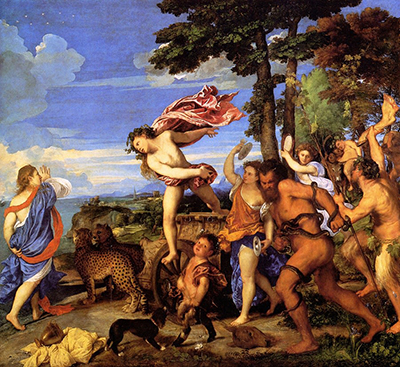
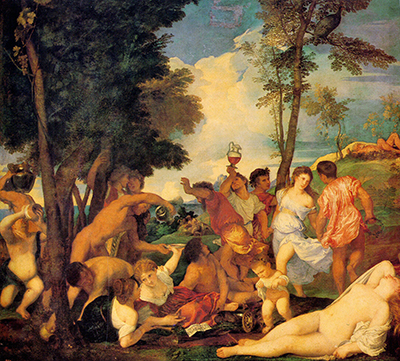
In Titian's Bacchanal of the Andrians, the extraordinary event is easy to miss: a stream crossing the foreground carries wine rather than water. People have come to its banks to drink, sing, dance and sleep. No single action explains the whole picture. Its pleasure lies in the way the eye moves from one small episode to another, then out toward the open sky and sea. Titian painted it for Alfonso I d'Este, Duke of Ferrara, between 1523 and 1526. The canvas is now in the Museo Nacional del Prado, Madrid, where it is catalogued as P000418. At 175 by 193 centimetres, it had the scale to make its mythical island seem like a place a viewer could enter.[1]
The title names the Andrians, the inhabitants of the Greek island of Andros. Their celebration is not the same story as Titian's Bacchus and Ariadne, despite the shared god and the fact that both pictures were made for the same Ferrara room. The source for the Andrians is a description of a wine-bearing river in Philostratus's Imagines. The distinction matters: it turns this painting from a generic drinking party into a carefully invented answer to an ancient text.[1][2]
At a Glance
- WorkBacchanal
- Research recordMuseo Nacional del Prado
Contents
- What does the ancient story say?
- Following the river through the painting
- The music you can see
- Ancient bodies in a Venetian landscape
- Alfonso d'Este's Alabaster Chamber
- From Ferrara to the Prado
- How to look at the painting
What does the ancient story say?
Philostratus describes Andros as a land favoured by Dionysus, the Greek god whom Roman writers called Bacchus. Wine rises from the ground and forms a river. Its quantity may be modest as water, the narrator jokes, but measured as wine it is a wonderful river. Men crowned with ivy sing to wives and children, while others dance or recline along the banks. Their song imagines that the drink makes people richer, more powerful, more generous, more beautiful and even taller. Philostratus presents these benefits as the drinkers' buoyant claims, not as sober facts.[2]
The description grows stranger as it goes on. Grape clusters form a bed for the river; staffs associated with Bacchus grow beside it like reeds. Tritons at its mouth scoop up wine in shells. Dionysus arrives by ship with satyrs, Bacchantes and Sileni, and with personifications of laughter and revelry. Much of that procession is described in words rather than securely identifiable in Titian's canvas. Looking for a one-to-one visual equivalent of every name would miss what the painter did with the text. He kept the island's central wonder and its collective mood, then organized an expansive scene around bodies, colour, music and landscape.[1][2]
The Imagines is an exercise in ekphrasis: writing that makes a visual work present to a reader. Its narrator describes imagined or purported pictures rather than providing a surviving ancient canvas that Titian could copy. Alfonso's court could enjoy the learned challenge of turning a described image back into a painted one. The Prado's historical essay notes the Este family's interest in a manuscript translation associated with Mario Equicola. Such reading helped make the commission an experiment in modern painting's relation to prestigious, largely lost ancient art.[3]
Following the river through the painting
At the left, trees make a dark, dense screen. People gather beneath it and around the lower edge of the stream. One bent figure draws attention down to the wine's source. Across the middle, raised arms and angled bodies set up a sequence of actions rather than a single frozen pose. Some figures move with the dance; others pour, watch, converse or rest. The changes in posture make the group read like a long, animated frieze. Fernando Checa Cremades, writing for the Prado, calls attention to precisely this combination of order and movement.[1][3]
The eye does not remain under the trees. Bright clothing pulls it toward the women on the right, where a pale dress, a warmer red-orange garment and exposed skin offer different kinds of light. Behind them, the space opens to a distant horizon. The island feels humid and inhabited, but it is also porous: the party leads toward the sea from which the ancient text says Dionysus comes. Titian does not need to show the whole verbal itinerary for that horizon to give the celebration a larger world.[2][3]
In the near foreground, a reclining nude lies apart from the busy groups. Her repose holds the lower right corner of the composition while the dancer's movement crosses the centre. This separation changes the tempo of looking. We take in the company as an exuberant crowd, pause at the sleeping body, and return to the smaller incidents. Checa describes the painting's variety of poses as a means of joining unity and diversity. What can seem casually assembled is a controlled alternation of bending, standing, turning and lying figures.[3]
The Prado's accessible guide calls the sleeper a nymph. Her pose recalls famous antique representations of a sleeping Ariadne, as well as other ancient sculptural models discussed in the collection record. A visual quotation does not make her the princess from Bacchus and Ariadne: that encounter takes place on Naxos, while this scene depicts Andros. The resemblance is useful evidence of Titian's interest in ancient forms, but it should not collapse the two stories into one.[1][4][5]
A child in the foreground urinates into the wine stream. It is an earthy, comic detail in an otherwise elevated myth. The Prado's historical account also connects the motif to classical funerary art. That historical source does not drain the joke from the scene. Titian's painting lets cultivated reference and bodily behaviour coexist, just as its elegant music sits beside drinking and sleep.[3]
The music you can see
On the ground near the lower centre is a small sheet bearing readable musical notation and words. The Prado identifies it as a canon attributed to Adriaen Willaert, a Flemish composer linked to the Ferrara court. Its old French refrain says, in effect, that a person who drinks but never drinks again does not understand drinking. The music is more than an accessory that tells us the figures are having a good time: it brings the court's own art into the ancient island.[1][3]
A canon uses a melody imitated by voices entering in sequence. That structure makes the written music an intriguing counterpart to Titian's composition, where gestures and colour passages recur without becoming mechanically identical. The analogy is an interpretation of the picture, not proof that the painter laid out the people according to a musical score. The score itself has prompted detailed attempts to reconstruct how it could be sung. Those reconstructions and the attribution to Willaert should be treated as scholarly questions rather than an audible soundtrack fixed by the painting.[1][6]
Recent research gives the musical detail a sharper courtly context. Gaia Prignano argues that the depicted canon may have served as a personal emblem of Alfonso's interest in advanced music theory and in reworking the ancient world. The argument is persuasive as a way to ask why the sheet has been placed so visibly in this mythological picture, although the painting does not state the patron's intention. The score lets a viewer consider two pleasures at once: the Andrians' unrestrained song and a Renaissance court's pleasure in difficult musical invention.[7]
The Prado also locates Titian's signature at the neckline of the woman dressed in red. It is a less conspicuous form of writing than the score, embedded in a figure rather than set out on paper. Together these details reward the close attention that a small private chamber could encourage, even as the crowd and landscape work from a distance.[1]
Ancient bodies in a Venetian landscape
The figures are not simply portraits of merrymakers observed outdoors. The Prado relates the reclining male near the centre to a design from Michelangelo's Battle of Cascina. It discusses antique precedents for the sleeping woman, including a Roman sarcophagus type. These comparisons concern poses and artistic invention; they do not identify the characters in Philostratus's story. Titian could absorb a prestigious figure type and still make it belong to a new, lively gathering.[1]
The painting's atmosphere is as important as its quotations. Dark branches shelter the left side, while the lighter space to the right gives the bodies air and distance. Cool, pale cloth and warmer garments catch the eye in different places. The river's route, the movement of the figures and the opening beyond them all prevent the broad composition from becoming a flat row of examples. Checa sees the atmospheric unity as one reason Titian later adjusted the landscape of Giovanni Bellini's Feast of the Gods, the earlier painting made for Alfonso's chamber. That is an art-historical reading of the relationship between the canvases, not a surviving instruction specifying exactly how the walls were hung.[3][8]
Philostratus's text describes sound, flowing liquid, revelry and the arrival of a god. Titian makes such effects visible through alternating poses, passages of colour and changes in depth. The written source can tell us that the stream is wine; the painting shows how people behave around it. The success of this translation between media rests in that difference. The viewer can read the ancient passage and still find episodes in the canvas that are Titian's own.[1][2]
Alfonso d'Este's Alabaster Chamber
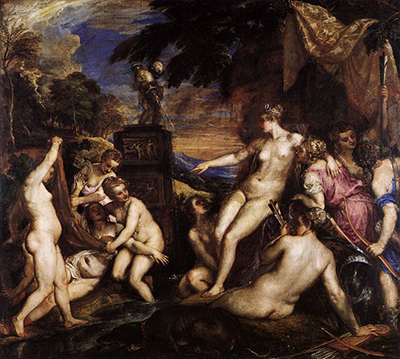
Alfonso assembled mythological pictures for his Camerino d'Alabastro in the ducal palace at Ferrara. Titian's Andrians followed his delivery of Bacchus and Ariadne in 1523, while The Worship of Venus had already brought another subject from Philostratus into the room. Bellini's Feast of the Gods was an earlier contribution. The grouping gave a viewer several ways to consider Bacchus, Venus, desire, drinking and ancient poetry without demanding that every canvas tell a continuous narrative.[1][3][5]
The project changed as Alfonso sought artists. Raphael and Fra Bartolomeo were among those considered, but their proposed works were not all realised. Titian eventually supplied three of the best-known surviving mythologies. Dosso Dossi contributed to the broader decoration: the National Gallery of Art identifies surviving panels from an Aeneid frieze that was placed above the larger mythological paintings. That extra register is a reminder that the room was a designed setting, more complex than a modern display of the three Titians side by side.[3][5][9]
The National Gallery says Alfonso sent Titian canvases sized for their intended positions. Yet the precise location of the chamber within the palace and the exact arrangement of its pictures remain uncertain. We can discuss the Andrians as a picture made to be experienced alongside other works without assigning it an undocumented wall. In a likely intimate room, its large field of figures, its tiny score and its antique allusions could meet viewers at several distances.[5]
Bellini's Feast of the Gods, now in Washington, provides a useful comparison. It was completed in 1514 and later altered; the National Gallery of Art attributes much of its present landscape to Titian. Bellini's gods gather for a feast in a wooded setting, but Titian's Andrians spreads the response to Dionysus through a whole island community. The two pictures show how the chamber could hold related pleasures while allowing the artists different rhythms and inventions.[8]
From Ferrara to the Prado
The Ferrara group did not remain intact. After the Este paintings left the city, the Andrians and Worship of Venus were in the Aldobrandini and Ludovisi collections in Rome. There they were available to artists who studied Venetian colour and mythological invention. The Prado records Rubens's copies, now in Stockholm, and points to the pictures' influence on Van Dyck and Poussin. A painting devised for one patron thus became a model for later painters before it entered another royal collection.[3]
The pair passed to Philip IV of Spain through dealings with Niccolò Ludovisi in the 1630s, connected in the Prado's account with negotiations over Piombino. Prado essays differ on whether to anchor the transaction in 1633 or 1637, so the decade is safer than a single unqualified date. In Madrid, Philip placed the paintings in the Alcázar rooms associated with his Titians. The Prado's object record later lists the Andrians at the Buen Retiro Palace in 1747 and in subsequent royal palace inventories. Those records track an individual canvas, not merely the fame of the Ferrara cycle.[1][3][10]
Today the Prado catalogues the Andrians separately from The Worship of Venus, which is P000419. Their shared patronage and later travels can make them seem a pair, but their sources and visual experiences differ. Worship fills an orchard with cupids and Venus; the Andrians follows a wine river through a gathering of adults and children. London's Bacchus and Ariadne builds a dramatic encounter between two protagonists. To move among the three is to see Titian try distinct solutions to Alfonso's interest in classical pleasure.[1][5][11]
How to look at the painting
Begin at the lower edge, where the wine stream and the score establish the two things that hold the party together: drink and song. Follow the bodies into the middle, noting how their actions overlap without becoming identical. Then compare the busy left with the sleeper at the right and the gap of open landscape behind her. These changes of pace are part of the picture's meaning. Philostratus imagined the island as a place where a river alters everybody's sense of possibility; Titian gives that possibility many human forms.[1][2]
The painting is also a record of sophisticated choices. Its ancient source is a verbal picture; its bodies draw on other art; its notation brings in contemporary music; its landscape relates it to a room made by several painters. None of those layers requires us to stop seeing a jubilant outdoor scene. They explain why a canvas apparently devoted to pleasure could sustain repeated, attentive looking.[1][3][5]
Researched Titian and related works
Frequently Asked Questions
It is in the Museo Nacional del Prado, Madrid, inventory P000418.[1]
The Prado dates the canvas to 1523–26, after Titian delivered Bacchus and Ariadne for Alfonso d'Este in 1523.[1]
Philostratus's Imagines I.25 describes a river of wine on Andros, a gift of Dionysus to the island's people. Titian built his scene around their responses to that miracle.[1][2]
The Prado identifies her as a nymph and compares her pose with ancient sleeping Ariadne imagery. The story depicted here takes place on Andros; Ariadne's meeting with Bacchus belongs to a different painting and island.[1][4][5]
Discussion
What do you notice when you look closely at Titian's Bacchanal of the Andrians?
Share a specific observation or a source that adds context.
Reader Insights
Which detail changes your reading?
How does its original setting affect what we see?
Which part of the evidence remains uncertain?
Join the Conversation
Add your observation below.
References
- Museo Nacional del Prado, “The Andrians,” collection record P000418. View source.
- Philostratus, Imagines I.25, “Andrians,” translated by Arthur Fairbanks, via Theoi Classical Texts Library. View source.
- Fernando Checa Cremades, Museo Nacional del Prado, “La bacanal de los andrios [Tiziano],” collection encyclopedia. View source.
- Museo Nacional del Prado, “The Andrians. Titian,” accessible collection guide. View source.
- National Gallery, London, “Titian, Bacchus and Ariadne,” collection essay. View source.
- Adriaen Willaert Foundation, catalogue entry “Qui boyt et ne reboyt.” View source.
- Gaia Prignano, “Music theories and identity issues: Depicting canons chez Alfonso I d’Este,” Music in Art 45 (2020), abstract, University of Bologna. View source.
- National Gallery of Art, Washington, “The Feast of the Gods,” collection record. View source.
- National Gallery of Art, Washington, Dosso Dossi, “The Trojans Building the Temple to Venus and Making Offerings at Anchises's Grave in Sicily,” collection record. View source.
- Museo Nacional del Prado, “Colección de Manuel de Fonseca y Zúñiga, VI conde de Monterrey,” collection encyclopedia. View source.
- Museo Nacional del Prado, “The Worship of Venus,” collection record P000419. View source.