 by Tom Gurney
Tom Gurney BSc (Hons) is an art history expert with over 20 years experience
Published on June 19, 2020 / Updated on October 15, 2026
Email: tomgurney1@gmail.com / Phone: +44 7429 011000
Titian’s Virgin and Child between Saints Anthony of Padua and Roch: Introduction
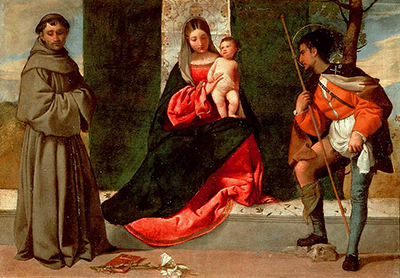
The Virgin and Child sit between a grey-robed friar and a pilgrim in bright clothing, with a landscape opening beyond them. The Museo Nacional del Prado in Madrid identifies the saints as Anthony of Padua and Roch and catalogues the painting as Titian’s P000288. It is an oil canvas measuring 92 × 133 centimetres. The museum’s object label dates it about 1510, while its curatorial essay places it closer to 1508. The difference reflects the difficulty of dating one of Titian’s earliest and most debated surviving works.[1]
The painting is also unfinished. The child and Roch were brought much farther toward completion than the Virgin, the backdrop behind her and the landscape. Their different states are a historical feature of the canvas. X-rays and infrared reflectography show where Titian altered his design and where drawing that would normally have been covered remains visible. This combination lets us see both a sacred image and part of the work that went into making it.[1]
At a Glance
- WorkThe Virgin and Child between Saints Anthony of Padua and Roch
- Research recordMuseo Nacional del Prado
Contents
- The four figures and their gestures
- How the focus moved from Roch to Anthony
- An unfinished image that still speaks
- Giorgione, Bellini and an early date
- A traceable later history
The four figures and their gestures
Anthony stands at the left in a Franciscan habit, his body enclosed by the broad fall of grey cloth. The Virgin and child occupy the centre, raised against a hanging backdrop and architectural setting. Roch stands at the right with a staff, placing one leg up on a rock. The small figure of Christ bridges the saints by the direction of his body and gaze. The group is balanced around Mary, but its relationships are more active than a perfectly still row of holy figures.[1]
The Prado’s title names Anthony of Padua, the Franciscan saint, not Anthony Abbot. That distinction matters because English captions sometimes shorten both names to “Saint Anthony,” though they refer to different people with different histories and visual attributes. Roch is the pilgrim saint whose raised leg and displayed wound help identify him. Their presence together may have answered a particular devotional purpose, but the Prado has no firm document naming the first patron or altar of this canvas.[1]
The centre feels more monumental than the painting’s physical height might suggest. Mary and the child form the peak of a broad triangular grouping; the saints stabilize its sides. A curtain and architectural support separate them from the landscape, while openings at either side keep the scene connected to the wider world. The darker mantle around Mary makes the infant’s lighter body stand out. Roch’s orange clothing draws the eye to the right and back toward the central exchange. These are visible features of the present design; because the canvas remained unfinished, some colour balances were never brought to a final state.[1]
The figures do not share a single episode in ordinary historical time. This is a sacred grouping for devotion: the Virgin and Christ appear with saints revered long after the Nativity. The important “action” is therefore a relationship of attention. The child looks toward Anthony, but Anthony averts his gaze, a gesture the Prado connects with his traditional modesty. Roch, showing the mark of his suffering, remains beside them. That interplay is not incidental: technical imaging reveals that Titian changed whom the child looked at while painting.[1]
How the focus moved from Roch to Anthony
The Prado reports that X-rays show the Christ Child originally looking toward Roch’s wound. In the finished face, Titian redirected the gaze toward Anthony. Anthony himself was adjusted: his head had first been turned farther left. The museum reads these changes together as a shift in the picture’s devotional focus from Roch toward Anthony. A viewer looking only at the final surface might experience the child’s appeal to the quiet friar without realising that another exchange was initially planned.[1]
Other changes accompanied that decision. Roch’s profile was originally a little higher, Mary’s head lower, and the curtain behind her was first more animated. The revisions show a painter testing relations among faces, drapery and background rather than transferring an entirely fixed drawing. They do not prove why a patron might have asked for a change or whether there was any patron intervention at all. The museum’s imaging documents the sequence of painted choices; the motives remain open.[1]
Roch’s leg-on-rock pose has a different kind of source. The Prado connects it to an ancient sculpture of Apollo playing the kithara in the Museo Archeologico, Venice. The comparison concerns bodily arrangement, not Christian subject. Titian could make a classical pose serve the presentation of a pilgrim saint. That borrowing fits a Venetian artistic world where antiquity, contemporary religious commissions and painters’ experiments could coexist within one picture.[1]
An unfinished image that still speaks
The Prado distinguishes the painting’s degrees of finish: Roch and the Christ Child are complete, whereas Mary and her backdrop are unfinished and the landscape is barely sketched in. It is tempting to call the whole work a “sketch,” but that would obscure the passages Titian did bring to completion. Its value lies partly in the difference among them. The child’s flesh and Roch’s figure can be read beside still-exposed stages elsewhere on the same canvas.[1]
Infrared reflectography reveals preparatory drawing under Roch’s profile and around the contours and folds of Mary’s robe. The museum also describes diagonal shading that marks shadows and more forceful drawing in her larger folds. Such lines would ordinarily have been covered by the final blue layer planned for her mantle. The Prado’s English essay uses an unusual term for that costly blue material; without a published pigment analysis tied to the passage, it is safer to describe the missing final blue paint than to assign a precise mineral to it. The visible drawing is evidence of an uncompleted painting sequence, not a design intended to stay permanently exposed.[1]
The museum relates this way of planning drapery to fresco practice, where broad marks could guide later application. Titian was also working in fresco early in his career. That association helps explain how an artist accustomed to planning large passages could build a canvas in stages. It does not let us date every stroke of underdrawing or reconstruct an entire finished colour scheme that was never executed.[1]
No secure reason for stopping has been documented. Illness, a cancelled commission, dissatisfaction, a move between studios or some later interruption might sound plausible, but none is proved by the Prado’s record. The object shows where work stopped. It does not tell us why. That distinction matters because incomplete paintings often invite stories that the evidence cannot support.[1]
Giorgione, Bellini and an early date
For centuries the painting was often attributed to Giorgione. It was already called Titian’s in a 1641 record from the collection of the Duke of Medina de las Torres in Naples, but the Giorgione attribution persisted. Wilhelm Schmidt returned it to Titian in 1904. According to the Prado, most specialists now accept Titian, though Charles Hope has preferred an undetermined artist and Paul Holberton has proposed Domenico Mancini, comparing a 1511 altarpiece in Lendinara. The Prado rejects that comparison as an attribution and retains Titian. The uncertainty should be acknowledged without presenting three equally accepted current catalogues.[1]
The reasons for the older Giorgione association are visible. The Prado compares this grouping to Giorgione’s Castelfranco altarpiece, painted around 1505: a balanced triangular arrangement, a backdrop and architecture behind the Virgin, and landscape on either side. It also sees Giorgionesque softness in Mary’s face and the transitions of light. These similarities are significant precisely because Titian and Giorgione were working close to one another during the years when both decorated the exterior of the Fondaco dei Tedeschi in Venice. Shared visual solutions do not automatically make this canvas a Giorgione.[1]
The Prado identifies another source in Giovanni Bellini’s San Zaccaria altarpiece for the Virgin and child. These comparisons create a useful picture of young Titian learning from two older Venetian painters while developing his own figure relations. They also put limits on a simple “master versus follower” account. Titian could adapt Giorgione’s compositional scheme, Bellini’s central figures and a classical pose for Roch while still making fresh changes as he painted this specific object.[1]
The gallery label’s c.1510 and the essay’s c.1508 should be read as two close scholarly estimates, not as competing dated inscriptions. The earlier estimate places the canvas in Titian’s closest period of contact with Giorgione. The current label provides a slightly broader public date. The unfinished state, attribution debate and lack of a documented commission mean that a day or exact year cannot be honestly supplied. The painting is best understood as an early Venetian work made within a few years on either side of 1508–10.[1]
The Prado suggests that it might have been made for the Scuola di San Antonio at the Venetian church of San Rocco. The pairing of Anthony and Roch makes that idea attractive, and the proposed date would fit the young Titian’s Venetian setting. But the museum states it as a possibility. There is no surviving commission entry connecting P000288 to that precise destination, and the unfinished state does not close the gap. The first secure ownership record is much later.[1]
A traceable later history
In 1641, the canvas belonged to the Duke of Medina de las Torres in Naples and was recorded as a Titian. He gave it to Philip IV of Spain, who sent it to El Escorial. The Prado’s object data places it in the Escorial sacristy in 1839, the year it entered the museum. These records connect an unfinished early Venetian painting with seventeenth-century Spanish collecting and a later public collection. They do not establish its route from Titian’s workshop to Naples over the intervening century.[1]
The object has continued to be studied and displayed as an early Titian. The Prado lists it in the 2006 Bellini, Giorgione and Titian exhibition, the 2016 London In the Age of Giorgione exhibition and 2023’s Titian 1508 in Venice. Those exhibitions show why a painting with unresolved questions matters: it brings issues of authorship, early chronology and artistic exchange into unusually close focus. Exhibiting it under Titian’s name does not erase the Prado’s own record of minority dissent.[1]
The Titian paintings guide places this canvas within the artist’s early religious work. It can be compared with the Prado’s later Virgin and Child with Saints Dorothy and George, another sacred grouping whose date and saint names have been debated. The two pictures have different supports, arrangements, completion states and histories. Keeping those differences visible makes the comparison more useful than treating all young Titian Madonnas as versions of one formula.[1]
Researched Titian and related works
Frequently Asked Questions
The Prado names Saint Anthony of Padua, a Franciscan. He should not be confused with Saint Anthony Abbot.[1]
That is Titian’s final arrangement. X-rays show that the child first looked toward Roch’s wound; the gaze was redirected during painting.[1]
No. The Prado says Roch and the child are complete, while Mary, her backdrop and the landscape remain at earlier stages.[1]
The Prado attributes it to Titian, and says most specialists agree. It also records historical Giorgione attributions and modern minority alternatives.[1]
Its first secure record is 1641 in the Medina de las Torres collection in Naples. It later passed to Philip IV, El Escorial and, in 1839, the Prado in Madrid.[1]
Discussion
What do you notice when you look closely at Titian’s Virgin and Child between Saints Anthony of Padua and Roch?
Share a specific observation or a source that adds context.
Reader Insights
Which detail changes your reading?
How does its original setting affect what we see?
Which part of the evidence remains uncertain?
Join the Conversation
Add your observation below.
References
- Museo Nacional del Prado, “The Virgin and Child between Saints Anthony of Padua and Roch,” P000288, collection essay by Miguel Falomir Faus, provenance and exhibition history. View source.