 by Tom Gurney
Tom Gurney BSc (Hons) is an art history expert with over 20 years experience
Published on June 19, 2020 / Updated on October 15, 2026
Email: tomgurney1@gmail.com / Phone: +44 7429 011000
Titian's Portrait of a Knight of Malta: Introduction
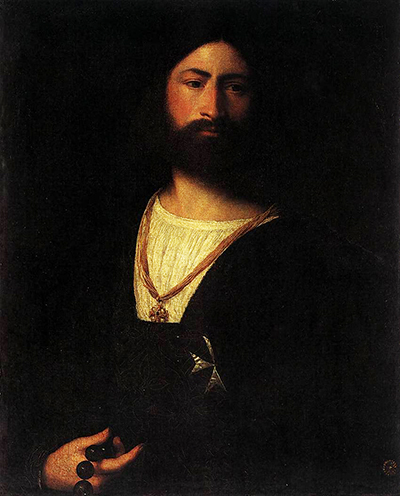
A bearded young man emerges from a dark background. His white shirt lights the middle of the picture, while a cross at his chest and a rosary in his hand tell us something about how he wished to appear. The Uffizi painting is known as Portrait of a Knight of Malta. The Italian national catalogue gives it to Titian, dates it broadly to 1510–15 and records it as oil on panel, inventory 1890 no. 942. The man's personal name remains unproved. This is a portrait with visible signs of membership and devotion, but also a history of debated authorship and difficult preservation.[1]
At a Glance
- WorkA Knight of Malta
- Research recordcatalogo.beniculturali.it
Contents
- What does the sitter show us?
- A portrait made with darkness
- Titian or Giorgione?
- Why this portrait matters
What does the sitter show us?
The figure's clothes are mostly black, but their darkness is varied rather than empty. The conservation account published by the Friends of the Uffizi describes a damask garment and a white shirt folded into fine pleats. A pendant ending in a cross lies at the neckline; another Maltese cross appears against the dark clothing. At the lower edge, his right hand holds large rosary beads. These points of light bring the viewer from face to chest to hand and give the otherwise restrained likeness a clear visual structure.[2]
The cross supports the traditional description of the man as a knight of the Order of Malta. The rosary adds an explicit devotional object. Together they make affiliation visible without revealing a biography. The portrait tells us how this man chose to be represented, or how a later viewer classified him; it does not supply an inscription naming him. An older proposal called him Stefano Colonna, a military captain. The national catalogue records that the identification was later questioned, and the Uffizi conservation essay treats it as a tradition seldom accepted by modern scholars. It is safer to call him the unidentified knight.[1][2]
There is a small painted inscription, but it does not solve the problem. The catalogue transcribes XXXV on one bead of the rosary. These Roman numerals could invite speculation, yet the institutional record does not turn them into a secure name, date or age. Their existence is a useful reminder that the portrait once repaid even closer looking than its bold light and dark arrangement first suggests.[1]
A portrait made with darkness
The sitter's head is surrounded by dark hair, beard, clothing and background. Against these, the face, shirt, crosses and beads become the main landmarks. The Friends of the Uffizi account emphasizes the subtle play of dark tones over one another and a thoughtful expression. That tonal treatment helped lead some historians toward Giorgione when the work's attribution was debated. From a small reproduction, however, it would be a mistake to pretend that one could settle its painter by pointing to a single dark passage.[2]
The painting's condition has affected what viewers could see. The conservation account says it was long covered by dense varnishes and retouching; dark colours had yellowed and lost much of their differentiation. Earlier cleaning had also eroded original material. Restorer Stefano Scarpelli's Uffizi-supported intervention made the white, jewels and flesh more legible, while fine cracking and past loss remained. Cleaning can uncover relationships between tones and details, but it cannot replace original paint that has gone. The current view must therefore be read as a preserved and treated historical surface, not a transparent window onto its first appearance.[2]
The national catalogue itself links poor preservation to difficulty judging attribution. This is more than a routine note about damage. When a portrait depends on closely graded darkness, a coating that merges those values can hide precisely the handling that might help distinguish one early Venetian painter from another. Conservation evidence explains why scholarly disagreement could persist without implying that every attribution is equally convincing.[1][2]
Titian or Giorgione?
The catalogue's present attribution is Titian. Its historical notes document a much less straight line. Cardinal Leopoldo de' Medici purchased the portrait from Paolo del Sera in Venice as a Titian. When it was sent to Poggio a Caiano in 1709, it carried Giorgione's name. Nineteenth- and twentieth-century writers proposed or debated Giorgione, Titian, Pietro della Vecchia and Paris Bordone. The labels changed while the object remained the same; the old names record judgments made at different times and in different conditions.[1]
The Friends of the Uffizi gives the purchase year as 1654 and says the portrait was displayed in the Uffizi's Tribuna from 1677. It later passed through Poggio a Caiano and Pitti before returning to the Uffizi. A 1775–76 inventory transcribed by Memofonte describes a knight with a jewel at his neck and a large rosary in his right hand as a Titian. This closely matches the work's distinctive attributes. It also shows that a historic inventory attribution should be read as evidence of reception, not as a verdict on who held the brush in about 1510.[2][3]
There is a source discrepancy about the support. Today's national catalogue and the Uffizi conservation account call the painting oil on panel and give the latter's dimensions as 80 by 60 centimetres. The 1775–76 inventory calls the described portrait a painting on canvas. Without a technical report resolving that difference, the safest description of the existing object follows the current Uffizi-linked records while acknowledging that the older document uses another term. The discrepancy alone does not prove that the painting was transferred from one support to another.[1][2][3]
Why this portrait matters
The portrait makes status and inward attention work together. Its crosses present the man's affiliation, while the rosary is held rather than merely displayed beside him. His expression and the surrounding dark space resist an easy public narrative of military accomplishment. These are observations about the image, not a claim to know what the sitter was thinking or what commission prompted it.[1][2]
For a reader exploring Titian's portraits, the Knight of Malta is also a case study in how a famous name becomes attached to a picture. A seventeenth-century buyer acquired it as Titian; subsequent custodians called it Giorgione; scholars debated it as its condition limited close judgment; and today's national catalogue again files it under Titian. Its securely visible subjects—man, crosses, rosary and dark dress—remain useful even when the personal identification and historical attribution are handled with care. Man with a Glove offers a separate, unnamed sitter for comparison, but the two portraits should not be treated as the same object or as equally documented cases.[1][2]
Researched Titian and related works
Frequently Asked Questions
The man's name is not secure. Stefano Colonna was proposed in older writing, but the identification has been questioned.[1][2]
The current Italian national catalogue attributes it to Titian. Earlier catalogues and scholars also proposed Giorgione and other painters; condition has complicated the judgment.[1]
A rosary. The national catalogue records the painted numerals XXXV on one of its beads.[1]
It is in the Gallerie degli Uffizi, Florence, inventory 1890 no. 942.[1]
Discussion
What do you notice when you look closely at Titian's Portrait of a Knight of Malta?
Share a specific observation or a source that adds context.
Reader Insights
Which detail changes your reading?
How does its original setting affect what we see?
Which part of the evidence remains uncertain?
Join the Conversation
Add your observation below.
References
- Catalogo Generale dei Beni Culturali, Italy / Gallerie degli Uffizi, “Ritratto di cavaliere di Malta,” record 0900129464. View source.
- Anna Maria Piccinini, Amici degli Uffizi, “Cavaliere di Malta (1510–1515 ca.),” restoration project account. View source.
- Memofonte, transcription of the Uffizi inventory of 1775–76, entry 2083, p. 125. View source.