



 by Tom Gurney
Tom Gurney BSc (Hons) is an art history expert with over 20 years experience
Published on June 19, 2020 / Updated on October 29, 2026
Email: tomgurney1@gmail.com / Phone: +44 7429 011000
The Wedding Party: Introduction
Eight people pose among trees, dressed for a wedding and facing the viewer with extraordinary stillness. At their centre, a bride in white seems to hover above the grass. A large black dog sits in front of the company, its blunt silhouette almost as commanding as the people behind it. Henri Rousseau painted The Wedding Party, known in French as La Noce, in 1905. The oil painting belongs to the Musée de l’Orangerie in Paris.[1]
The occasion is familiar, but its arrangement becomes stranger the longer we look. Individual faces emerge from a compact wall of formal clothes; thin trunks rise around bodies that scarcely seem to occupy the same ground. The bride, her spreading veil and the dog make the simplest spaces between the figures difficult to reconcile.
At a Glance
- ArtistHenri Rousseau
- SubjectThe Wedding Party
- ExploreA wedding whose participants remain unknown; White dress, dark clothes and individual faces
This work across Henri Rousseau’s career
Carnival Evening
1886 [2]The Merry Jesters
1906 [7]The Snake Charmer
1907 [8]Contents
- A wedding whose participants remain unknown
- White dress, dark clothes and individual faces
- Trees that enclose and complicate the space
- What Rousseau changed while painting
- The name at the lower right
- From private collections to the Orangerie
- Annotated details
A wedding whose participants remain unknown
The canvas measures 163 centimetres high by 114 centimetres wide. Its upright shape allows the people to fill much of the picture while leaving room for an arching enclosure of branches. The Orangerie dates it to 1905 and records its appearance at the Salon des Indépendants that year.[1] This is a substantial exhibition picture, with the scale and concentration to turn a private gathering into a public encounter.
We can recognise the ritual without identifying the wedding. In his entry for the 1985 Rousseau exhibition catalogue, Michel Hoog stated that neither the sitters’ identities nor the photograph he believed had inspired the composition had been found. He considered the faces individual portraits and the photographic origin strongly indicated, but he could not supply the original image.[12] That distinction still matters when approaching the picture: a persuasive account of how a group was posed does not recover the names of its members.
The frontal arrangement gives the photographic connection its immediate force. Five people stand behind the bride, while an older figure sits at either side of her. Heads rise in a closely gathered sequence, with relatively little overlap between the faces. Each person has been made available to the viewer, as though the company has paused to ensure that everyone appears in the record of the day.
Yet the feeling of a shared occasion does not produce much exchange within the group. Most of the attention comes outward, towards us. The differences between faces are more conspicuous than conversation or movement. The bride is central, but the people around her retain their separate presence. A wedding photograph might preserve a gathering for those who knew it; Rousseau’s painting preserves a company whose personal history remains beyond our reach.
Hoog also noted a suggestion that the man on the right in the second row could be Rousseau himself. He presented it as an identification made by others, without establishing it.[12] The possibility is intriguing, though it offers no secure key to the remaining faces or the occasion. The painter’s own presence is much firmer elsewhere on the canvas: in his signature.
White dress, dark clothes and individual faces
The bride is the painting’s broadest field of light. Her dress widens towards the ground, gathering the pale veil, sleeves and sash into a single commanding shape. A small green sprig at her chest interrupts the white. The hands and face introduce warmer tones, while the sash makes a conspicuous crossing near the centre of her body. Everything around her strengthens this central brightness.
Behind her, dark jackets and dresses join into a nearly continuous mass. Pale shirts, collars and faces punctuate it. The moustached man at the left, the fair-haired figure beside him and the other heads above the bride are clearly distinguished, even at the small scale of a reproduction. Their expressions do not merge into a collective mood. Some seem solemn, some merely attentive; assigning a single emotion to all eight would lose the variety Rousseau has preserved.
The two seated figures give the gathering its lower corners. On the left, the older figure’s blue garment spreads broadly above dark lower clothing, with a hand resting on a walking stick. On the right, a brown upper garment emerges beside the bride’s white veil. Their lower placement suggests a group organised around differences of age and height, although the unknown identities prevent a confident reconstruction of family relationships.
These bodies offer less certainty than the faces. The bride’s dress ends above a dark green interval, while her veil extends sideways over the seated figure on the right. The Orangerie draws particular attention to this overlap: the veil crosses the older woman’s dress and disrupts the depth suggested by the arrangement of the people. Its commentary describes the bride as an apparition suspended in space.[1] That is a vivid account of the visual effect. It need not turn her into a literal ghost or make the wedding an allegory of death.
The dress remains recognisable as clothing, but it also acts as a pale shape laid across neighbouring shapes. Looking at the faces encourages us to imagine real people; following the edges of the veil brings us back to the construction of the painting. Rousseau keeps those two experiences close together.
Annotated Details from The Wedding Party
The numbered points identify visible features discussed in this article. Return from each detail to the whole composition. Henri Rousseau, The Wedding Party (La Noce), 1905. Musée de l’Orangerie, Paris, RF 1960 25. Google Art Project reproduction published in 2012. Google Art Project reproduction via Wikimedia Commons. Image source. Public domain. Numbers added to a separate resized overview. Details cropped directly from the published original without enlargement, recolouring or retouching.
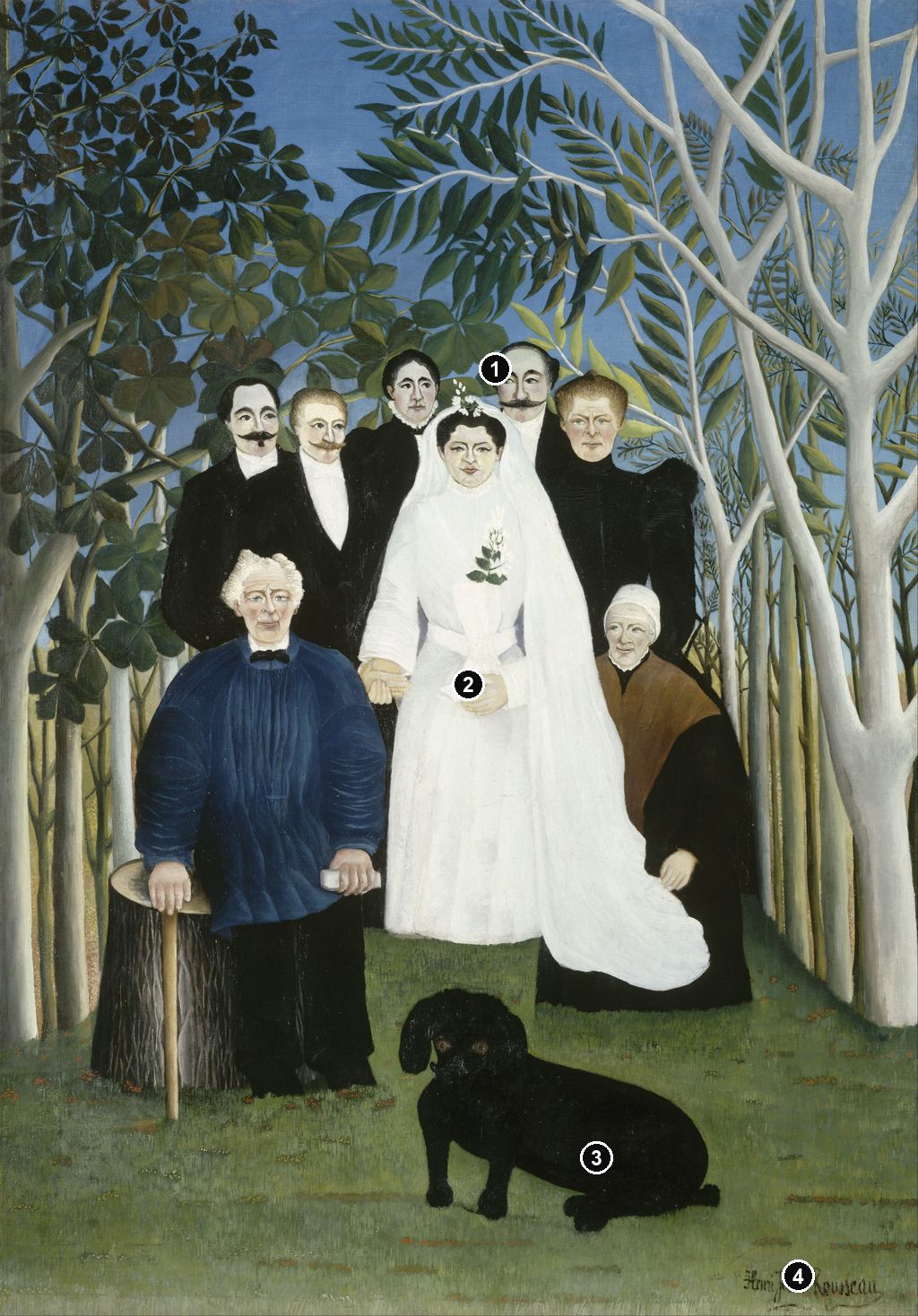
Details from THE WEDDING PARTY
Look from the individual faces to the white dress, foreground dog and written signature to follow the painting’s distinct kinds of presence.
Separate faces above the white dress
Pale faces and shirt fronts break through the dark mass of formal clothes. Each head has its own shape and expression, while the figures remain tightly gathered and turned towards the viewer.
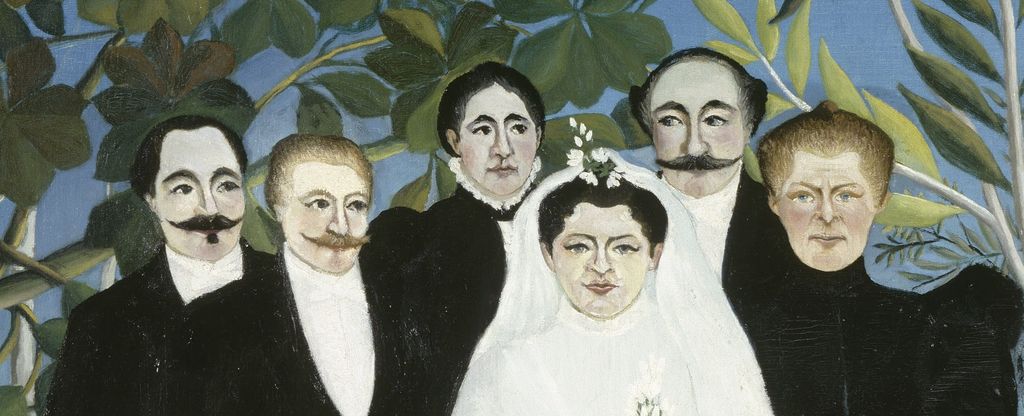
A white bow, hands and overlapping veil
The large bow and two hands gather attention at the bride’s waist. Below them the veil spreads across the seated figure on the right, making the relation between the pale dress and neighbouring body difficult to settle.
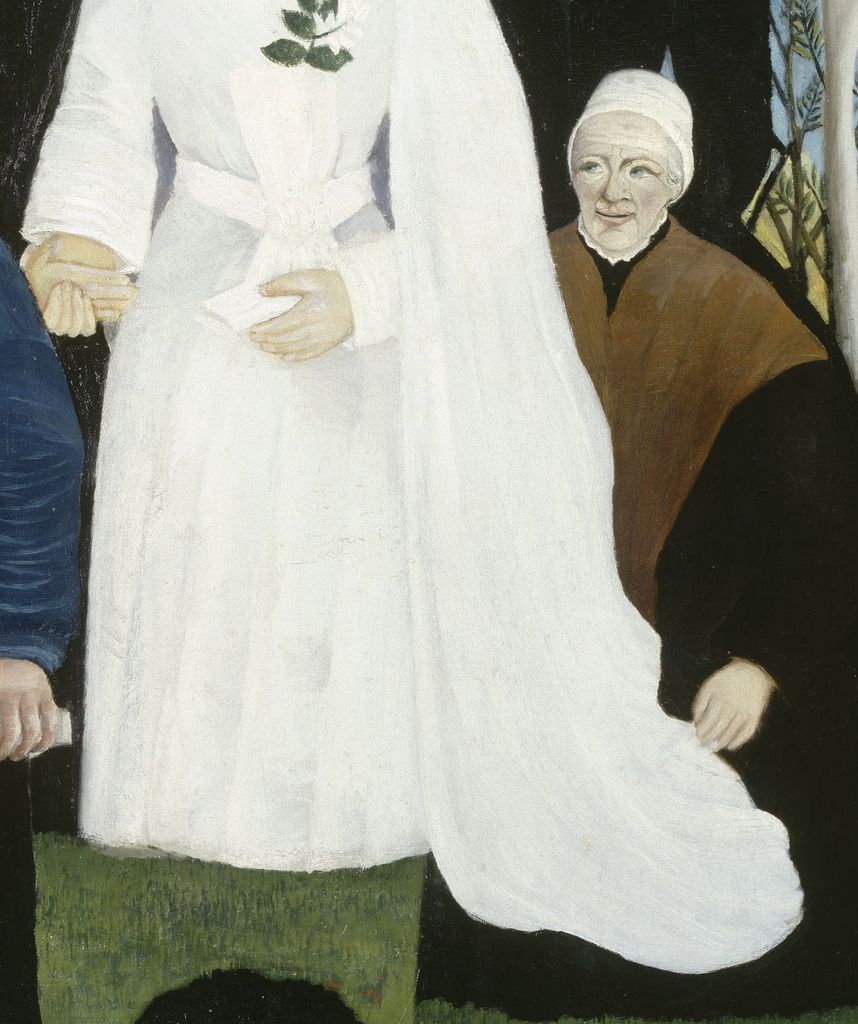
The complete black dog on the grass
The dog’s broad black silhouette occupies the open grass below the company. Upright front legs, an extended body and the curled tail give this foreground shape a weight of its own.
A full name at the lower right
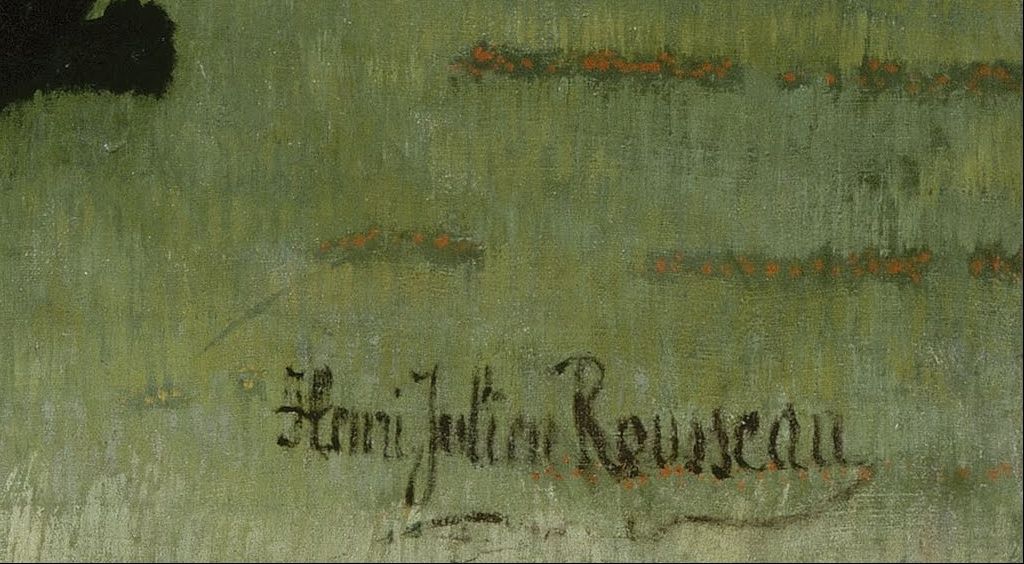
The signature Henri Julien Rousseau sits low on the grass. The maker’s written name remains legible beneath the group whose individual identities are not established.
Trees that enclose and complicate the space
The trees form a dense border around the company. On the left, broad dark leaves crowd towards the heads. On the right, pale trunks divide and climb through finer foliage. The difference between these two sides makes the enclosure feel varied rather than symmetrical. Blue sky appears in the spaces above and behind the branches, keeping the upper part of the painting open even where the vegetation is thick.
The trunks also supply several suggestions of distance. Larger trees stand at the edges, and narrower stems continue behind the figures. Hoog observed that the decreasing widths of trunks and leaves establish a kind of perspective, in tension with the flat, motionless group. He proposed that this might distinguish Rousseau’s setting from the painted backgrounds used in photographic studios.[12] The proposal helps explain the unusual combination of a posed company and an enclosing outdoor world; it does not identify a particular studio or backdrop.
The landscape never becomes a fully traversable place. There is a small area of grass in front of the people, but the group blocks our passage beyond it. At the sides, trunks hem the bodies in. The sky belongs to a spacious distance, while leaves and clothes press towards the surface. We can imagine standing before this company more easily than walking through its setting.
The Orangerie’s commentary recalls Basler’s comparison of the figures with medieval frescoes and early votive paintings.[1] The association offers another way to approach their solemn presence. The company seems set apart within its leafy enclosure, with the bride’s brightness gathering attention at the centre. This can give an ordinary social occasion the gravity of a ceremonial image without establishing a religious programme for the work.
Hoog traced a diagonal structure through the painting, describing a Saint Andrew’s cross whose centre falls at the knot of the bride’s sash. He also compared the shallow grouping to Manet’s The Balcony.[12] These are compositional readings, rather than proof of copying. They encourage us to follow the lines that converge on the bride and the way individual figures can share a narrow space without forming a continuous illusion of depth.
The dog helps anchor that arrangement. Its black body occupies an otherwise open patch of grass and gives the foreground a weight of its own. Its size makes it difficult to treat as a minor accessory. From the dog, the eye moves up to the bride’s white dress, then outward to the dark company and the framing trunks. The simple opposition of black and white helps hold a crowded picture together.
What Rousseau changed while painting
The finished surface has a poised stillness, yet evidence of revision shows that Rousseau arrived at it through alteration. Hoog’s 1985 entry reported several findings from X-rays: changes involving faces turned towards the bride, an earlier extension of the seated woman’s dress on the right down towards the dog, and the addition of the bride’s veil over figures that had already been completed.[12] These are the catalogue’s reports of technical examination. The visible painting alone cannot reveal every earlier stage.
More recent research supplies a related account. In the Orangerie’s 2026 scientific-analysis transcript, Johanna Salvant, a physicochemist at the Centre de recherche et de restauration des musées de France, explains that Rousseau frequently adjusted compositions directly on the canvas. She singles out the changed bridal dress in La Noce and connects it, probably, with the addition of the dog.[13] The alteration is the finding; the relationship between the two changes remains a qualified explanation.
This is especially useful evidence because the dress and dog are so important to the finished picture. Changing one would alter the space available to the other. The white silhouette rises in the middle, the black silhouette sits below, and the ground between them has to carry the transition. Revision here concerns the balance of the whole scene, including the relative prominence of a person and an animal.
Salvant also discusses the use of lead white and zinc white, with details of the bride’s bow, hand and dress among the examples shown in the transcript. She describes an observed tendency for zinc white to occur preferentially in touches made towards the final stage of a composition.[13] This gives material substance to the picture’s development while leaving room for the caution in her wording. It does not establish that every pale passage was painted with one pigment or in a single final campaign.
The Orangerie interprets the veil’s spatial awkwardness as cultivated: an effect resulting from a deliberate change.[1] The evidence makes it possible to take Rousseau’s adjustments seriously without declaring every uncertain proportion intentional. A specific revision can be documented; a complete account of the painter’s intentions cannot be recovered from it. His broader style and technique emerge through such particular decisions.
The name at the lower right
Rousseau signed the painting “Henri Julien Rousseau” at the lower right, as both the Orangerie record and the 1985 catalogue confirm.[1][12] The full name is a small detail with a wider significance. It identifies the maker beneath a group of people whose names remain unknown.
Juliette Degennes, curator at the Orangerie, discusses this signature in the museum’s 2026 account of Rousseau’s professional identity. She points out that he generally signed Henri Rousseau or Henri Julien Rousseau, using La Noce as an example of the latter. He did not sign himself with the nickname “Douanier.” Degennes reads the prevalence of signatures in his work as a claim to the status of artist.[3]
That interpretation brings the wedding picture into the history of an artist presenting his work to the public. The signature belongs to the same canvas as the carefully differentiated faces and the altered dress. The name he chose to write sits beneath the results of sustained compositional work.
From private collections to the Orangerie
The Orangerie records the painting with Serge Férat, also known as Jastrebzoff, before its entry into Paul Guillaume’s collection in 1929. It subsequently belonged to Domenica Walter. The older catalogue also lists the Galerie Percier between Férat and Guillaume, adding an intermediary without supplying a complete dated chain.[1][12]
The French state acquired it from Madame Jean Walter in 1959 with assistance from the Société des Amis du Louvre. The current museum record distinguishes that purchase from its material entry into the Orangerie in 1977. Its inventory number is RF 1960 25.[1] The purchase and physical arrival mark distinct stages in its museum history.
Its public history also extends beyond the 1905 exhibition: the Orangerie lists it at the Indépendants again in 1911.[1] The picture therefore survived both as an exhibition work and as a possession passing through important private collections. The unnamed company has become one of the enduring groups through which viewers encounter Rousseau.
A related question of posed people, animals and photographic appearance arises in La Carriole du Père Junier, which Hoog himself used as a comparison for the dog in the foreground.[12] The Wedding Party keeps its own history and its own unanswered questions. Its power lies in how precisely it holds the unknown people before us: separate faces, tightly gathered bodies, a brilliant bride and a seated dog occupying their allotted places in an unsettled space.
Henri Rousseau artworks directory
This directory brings together works covered on this site and other works documented in the cited museum records and catalogues. Alternate titles share one entry; distinct versions remain separate. Historical dates for works without an article follow the cited catalogues. This is not a catalogue raisonné.
Frequently Asked Questions
Their identities are not securely established in the sources discussed here. Michel Hoog’s 1985 entry states that the sitters and the photograph believed to have inspired the picture had not been identified. His mention of a possible Rousseau self-portrait within the group remains a hypothesis.[12]
The black dog sits in the foreground, with its front legs upright and its body extending to the right. Its conspicuous size and silhouette give weight to the open grass below the bride and make it a major part of the arrangement.
Discussion
Look again at the images and ideas explored in The Wedding Party. These editorial prompts invite your observations.
Reader Insights
How does the dog’s size affect the balance between the bride and the rest of the company?
Where do the trees create depth, and where do the figures seem to flatten it?
Does knowing about the changes to the dress and veil alter the way you read their unusual shapes?
Join the Conversation
Share a detail, comparison or question about The Wedding Party below.
References
- Musée de l’Orangerie. La Noce, Henri Rousseau, current object record, interpretive commentary, inscriptions, provenance and exhibition history, accessed 23 October 2026. Inventory RF 1960 25. View source.
- Philadelphia Museum of Art, Carnival Evening,1963-181-64,object59593. View source.
- Juliette Degennes / Musée de l’Orangerie. Henri Rousseau, L’ambition de la peinture: Un artiste dans son époque, 2026, film transcript, p. 2, discussion of signatures and professional identity; full transcript pp. 1–4. View source. (in French).
- National Gallery, Surprised!, NG6421. View source.
- Musée d’Orsay, La Guerre,RF19461 (in French). View source.
- MoMA, The Sleeping Gypsy. View source.
- Philadelphia Museum of Art, The Merry Jesters, 1950-134-176, object51097. View source.
- Musée d’Orsay, La Charmeuse de serpents, RF 1937 7 (in French). View source.
- Musée de l’Orangerie, La Carriole du Père Junier, RF 1960 26 (in French). View source.
- Solomon R. Guggenheim Museum / Cornelia Lauf, The Football Players,60.1583: current collection record. View source.
- MoMA, The Dream, 252.1954. View source.
- Michel Hoog. “The Wedding,” entry 28, in Henri Rousseau: Essays, Museum of Modern Art, 1985, p. 160; accompanying plate p. 161. English translation from the French by Richard Miller; plate-note authorship specified on the preceding “Plates” page. View source.
- Johanna Salvant / Musée de l’Orangerie. Henri Rousseau, L’ambition de la peinture: Les analyses scientifiques, 2026, film transcript, pp. 1–2; work and research credits p. 3. View source. (in French).
- The Museum of Modern Art, Henri Rousseau: Essays (1985), selected catalogue entries, chronology and notes on early devotees. View source. Selected entries, chronology (pp.91–95) and early-devotee notes (pp.262–264) were consulted. Historical collection credits do not establish present ownership.
- Daniel Catton Rich, Henri Rousseau (The Museum of Modern Art, 1942), selected drawings and landscape studies; historical catalogue. View source. The dated 1942 publication is used for the two Quai d’Auteuil ink views; its Malakoff date differs from the 1985 catalogue.
- MANAS, Laval, Henri Rousseau, dit le Douanier, urban landscapes and preparatory study (in French). View source.
- National Gallery of Art, Self-Portrait (1895), pen-and-ink drawing, accession 1995.47.66. View source.
- The Museum of Modern Art, War (published January 1895), lithograph, accession 684.1943. View source.
- Barnes Foundation, Landscape and Four Young Girls, object 5521, BF855. View source.


 Henri Rousseau.jpg)


 Henri Rousseau.jpg)