



 by Tom Gurney
Tom Gurney BSc (Hons) is an art history expert with over 20 years experience
Published on June 19, 2020 / Updated on October 29, 2026
Email: tomgurney1@gmail.com / Phone: +44 7429 011000
Le Barrage: Introduction
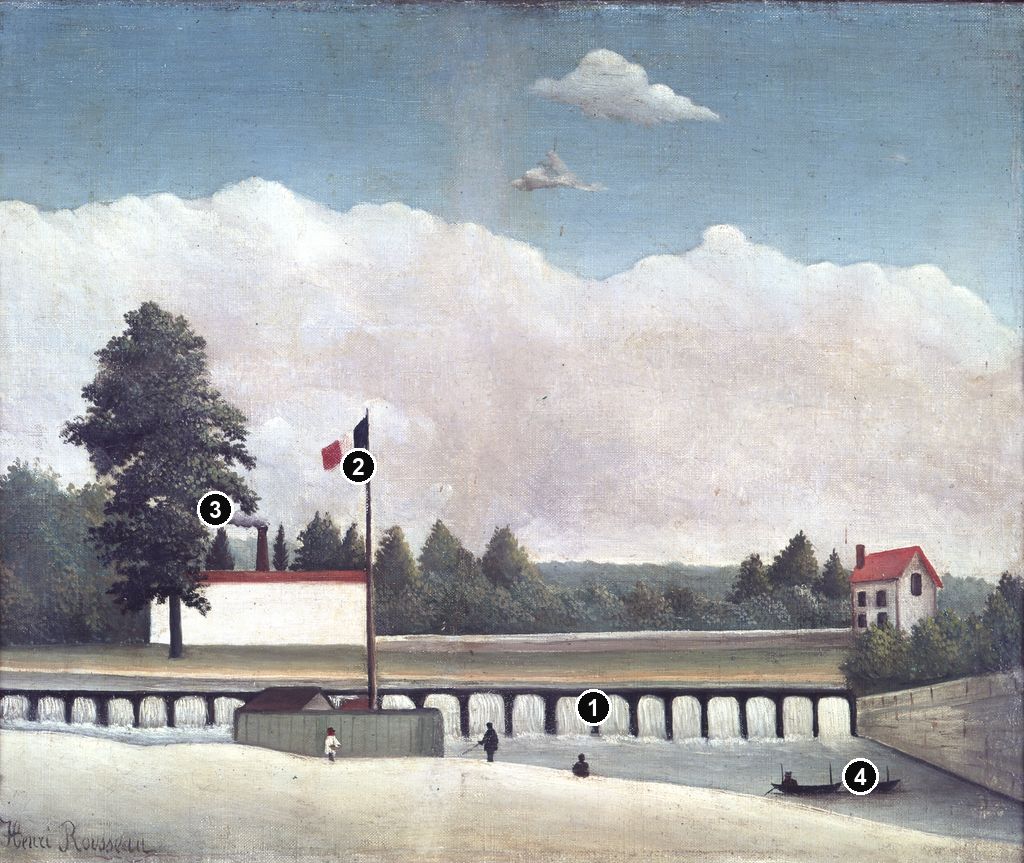
A long dark dam stretches almost from edge to edge of Le Barrage. White water falls through its repeated openings, while an enormous bank of cloud rises above the trees and roofs. Below, a few people and small boats occupy a much narrower world. Henri Rousseau gives the structure a commanding place, yet the picture rewards attention to its quieter connections: the tiny flag against the sky, a roof glimpsed behind a tree, and the sloping boundary between water and pale foreground.
At a Glance
- ArtistHenri Rousseau
- SubjectLe Barrage
- ExploreThe dam as the picture’s backbone; White surfaces, different distances
This work across Henri Rousseau’s career
Carnival Evening
1886 [1]Le Barrage (current article)
1893 (published caption) [4]The Merry Jesters
1906 [7]The Snake Charmer
1907 [8]Contents
- The dam as the picture’s backbone
- White surfaces, different distances
- Trees, buildings and a small flag
- People at the water’s edge
- Reading the scene
- Annotated details
The dam as the picture’s backbone
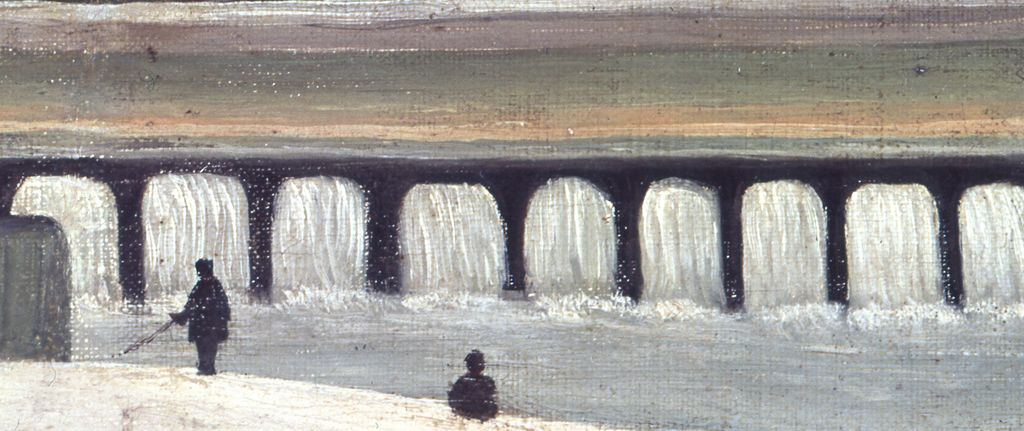
The dam sits low in the composition, leaving a surprising amount of room for the sky. Its upper edge makes a nearly uninterrupted dark line. Beneath it, white shapes descend at close intervals, their rounded tops and uneven lower edges producing a succession of little falls. Dark divisions keep each one separate, giving the structure a measured rhythm that remains clear even when the people below have dwindled almost to dots.
The water’s movement is concentrated in this narrow strip. Each pale drop suggests a downward direction, though the line of drops pulls the eye sideways across the painting. These two movements work together: falling water makes the dam readable as an active structure, and repetition makes its length felt. Rousseau has compressed much of the picture’s energy into a band that occupies only a small fraction of its height.
Above the dam lies a thinner green strip, and farther back a pale wall runs across the scene. Their roughly parallel edges carry the eye from the broad building at the left towards the small house at the right. The dam therefore belongs to a larger arrangement of boundaries. Water, green ground, wall and trees occupy distinct levels. Their closeness makes the built landscape look tightly organised, with little space left between one layer and the next.
White surfaces, different distances
The cloud is the largest pale form in the picture. It spreads across the middle sky, swelling into rounded crests along its upper edge. Its lower mass seems to settle behind the trees. Soft grey and faint warm tones within it suggest volume, while its continuous breadth gives the whole scene a substantial backdrop. The buildings and foliage stand out against this light field with unusual clarity.
Much smaller clouds float in the blue above. Their separate shapes give the upper sky a different pace: the eye can move around them, whereas the great lower bank fills almost every available gap. The blue opening above it also prevents the cloud from seeming limitless. There is a distinct upper margin to the dense, luminous expanse, and an airy interval between that margin and the top of the picture.
White returns at several distances below. The broad left building presents a pale face; a long light wall leads towards the right; the small house catches the eye beneath its red roof; and the falls break into repeated bright units. The pale foreground opens out towards the viewer. These passages do different jobs. Smooth walls establish firm planes, falling water creates a broken edge, and the cloud provides a softer, more expansive surface. Their related colouring binds together parts of the landscape that are otherwise sharply divided.
Trees, buildings and a small flag
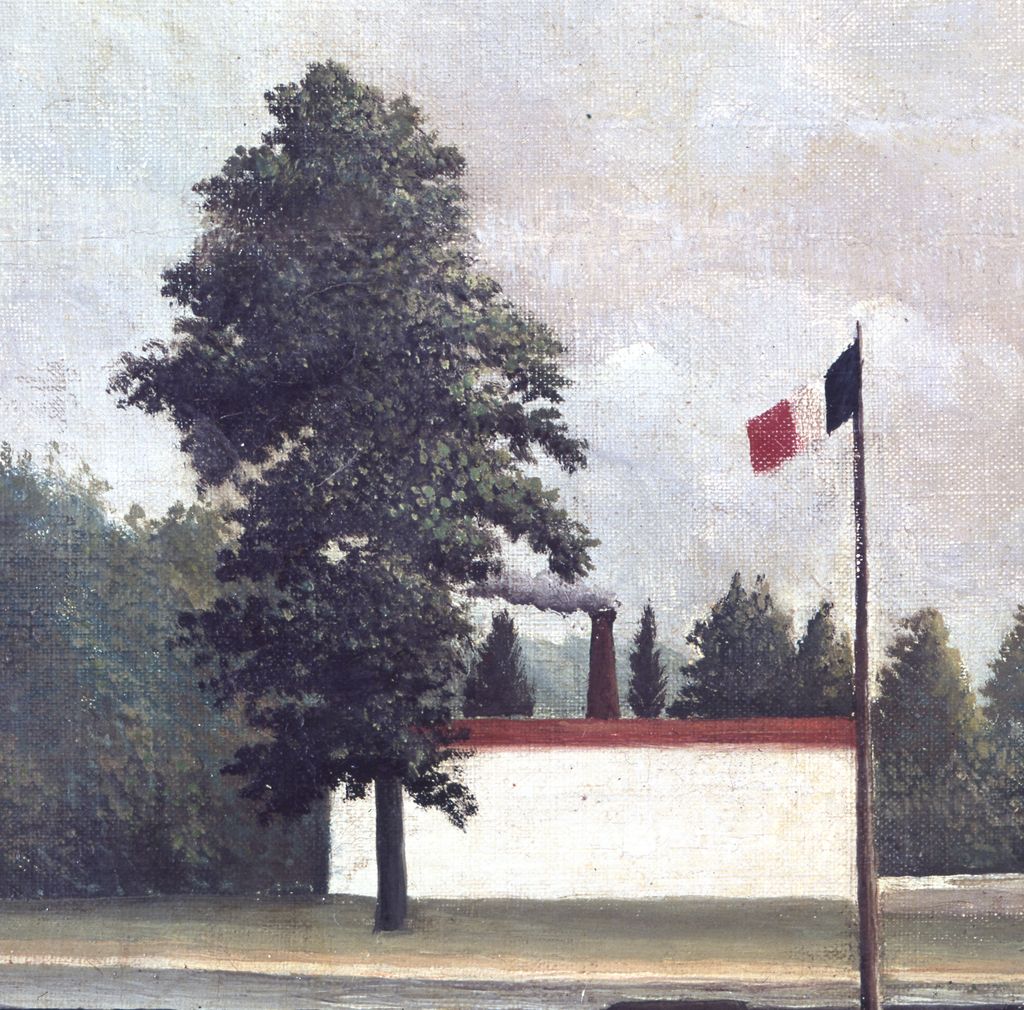
A large tree rises near the left edge, its irregular crown silhouetted against the cloud. The trunk reaches down beside the industrial building, concealing part of the roof and wall. This overlap matters to the sense of depth. The tree appears in front of the building, the building stands before the more distant foliage, and the cloud lies behind them all. These overlaps make the layered scene legible within a restricted depth.
The tree’s spreading outline contrasts with the narrower uprights close by. The chimney appears among the foliage behind the roof, with a small trace of smoke above it. Its dark vertical shape is easy to absorb into the cluster of trunks and pointed crowns until that smoke gives it a different character. Vegetation and industry share the same restricted skyline, their silhouettes close enough to make the viewer look twice.
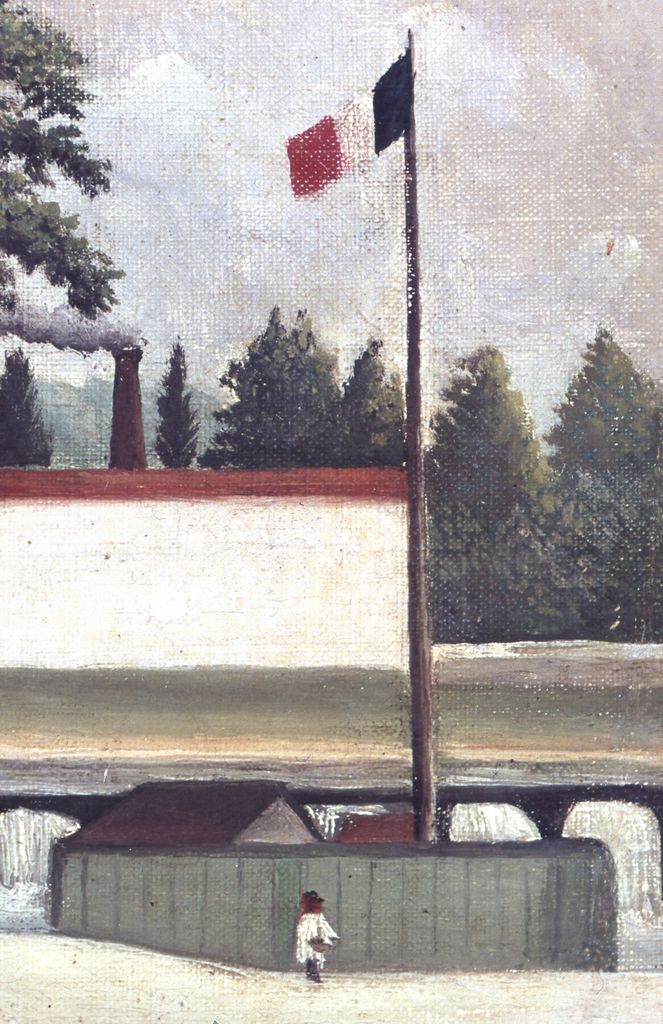
The flagpole makes a particularly slender interruption. It rises from the low structure near the foreground and carries a small French tricolour against the pale cloud. Red and blue register strongly because so much of the scene consists of quieter greens, greys and whites. The flag’s little projecting shape also gives the long upright an identifiable top. Below, the low shelter and its darker roof provide a compact base, joining this fine vertical accent to the much heavier horizontal dam.
At the right, the small white house offers another concentrated patch of red. Its roof is sharply defined against the surrounding trees, while dark windows articulate the pale façade. The building’s compact, upright proportions distinguish it from the long low block on the opposite side. The two roofs give the eye points to travel between, across a green and white middle distance that might otherwise pass as a continuous strip.
People at the water’s edge
Below the dam, tiny upright figures introduce a human scale beside broad stretches of pale foreground. Their forms are economical: light and dark marks suggest bodies, clothing and heads with very little detail. The intervals between them are easier to read than any individual expression. Their smallness makes the structure’s repeated openings seem considerably larger.
A low rectangular shelter interrupts the dam near the flagpole. Its compact roof and greenish front form a modest enclosure within the open foreground. One pale figure close by is especially useful as a measure: the person is small beside this low building, which is itself small beside the length of the dam. Scale unfolds through these successive relationships. The eye moves from a human mark to a shelter, then to a structure extending across most of the scene.
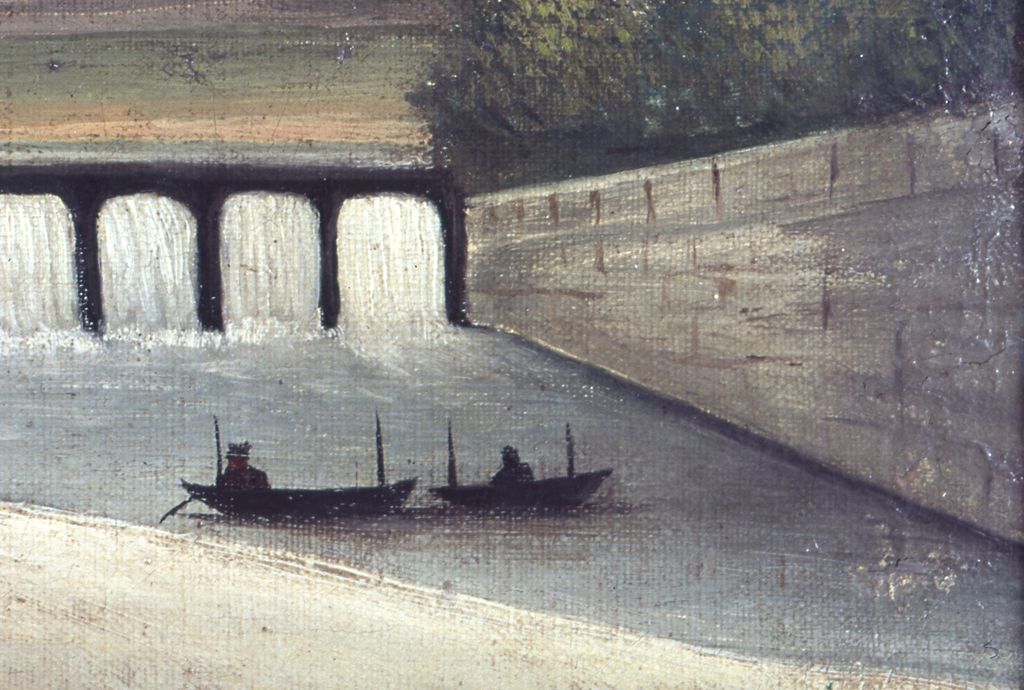
On the right, narrow boats lie in a dark wedge of water. Their low hulls and the fine uprights around them create delicate shapes close to the lower edge. Behind them, a retaining wall turns towards the viewer. Its sloping upper boundary and visible horizontal divisions introduce a firmer sense of recession than the long frontal dam. This corner gives the landscape a bend, allowing the water to slip into view beside the pale bank.
That small diagonal passage is essential to the space. Most of the picture encourages a lateral reading, from one side to the other. The right corner draws the eye forward and down. The pale ground and the darker water adjoin one another, with the change of tone helping to distinguish the figures’ settings. A river landscape emerges through these local clues, even though the open water occupies relatively little room.
Annotated Details from Le Barrage
The numbered points identify visible features discussed in this article. Return from each detail to the whole composition. Henri Rousseau, Le Barrage (The Dam). The date, precise site and present collection remain uncertain. Photograph: Françoise Foliot / Fonds Françoise Foliot, preserved by Wikimédia France. Image source. CC BY-SA 4.0. Numbered overview and cropped details adapted from Françoise Foliot’s photograph. The overview is resized and numbered; details are cropped. These adaptations are offered under CC BY-SA 4.0. No recolouring or retouching.
Details from LE BARRAGE
Follow the dam’s repeated falls, then compare the flagpole, the tree and factory, and the boats at the turning wall.
White falls along a dark horizontal
Bright drops repeat beneath the dam’s long dark upper edge. Their narrow vertical movement gives the structure a measured rhythm beside the much smaller foreground people.
A small flag above a low shelter
The tricolour marks the top of a slender pole rising from the low enclosure. Its narrow upright links the pale cloud with the compact roof and figure below.
A spreading tree and a factory roof
The tree partly conceals the pale building and its red roof. Behind it, a short chimney and a trace of smoke add another kind of upright to the clustered vegetation.
Two boats beside a turning wall
Narrow hulls and fine rods gather within the dark water at the right. The retaining wall turns towards the foreground, changing the direction of this largely horizontal scene.
Reading the scene
The bilingual publication Étude sur les Fleuves et l’Art / Notes on Rivers and Art captions Le Barrage as 1893. Its author, Bernd Gundermann, offers a political reading of the barriers, factory and flag, connecting them with industrial power and social separation. That is a later interpretation of the painting, rather than a recorded explanation by Rousseau.[4]
The arrangement invites several responses. The low figures may make the built structures feel imposing; the broad sky and rounded cloud give the same scene spaciousness. Strong boundaries divide the lower landscape, yet repeated colours and overlapping silhouettes bring its different parts together. Looking closely means allowing these effects to coexist. A dark dam, a red roof and a tiny boat each change character according to the larger shape beside them.
Henri Rousseau artworks directory
This directory brings together works covered on this site and other works documented in the cited museum records and catalogues. Alternate titles share one entry; distinct versions remain separate. Historical dates for works without an article follow the cited catalogues. This is not a catalogue raisonné.
Frequently Asked Questions
The French title means The Dam. The river structure extends across most of the lower picture, with repeated white falls beneath a dark upper edge.
Notes on Rivers and Art gives 1893 in its caption and main discussion, although one English paragraph gives 1892. The caption date should therefore be treated with that internal inconsistency in mind.[4]
The painting’s exact site and current collection remain uncertain. The buildings, figures and flag do not by themselves identify a particular location.
The flag is visibly prominent, and Gundermann includes it in his political interpretation. Its presence alone cannot establish Rousseau’s intended message.[4]
Discussion
Look again at the images and ideas explored in Le Barrage. These editorial prompts invite your observations.
Reader Insights
How does the painting change when you look first at the great cloud, then at the people beneath the dam?
Which details give the strongest sense of depth within this largely horizontal arrangement?
What effects do the repeated white falls have beside the broad, uninterrupted white cloud?
Join the Conversation
Share a detail, comparison or question about Le Barrage below.
References
- Philadelphia Museum of Art, Carnival Evening,1963-181-64,object59593. View source.
- Musée de l’Orangerie / Juliette Degennes, Henri Rousseau,L’ambition de la peinture: Un artiste dans son époque (in French). View source.
- National Gallery, Surprised!, NG6421. View source.
- Bernd Gundermann / Initiatives pour l’Avenir des Grands Fleuves. Étude sur les Fleuves et l’Art / Notes on Rivers and Art, n.d., Rousseau discussion and Le barrage / The Dam caption, printed pp. 33–35. Bilingual text; the caption gives 1893, while one English paragraph gives 1892. View source.
- Musée d’Orsay, La Guerre,RF19461 (in French). View source.
- MoMA, The Sleeping Gypsy. View source.
- Philadelphia Museum of Art, The Merry Jesters, 1950-134-176, object51097. View source.
- Musée d’Orsay, La Charmeuse de serpents, RF 1937 7 (in French). View source.
- Musée de l’Orangerie, La Carriole du Père Junier, RF 1960 26 (in French). View source.
- Solomon R. Guggenheim Museum / Cornelia Lauf, The Football Players,60.1583: current collection record. View source.
- MoMA, The Dream, 252.1954. View source.
- The Museum of Modern Art, Henri Rousseau: Essays (1985), selected catalogue entries, chronology and notes on early devotees. View source. Selected entries, chronology (pp.91–95) and early-devotee notes (pp.262–264) were consulted. Historical collection credits do not establish present ownership.
- Daniel Catton Rich, Henri Rousseau (The Museum of Modern Art, 1942), selected drawings and landscape studies; historical catalogue. View source. The dated 1942 publication is used for the two Quai d’Auteuil ink views; its Malakoff date differs from the 1985 catalogue.
- MANAS, Laval, Henri Rousseau, dit le Douanier, urban landscapes and preparatory study (in French). View source.
- National Gallery of Art, Self-Portrait (1895), pen-and-ink drawing, accession 1995.47.66. View source.
- The Museum of Modern Art, War (published January 1895), lithograph, accession 684.1943. View source.
- Barnes Foundation, Landscape and Four Young Girls, object 5521, BF855. View source.


 Henri Rousseau.jpg)


 Henri Rousseau.jpg)