



 by Tom Gurney
Tom Gurney BSc (Hons) is an art history expert with over 20 years experience
Published on June 19, 2020 / Updated on October 29, 2026
Email: tomgurney1@gmail.com / Phone: +44 7429 011000
View of Montsouris Park, the Kiosk: Introduction
A broad green pool separates the park visitors from the little roofed pavilion. Across the bottom of Henri Rousseau’s painting, pale suits, dark shoes, pink ribbons and a red umbrella form a procession of sharply defined details. Above them, trees rise almost the full height of the canvas. The people have room to pass one another, while the foliage seems to close around the water.
The Barnes Foundation dates View of Montsouris Park, the Kiosk to about 1908–10. Also titled Vue du parc Montsouris, le kiosque, it is an oil painting on canvas measuring 66 × 80 cm, held by the Philadelphia collection as BF570. The museum identifies the water as the park’s artificial lake.[1]
At a Glance
- ArtistHenri Rousseau
- SubjectView of Montsouris Park, the Kiosk
- ExploreThe kiosk across the water; Seven figures along the promenade
This work across Henri Rousseau’s career
Carnival Evening
1886 [2]The Merry Jesters
1906 [7]The Snake Charmer
1907 [8]Contents
- The kiosk across the water
- Seven figures along the promenade
- Trees that shape the space
- A city beyond the foliage
- Distance with the clarity of a stage
- Annotated details
The kiosk across the water
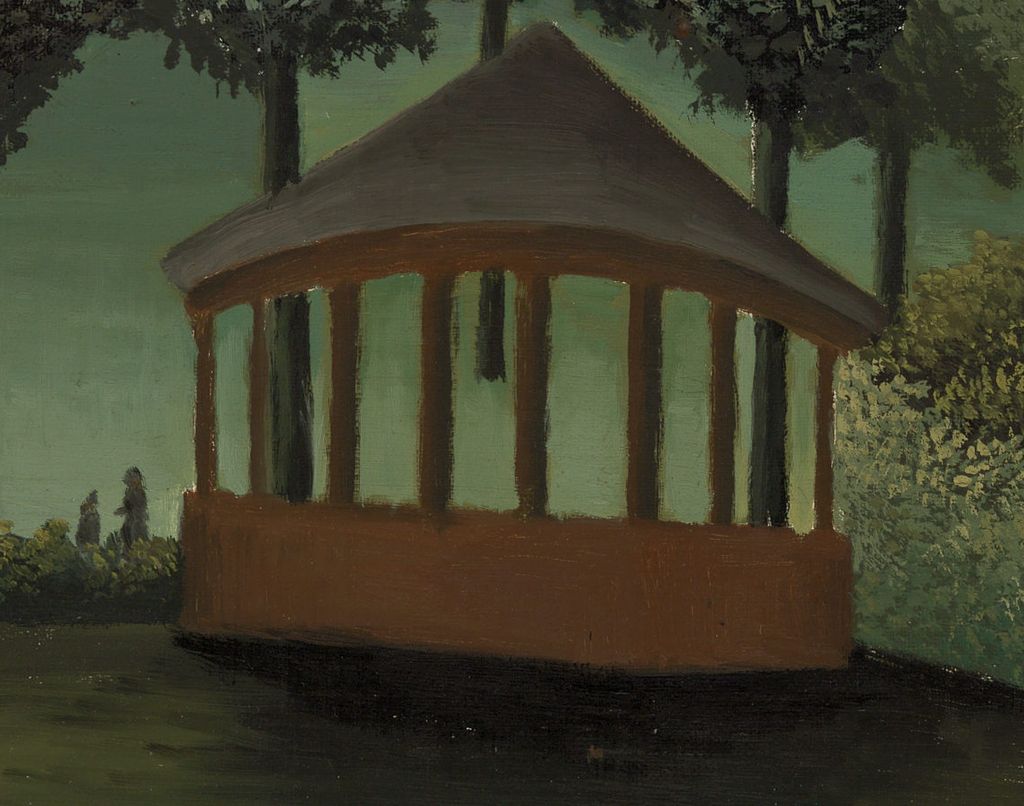
The pavilion sits slightly left of centre, its orange-brown base unusually solid beneath an open framework. Slender posts divide the interior into narrow upright gaps. Green appears between them, so that the structure both interrupts the landscape and allows it to continue through. The low roof spreads beyond the posts, gathering them beneath a grey triangular silhouette. Its apex is modest beside the pointed trees rising behind it.
That contrast establishes the building’s scale. Although the kiosk gives the painting its distinguishing feature, it occupies only a small part of the canvas. Vegetation towers above it and a broad interval of water opens below. Its warm colour gives it prominence within this green enclosure. The roof’s simple slopes stand out among the branching forms.
Under the base, dark horizontal marks gather into a shadow-like patch. Further down, lighter strokes stretch across the green surface. These marks suggest water without turning the lake into a bright mirror. The pavilion has weight, but its surroundings remain muted and difficult to measure. The lower edge of the structure feels close to the surface, while the far bank curves away on either side.
The eye can approach the kiosk more easily than an imagined visitor can. From the foreground path, the water holds it at a distance. On the right, a brown path slips diagonally between the lakeside planting and the trees, suggesting a route around the pool. The composition offers both a direct look across the water and a slower passage along its edge.
Seven figures along the promenade
Seven people occupy the pale path in front. They form four unevenly spaced units: two figures at the left, two nearer the middle, another pair just right of centre, and a solitary figure near the right edge. The generous intervals allow each group to retain its own outline.
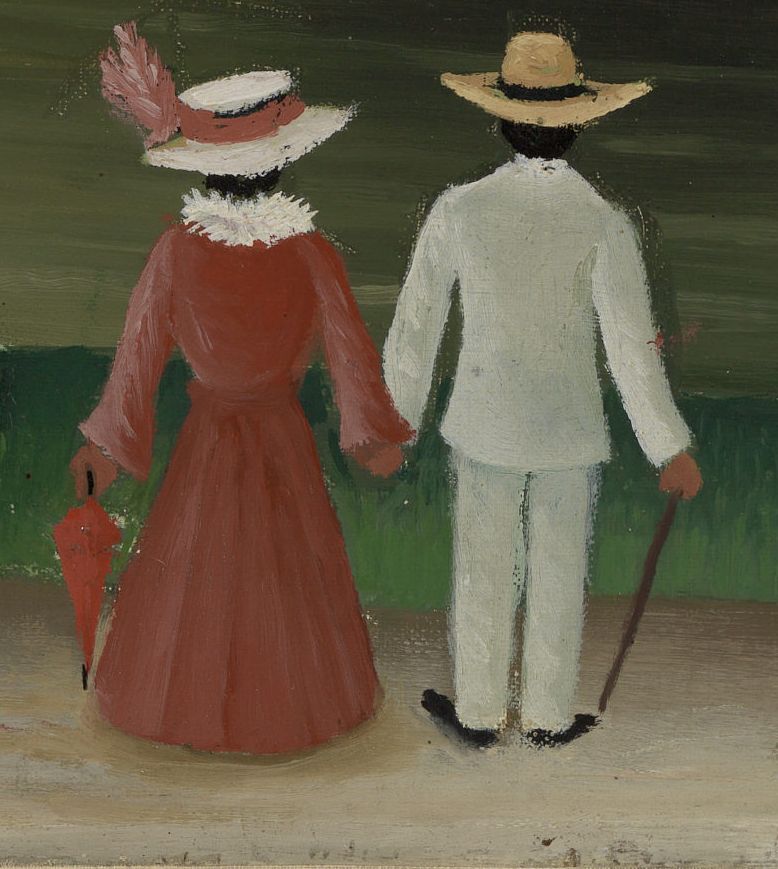
At the far left, a small white-clothed figure stands beside a much darker blue form. Long pink ribbons fall from the larger figure’s headwear. A little further along, the broad red skirt and pale suit make the most emphatic pairing of colours. The red-clothed figure holds a closed umbrella pointing down towards the path. Beside it, the white-suited figure’s dark cane makes another thin descending line.
The grey-blue and pink costumes near the centre-right introduce a different rhythm. Knee-length trousers expose pale lower legs above dark footwear. One figure rests a hand at the waist; the other holds a cane at an angle. On the far right, a cream suit and straw-coloured hat repeat the lighter notes seen earlier. An extended arm leaves a small open space between the hand and the torso.
These gestures invite a story, yet the painting gives each person very little facial information. The visible evidence is richest in clothes, posture and spacing. We can follow the turn of a body or the angle of a stick more securely than we can decide what someone is thinking. The figures’ relationships remain open. Their proximity makes the pairs readable as groups without establishing a family history or a particular encounter.
Most of the shoes sit very close to the lower edge. This keeps the promenade near the viewer and gives the people a firm common baseline. Their hats, however, rise and fall in a gently irregular sequence. Looking from one to the next produces a sense of movement even though several bodies seem almost stationary. The procession lives in the arrangement as much as in the poses.
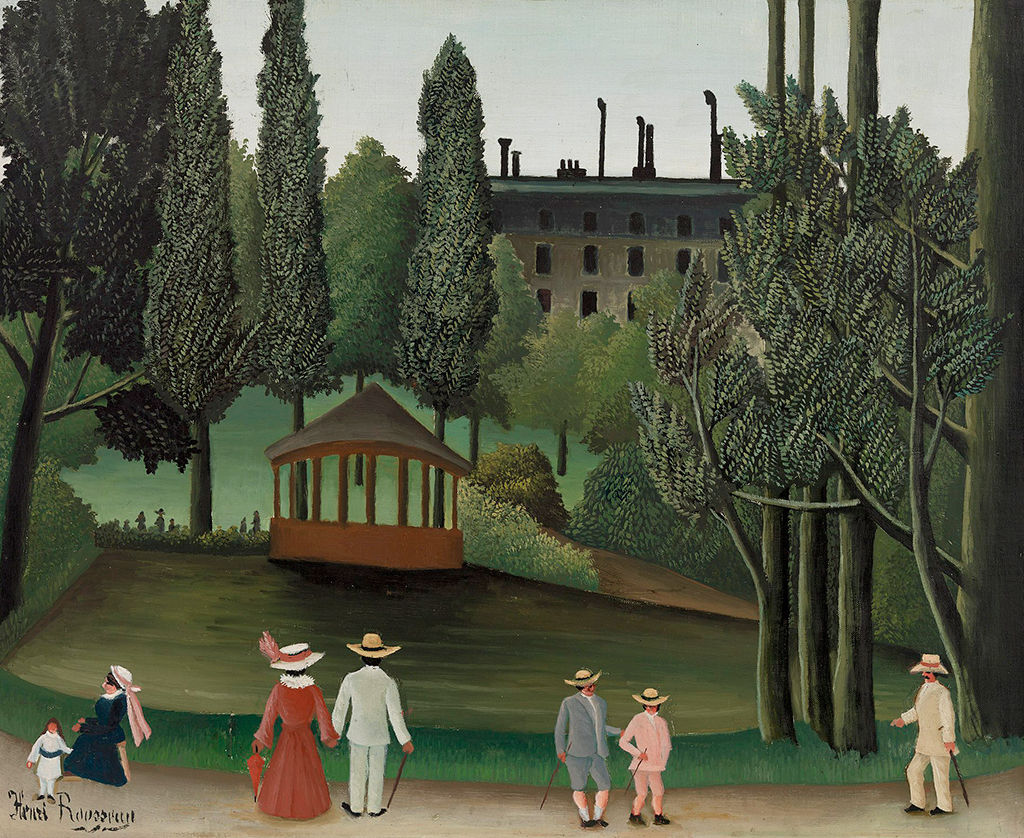
View of Montsouris Park, the Kiosk — Henri Rousseau.
Trees that shape the space
The trees have several distinct jobs. At the left, a dark trunk leans towards branching limbs that spread over the corner. Further in, narrow pointed crowns stand like tall columns. Their closely repeated leaves make dense, tapering surfaces. Gaps of lighter sky and distant greenery punctuate their dark silhouettes.
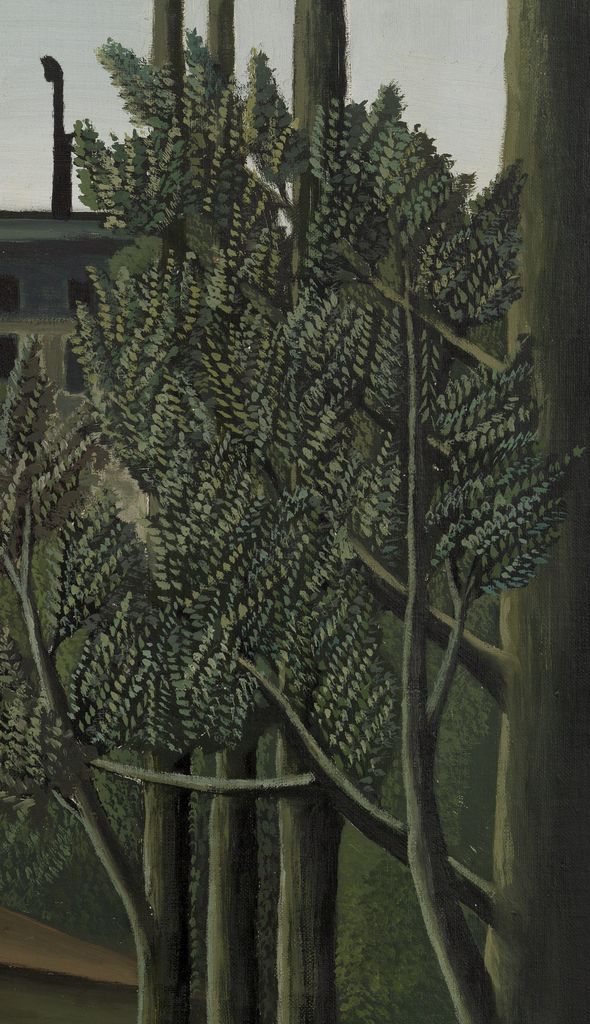
On the right, the vegetation becomes more intricate. Pale oval leaf marks lie against dark branches and trunks, producing a mesh of small repeated contrasts. Some branches fork; others stretch almost horizontally across the cluster. The mass reaches towards the kiosk while also rising beyond the top edge. A thick trunk at the extreme right makes a particularly firm boundary.
This difference between the two sides prevents the enclosure from becoming symmetrical. The narrow trees left of centre leave the pavilion relatively easy to read. The right-hand cluster is broader and more tangled, making the diagonal path seem to squeeze through a restricted opening. The lake consequently feels sheltered, with the greater visual pressure falling on its right side.
Individual leaf marks reward close attention, but their larger arrangement is equally important. Step back from them and they become long fingers, fans and rounded blocks of green. Rousseau’s painted vegetation works at both scales: a surface of small repeated touches and a set of substantial shapes. Those shapes divide the canvas before any botanical identification is needed.
The trunks also connect widely separated parts of the picture. Their lower ends stand near the grass bordering the promenade, while their tops disappear above the roofline of the distant building. They carry the eye upwards from the visitors into a part of the park where human movement becomes almost invisible. The little pavilion sits between these two registers, made for people but absorbed within the trees.
Annotated Details from View of Montsouris Park, the Kiosk
The numbered points identify visible features discussed in this article. Return from each detail to the whole composition. Henri Rousseau, View of Montsouris Park, the Kiosk, c. 1908–1910. Barnes Foundation, Philadelphia, BF570. Museum-derived reproduction published on Wikimedia Commons in 2018. Image source. Public domain. Numbers added to the overview; details cropped from the published original. No recolouring or retouching.
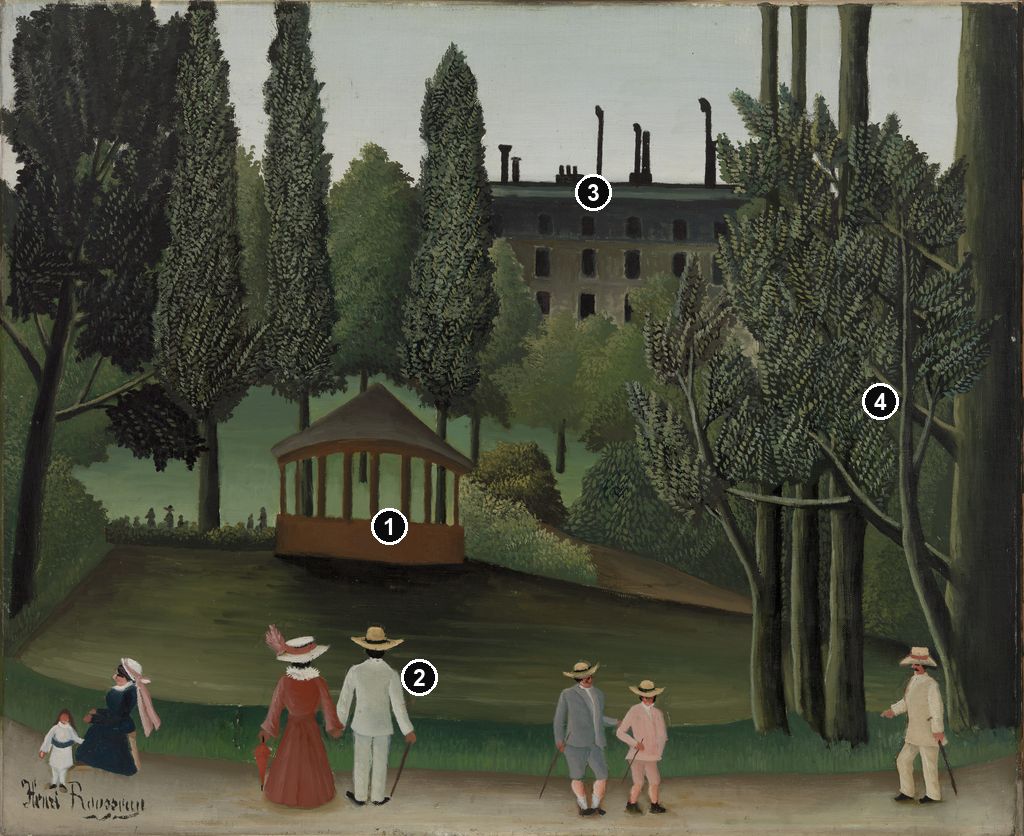
Details from VIEW OF MONTSOURIS PARK, THE KIOSK
Compare the kiosk’s open framework with the foreground clothes, the distant roofline and the denser branching foliage on the right.
An open pavilion across the water
The low roof gathers slender posts over a warm orange-brown base. Green remains visible between the uprights, allowing the planting beyond to continue through the small building.
Red dress, pale suit and descending lines
The broad red skirt and pale suit give this pair a strong colour contrast. A closed umbrella and a dark cane descend towards the path, while the hats and feather create a more irregular upper edge.
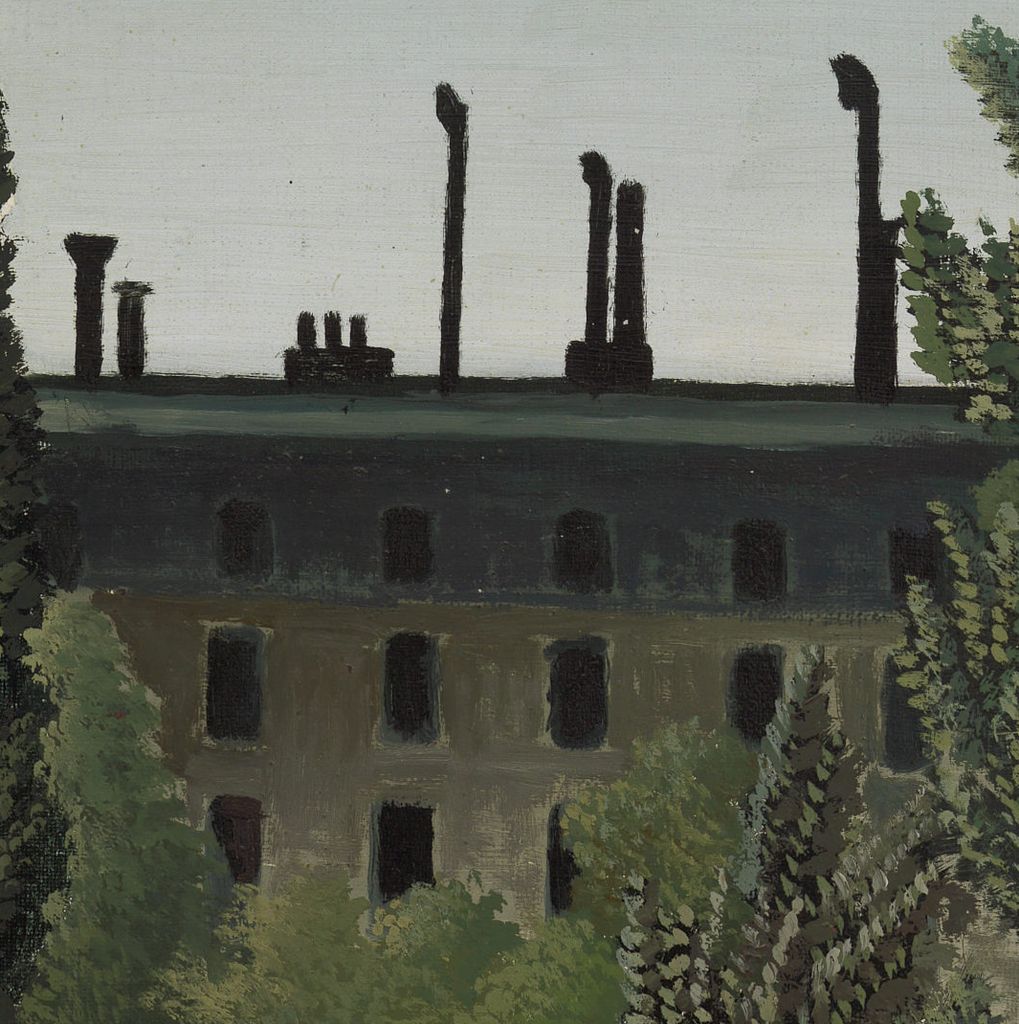
Roof pipes above repeated windows
Dark roof projections rise against the pale sky above rows of small windows. Their narrow upright shapes answer the trunks and pavilion posts elsewhere in the painting.
Leaf marks and crossing branches
Small pale leaves gather over dark trunks and branching limbs. Their repeated touches form a dense screen, crossed by longer lines that make the right-hand cluster distinct from the pointed trees opposite.
A city beyond the foliage
Behind the greenery stands a broad, pale building. Its dark windows repeat across the façade in rows, though trees conceal much of the lower portion. The upper edge is more exposed. Thin black pipes or chimney stacks rise from the roof into the sky, several with small bends at their tips. Their silhouettes are among the crispest details in the upper half.
The building changes the character of the view. Without it, the lake and enclosing trees might seem to continue into an indefinite wooded distance. The rectangular façade supplies a solid limit. Its repeated windows set up a measured pattern behind the less regular foliage, and the narrow roof projections answer the upright trunks below. Architecture and vegetation share a vocabulary of dark vertical marks.
There is little empty sky. It appears chiefly above the roof and in slender spaces between trees. As a result, the upper half feels filled almost to capacity. The eye finds relief in the comparatively broad surface of the lake and the pale strip of the foreground path. These quieter areas are essential to the crowded detail elsewhere.
The view holds different kinds of order together: a roof supported by evenly spaced posts, windows cut into a flat façade, people distributed along a path, and leaves accumulated across branches. Their scales vary, but each offers a pattern that can be grasped at a glance and examined more closely. The painting’s calm depends on these repeated structures as well as on its subdued green colour.
Distance with the clarity of a stage
The Barnes compares the foreground arrangement to figures crossing a stage in front of painted scenery. It is a useful curatorial reading of the picture’s shallow-looking space.[1] The pale path stretches across the front like a continuous platform, while the lake spreads upwards behind it. Many of the forms remain sharply bounded, whether close to us or further away.
Several details help us read distance. The foreground people are much larger than the tiny dark figures visible beyond the water at the left. Trees overlap the building. The diagonal path narrows as it passes into the vegetation. These cues establish an intelligible park, while the enclosing trees interrupt a deeper view.
Instead, attention moves between separate areas. A ribbon catches the eye; a kiosk post leads upwards; a black roof pipe appears between leafy crowns. The painting makes looking into a sequence of small discoveries. Even the distant building keeps a graphic clarity that lets its windows compete for notice with the foreground hats and canes.
This gives the scene its particular balance of ease and formality. The broad promenade suggests casual movement, yet every figure remains exceptionally legible. The foliage is abundant, yet its main masses hold their places. For readers exploring Rousseau’s style and technique, the picture offers a concentrated example of how outline, repetition and overlapping shapes can organise a landscape.
The kiosk is the hinge of that arrangement. Its pointed roof gathers the tall forms above, its upright posts repeat the trunks, and its warm base answers the red dress below. Across the separating water, these visual connections bring building, trees and visitors into a single design. A quiet visit to the park becomes an absorbing exercise in looking from one clearly placed thing to another.
Henri Rousseau artworks directory
This directory brings together works covered on this site and other works documented in the cited museum records and catalogues. Alternate titles share one entry; distinct versions remain separate. Historical dates for works without an article follow the cited catalogues. This is not a catalogue raisonné.
Frequently Asked Questions
It belongs to the Barnes Foundation in Philadelphia, where its inventory number is BF570.[1]
It is the small open-sided pavilion across the water, recognisable by its low pointed roof and orange-brown supports. It provides the central architectural focus of the view.
Their spacing creates several small groups, but the picture alone does not establish their identities or relationships. Clothes, gestures and relative positions offer firmer starting points for looking.
Discussion
Look again at the images and ideas explored in View of Montsouris Park, the Kiosk. These editorial prompts invite your observations.
Reader Insights
Follow the repeated upright lines from canes to kiosk posts, trunks and roof pipes. Which connections become most noticeable?
How would the mood and depth change if the pale building behind the trees disappeared?
Does the broad lake draw your attention towards the kiosk, or hold you at a distance from it?
Join the Conversation
Share a detail, comparison or question about View of Montsouris Park, the Kiosk below.
References
- Barnes Foundation. View of Montsouris Park, the Kiosk (Vue du parc Montsouris, le kiosque), collection record BF570, identity fields and short description, accessed 23 October 2026. View source.
- Philadelphia Museum of Art, Carnival Evening,1963-181-64,object59593. View source.
- Musée de l’Orangerie / Juliette Degennes, Henri Rousseau,L’ambition de la peinture: Un artiste dans son époque (in French). View source.
- National Gallery, Surprised!, NG6421. View source.
- Musée d’Orsay, La Guerre,RF19461 (in French). View source.
- MoMA, The Sleeping Gypsy. View source.
- Philadelphia Museum of Art, The Merry Jesters, 1950-134-176, object51097. View source.
- Musée d’Orsay, La Charmeuse de serpents, RF 1937 7 (in French). View source.
- Musée de l’Orangerie, La Carriole du Père Junier, RF 1960 26 (in French). View source.
- Solomon R. Guggenheim Museum / Cornelia Lauf, The Football Players,60.1583: current collection record. View source.
- MoMA, The Dream, 252.1954. View source.
- The Museum of Modern Art, Henri Rousseau: Essays (1985), selected catalogue entries, chronology and notes on early devotees. View source. Selected entries, chronology (pp.91–95) and early-devotee notes (pp.262–264) were consulted. Historical collection credits do not establish present ownership.
- Daniel Catton Rich, Henri Rousseau (The Museum of Modern Art, 1942), selected drawings and landscape studies; historical catalogue. View source. The dated 1942 publication is used for the two Quai d’Auteuil ink views; its Malakoff date differs from the 1985 catalogue.
- MANAS, Laval, Henri Rousseau, dit le Douanier, urban landscapes and preparatory study (in French). View source.
- National Gallery of Art, Self-Portrait (1895), pen-and-ink drawing, accession 1995.47.66. View source.
- The Museum of Modern Art, War (published January 1895), lithograph, accession 684.1943. View source.
- Barnes Foundation, Landscape and Four Young Girls, object 5521, BF855. View source.


 Henri Rousseau.jpg)


 Henri Rousseau.jpg)