


 Henri Rousseau.jpg)
 by Tom Gurney
Tom Gurney BSc (Hons) is an art history expert with over 20 years experience
Published on June 19, 2020 / Updated on October 29, 2026
Email: tomgurney1@gmail.com / Phone: +44 7429 011000
Flowers in a Vase (1909): Introduction
A striped flower rises above pink, tightly gathered blooms, while small yellow heads spread through the greenery like scattered lights. Beneath this generous bouquet, a narrow glass vase stands on an orange tabletop. A separate strand of ivy stretches across the foreground. Henri Rousseau’s Flowers in a Vase, signed and dated 1909, belongs to the Buffalo AKG Art Museum. Painted in oil on canvas and measuring 45.4 × 32.7 cm, it holds an arrangement whose individual parts remain unusually clear: flowers, leaves, vase, curtain and table.[1]
At a Glance
- ArtistHenri Rousseau
- SubjectFlowers in a Vase (1909)
- ExploreA bouquet built from differences; Leaves, glass and the green curtain
This work across Henri Rousseau’s career
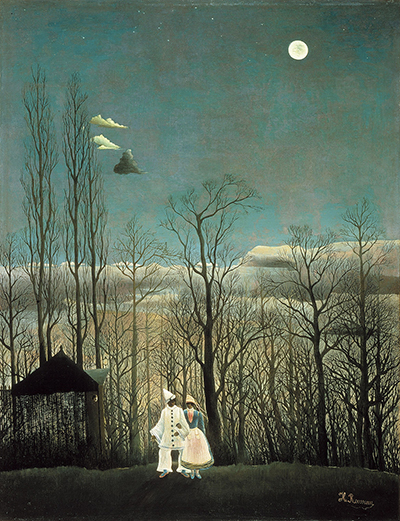
Carnival Evening
1886 [2]The Merry Jesters
1906 [7]The Snake Charmer
1907 [8]Contents
- A bouquet built from differences
- Leaves, glass and the green curtain
- A room reduced to a few planes
- Flowers and the small painting
- Printed bouquets and the ivy’s unanswered question
- From the Sandor collection to Buffalo
A bouquet built from differences
The large blossoms make the first impression. Two rich pink flowers occupy the left and lower centre, their rounded masses packed with curling petals. To the right, two paler blooms open into more irregular outlines. They establish a broad crown above the vase, with the lowest pink flower almost covering its mouth. Across this lower tier, the movement is sideways; above it, stems and smaller flowers carry the eye upwards.
The red and yellow bloom on the left, one of the tulips identified by the museum, introduces a sharply different shape.[1] Its long, pointed petals rise like flames, each coloured area broad enough to be read at a glance. Near the middle, white daisy-like flowers extend narrow petals around yellow centres. Their open stars interrupt the dense pink forms around them. Higher up, clusters of small yellow heads supply a finer rhythm. They fill the spaces between larger blooms without turning the bouquet into an undifferentiated mass.
White flowers with yellow centres reach towards both sides of the canvas. Their pale silhouettes stand out against the green hanging, widening the bouquet beyond the central concentration of pink. Dark violet forms on the upper right answer the bright striped tulip on the left. A few small blue accents are less immediately conspicuous; finding them changes the balance of the whole, bringing cool notes into an arrangement dominated by pink, yellow and red.
The museum’s 2016 exhibition label identifies peonies, tulips, daisies, mimosas, acacias and forget-me-nots in the bouquet.[1] Looking closely also means following the differences between them: a rounded flower beside a pointed one, a crowded head beside an open star, and a broad leaf beside a thin spray. Rousseau gives the arrangement variety through these encounters. The bouquet remains legible even where its flowers overlap most closely.
Leaves, glass and the green curtain
The greenery provides much of the bouquet’s shape. Large leaves spread beneath and between the blossoms, their pointed ends directing attention outwards. Fine fronds hang at either side of the lower flowers. Their narrow divisions contrast with the broad, almost unbroken surfaces nearby. Some leaves are light enough to separate readily from the curtain; others approach its darker green and become visible through their edges. The background therefore participates in the bouquet, alternately supporting and absorbing its foliage.
The vase has an unusual construction. Its dark, rounded upper part contracts before opening into a tall, widening base. Pale vertical streaks run down this lower section, giving it a fluted appearance. The glass is less transparent than one might expect: it has a substantial outline and a weight of its own. A small light mark on the dark upper part makes a compact contrast with the long pale lines below. Rousseau has given the container two distinct kinds of surface within one continuous silhouette.
Behind it, the curtain is divided by long vertical folds. These lines echo the streaks in the vase, though they are quieter and farther apart. The repeated direction steadies the centre of the picture. Above this upright structure, the bouquet expands; below it, the ivy opens across the tabletop. The arrangement can be followed as a sequence of broad crown, narrow support and spreading foreground branch.
The Buffalo AKG’s label observes that the generally smooth brushing is interrupted in places by white preparatory ground showing through as texture.[1] Alongside this museum observation, the image shows delicate variations within the pale petals: pink lines and creamy passages give definition to their folds.
 in Detail Henri Rousseau.jpg)
Flowers in a Vase (1909) — Henri Rousseau.
A room reduced to a few planes
The orange table supplies the strongest change of colour in the painting. Its upper edge runs almost horizontally behind the vase, then turns downwards at the right. That sloping side introduces a suggestion of depth into a setting otherwise dominated by front-facing forms. There is little room for the eye to wander beyond the still life. The curtain closes the background, and the table brings the objects forward.
The bouquet feels full, yet the surrounding space stays shallow. Individual petals overlap and leaves pass behind flowers, but these local indications of depth do not open into a spacious interior. The vase stands firmly in the centre, while the flowers spread almost parallel to the picture’s surface. This combination helps explain the peculiar intimacy of the work: the flowers are presented for close inspection, with few distractions around them.
The museum’s label draws attention to the frontal viewpoint, clear forms and compressed space.[1] These qualities can be seen most readily by tracing the boundaries between things. The pale flowers separate cleanly from the green curtain. The vase is enclosed by a dark edge against the same background. At the bottom, the ivy leaves lie across the orange in a series of distinct shapes. Each boundary contributes to the picture’s clarity, even when the space it describes remains difficult to measure.
The orange also carries the warmth of the striped tulip into the lower part of the canvas. Between them lie the pink blossoms and the darker vase. Colour joins these physically separated areas. The green ivy, in turn, brings the colour of the bouquet down onto the table, tying the foreground to the mass of leaves above.
Flowers and the small painting
In his 1985 catalogue entry, Michel Hoog places Rousseau’s interest in still life late in his career and notes the changing species and arrangements across his flower paintings. He treats the bouquet as a subject that allowed varied combinations of form and colour.[12] The Buffalo painting makes that freedom tangible. Its flowers differ greatly in scale and contour, yet the whole remains balanced around a central vase. Variety is held within a simple arrangement that can be grasped before every detail has been recognised.
The small size matters. This is a picture suited to looking at from nearby, where the little yellow flower heads and the divisions in the fronds can become part of the experience. The Musée de l’Orangerie’s 2026 exhibition text places Rousseau’s small bouquets, still lifes and suburban views within his efforts to reach buyers with modest budgets and interiors. It describes decorative imagery as one strand of his market alongside more ambitious exhibition compositions.[13] That broader account offers context for the format, although it does not identify an original buyer or commission for this particular canvas.
For readers exploring Rousseau’s paintings, this still life offers a concentrated example of his organisation of vegetation. The visible interest lies in how one form meets another: pink petals against a broad green leaf, a white flower against the curtain, or a slender stem passing through a cluster of yellow heads. The domestic setting gives these relationships a compact frame. There is enough variety to sustain looking, while the limited setting keeps returning attention to the flowers.
Printed bouquets and the ivy’s unanswered question
Hoog proposes that illustrated flower books may have contributed to Rousseau’s bouquets. He names works by Pierre Zaccone, Kate Greenaway and Anaïs de Neuville as possible sources, suggesting that printed arrangements could help account for the flowers’ composed presentation.[12] This is a scholarly hypothesis. The entry does not establish a particular page copied for the Buffalo picture. It invites us to consider the bouquet’s relationship with decorative illustration while leaving the precise origin of the arrangement open.
That possibility is relevant because the bouquet has the completeness of a presentation. Large and small flowers are distributed across its width; pale blooms reach out on either side; the central stems rise above the dense lower flowers. Looking at those choices can suggest a designed image of abundance. It cannot, by itself, establish whether Rousseau arranged flowers before him, adapted a printed model, or combined resources.
The ivy raises a similar question. Set apart from the vase, its long stem and repeated leaves are given unusual prominence. Hoog asks whether it might refer to friendship, fidelity or dependence, and whether the painting could have been intended as a gift or commission. He explicitly leaves those possibilities unresolved.[12] No single symbolic meaning should therefore govern the reading. The branch already has a clear visual role: its horizontal reach balances the upright vase, fills the open table and supplies a second kind of greenery below the bouquet. Any further meaning remains a possibility rather than an explanation supplied by Rousseau.
From the Sandor collection to Buffalo
The Buffalo AKG’s published provenance records the painting with Count Sandor in 1911. It allows the possibility that he bought it from a small exhibition in Paris, without treating that purchase occasion as certain. The work then passed to his niece, Countess Sandor.[1] This is the earliest ownership sequence supplied by the museum; it does not identify the person for whom Rousseau originally painted the flowers.
The later transfers are more precisely set out. In 1939, the painting was sold to Arthur Tooth and Sons in London, then to M. Knoedler and Company. On 12 December 1939 it was sold to the Albright Art Gallery. The present Buffalo AKG record gives the credit as the Room of Contemporary Art Fund, 1939, and the accession number RCA1939:17.[1] The museum’s current name and the historical name used for the acquisition belong to different moments in the same painting’s history.
Its title needs similar care. Rousseau painted several flower arrangements, and the related Flowers in a Vase is a separate work. Hoog’s catalogue identifies the Buffalo canvas as DV 232A and distinguishes another still life, then in the William S. Paley collection, as DV 232B.[12] In the Buffalo painting, Rousseau’s signature and the 1909 date sit at the lower left, sharing the orange ground with the ivy. The long branch leads past his name and back towards the vase.
Henri Rousseau artworks directory
This directory brings together works covered on this site and other works documented in the cited museum records and catalogues. Alternate titles share one entry; distinct versions remain separate. Historical dates for works without an article follow the cited catalogues. This is not a catalogue raisonné.
Frequently Asked Questions
It is in the Buffalo AKG Art Museum collection, accession RCA1939:17. The museum records its acquisition through the Room of Contemporary Art Fund in 1939.[1]
The museum’s 2016 label identifies peonies, tulips, daisies, mimosas, acacias and forget-me-nots. Pink and pale layered blossoms dominate the lower bouquet, while smaller flowers rise among the leaves.[1]
Friendship is one possibility raised by Michel Hoog, alongside fidelity and dependence. His catalogue entry establishes neither a definite meaning nor a gift recipient.[12]
Hoog suggests illustrated flower books as possible sources. The entry does not prove that this painting reproduces a particular printed bouquet.[12]
Discussion
Look again at the images and ideas explored in Flowers in a Vase (1909). These editorial prompts invite your observations.
Reader Insights
Which flower first draws your attention, and how does its colour or shape lead you towards the others?
How would the composition change if the ivy were removed from the tabletop?
Where do you find the strongest suggestion of depth, and where does the arrangement seem closest to a flat pattern?
Join the Conversation
Share a detail, comparison or question about Flowers in a Vase (1909) below.
References
- Buffalo AKG Art Museum. Flowers in a Vase, 1909, RCA1939:17, current collection record, inscriptions and provenance; includes label from For the Love of Things: Still Life, 27 February–29 May 2016. Accessed 23 October 2026. View source.
- Philadelphia Museum of Art, Carnival Evening,1963-181-64,object59593. View source.
- Musée de l’Orangerie / Juliette Degennes, Henri Rousseau,L’ambition de la peinture: Un artiste dans son époque (in French). View source.
- National Gallery, Surprised!, NG6421. View source.
- Musée d’Orsay, La Guerre,RF19461 (in French). View source.
- MoMA, The Sleeping Gypsy. View source.
- Philadelphia Museum of Art, The Merry Jesters, 1950-134-176, object51097. View source.
- Musée d’Orsay, La Charmeuse de serpents, RF 1937 7 (in French). View source.
- Musée de l’Orangerie, La Carriole du Père Junier, RF 1960 26 (in French). View source.
- Solomon R. Guggenheim Museum / Cornelia Lauf, The Football Players,60.1583: current collection record. View source.
- MoMA, The Dream, 252.1954. View source.
- Michel Hoog. “Flowers in a Vase,” entry 52, in William Rubin and Carolyn Lanchner et al., Henri Rousseau, Museum of Modern Art, New York, 1985, p. 218; colour plate p. 219 (PDF pp. 223–224). View source.
- Musée de l’Orangerie. Henri Rousseau, l’ambition de la peinture, exhibition texts, 25 March–20 July 2026, especially “Variations et déclinaisons. À la recherche du marché.” Accessed 23 October 2026. View source. (in French).
- The Museum of Modern Art, Henri Rousseau: Essays (1985), selected catalogue entries, chronology and notes on early devotees. View source. Selected entries, chronology (pp.91–95) and early-devotee notes (pp.262–264) were consulted. Historical collection credits do not establish present ownership.
- Daniel Catton Rich, Henri Rousseau (The Museum of Modern Art, 1942), selected drawings and landscape studies; historical catalogue. View source. The dated 1942 publication is used for the two Quai d’Auteuil ink views; its Malakoff date differs from the 1985 catalogue.
- MANAS, Laval, Henri Rousseau, dit le Douanier, urban landscapes and preparatory study (in French). View source.
- National Gallery of Art, Self-Portrait (1895), pen-and-ink drawing, accession 1995.47.66. View source.
- The Museum of Modern Art, War (published January 1895), lithograph, accession 684.1943. View source.
- Barnes Foundation, Landscape and Four Young Girls, object 5521, BF855. View source.
 Henri Rousseau.jpg)
 Henri Rousseau.jpg)