



 by Tom Gurney
Tom Gurney BSc (Hons) is an art history expert with over 20 years experience
Published on June 19, 2020 / Updated on October 29, 2026
Email: tomgurney1@gmail.com / Phone: +44 7429 011000
Tiger Hunt: Introduction
Henri Rousseau's Tiger Hunt gathers three figures, a low-lying tiger and a white horse in a bare, rocky landscape. The title promises an encounter full of movement; the painting holds its participants in a strangely measured arrangement. Bright clothing and elaborate riding equipment stand out against sand and shadow, while a ladder, a long gun-like object and a small chest occupy the foreground. Looking between these things, we begin to assemble a story whose decisive action remains outside our view.
At a Glance
- ArtistHenri Rousseau
- SubjectTiger Hunt
- ExploreA small painting with an open setting; Three figures around the tiger
This work across Henri Rousseau’s career
Carnival Evening
1886 [1]Tiger Hunt (current article)
c. 1895 [5]The Merry Jesters
1906 [7]The Snake Charmer
1907 [8]Contents
- A small painting with an open setting
- Three figures around the tiger
- The white horse and the balance of the scene
- Equipment at the edge of the story
- Rocks, distance and the limits of recognition
- A historical comparison
- Annotated details
A small painting with an open setting
The Columbus Museum of Art dates Tiger Hunt to about 1895. It is an oil painting on canvas measuring 15 × 18⅛ inches, recorded as a gift of Ferdinand Howald under object number 1931.091.[5] Its modest dimensions bring the figures and their equipment into an intimate field of vision. There is room to examine each separate form, yet enough unoccupied ground to keep the gathering from becoming crowded.
The composition is wider than it is high. A blue-grey sky stretches above a broken ridge of dark rocks, and the sandy ground opens towards us beneath the group. Most of the people and animals occupy the lower half. This leaves a broad, quiet area overhead, giving their small assembly an exposed quality. Nothing in the sky directs attention towards a particular instant: there is no dramatic shaft of light or conspicuous disturbance to tell us when to expect a climax.
The landscape provides few clues to a precise location. Its pale slopes and angular dark masses establish a dry, stony environment, with a small patch of pointed green leaves near the right edge. These sparse elements make the clothing, bodies and objects unusually legible. We can move across the scene almost as though examining things laid out on a table.
Three figures around the tiger
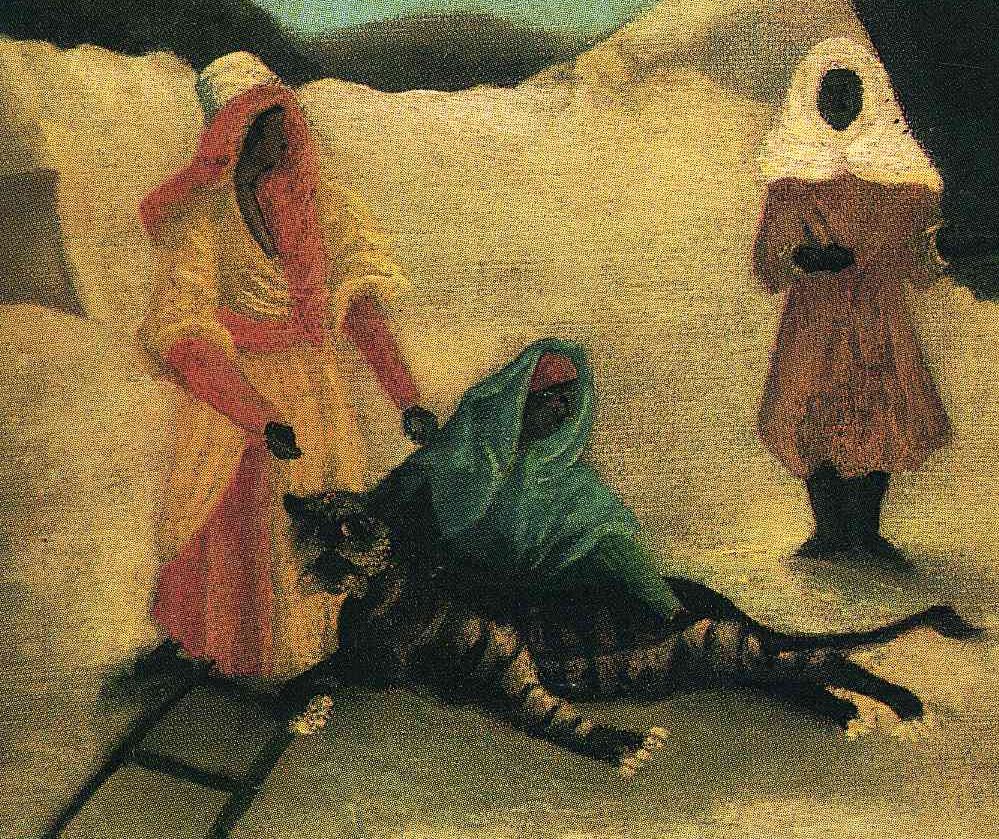
The tiger stretches horizontally across the lower left and centre. Its striped body is close to the ground, its head turned towards the left, with limbs reaching towards the right. The bands of dark and warm colour give the animal a density that contrasts with the relatively plain sand. Its long, low shape also establishes a base for the more upright forms around it.
At the left, a standing figure wears a pale hood and a long costume in yellow, orange and red. A vivid red strip surrounds the darker face and continues down the front. The arms extend towards the animal, drawing our attention into the close cluster of bodies. The costume's long folds help preserve the figure's upright shape even where its hands approach the tiger.
Beside the animal, a second figure bends beneath a broad blue-green covering. The inclined head and spreading garment form a compact sloping mass. From a distance the blue cloth is one of the first things we see; closer looking reveals how it overlaps the tiger and interrupts the animal's outline. The exact relationship of hands, fabric and body is less immediately clear than the larger arrangement of colours. That small difficulty slows our reading of the action.
A third figure stands farther back, between the left group and the horse. A white hood encloses a dark face above an ochre garment, and the hands are held together near the front of the body. Dark feet anchor this figure to the ground. The posture makes a strong vertical pause beside the bent form and the sprawling animal. We may read the figure as waiting or watching, but the painted pose supplies no definite thought or emotion.
The title encourages us to connect these figures with a hunt. Their stillness, however, leaves its precise stage uncertain. The tiger's posture alone cannot establish whether it is dead, injured or captured. We see a gathering around an animal, with gestures that suggest involvement; the painting withholds the continuous sequence that would settle what has just happened.
The white horse and the balance of the scene
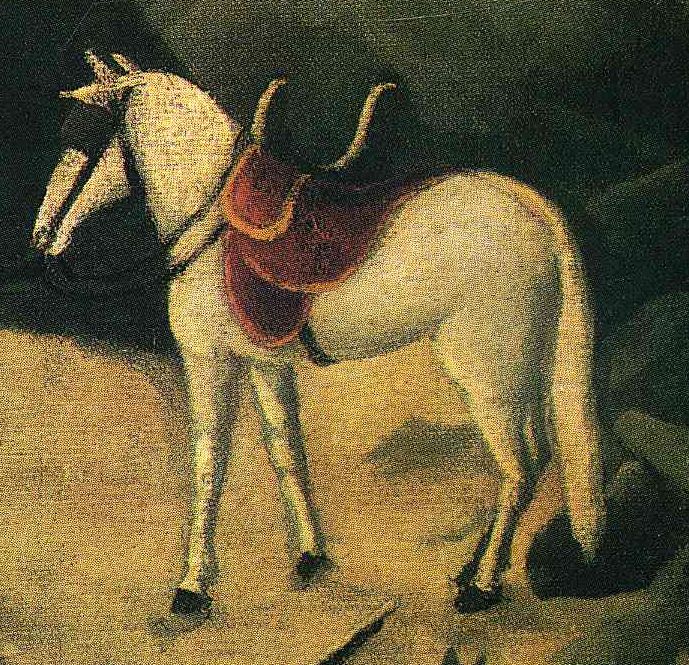
The horse occupies the right side, facing the human group. Its pale body catches the eye against the dark rock behind it, and the narrow legs introduce a different kind of delicacy from the heavy folds of the figures' clothing. Black hooves punctuate the ground. Above them, the rounded belly and haunches give the animal a smooth, almost contained silhouette.
Its head points left and slightly down, helping carry our gaze back towards the people and tiger. The dark mane and fine lines of the bridle articulate the neck without breaking up the broad white body. Red and gold riding equipment adds a concentrated patch of ornament across its back. Curving fittings rise above the saddle, echoing the horse's curved outline while standing apart from the straight-edged rocks.
The horse has space around its feet. By comparison, the tiger is pressed into a tangle of stripes, fabric and reaching arms. These two ways of arranging an animal give the painting much of its variety: one can be followed in a clear circuit around the body, while the other draws us into overlapping forms. Neither animal disappears into its surroundings.
White connects the horse with the hoods of the standing figures. Red links its equipment with the costume on the opposite side. These repetitions carry the eye across the empty centre without filling it. The blue-green bent figure, meanwhile, provides a cooler concentration within the warmer left group. Colour helps us distinguish the participants before we understand their relationships.
Equipment at the edge of the story
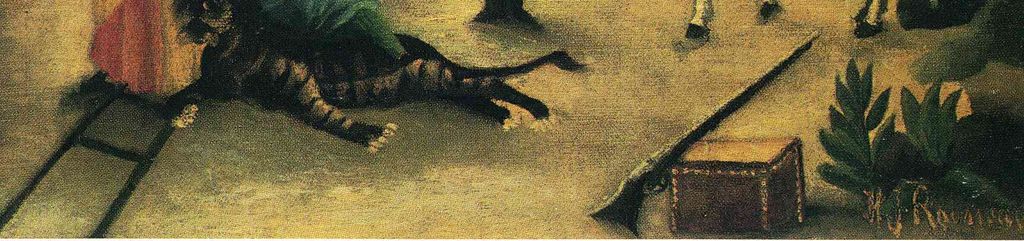
A dark ladder enters from the lower left corner. Its rails angle towards the figures, and its rungs make a short sequence of repeated bars. Because part of it continues beyond the edge, it seems to extend into the space in front of the painting. We encounter this practical object before reaching the tiger, as if approaching the group across the sandy ground.
The ladder's presence is also puzzling. Its shape is clear enough to recognise, but the scene gives no equally clear explanation for its use here. It introduces the possibility of activity extending beyond the moment shown. A viewer can imagine preparations or movements, yet the object does not tell us which imagined sequence to choose.
On the other side, a long rifle-like object lies diagonally beside a rectangular chest. The chest has a reddish body and a bright border, its top plane visible from above. A few pointed leaves rise nearby. Together these forms occupy a small, carefully differentiated area: the long dark line, the compact box and the separate green blades each have a distinct shape and direction.
The two foreground diagonals guide us inward from opposite sides. At the left, the ladder leads directly towards the cluster; at the right, the long object crosses the open sand below the horse. They make the foreground feel accessible while the rocks behind the group close off a deeper route. This gives the whole arrangement a shallow, enclosed character despite the breadth of sky.
The chest's edges, the ladder's rungs and the pointed leaves form a little still life within the larger scene. Their precision makes the unexplained story more absorbing. Objects that seem ready to help us understand the event remain quiet about their purpose.
Annotated Details from Tiger Hunt
The numbered points identify visible features discussed in this article. Return from each detail to the whole composition. Henri Rousseau, Tiger Hunt, c.1895. Columbus Museum of Art, 1931.091; gift of Ferdinand Howald. Image via WikiArt. Image source. Public domain. Numbers added to a separate resized overview. Details cropped directly from the published original without enlargement, sharpening, recolouring, cleaning or retouching.
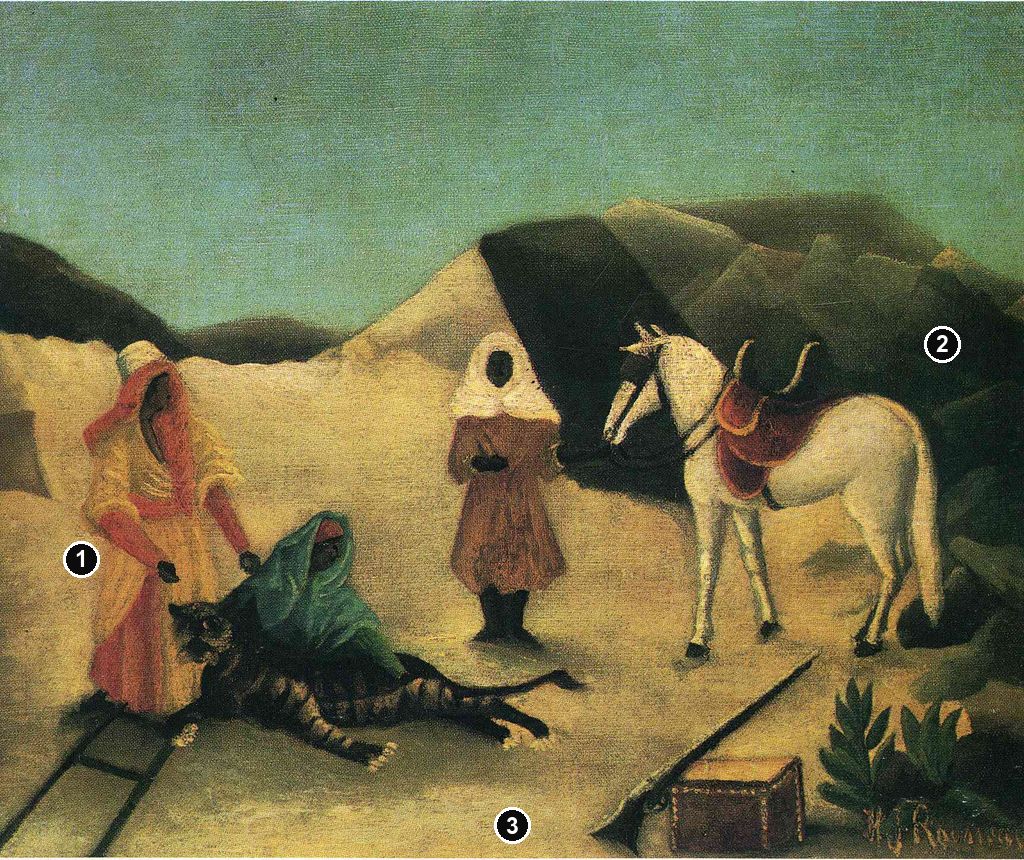
Details from TIGER HUNT
Compare the overlapping tiger group with the horse’s clear outline, then follow the equipment entering the scene from opposite foreground corners.
Figures gathered around the tiger
The bright upright costume, blue-green covering and striped animal overlap closely. The nearby standing figure introduces a more compact vertical beside the spreading cloth and the tiger’s long body.
A white horse against dark rocks
The pale body is clearly separated from the angular rock behind it. Red-and-gold riding equipment supplies a concentrated pattern across its back, while space around the hooves makes the legs easy to follow.
Equipment across the foreground
The ladder enters from the lower left, while the long rifle-like object lies beside a chest and pointed leaves at the right. These opposing diagonals lead into a gathering whose exact stage remains uncertain.
Rocks, distance and the limits of recognition
Behind the figures, the rocks rise in large, adjoining planes. Pale slopes catch more light, while dark triangular faces create abrupt changes in tone. At the right, several peaks overlap, making a compact succession of ridges. The horse's white neck is particularly striking against one of the darkest areas.
This setting supplies a firm structure for the softer shapes in front. The central figure's hood rounds over the head; the horse's body swells gently; the blue garment spreads and folds. Against them, the rocks appear cut into broad facets. Rousseau's style and technique give the folded blue cloth and rounded horse enough weight to hold their own against these sharp rock faces.
Distance is suggested through overlap and rising ground, but the painting gives relatively little small detail with which to measure it. The rocks can feel both close behind the figures and imposing in their scale. The sky increases that uncertainty by remaining almost uninterrupted. Our attention returns to the foreground, where a rung, a hoof or the edge of the chest provides something more definite to grasp.
The participants' faces offer similarly limited information. Clothing and posture distinguish the figures far more clearly than facial expression does. The costumes contribute to the scene's unfamiliarity, but their colours and shapes cannot securely identify a nationality, religion or community. Attending to what is visible preserves the particularity of the picture without supplying biographies for its unnamed people.
A historical comparison
In his 1942 Rousseau catalogue, Daniel Catton Rich associated Tiger Hunt with the North African themes of Eugène Fromentin and Jean-Léon Gérôme. He discussed it near The Sleeping Gypsy and captioned the painting with the date range 1895–97.[12] The Columbus museum's present dating is about 1895.[5] Both descriptions place the work in the mid-1890s, while the current qualified date is the appropriate one to use for the painting today.
Rich's comparison offers a useful way to approach the combination of costume, riding equipment and dry landscape. It identifies a broader artistic association rather than an exact model that resolves every detail. Within this picture, the expressive weight falls on the arrangement of a few distinct bodies and objects. Their isolation on the pale ground makes even a small gesture conspicuous.
The small scale encourages a personal encounter with these ambiguities. From a little distance the participants fall into clear groups; looking closely, we find details that complicate our first impression of an easily readable hunt. A story seems almost within reach, held in the inclined head, the bright saddle and the equipment scattered at our feet.
Henri Rousseau artworks directory
This directory brings together works covered on this site and other works documented in the cited museum records and catalogues. Alternate titles share one entry; distinct versions remain separate. Historical dates for works without an article follow the cited catalogues. This is not a catalogue raisonné.
Frequently Asked Questions
It belongs to the Columbus Museum of Art, where it is recorded as object 1931.091, a gift of Ferdinand Howald.[5]
The tiger lies low across the foreground, but its pose does not establish its condition. The title names a hunt without explaining the precise moment shown.
The visible setting is predominantly bare sand and rock beneath an open sky. A small group of green leaves appears at the right edge.
Discussion
Look again at the images and ideas explored in Tiger Hunt. These editorial prompts invite your observations.
Reader Insights
How does the horse's clear outline change your response to the overlapping figures and tiger on the left?
What possible role does the ladder suggest, and how much of that story comes from your own imagination?
Which detail first draws your eye away from the tiger, and where does it lead you next?
Join the Conversation
Share a detail, comparison or question about Tiger Hunt below.
References
- Philadelphia Museum of Art, Carnival Evening,1963-181-64,object59593. View source.
- Musée de l’Orangerie / Juliette Degennes, Henri Rousseau,L’ambition de la peinture: Un artiste dans son époque (in French). View source.
- National Gallery, Surprised!, NG6421. View source.
- Musée d’Orsay, La Guerre,RF19461 (in French). View source.
- Columbus Museum of Art. Tiger Hunt, current online collection, object 1931.091, Description group; accessed 23 October 2026. View source.
- MoMA, The Sleeping Gypsy. View source.
- Philadelphia Museum of Art, The Merry Jesters, 1950-134-176, object51097. View source.
- Musée d’Orsay, La Charmeuse de serpents, RF 1937 7 (in French). View source.
- Musée de l’Orangerie, La Carriole du Père Junier, RF 1960 26 (in French). View source.
- Solomon R. Guggenheim Museum / Cornelia Lauf, The Football Players,60.1583: current collection record. View source.
- MoMA, The Dream, 252.1954. View source.
- Daniel Catton Rich. Henri Rousseau, Museum of Modern Art, 1942, printed pp. 30–31, including plate on p. 31 (PDF pp. 35–36). View source.
- The Museum of Modern Art, Henri Rousseau: Essays (1985), selected catalogue entries, chronology and notes on early devotees. View source. Selected entries, chronology (pp.91–95) and early-devotee notes (pp.262–264) were consulted. Historical collection credits do not establish present ownership.
- Daniel Catton Rich, Henri Rousseau (The Museum of Modern Art, 1942), selected drawings and landscape studies; historical catalogue. View source. The dated 1942 publication is used for the two Quai d’Auteuil ink views; its Malakoff date differs from the 1985 catalogue.
- MANAS, Laval, Henri Rousseau, dit le Douanier, urban landscapes and preparatory study (in French). View source.
- National Gallery of Art, Self-Portrait (1895), pen-and-ink drawing, accession 1995.47.66. View source.
- The Museum of Modern Art, War (published January 1895), lithograph, accession 684.1943. View source.
- Barnes Foundation, Landscape and Four Young Girls, object 5521, BF855. View source.


 Henri Rousseau.jpg)


 Henri Rousseau.jpg)