


 by Tom Gurney
Tom Gurney BSc (Hons) is an art history expert with over 20 years experience
Published on June 19, 2020 / Updated on October 29, 2026
Email: tomgurney1@gmail.com / Phone: +44 7429 011000
Flowers in a Vase: Introduction
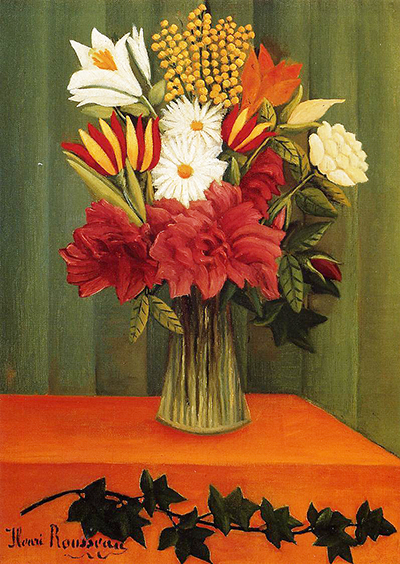
Henri Rousseau’s Flowers in a Vase rises from an orange table in a succession of sharply different shapes: folded red petals, white stars, pointed striped flowers and a spray of little yellow heads. Below them, long stems show through a clear glass vessel. A separate branch of ivy stretches across the foreground, almost the width of the picture. This is the still life formerly in William S. Paley’s collection, catalogued by Sotheby’s in 2022 as Vase de fleurs à la branche de lierre, première version, an oil on canvas dating to about 1901–02.[1]
At a Glance
- ArtistHenri Rousseau
- SubjectFlowers in a Vase
- ExploreA bouquet with a particular identity; Colour and the movement of the flowers
This work across Henri Rousseau’s career
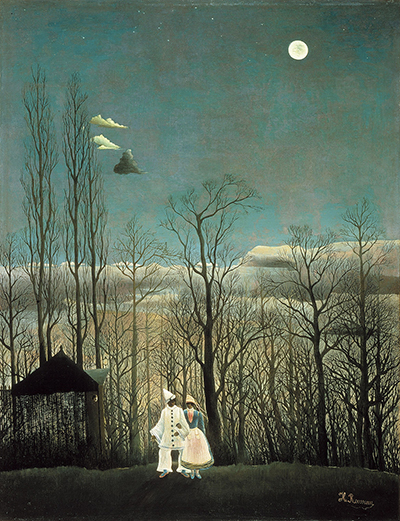
Carnival Evening
1886 [2]Flowers in a Vase (current article)
c. 1901–1902 [1]The Merry Jesters
1906 [7]The Snake Charmer
1907 [8]Contents
- A bouquet with a particular identity
- Colour and the movement of the flowers
- Looking through the glass
- The ivy across the foreground
- Comparing the two ivy arrangements
- From a small canvas to the Paley collection
A bouquet with a particular identity
The longer French title, meaning a vase of flowers with an ivy branch, gives a useful way into the painting. The ivy is as conspicuous as the vase, yet it sits well below the bouquet, isolated against the orange surface. Together with the green hanging behind the flowers and the fluted glass, it identifies a particular arrangement within Rousseau’s varied flower paintings. Sotheby’s gives its dimensions as 46.4 × 33 cm and records the signature at the lower left.[1]
The 1901–02 dating also appears in Daniel Catton Rich’s 1942 Rousseau catalogue, which reproduces this composition on page 62 as Vase of Flowers. The caption names William S. Paley as its owner at that time.[12] Dating has nevertheless varied: the bibliography in the 2022 auction catalogue lists publications assigning the painting to around 1909 or 1908–09. The auction’s own description agrees with the earlier 1901–02 range, without explaining the intervening differences.[1]
The broad red band across the lower bouquet, the large white flower high on the left and the orange pointed bloom to the right of the yellow spray make a compact pattern that can be recognised even in a small reproduction. These separate attractions pull the eye in different directions.
Colour and the movement of the flowers
The red flowers form the bouquet’s heaviest passage. Their petals curl, fold and overlap, creating dark recesses among areas of pink and crimson. Across the lower part of the arrangement they make something like a ruffled collar above the vase. Their breadth gives the flowers a weight that the narrow glass seems just able to support. Higher up, the bouquet loosens, allowing individual forms to project against the green background.
White punctuates this red mass. Two daisy-like flowers sit near the middle, their yellow centres surrounded by narrow pale petals. Above and to the left, a much larger white bloom turns outward, its broad curling shapes opening around a yellow interior. It is an effective counterweight to the pointed orange flower across the bouquet. One spreads and folds; the other pushes upward in a series of firm tips. Both interrupt the softer, rounded rhythm of the red flowers below.
The striped red-and-yellow flowers introduce another kind of order. Each pointed petal carries a strong division of colour, making the flower legible almost as a small pattern within the larger arrangement. Nearby, the yellow spray breaks colour into numerous little dots. These alternatives—stripes and dots, broad folds and slender rays—keep the bouquet active without requiring a deep space behind it. The eye can move from one kind of mark to another while remaining close to the picture’s surface.
The two sides are unevenly balanced. On the left, the large white bloom and the striped forms push outward. On the right, a cream flower sits among leaves with dark, emphatic veins, while a closed reddish bud bends down toward the vase. That descending branch softens the bouquet’s upward thrust. It also gives the right side a trailing movement that the left lacks. Rousseau’s arrangement feels carefully gathered, but its parts retain their individual directions.
Looking through the glass
The vase connects this crowded upper half to the comparatively bare table. Its sides narrow toward the flowers and widen into a flared foot. Through the glass, pale and dark vertical strokes suggest the stems, while the vessel’s ridges complicate their appearance. It is difficult to separate every stem from every reflection or groove. That visual uncertainty gives the glass a different character from the firmly outlined leaves and petals above.
Transparency here makes the support of the bouquet visible. Long stalks descend from the red flowers to the foot of the vase, drawing the eye through the object rather than stopping it at an opaque surface. Their greens and browns bring the bouquet’s colours down toward the orange table. The pale striations also lighten this lower passage, preventing the glass from becoming a single dark block beneath the flowers.
Behind it, the hanging supplies another set of vertical lines. Broad bands of green suggest folds, with darker seams running down toward the table. These larger, quieter divisions echo the narrow lines inside the vase. Because the hanging occupies almost the entire background, the bouquet has no distant room or landscape into which it can dissolve. The greens provide a close enclosure, setting off the pale flowers and containing the bursts of red and yellow.
The table introduces a different geometry. Its rear edge runs across the picture before turning sharply down to the right, while a lower horizontal division suggests its front. The vase stands on the upper plane; the ivy spreads across the orange band below. These simple divisions establish depth with very few cues. They also make the composition feel shallow and direct, bringing both bouquet and ivy within easy visual reach.
The ivy across the foreground
The ivy occupies an unusually generous stretch of space. Its dark stem crosses the foreground in a loose curve, with pointed leaves projecting above and below it. The leaves overlap in places but remain sufficiently separate to show their angular outlines. Their dark green makes a strong contrast with the table, and their repeated points answer the flowers’ more elaborate shapes.
There is a pause between this branch and the foot of the vase. The orange space allows the two to be seen independently: a standing arrangement above, a low, extended one below. The ivy gives the eye a route across the picture after the bouquet has carried it upward. It also shares the lower edge with Rousseau’s signature, balancing the accumulation of detail near the top.
The ivy has invited symbolic interpretation. The 1985 MoMA catalogue, discussing Rousseau’s related flower painting in Buffalo, identifies the Paley work as another version using the same vase and ivy motif. It raises friendship, fidelity and dependence as possible meanings, while leaving open whether the paintings were gifts or commissions.[13] Those questions add a possible emotional dimension to the branch, but no known recipient or documented occasion in that account fixes its meaning. Its visible role is clearer: it brings the bouquet’s green out across the table and gives the composition a second, horizontal centre of interest.
Comparing the two ivy arrangements
Rousseau’s Flowers in a Vase of 1909 at the Buffalo AKG Art Museum is a separate painting. The museum records dimensions of 45.4 × 32.7 cm and a lower-left signature accompanied by the date 1909.[14] In the 1985 catalogue, Buffalo’s picture is identified as DV 232A and the Paley composition as DV 232B.[13] Their closely related settings make comparison especially revealing.
In the Buffalo painting, rounded pink blossoms occupy much of the bouquet’s middle, small white flowers spread along its upper sides, and darker blue-purple forms appear among the other colours. Here, the lower red flowers gather into a more continuous ruffled band, while the large white bloom on the left and the orange form on the right stand more independently above it. The shared glass, green hanging and foreground ivy act as a stable framework within which the flowers change the balance of the whole picture.
The 1985 catalogue proposes illustrated flower books as possible sources for Rousseau’s bouquets, naming works by Pierre Zaccone, Kate Greenaway and Anaïs de Neuville. This is a scholarly suggestion; no illustration is identified as demonstrably copied for the Paley painting.[13] The two arrangements show how readily a recurring setting could accommodate new shapes and colours, while leaving open whether Rousseau used cut flowers, printed images or a combination of resources for this canvas.
From a small canvas to the Paley collection
The picture’s scale places it within an intimate part of Rousseau’s production. The Musée de l’Orangerie’s 2026 exhibition text describes his small bouquets, still lifes and suburban views as works suited to the budgets and homes of modest clients. It connects his variations in subject and format with the search for buyers.[15] That wider context helps explain the practical appeal of a self-contained floral arrangement, though it does not identify this painting’s original purchaser or prove that it was commissioned.
According to the exhibition history assembled in Sotheby’s 2022 catalogue, this work appeared at the Salon des Indépendants in 1902 as Bouquet de fleurs, number 1546. The same account records exhibitions at the Marie Harriman Gallery in New York in 1931 and the Kunsthalle Basel in 1933, followed by MoMA’s Masters of Popular Painting in 1938.[1] These entries trace the little bouquet’s passage from an early exhibition setting into the international presentation of Rousseau’s art. Its presence in Rich’s illustrated 1942 catalogue gives a particularly clear historical view of the composition.[12]
The documented ownership sequence begins with the Paris dealer Paul Guillaume, who, according to Sotheby’s, had acquired it by 1927 and retained it until at least 1936. It passed through the Valentine Gallery in New York, from which William S. Paley bought it in 1937. The William S. Paley Foundation acquired it by bequest in 1990. Sotheby’s also records a loan to MoMA from that year and its inclusion in the Paley collection exhibitions of 1992–94 and 2012–14.[1]
This long association with MoMA belongs to the painting’s loan and exhibition history. In 2022 it was offered by Sotheby’s among works from the Paley collection sold to benefit the museum and other charitable organisations.[1] Across that history, the painting remains strikingly domestic in its address. Its broad flowers face the viewer, the vase exposes the stems holding them up, and the ivy lies close to the lower edge, as though the table continued just beyond the frame.
Henri Rousseau artworks directory
This directory brings together works covered on this site and other works documented in the cited museum records and catalogues. Alternate titles share one entry; distinct versions remain separate. Historical dates for works without an article follow the cited catalogues. This is not a catalogue raisonné.
Frequently Asked Questions
The 1985 catalogue suggests several possible symbolic associations, including friendship and fidelity, but leaves the paintings’ original destinations unresolved. A definite message for this branch has not been established.[13]
The 2022 Sotheby’s provenance names the William S. Paley Foundation as acquiring it by bequest in 1990 and records a loan to MoMA from that year. It was offered in the 2022 Paley sale benefiting MoMA and other charities; that history does not establish current permanent ownership by the museum.[1]
Discussion
Look again at the images and ideas explored in Flowers in a Vase. These editorial prompts invite your observations.
Reader Insights
How does the separate ivy branch change the balance of the bouquet above it?
Which flower first draws your attention, and what makes it stand out?
How would the composition change if the vase were opaque?
Join the Conversation
Share a detail, comparison or question about Flowers in a Vase below.
References
- Sotheby’s. Henri Rousseau, Vase de fleurs à la branche de lierre, première version, Modern Evening Auction, 2022, lot 109: description, official image, provenance, exhibition history and literature. Earlier exhibition and publication details are reported through this catalogue. View source.
- Philadelphia Museum of Art, Carnival Evening,1963-181-64,object59593. View source.
- Musée de l’Orangerie / Juliette Degennes, Henri Rousseau,L’ambition de la peinture: Un artiste dans son époque (in French). View source.
- National Gallery, Surprised!, NG6421. View source.
- Musée d’Orsay, La Guerre,RF19461 (in French). View source.
- MoMA, The Sleeping Gypsy. View source.
- Philadelphia Museum of Art, The Merry Jesters, 1950-134-176, object51097. View source.
- Musée d’Orsay, La Charmeuse de serpents, RF 1937 7 (in French). View source.
- Musée de l’Orangerie, La Carriole du Père Junier, RF 1960 26 (in French). View source.
- Solomon R. Guggenheim Museum / Cornelia Lauf, The Football Players,60.1583: current collection record. View source.
- MoMA, The Dream, 252.1954. View source.
- Daniel Catton Rich. Henri Rousseau, Museum of Modern Art, 1942, p. 62 (PDF p. 67), illustrated Vase of Flowers and caption. View source.
- Museum of Modern Art. Henri Rousseau: Essays, English-language edition, 1985, translations from the French by Richard Miller; catalogue entry 52, p. 218, and colour plate p. 219 (PDF pp. 223–224): Buffalo bouquet and comparison with the Paley painting, DV 232B. View source.
- Buffalo AKG Art Museum. Flowers in a Vase, 1909, collection record, RCA1939:17: measurements, inscription and official image; accessed 23 October 2026. View source.
- Musée de l’Orangerie. Henri Rousseau, l’ambition de la peinture, 2026, exhibition text, “Variations et déclinaisons. À la recherche du marché.” View source. (in French).
- The Museum of Modern Art, Henri Rousseau: Essays (1985), selected catalogue entries, chronology and notes on early devotees. View source. Selected entries, chronology (pp.91–95) and early-devotee notes (pp.262–264) were consulted. Historical collection credits do not establish present ownership.
- Daniel Catton Rich, Henri Rousseau (The Museum of Modern Art, 1942), selected drawings and landscape studies; historical catalogue. View source. The dated 1942 publication is used for the two Quai d’Auteuil ink views; its Malakoff date differs from the 1985 catalogue.
- MANAS, Laval, Henri Rousseau, dit le Douanier, urban landscapes and preparatory study (in French). View source.
- National Gallery of Art, Self-Portrait (1895), pen-and-ink drawing, accession 1995.47.66. View source.
- The Museum of Modern Art, War (published January 1895), lithograph, accession 684.1943. View source.
- Barnes Foundation, Landscape and Four Young Girls, object 5521, BF855. View source.
 Henri Rousseau.jpg)
 Henri Rousseau.jpg)