



 by Tom Gurney
Tom Gurney BSc (Hons) is an art history expert with over 20 years experience
Published on June 19, 2020 / Updated on October 29, 2026
Email: tomgurney1@gmail.com / Phone: +44 7429 011000
The Equatorial Jungle: Introduction
Two small faces look out through Henri Rousseau’s immense leaves. Their dark eyes are easy to miss among the crossing stems and pale, pointed grasses; once found, they become the centre of the painting. Around them, vegetation rises almost to the upper edge, leaving a window of cool sky. The Equatorial Jungle, signed and dated 1909, makes the act of looking feel like a gradual encounter. The oil painting measures 140.6 × 129.5 cm and belongs to the Chester Dale Collection at the National Gallery of Art in Washington.[1]
At a Glance
- ArtistHenri Rousseau
- Date1909
- MediumOil on canvas
- Dimensions140.6 × 129.5 cm
- CollectionNational Gallery of Art, Washington, Chester Dale Collection
- Accession number1963.10.213[1]
This work across Henri Rousseau’s career
Carnival Evening
1886 [2]The Merry Jesters
1906 [7]The Snake Charmer
1907 [8]Contents
- A forest built around a window
- Finding the two watchers
- Flowers, grasses and uncertain scale
- An equatorial forest imagined in Paris
- The signature and the painting’s journey
- A horizontal forest beside the upright one
- Annotated details
A forest built around a window
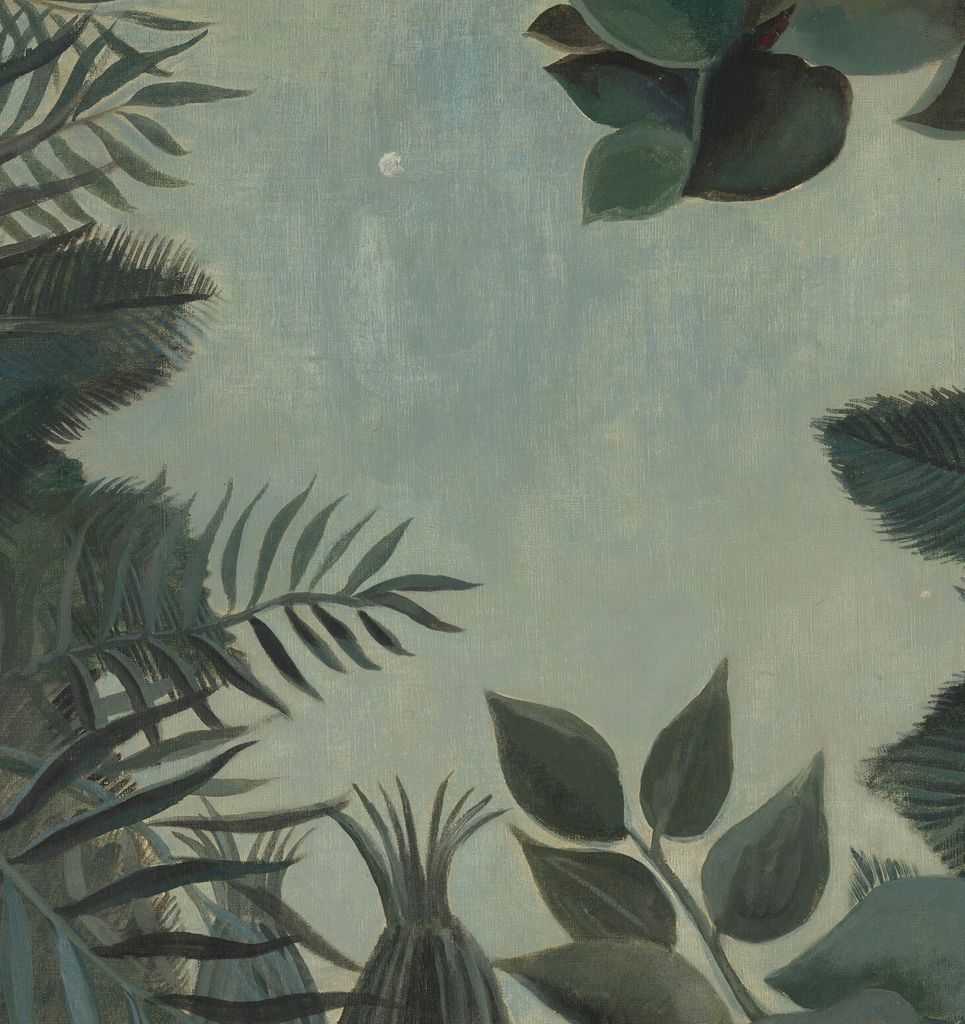
The upright canvas gives the plants room to tower. Broad leaves climb the right side, rounder leaves hang across the top, and thin fronds reach inward from the left. Between them lies a pale, roughly oval opening. Its irregular edges make the sky resemble something glimpsed through a screen held close to the eye. There is no wide horizon to establish the forest’s extent. The view remains enclosed by the growth immediately before us.
That opening offers the eye a moment of rest. Its blue-grey colour is quieter than the surrounding greens, and its relatively empty surface makes the fine silhouettes of branches and leaflets especially clear. A dark spray reaching across it from the left can be followed leaf by leaf. Near the bottom of the opening, a stem bearing several pointed leaves divides the pale space again. Even the clearest part of the picture is gradually being occupied.
Rousseau gives each kind of growth its own rhythm. Long, narrow leaves form fans; small leaflets repeat along slender stems; the rounded leaves overhead appear heavier and more compact. On the right, a tall plant opens into a succession of large, elongated shapes. Their curves establish a broad framework within which the smaller vegetation becomes intricate. Looking across the painting involves changing pace, moving between these readily grasped outlines and much finer networks of lines.
Blue-green, yellow-green and muted grey-green surfaces overlap, with darker intervals separating them. A leaf can be distinguished from its neighbour by a slight change of colour, a pale vein or an edge that turns into shadow. The forest initially reads as a continuous wall, then divides into individual forms. This slow separation prepares us to notice the animals hidden within it.
Finding the two watchers
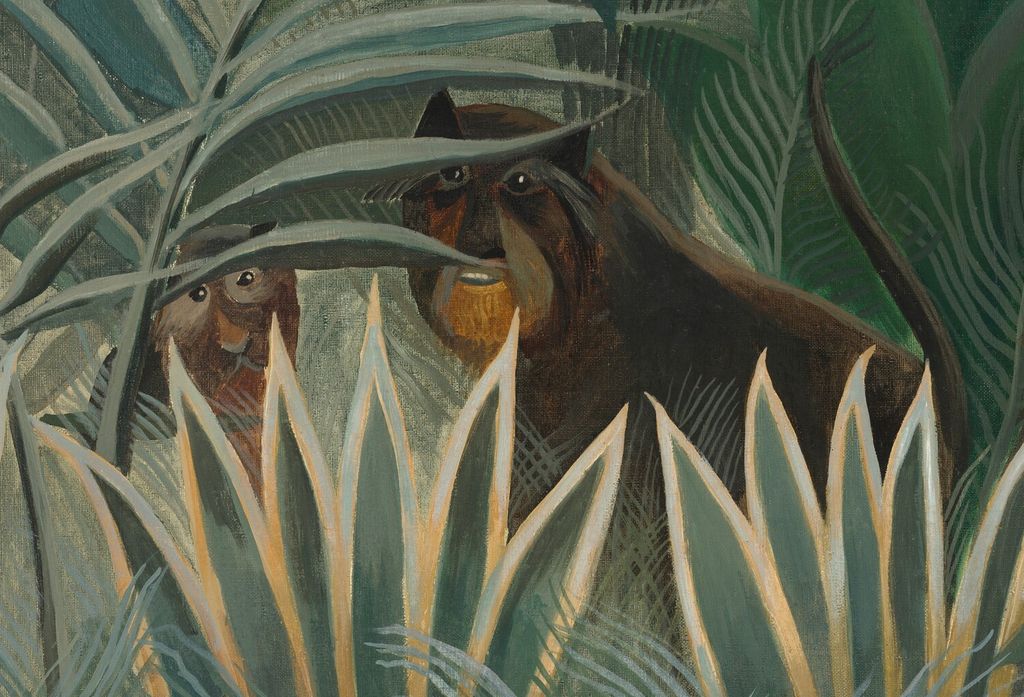
Both animals occupy the lower centre, well below the sky. The larger one extends towards the right, its dark body nearly merging with the surrounding leaves. Its face is more distinct: small black eyes, a long muzzle, pale markings around the mouth and upright, pointed ears. A raised tail helps us trace the body through the foliage. Beside it, to the left, a second and smaller face appears beneath a diagonal frond. The National Gallery describes this creature as perhaps a baby, while leaving the animals’ species unnamed.[1]
Their concealment changes the order in which we see them. The larger animal’s eyes and warm facial colours draw attention first; the smaller face may then appear almost as a discovery within that discovery. Neither body is offered whole and unobstructed. Pale blades rise across them, while the frond passing above their eyes connects their heads to the many diagonal movements elsewhere in the painting. They share the plants’ crowded space.
The eyes have particular force because they interrupt so much patterned growth. Almost every other small mark belongs to a repetition: another leaflet, another vein, another blade of grass. A pair of eyes introduces a different kind of attention. We can spend time examining the forest and then feel that something within it has been looking towards us all along. Their steady gaze sustains the encounter while leaving what happens next unresolved.
The smaller animal’s proximity to the larger one invites a relationship, but the picture leaves it open. Size alone cannot establish parent and offspring, and the surrounding plants make even their bodily positions difficult to read. What remains clear is their shared shelter behind the same foreground screen. The painting’s suspense comes partly from this limited access: we recognise a presence before we can fully describe it.
Flowers, grasses and uncertain scale
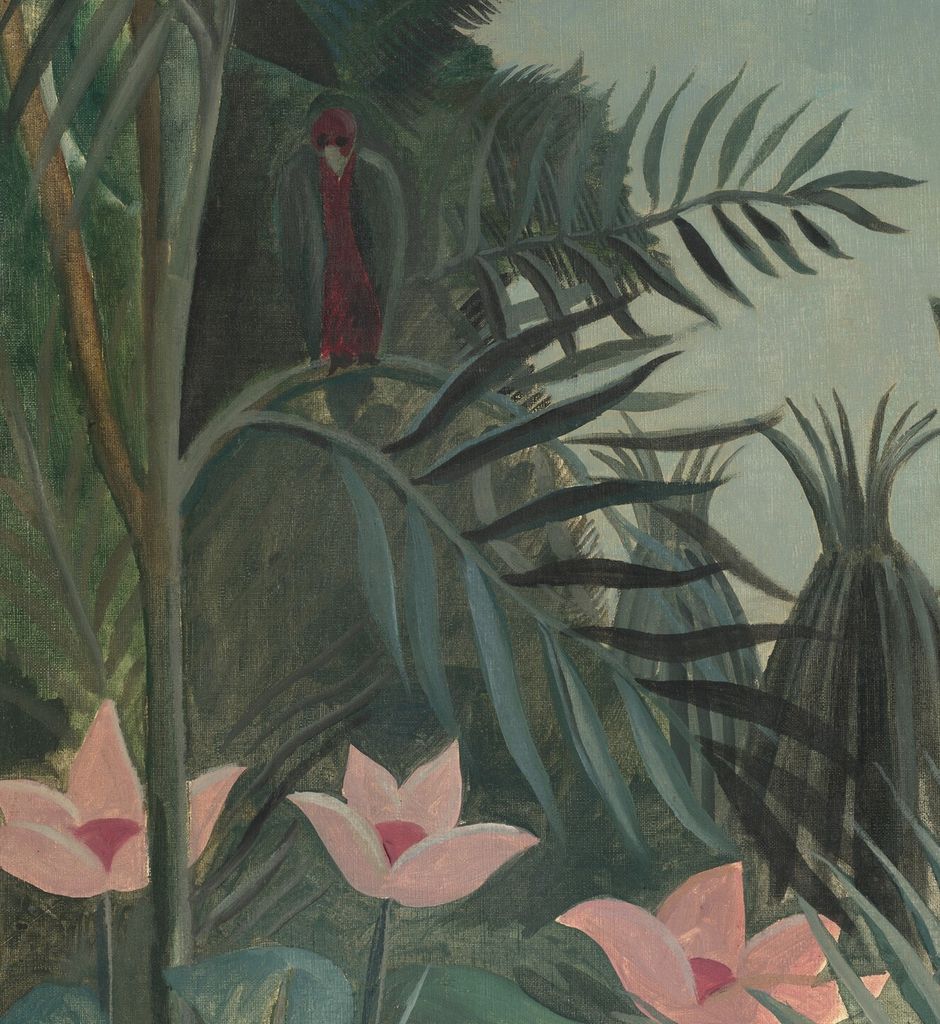
Three pale flowers with pink centres punctuate the left side. Their thin stems rise through a much denser field of leaves, holding the flower heads apart so that each can be seen clearly. Above them sits a small red bird, nearly absorbed into the darker vegetation. The bird is a second, more secluded discovery, away from the animals and much higher in the picture. Its narrow red shape provides a warm accent against the surrounding green.[1]
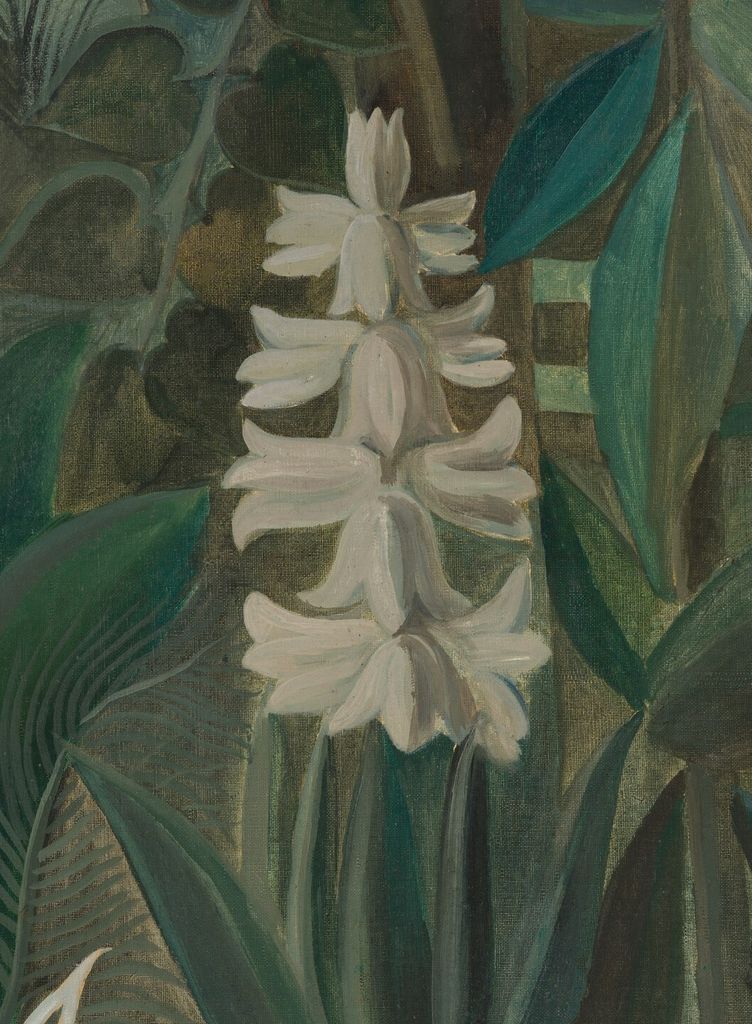
On the right, a tall white flower cluster commands a larger area. The National Gallery calls it an oversized white hyacinth.[1] Its light blossoms are easy to see even at a distance, and their stacked arrangement reinforces the canvas’s upward movement. The flower stands beside the animals without sharing their obscurity. Moving between its white forms and their partly hidden faces makes the differences in visibility especially striking.
Scale becomes difficult to settle. The broad leaves seem enormous beside the heads below them, yet there is no human figure, familiar building or open stretch of ground to supply a dependable measure. The white flower can look monumental; the animals can seem unusually small. These impressions shift as attention moves from one form to another. Rousseau’s arrangement allows the same forest to feel intimate in its details and immense in its proportions.
The foreground grasses intensify that effect. Their pale blades rise in pointed clusters, with yellow and orange touches near the bases. Across these sharp forms runs another, finer pattern of curving lines. Against the broad, comparatively solid leaves behind them, the grasses look almost combed into separate strands. Their detailed surface holds us close to the front of the painting, while the animals remain just beyond it.
There is a route for the eye through this abundance: flowers, faces, sky and back to the pale grasses. A physical passage through the forest is much harder to imagine. The bottom edge is occupied by growth, and successive layers continue to obstruct the space beyond. The painting makes movement available through looking. Its crowded surface keeps returning us to the task of distinguishing one shape from the next.
Annotated Details from The Equatorial Jungle
The numbered points identify visible features discussed in this article. Return from each detail to the whole composition. Henri Rousseau, The Equatorial Jungle, 1909. National Gallery of Art, Washington, 1963.10.213. Chester Dale Collection. Image source. CC0 / Public domain. Numbers added to the overview; detail views cropped from the original. No recolouring or retouching.
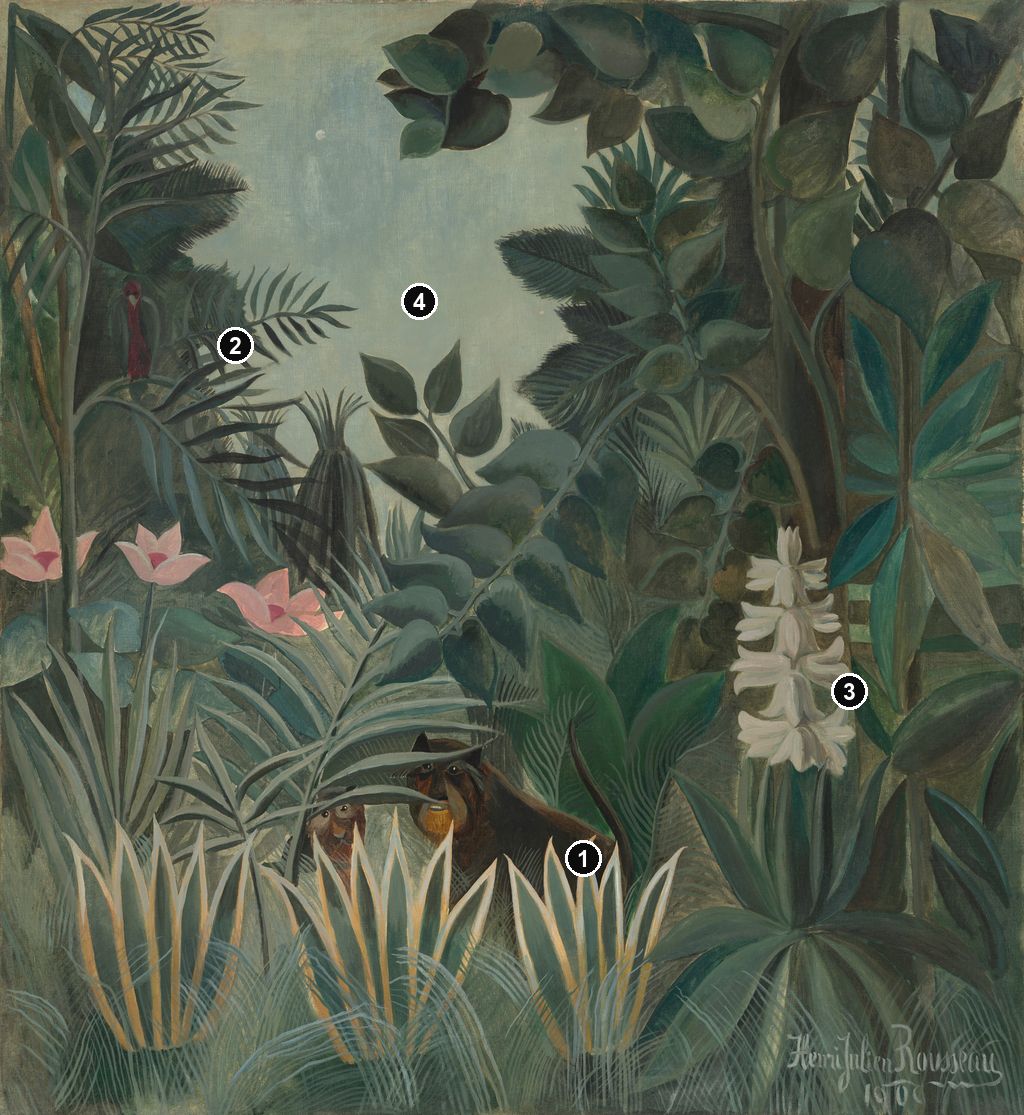
Details from THE EQUATORIAL JUNGLE
Compare the partly hidden faces with the bird, flowers and opening of sky that divide the surrounding vegetation.
Two faces behind the grasses
Two pairs of eyes emerge behind overlapping blades and a broad frond. The larger face sits higher, while the smaller one is more deeply interrupted by the foreground growth.
A red bird above pink flowers
A narrow red bird perches among dark stems above the pink flowers. Its small vertical shape is easy to lose beside the much larger leaves.
White flowers beside broad leaves
A pale upright flower spike stands against darker greens. Its repeated curved petals contrast with the broad pointed leaves that enclose it.
An opening filled with silhouettes
A pale area of sky opens between the plants, but narrow fronds and stems continue across it. Small leaves remain individually visible against this quieter ground.
An equatorial forest imagined in Paris
The title suggests a distant climate without locating a particular country. Rousseau’s resources were available in Paris. The Musée de l’Orangerie describes his visits to the natural-history museum and the Jardin des Plantes glasshouses, alongside his use of press illustrations and the exotic imagery circulated through colonial exhibitions. Its 2026 account also records that Rousseau acknowledged in 1910 that he had never left France.[12] The word “equatorial” therefore opens an imaginative geography whose plants and inhabitants need not belong to a single observed place.
This Parisian background includes the ways distant nature was selected and displayed for metropolitan audiences. Tropical plants could be studied under glass; animals could be encountered as museum specimens; printed images brought other environments into the studio. Colonial exhibitions gave such imagery a public setting shaped by the presentation of empire. These were mediated encounters, furnishing a painter with forms he could detach from their original surroundings and combine anew.[12]
The Musée Maillol’s 2019 exhibition dossier describes that combining process across Rousseau’s jungles. It identifies the Galeries Lafayette Bêtes sauvages album among his resources and discusses his shifts of scale, crowded spaces and assemblages of plants and animals that do not naturally coexist.[13] This explains a broader working repertoire; it does not identify an exact printed model for either animal in The Equatorial Jungle.
Here, the freedom to recombine becomes visible in the relationships between forms. The white blossoms, dark faces, long grasses and heavy upper leaves each retain a strong outline, while their overlaps unite them. Readers exploring Rousseau’s wider jungle paintings will find other balances of animals and vegetation. This canvas places particular weight on concealment, allowing a quiet encounter to develop within an almost continuous field of growth.
The signature and the painting’s journey
At the lower right, pale lettering gives the name “Henri Julien Rousseau” and the date 1909.[1] The inscription occupies a densely worked corner, among the fine grasses and dark green leaves. Its light strokes stand out against that setting while remaining close in colour to the pale blades elsewhere. After the searching movement required by the rest of the picture, the signature supplies a comparatively direct statement of authorship and date.
The painting’s subsequent history begins with Robert Delaunay, who received it from Rousseau. The National Gallery lists Paul Guillaume as a possible owner, based on a photograph in an album that belonged to the dealer. The work then passed through Ambroise Vollard. Juliana Force bought it in 1925 and returned it to him that year; the published provenance gives no reason. Galerie Étienne Bignou sold it to Chester Dale in 1928, and Dale’s bequest brought it to the National Gallery in 1963.[1]
Its exhibition history traces changing settings for this enclosed forest. It appeared in the 1928 Wildenstein Galleries benefit exhibition for the French Hospital of New York, as number 35, and in Washington’s 1965 presentation of the Dale bequest. For Henri Rousseau: Jungles in Paris in 2005–06, it was shown only at the Washington venue. It also appeared in the National Gallery’s Dale collection exhibition of 2010–12.[1] These appearances brought the painting before audiences both as part of a collector’s holdings and within a concentrated study of Rousseau’s jungles.
A horizontal forest beside the upright one
Rousseau’s Tropical Forest with Monkeys, painted in 1910, offers a useful comparison. Also at the National Gallery, it measures 129.5 × 162.5 cm and entered the collection through the John Hay Whitney gift in 1982. Its horizontal format spreads five monkeys across a broader field, beneath a comparatively open band of pale sky.[14] The two works share an institution today through separate collecting histories.
In the horizontal painting, the animals occupy several levels. Two appear among branches on the left, two orange figures hang higher on the right, and a large brown monkey sits below. The viewer can move laterally between these separate positions. In The Equatorial Jungle, both animals are gathered low in the composition, while the leaves rise above them. Attention alternates between a single concentrated encounter and the height of the enclosing plants.
The skies also change the experience. The horizontal picture opens across its upper width, permitting the vegetation to stand against a continuous light background. The 1909 canvas holds its patch of sky within a border of leaves. Seen together, the paintings show how strongly format and placement govern our sense of access. One distributes living figures across a wide expanse; the other makes two small faces emerge from a close, upright screen.
Henri Rousseau artworks directory
This directory brings together works covered on this site and other works documented in the cited museum records and catalogues. Alternate titles share one entry; distinct versions remain separate. Historical dates for works without an article follow the cited catalogues. This is not a catalogue raisonné.
Frequently Asked Questions
The painting is signed and dated 1909 at the lower right.[1]
Two partly concealed animals appear near the lower centre, and a small red bird sits above the pink-centred flowers on the left. The National Gallery does not identify the two larger animals’ species; it cautiously suggests that the smaller might be a baby.[1]
It belongs to the National Gallery of Art in Washington, as part of the Chester Dale Collection, accession 1963.10.213.[1]
Rousseau never left France. His jungle imagery drew on Parisian glasshouses, natural-history displays, illustrations and the exotic imagery of colonial exhibitions.[12]
Discussion
Look again at the images and ideas explored in The Equatorial Jungle. These editorial prompts invite your observations.
Reader Insights
Which did you notice first: the two faces, the flowers or the opening of sky? How did that first discovery shape the rest of your looking?
How does the white flower affect your sense of the animals’ size?
Compare the upright canvas with Tropical Forest with Monkeys. Where does each painting allow your eye to move most freely?
Join the Conversation
Share a detail, comparison or question about The Equatorial Jungle below.
References
- National Gallery of Art. The Equatorial Jungle, 1909, accession 1963.10.213, current collection record, visual description, provenance notes and exhibition history, accessed 23 October 2026. View source.
- Philadelphia Museum of Art, Carnival Evening,1963-181-64,object59593. View source.
- Musée de l’Orangerie / Juliette Degennes, Henri Rousseau,L’ambition de la peinture: Un artiste dans son époque (in French). View source.
- National Gallery, Surprised!, NG6421. View source.
- Musée d’Orsay, La Guerre,RF19461 (in French). View source.
- MoMA, The Sleeping Gypsy. View source.
- Philadelphia Museum of Art, The Merry Jesters, 1950-134-176, object51097. View source.
- Musée d’Orsay, La Charmeuse de serpents, RF 1937 7 (in French). View source.
- Musée de l’Orangerie, La Carriole du Père Junier, RF 1960 26 (in French). View source.
- Solomon R. Guggenheim Museum / Cornelia Lauf, The Football Players,60.1583: current collection record. View source.
- MoMA, The Dream, 252.1954. View source.
- Musée de l’Orangerie. Henri Rousseau, l’ambition de la peinture, exhibition texts, 25 March–20 July 2026, section “Un style à soi,” accessed 23 October 2026. View source. (in French).
- Musée Maillol. Du Douanier Rousseau à Séraphine: Les grands maîtres naïfs, press dossier, 2019, section 6, “Les Bêtes sauvages des Galeries Lafayette,” printed p. 17. View source. (in French).
- National Gallery of Art. Tropical Forest with Monkeys, 1910, accession 1982.76.7, current collection record, visual description and provenance, accessed 23 October 2026. View source.
- The Museum of Modern Art, Henri Rousseau: Essays (1985), selected catalogue entries, chronology and notes on early devotees. View source. Selected entries, chronology (pp.91–95) and early-devotee notes (pp.262–264) were consulted. Historical collection credits do not establish present ownership.
- Daniel Catton Rich, Henri Rousseau (The Museum of Modern Art, 1942), selected drawings and landscape studies; historical catalogue. View source. The dated 1942 publication is used for the two Quai d’Auteuil ink views; its Malakoff date differs from the 1985 catalogue.
- MANAS, Laval, Henri Rousseau, dit le Douanier, urban landscapes and preparatory study (in French). View source.
- National Gallery of Art, Self-Portrait (1895), pen-and-ink drawing, accession 1995.47.66. View source.
- The Museum of Modern Art, War (published January 1895), lithograph, accession 684.1943. View source.
- Barnes Foundation, Landscape and Four Young Girls, object 5521, BF855. View source.


 Henri Rousseau.jpg)


 Henri Rousseau.jpg)