



 by Tom Gurney
Tom Gurney BSc (Hons) is an art history expert with over 20 years experience
Published on June 19, 2020 / Updated on October 29, 2026
Email: tomgurney1@gmail.com / Phone: +44 7429 011000
The Eiffel Tower: Introduction
Henri Rousseau gives the Eiffel Tower a surprisingly small place in a spacious river landscape. Beyond a bridge picked out with warm lights, its narrow silhouette rises into an opening in the clouds. Water fills the foreground; dark trees crowd the banks. Painted about 1898, this oil on canvas measures 52.4 × 77.2 cm and belongs to the Museum of Fine Arts, Houston, as a gift of Audrey Jones Beck.[1] Its distant landmark rewards a slow approach through the painting, past the river traffic and the people beside the water.
At a Glance
- ArtistHenri Rousseau
- SubjectThe Eiffel Tower
- ExploreFollowing the river into the picture; The bridge and the tower
This work across Henri Rousseau’s career
Carnival Evening
1886 [2]The Merry Jesters
1906 [7]The Snake Charmer
1907 [8]Contents
- Following the river into the picture
- The bridge and the tower
- A sky built from long bands
- Small lives beside a large expanse
- Modern Paris within an everyday landscape
- Which Eiffel Tower painting is this?
- Annotated details
Following the river into the picture
The river opens towards us in a broad, pale expanse. Low embankments run diagonally inward from the bottom corners, narrowing the water towards the bridge. These long edges make the foreground easy to enter: the eye can follow either bank into the distance. Their convergence also establishes the position of the tower, which stands close to the centre of the opening. The famous structure is small, yet the surrounding landscape continually directs attention towards it.
Rousseau gives the two banks different weights. On the left, a pale building with a dark roof projects beside the water. A thin chimney rises from it, and dark horizontal forms lie close to its foot. On the right, an almost continuous line of foliage rises above irregular tan mounds and a walkway. The building interrupts the left bank with a firm rectangle; the right bank proceeds through slopes, rounded forms and scattered figures. This unevenness keeps the strong central arrangement from becoming a mirror image.[1]
There is also a difference between the river's shape and its painted surface. The banks lead rapidly backwards, while the water spreads sideways in long strokes of pale blue, cream and pink. Those horizontal bands slow the passage into depth. The river becomes a substantial presence in its own right, broad enough to make the bridge and tower seem far away. Looking across this quiet surface takes time, even though the route through the composition is so clear.
The bridge and the tower
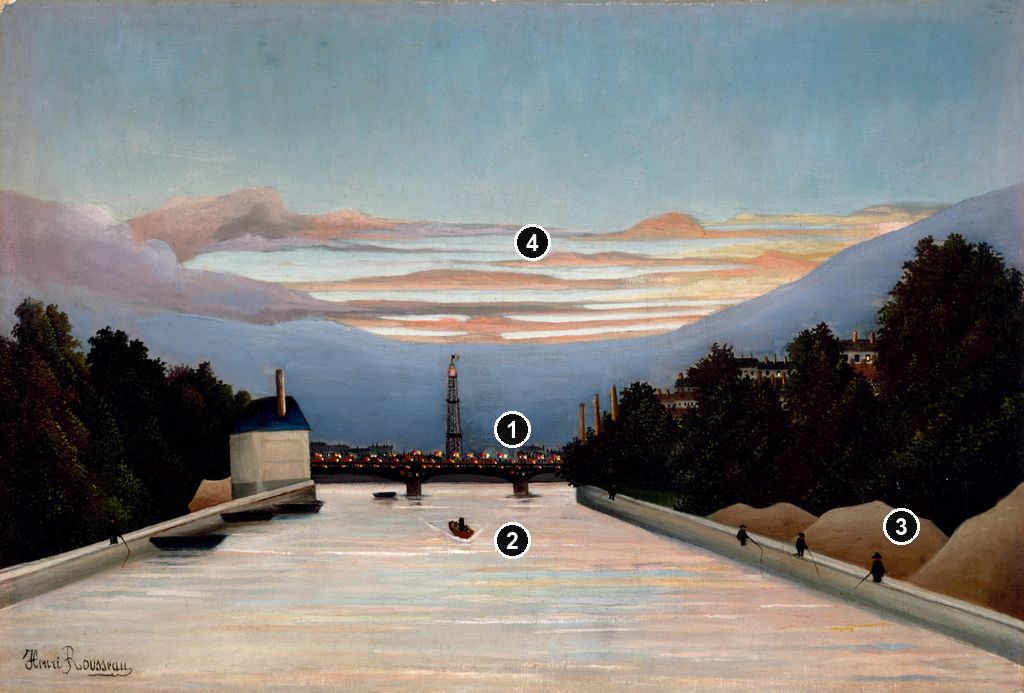
The bridge forms a dark bar across the far end of the river. Its arches open beneath a line of small red, orange and yellow touches. Against the dark trees, these bright points are unusually distinct. They draw a horizontal line through the composition immediately below the tower, making the distant crossing one of the most active passages in an otherwise restrained scene. The arches allow the water to appear to continue beyond this boundary.[1]
Above them, the tower rises as a slender succession of dark structural sections. A tiny warm mark near the top answers the brighter touches along the bridge. Its base is absorbed into the busy strip of the distant city, so that the visible tower seems to emerge from the lights. There is little surrounding detail to compete with its outline against the sky. Its recognisability allows Rousseau to make it a small element without losing it among the landscape's other verticals.
The chimney on the left helps us notice how carefully these vertical accents are distributed. It is nearer, plainer and offset from the centre. The tower is farther away and more intricate. Trees rise on both sides, with buildings appearing among the right-hand foliage. Across these changes of scale, the eye moves between ordinary structures and the celebrated landmark. The Eiffel Tower belongs to the same continuous view as the modest building, the bridge and the riverbanks.
A sky built from long bands
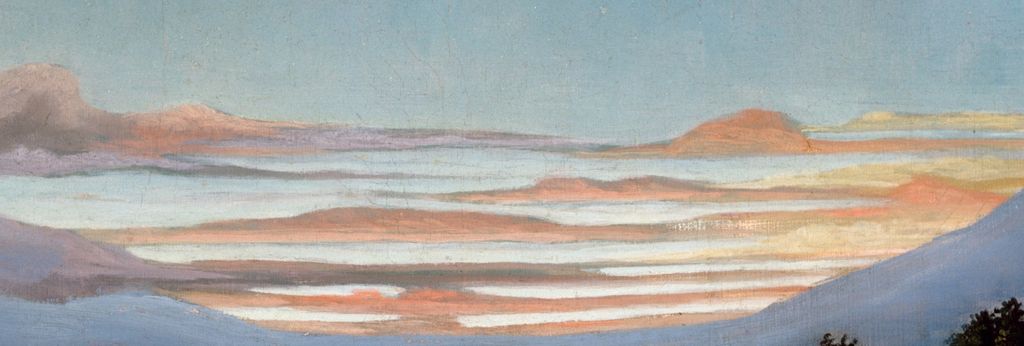
The sky occupies a large part of the canvas, and its structure is as distinctive as the river below. Blue-grey clouds slope down towards a warm opening near the horizon. Across that opening, pale strips alternate with orange and muted pink. Their long, uneven edges extend almost horizontally behind the tower. Higher up, the sky becomes a broader, cooler field, giving the brighter lower bands room to register.[1]
The clouds create a second opening within the one made by the trees. Dark foliage encloses the water from the sides; cloud masses enclose the warm sky above the bridge. Both arrangements concentrate attention near the distant centre. The tower stands where these two framed spaces meet. Its thin upright is particularly effective here because so much of the surrounding paint runs sideways, across clouds, bridge and water.
Colour connects the upper and lower halves of the picture. The pale warmth of the cloud opening returns in the river's pink and cream streaks, while the cooler sky finds an answer in blue-grey passages across the water. These correspondences give the scene an evening-like atmosphere without requiring a precise hour. The broad river remains luminous beneath the dark banks. Even the tan mounds on the right contribute to this distribution of light, forming a chain of pale shapes below the trees.
The clouds contain some of the painting's strongest suggestions of movement. Their layered edges seem to stretch across the still landscape, drawing attention away from the central axis and towards the width of the canvas. As the eye returns from one side to the other, the tower reappears as a fixed point within this changing sky.
Small lives beside a large expanse
A tiny boat occupies the central water below the bridge. Its dark shape and small upright accent interrupt the pale surface, establishing a scale that the river's broad bands alone would leave uncertain. On the right bank, separate dark figures stand along the walkway. Their spacing carries the eye from the foreground towards the trees and the distant crossing. A small figure also appears along the left bank.[1]
These people make the setting feel accessible. There are places to stand and a route to follow beside the water. Yet the figures are too small to become individual portraits or to give the scene a single dominant incident. We can register human presence while continuing to take in the larger arrangement. The open water between the banks acquires much of its breadth from the contrast with these small bodies.
The tan mounds beside the right-hand path have another role in this sense of scale. They separate the figures from the dark vegetation, making the little silhouettes easier to see. Their irregular outlines also soften the transition between the straight embankment and the uneven trees. The bank feels occupied and varied, although Rousseau leaves the activities of its people largely open to the viewer.
Annotated Details from The Eiffel Tower
The numbered points identify visible features discussed in this article. Return from each detail to the whole composition. Henri Rousseau, The Eiffel Tower, c.1898. Museum of Fine Arts, Houston, 98.299. John A. and Audrey Jones Beck Collection, gift of Audrey Jones Beck. Photograph: Jud Haggard / Museum of Fine Arts, Houston, via Wikimedia Commons. Image source. Public domain. Numbers added to a separate resized overview. Details cropped from the published original without enlargement, recolouring or retouching.
Details from THE EIFFEL TOWER
Look from the distant tower and bridge to the boat, riverbank figures and horizontal cloud bands.
A tower rising from the bridge lights
The tower’s narrow structure rises above a dark bridge picked out in warm touches. Its thin upright answers the small lights while contrasting with the long horizontal opening beneath the clouds.
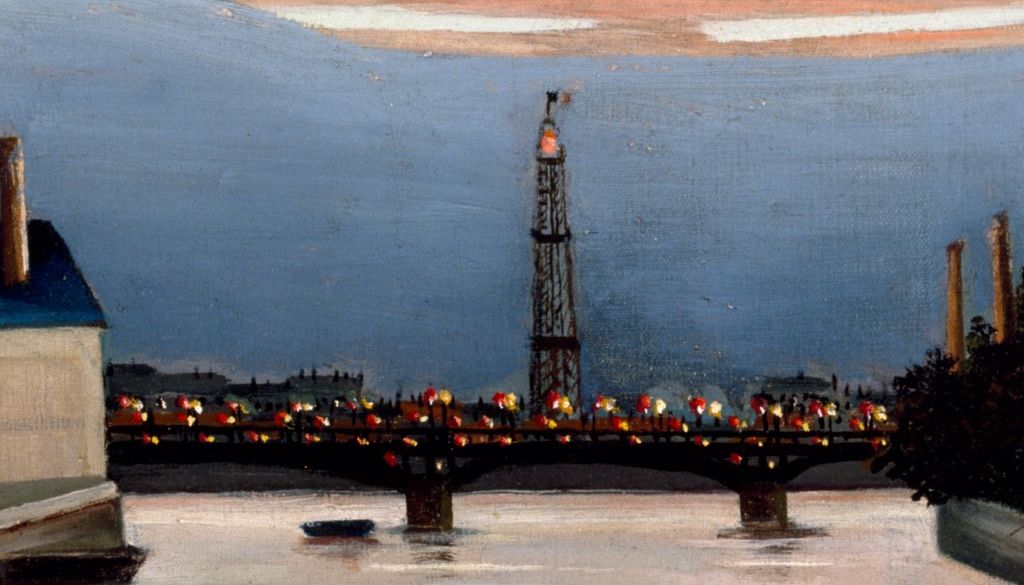
A boat within the open water
A small dark boat interrupts the broad pale river. Light marks beside it give the water a local movement within the much longer horizontal bands that spread across the painting.
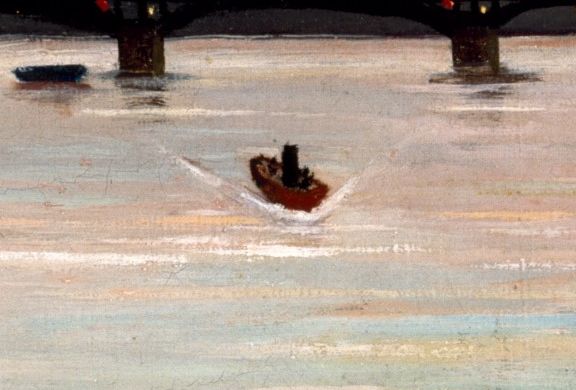
Small figures along the embankment
Dark figures and slender lines follow the right-hand embankment. Their small scale gives the pale river its breadth, while tan mounds separate them from the dense trees.
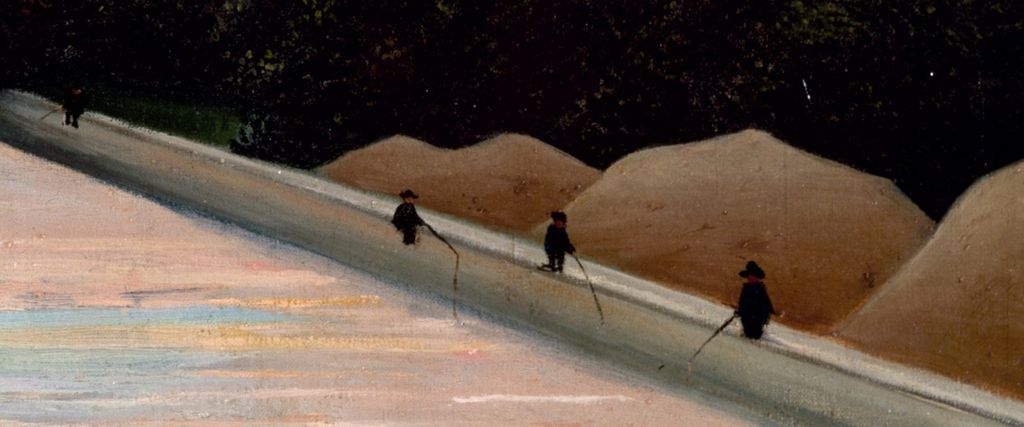
Warm strips within the cool sky
Long pink, cream and muted orange strips open between the cooler cloud masses. Their horizontal rhythm returns in the pale bands of the river below.
Modern Paris within an everyday landscape
The tower had been built for the Paris Exposition of 1889. In its exhibition Artists on the edges of Paris, the Pola Museum of Art places Rousseau's interest in the structure alongside his curiosity about steel bridges, airships and light aeroplanes. It also emphasises his attraction to the changing outskirts of the city.[12] That context helps explain why an urban monument can appear within a scene so strongly shaped by trees, open sky and water.
Here, modern structures are distributed across the view. The bridge carries a line of lights; the chimney marks a low building; rooftops interrupt the foliage; the tower punctuates the horizon. Their different sizes and positions make the city present throughout the landscape. Nature and construction meet along both banks. The dense trees provide the dark setting in which the small lights become visible, while the embankments give the river its emphatic narrowing shape.
The Musée de l'Orangerie's account of Rousseau's practice describes an artist drawing on his observations during walks around a Paris in transformation. It also places his varied landscapes and formats within his efforts to reach buyers with modest budgets and interiors.[13] This wider practice brings everyday views into focus as a substantial part of his work. In the Houston picture, attention passes easily from the celebrated tower to the uncelebrated riverbank building, from the lit bridge to a person standing beside a mound. Each helps make the particular landscape.
Which Eiffel Tower painting is this?
Rousseau painted more than one view involving the landmark. The Pola Museum of Art's exhibition identifies its own View of the Eiffel Tower and the Trocadéro, dated 1896–98, as a work in that collection.[12] Readers following the related Seine and Eiffel Tower in the Sunset will encounter that separate painting. The Houston canvas discussed here is identified by its broad foreground river, distant illuminated bridge, central boat and small tower framed by dark banks.
Henri Rousseau artworks directory
This directory brings together works covered on this site and other works documented in the cited museum records and catalogues. Alternate titles share one entry; distinct versions remain separate. Historical dates for works without an article follow the cited catalogues. This is not a catalogue raisonné.
Frequently Asked Questions
The museum-supplied record dates the Houston painting to about 1898. The date is approximate.[1]
It belongs to the Museum of Fine Arts, Houston. Its credit line identifies it as a gift of Audrey Jones Beck.[1]
It is oil on canvas, measuring 52.4 cm high by 77.2 cm wide, without its frame.[1]
They are separate works. The Pola collection's painting is titled View of the Eiffel Tower and the Trocadéro and was dated 1896–98 in the museum's 2016–17 exhibition.[12]
Discussion
Look again at the images and ideas explored in The Eiffel Tower. These editorial prompts invite your observations.
Reader Insights
Does the tower's small size make you notice it more or less? Which surrounding shapes first draw your eye towards it?
How would the scene's atmosphere change if the bridge's warm lights were removed?
Follow the riverbanks towards the distance, then follow the horizontal bands of water and cloud. How do these two movements affect your experience of space?
Join the Conversation
Share a detail, comparison or question about The Eiffel Tower below.
References
- The Museum of Fine Arts, Houston, via Google Arts & Culture. The Eiffel Tower — Henri Rousseau, undated museum-supplied object record, “Details” fields and supplied artwork image; accessed 23 October 2026. View source.
- Philadelphia Museum of Art, Carnival Evening,1963-181-64,object59593. View source.
- Musée de l’Orangerie / Juliette Degennes, Henri Rousseau,L’ambition de la peinture: Un artiste dans son époque (in French). View source.
- National Gallery, Surprised!, NG6421. View source.
- Musée d’Orsay, La Guerre,RF19461 (in French). View source.
- MoMA, The Sleeping Gypsy. View source.
- Philadelphia Museum of Art, The Merry Jesters, 1950-134-176, object51097. View source.
- Musée d’Orsay, La Charmeuse de serpents, RF 1937 7 (in French). View source.
- Musée de l’Orangerie, La Carriole du Père Junier, RF 1960 26 (in French). View source.
- Solomon R. Guggenheim Museum / Cornelia Lauf, The Football Players,60.1583: current collection record. View source.
- MoMA, The Dream, 252.1954. View source.
- Pola Museum of Art. Artists on the edges of Paris: Le Douanier Rousseau, Foujita, and Atget, 2016–17, introduction and Section I, “Rousseau and Picasso: the transformation of urban Paris,” including the View of the Eiffel Tower and the Trocadéro caption; accessed 23 October 2026. View source.
- Musée de l'Orangerie. Henri Rousseau, l'ambition de la peinture, exhibition texts, 25 March–20 July 2026, “Variations et déclinaisons. À la recherche du marché”; accessed 23 October 2026. View source. (in French).
- The Museum of Modern Art, Henri Rousseau: Essays (1985), selected catalogue entries, chronology and notes on early devotees. View source. Selected entries, chronology (pp.91–95) and early-devotee notes (pp.262–264) were consulted. Historical collection credits do not establish present ownership.
- Daniel Catton Rich, Henri Rousseau (The Museum of Modern Art, 1942), selected drawings and landscape studies; historical catalogue. View source. The dated 1942 publication is used for the two Quai d’Auteuil ink views; its Malakoff date differs from the 1985 catalogue.
- MANAS, Laval, Henri Rousseau, dit le Douanier, urban landscapes and preparatory study (in French). View source.
- National Gallery of Art, Self-Portrait (1895), pen-and-ink drawing, accession 1995.47.66. View source.
- The Museum of Modern Art, War (published January 1895), lithograph, accession 684.1943. View source.
- Barnes Foundation, Landscape and Four Young Girls, object 5521, BF855. View source.


 Henri Rousseau.jpg)


 Henri Rousseau.jpg)