



 by Tom Gurney
Tom Gurney BSc (Hons) is an art history expert with over 20 years experience
Published on June 19, 2020 / Updated on October 29, 2026
Email: tomgurney1@gmail.com / Phone: +44 7429 011000
The Barnyard: Introduction
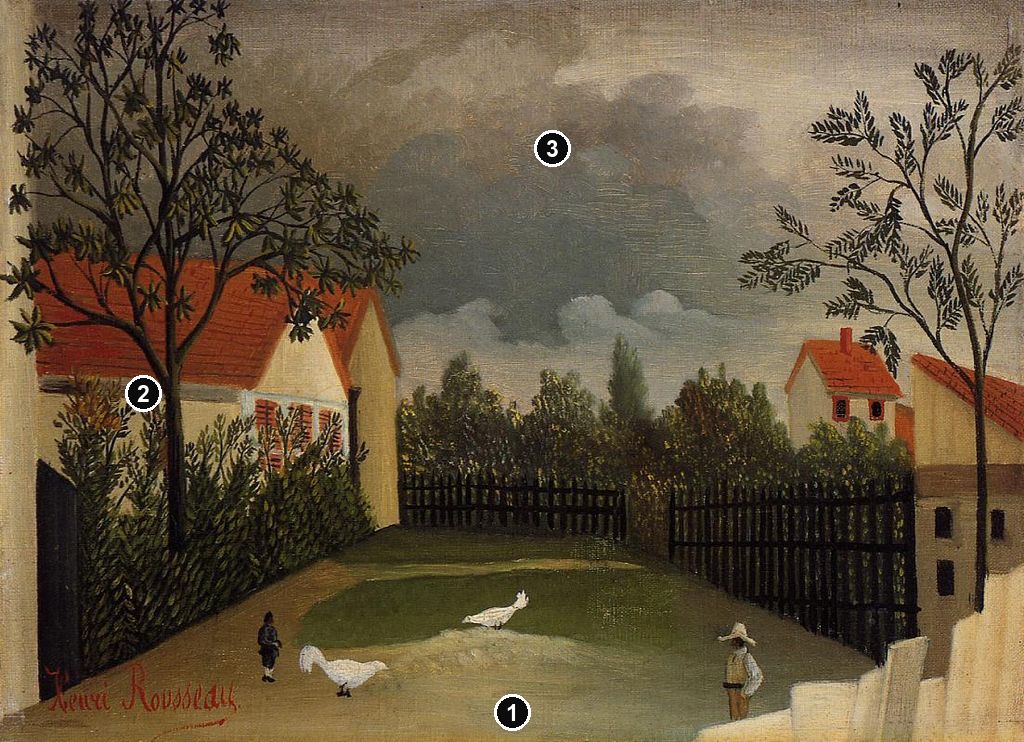
Two white birds occupy the open ground in Henri Rousseau’s The Barnyard, while two tiny people stand near the edges of their enclosure. Red roofs, black fences and branching trees give this unassuming yard a firm structure beneath an immense grey sky. The Centre Pompidou records the painting as La Basse-cour, dates it to 1896–98 and identifies it as an oil on canvas measuring just 24.6 × 32.9 cm. Its small dimensions make the breadth of that sky, and the carefully divided space below it, especially striking.[1]
At a Glance
- ArtistHenri Rousseau
- SubjectThe Barnyard
- ExploreA yard shaped by its boundaries; Birds and people on the same ground
This work across Henri Rousseau’s career
Carnival Evening
1886 [2]The Barnyard (current article)
1896–1898 [1]The Merry Jesters
1906 [7]The Snake Charmer
1907 [8]Contents
- A yard shaped by its boundaries
- Birds and people on the same ground
- Houses, trees and the weight of the sky
- An intimate scale
- The Kandinsky connection
- Annotated details
A yard shaped by its boundaries
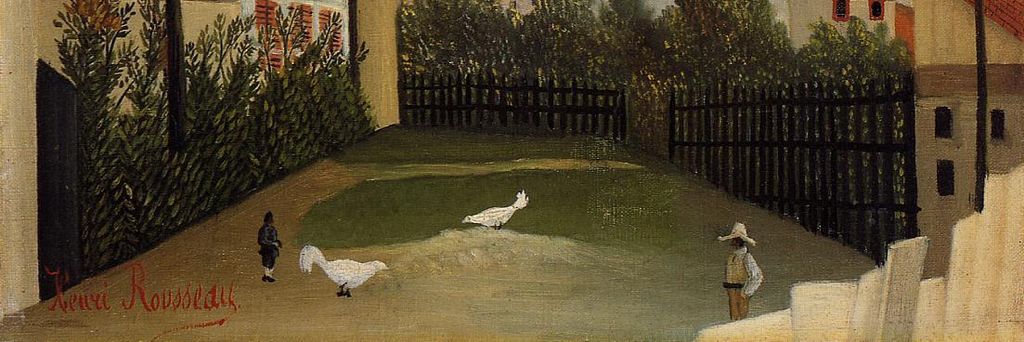
The foreground opens into a shallow, bowl-like space. Bare earth surrounds an oval patch of green, with a broad pale area spreading across the ground nearest the viewer. Along the left, a curved path follows the vegetation towards the back fence. Its sweep provides an easy route into the picture: the eye can travel around the green patch without encountering a dominant figure or a dramatic event. The yard itself becomes the principal subject, held together by its edges and the few living forms placed within it.
At the back, the black pickets make a nearly continuous band, interrupted near the centre. Their repeated verticals give the enclosure a measured rhythm. On the right, another run of fencing angles towards the foreground, its stakes becoming taller as they approach. This diagonal helps us gauge the depth of the yard. At the same time, the emphatic dark bars remain conspicuous on the picture’s surface, almost as legible as the outlines of the buildings. Rousseau makes a fence serve both as an everyday boundary and as a strong graphic pattern.
The pale wall at the lower right introduces a different kind of barrier. Its stepped upper edge cuts across the ground and conceals part of the nearby person. We appear to be looking into an enclosed place from beyond its immediate boundary. The contrast between this solid, light-coloured wall and the open black pickets gives the foreground particular force. One boundary blocks our view; the other lets us see vegetation between its narrow uprights. Together they turn an otherwise simple patch of ground into a succession of overlapping spaces.
Birds and people on the same ground
The two birds are the brightest small forms in the yard. The nearer bird, left of centre, bends its long neck towards the earth; the other, farther back beside the green patch, holds its head up. Their different poses animate the open space without disturbing its quiet. They also give the viewer two successive points to follow into the scene. Against the muted brown and green ground, their white bodies are unusually easy to find, even in a small reproduction.[1]
The people take longer to notice. A dark figure stands at the left, near the bent-necked bird, while a second figure with a pale hat occupies the right foreground. Their separation leaves the centre largely to the birds and the ground around them. Neither person is developed as a portrait with a readable expression. Instead, a few contrasts of clothing, posture and scale establish human presence. The person at the right is partly hidden by the wall, which makes the enclosure feel like a place continuing beyond what the viewer can see.
These four occupants do not combine into an obvious story. The image gives us no clear exchange between the two people and no conspicuous action around which to organise the scene. Its interest lies in their shared space: bodies stand, bend or lift a head within a network of paths and boundaries. Looking from one to another reveals how widely Rousseau has distributed the activity. A yard that first appears almost empty begins to feel inhabited, though its inhabitants remain small beside the houses, fences and sky.
Houses, trees and the weight of the sky
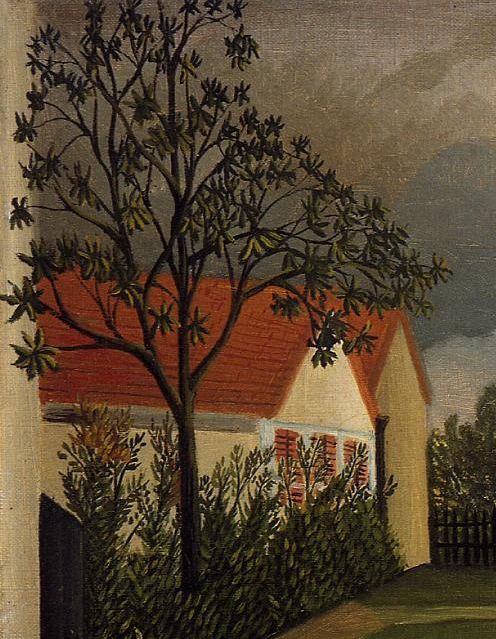
A cream building presses close to the left edge. Its broad red roof is screened by a tree whose trunk rises through the foreground planting. Red shutters and dark window openings mark out smaller rectangles below. Across the yard, pale houses carry further red roofs, one set farther back behind the right-hand fence. These warm roof shapes punctuate a scene dominated by earth colours, black and green. Their sloping edges also answer the curve of the path and the receding fences, giving the enclosure several different directions of movement.
The trees on either side rise beyond the roofs. Their thin, dark branches spread across the pale and grey sky, carrying separate clusters of leaves. The left tree is fuller and more tangled; the right tree is more open, with longer intervals between its sprays of foliage. This unequal framing keeps the composition from becoming rigidly symmetrical. Both trees make the space feel sheltered at ground level, while their branching silhouettes draw attention upwards, away from the small occupants of the yard.
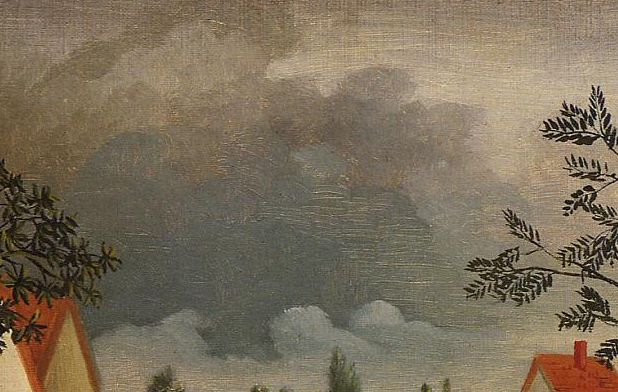
Between them, a great bank of cloud occupies much of the upper field. Its dark central mass lowers towards the distant treeline, with lighter rounded forms beneath and a paler opening above. The broad cloud shapes contrast with the fine divisions of leaves, pickets and shutters. As the eye moves upwards, the scale of the painting changes: a world of small, countable details gives way to a much larger, less easily measured expanse. This change helps a modest canvas convey a surprising sense of breadth.
The cloudy sky lends the scene gravity while the yard below remains still. The clouds work through their size, tone and position, pressing against the upward reach of the trees and setting off the roofs below. Rousseau’s red signature appears low on the left, close to the earth and vegetation; the museum records the inscription there as “Henri Rousseau.” It forms a final small accent in the lower part of this densely organised view.[1]
Annotated Details from The Barnyard
The numbered points identify visible features discussed in this article. Return from each detail to the whole composition. Henri Rousseau, The Barnyard (La Basse-cour), 1896–1898. Centre Pompidou, Musée national d’art moderne, AM 81-65-860. Published reproduction via Wikimedia Commons. Public-domain reproduction via Wikimedia Commons. Image source. Public domain. Numbers added to a separate resized overview. Broad details cropped from the published original without enlargement, recolouring or retouching.
Details from THE BARNYARD
Compare three broad views of the enclosure, house and sky, noticing how the birds and people share the space beneath the clouds.
An enclosure shared by birds and people
Two white birds and two small people occupy separate points around the pale ground. Dark fence stakes and the foreground wall hold them within a shared enclosure; the right figure remains partly hidden as in the complete painting.
A house screened by branches
The left tree spreads across the red roof and pale wall. Separate leaves, shutter shapes and dark window openings turn an ordinary house into a layered pattern of warm colour and dark marks.
A broad cloud above the roofs
The grey cloud forms a large solid mass between the trees. Its rounded lower shapes and pale upper opening change the scale of the view, above the small roofs and fenced yard.
An intimate scale
The Barnyard’s measurements matter to the experience of looking. At less than thirty-three centimetres wide, the painting gathers its fence stakes, windows, leaves and small figures into a space suited to close attention. From farther away, the main divisions assert themselves: dark cloud, warm roofs, green enclosure and pale ground. Moving closer reveals the separate elements within those divisions. The picture offers both a compact overall design and a succession of small discoveries, rather like looking across a real yard and gradually distinguishing its occupants.
This scale fits a wider part of Rousseau’s practice. The Musée de l’Orangerie’s 2026 exhibition texts describe his small canvases as suited to modest budgets and interiors, and connect his landscape production with observations made around the changing outskirts of Paris. The same account places these works alongside his ambition for large public exhibition pictures.[12] That context helps explain why an ordinary enclosure could sustain a complete composition. It does not identify this yard’s location or its first purchaser. Here, domestic architecture and small-scale outdoor life provide enough variety for an absorbing landscape; the wider range of Rousseau’s subjects can be explored through his paintings.
The Kandinsky connection
The painting entered the Musée national d’art moderne through Nina Kandinsky’s bequest in 1981. The Centre Pompidou also records its connection with Wassily Kandinsky’s collection.[1] This places the quiet yard within the history of Rousseau’s appreciation by other artists. A landscape whose people and setting remain anonymous has a documented connection to the Kandinsky collection, giving this intimate view a wider place in the history of modern art.
The 1985 Museum of Modern Art catalogue supplies background to that connection. Its entry on Kandinsky places his marked interest in Rousseau in 1911–12, during preparations for Der Blaue Reiter, published in 1912. The almanac reproduced seven works by Rousseau, and Kandinsky acquired two paintings with Robert Delaunay’s help.[13] The entry does not specify when he purchased The Barnyard. It establishes a wider pattern of collecting and reproduction through which Rousseau’s work continued to circulate after his death.
Henri Rousseau artworks directory
This directory brings together works covered on this site and other works documented in the cited museum records and catalogues. Alternate titles share one entry; distinct versions remain separate. Historical dates for works without an article follow the cited catalogues. This is not a catalogue raisonné.
Frequently Asked Questions
The Centre Pompidou dates La Basse-cour to 1896–98, giving a range rather than a single year.[1]
It belongs to the Centre Pompidou’s Musée national d’art moderne collection, inventory number AM 81-65-860. Nina Kandinsky bequeathed it in 1981.[1]
The museum record does not name the site or the two people. The painting shows an enclosed yard with two white birds, houses and fences; specific identities would go beyond that evidence.[1]
Discussion
Look again at the images and ideas explored in The Barnyard. These editorial prompts invite your observations.
Reader Insights
How does the pale foreground wall change your sense of where you are standing in relation to the yard?
Follow the two white birds and then the two people. Which pair most strongly directs your attention, and why?
How would the enclosure feel if the sky occupied a much smaller part of the canvas?
Join the Conversation
Share a detail, comparison or question about The Barnyard below.
References
- Centre Pompidou, Musée national d’art moderne. La Basse-cour, current collection record, inventory AM 81-65-860; metadata, inscriptions and official image, accessed 23 October 2026. View source. (in French).
- Philadelphia Museum of Art, Carnival Evening,1963-181-64,object59593. View source.
- Musée de l’Orangerie / Juliette Degennes, Henri Rousseau,L’ambition de la peinture: Un artiste dans son époque (in French). View source.
- National Gallery, Surprised!, NG6421. View source.
- Musée d’Orsay, La Guerre,RF19461 (in French). View source.
- MoMA, The Sleeping Gypsy. View source.
- Philadelphia Museum of Art, The Merry Jesters, 1950-134-176, object51097. View source.
- Musée d’Orsay, La Charmeuse de serpents, RF 1937 7 (in French). View source.
- Musée de l’Orangerie, La Carriole du Père Junier, RF 1960 26 (in French). View source.
- Solomon R. Guggenheim Museum / Cornelia Lauf, The Football Players,60.1583: current collection record. View source.
- MoMA, The Dream, 252.1954. View source.
- Musée de l’Orangerie. Henri Rousseau, l’ambition de la peinture, exhibition texts, 25 March–20 July 2026, sections “Variations et déclinaisons. À la recherche du marché” and “L’ambition de la peinture officielle,” accessed 23 October 2026. View source. (in French).
- Museum of Modern Art. Henri Rousseau: Essays, 1985, Documents section, entry “Kandinsky, Wassily,” printed p. 263 (PDF p. 266). View source.
- The Museum of Modern Art, Henri Rousseau: Essays (1985), selected catalogue entries, chronology and notes on early devotees. View source. Selected entries, chronology (pp.91–95) and early-devotee notes (pp.262–264) were consulted. Historical collection credits do not establish present ownership.
- Daniel Catton Rich, Henri Rousseau (The Museum of Modern Art, 1942), selected drawings and landscape studies; historical catalogue. View source. The dated 1942 publication is used for the two Quai d’Auteuil ink views; its Malakoff date differs from the 1985 catalogue.
- MANAS, Laval, Henri Rousseau, dit le Douanier, urban landscapes and preparatory study (in French). View source.
- National Gallery of Art, Self-Portrait (1895), pen-and-ink drawing, accession 1995.47.66. View source.
- The Museum of Modern Art, War (published January 1895), lithograph, accession 684.1943. View source.
- Barnes Foundation, Landscape and Four Young Girls, object 5521, BF855. View source.


 Henri Rousseau.jpg)


 Henri Rousseau.jpg)