



 by Tom Gurney
Tom Gurney BSc (Hons) is an art history expert with over 20 years experience
Published on June 19, 2020 / Updated on October 29, 2026
Email: tomgurney1@gmail.com / Phone: +44 7429 011000
The Banks of the Oise: Introduction
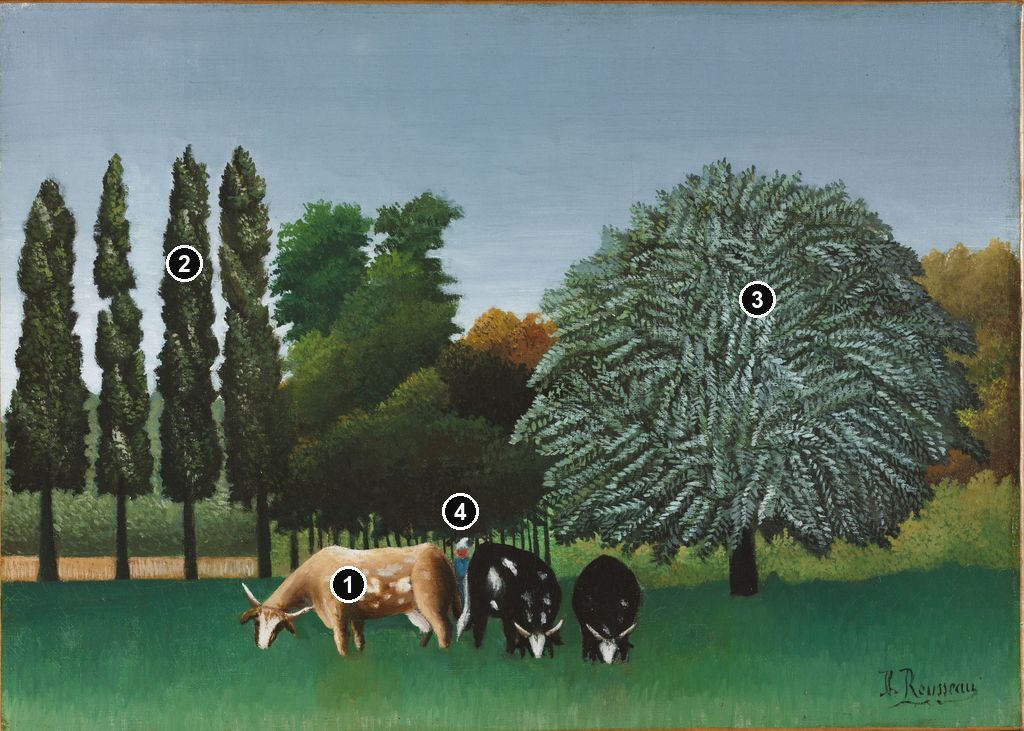
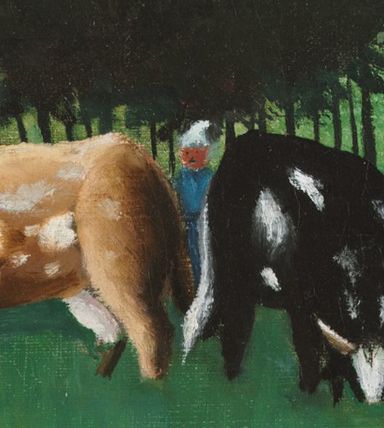
Three cows graze beneath trees that seem to have been given separate places in a garden. Four narrow uprights stand on the left; a great silvery crown fills the right. Between these extremes, Henri Rousseau gathers green, brown and orange foliage into a low, irregular screen. The animals occupy the front of this small landscape with a solidity that makes the blue-clad person behind them almost disappear. Harvard Art Museums dates The Banks of the Oise to about 1907 and identifies it as an oil painting on canvas measuring 33 × 46 centimetres.[1]
At a Glance
- ArtistHenri Rousseau
- SubjectThe Banks of the Oise
- ExploreThree animals in the foreground; Trees with different kinds of presence
This work across Henri Rousseau’s career
Carnival Evening
1886 [2]The Merry Jesters
1906 [7]The Snake Charmer
1907 [8]Contents
- Three animals in the foreground
- Trees with different kinds of presence
- A landscape named for the Oise
- The almost hidden herdsman
- An intimate format
- Names, ownership and a life in collections
- Annotated details
Three animals in the foreground
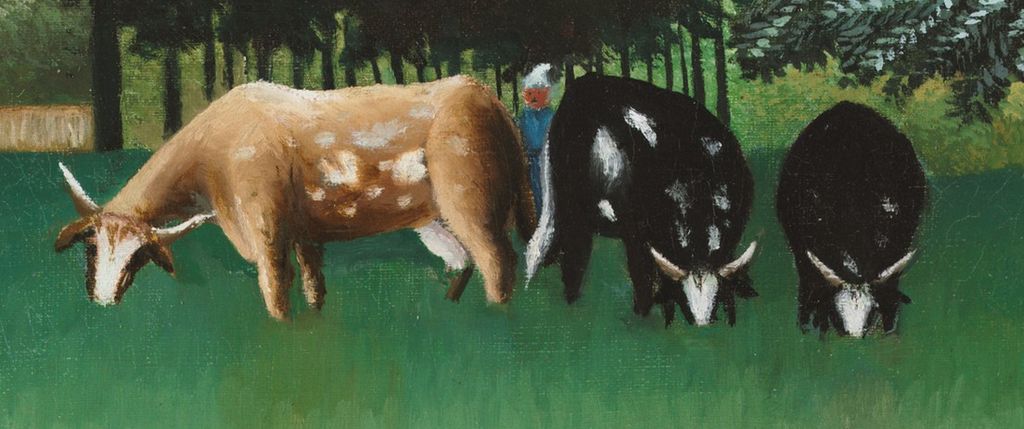
The light brown cow on the left presents its flank to us. Its head points down and outward, towards the painting's edge, while its long body extends across the grass. White markings break up the brown surface, and pale horns emerge beside the lowered head. The animal's pose gives the group its broadest horizontal shape. It also makes grazing immediately legible: the head belongs near the grass, the body remains steady above it, and the legs hold the animal in place.
The two black cows change the pattern. Their bodies are turned more towards the viewer, with their heads lowered in front of them. White patches and horns pick out forms that might otherwise merge into single dark masses. One stands near the centre, close to the brown cow; the other is set a little farther right, opening a small interval in the group. Rousseau gives us three versions of the same quiet action without making the animals identical.
That difference of orientation does much of the work. We can follow the brown cow sideways, then encounter the darker animals more directly. Their downward-pointing heads repeatedly return attention to the green foreground. None looks up to acknowledge us. The slight changes in stance keep the group from becoming a row of emblems. The cows appear occupied, and the viewer watches an activity that can continue beyond the moment represented.
The small human figure behind them supplies a measure of scale. Its body is partly lost among the animals, whereas their backs and flanks remain broad and clear. The disproportion gives the scene much of its character: the cattle possess the foreground, and the person who presumably attends them becomes a small accent within their world.
Trees with different kinds of presence
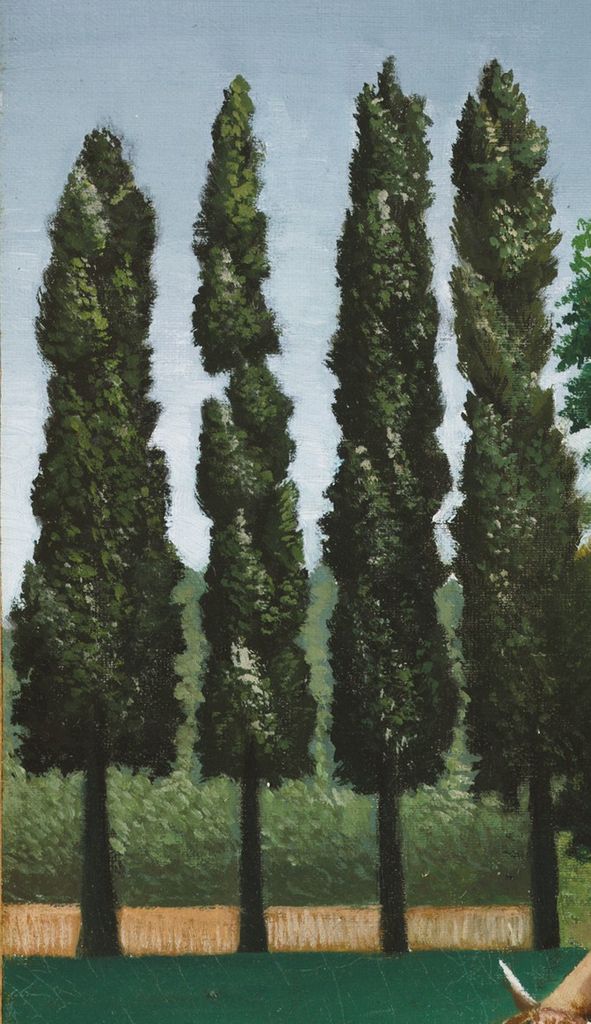
Rousseau sets a second group above the cows. The four slender trees on the left rise almost to the top of the canvas. Dark trunks and narrow crowns create repeated vertical strokes, separated by openings through which the distant ground and sky remain visible. Their foliage does not dissolve into a single woodland mass. Each tree retains its outline, so that the eye can count the intervals as readily as the forms themselves.
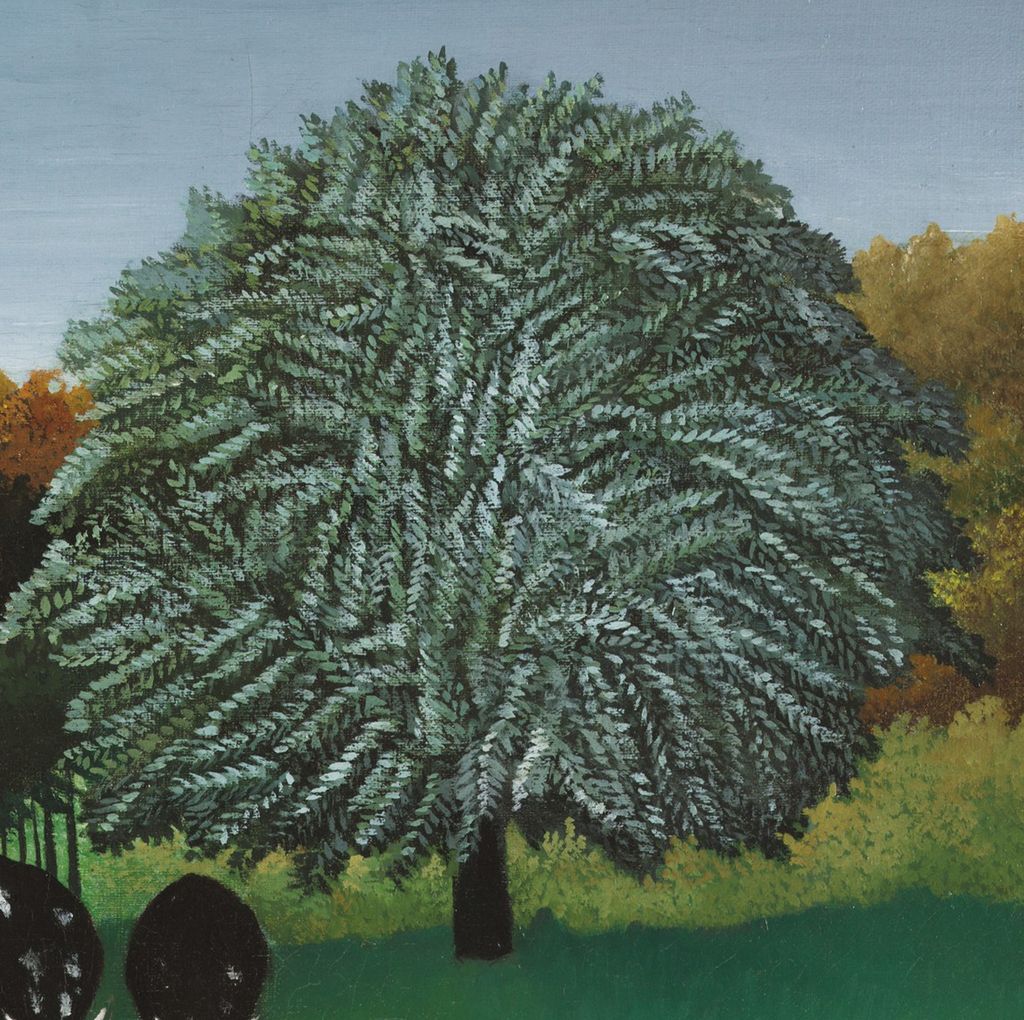
The large tree on the right has a different weight. Its rounded crown spreads sideways over a short visible trunk. Pale, closely spaced marks trace the foliage, with dark lines and gaps providing a branching structure underneath. The result is dense without becoming featureless. Against the open sky, the crown has a conspicuous outer edge; within that edge, the repeated dashes create a surface full of small changes. Its cool, silvery appearance makes the surrounding greens seem deeper.
Between the two groups, the background rises in uneven stages. A green cluster leans into the sky; farther back, warmer orange and brown passages interrupt the prevailing foliage. Harvard's gallery text describes the background brushwork as dappled and autumnal, drawing attention to the patterned surface as well as its suggestion of a season.[1] Those warm touches do not spread evenly through the picture. They remain partly screened by the larger forms, offering glimpses of another layer behind them.
The composition is held together by the broad green ground below and the pale sky above. A thin brown horizontal strip at the left runs behind the tree trunks, adding a low line across the uprights. With so little sky detail, the silhouettes become especially important. The tall trees, the middle clump and the spreading crown can be read separately, then assembled into one continuous enclosure. The same deliberate placing that distinguishes the cows also distinguishes the vegetation.
A landscape named for the Oise
The title offers a geographical starting point, although no broad expanse of river announces itself in this view. The eye meets pasture, animals and foliage. Harvard identifies the painting as one of Rousseau's rural landscapes of the Île-de-France around Paris; its former title, Landscape with Cows, describes the visible subject more directly.[1] Both names are useful. One invites us to think of a region, while the other directs attention to the forms that dominate the canvas.
Rousseau's treatment of familiar places could involve substantial rearrangement. The MANAS museum in Laval explains that his views of Paris and its surroundings often developed from studies made outdoors into compositions completed in the studio. Its discussion of the preparatory View of the Île Saint-Louis Taken from the Pont Henri IV shows him testing the disposition of buildings and colours before developing a finished picture.[12] This provides a useful context for the carefully ordered landscape here, although it does not establish the existence of a particular preparatory study for the Harvard canvas.
The distinction matters when looking at the trees. Their separation and unequal scale give each one a clear role within the rectangle. A viewer need not reconstruct a precise spot beside the Oise to appreciate that arrangement. The painting offers a coherent place through repeated shapes, overlapping foliage and the quiet space around the animals. Its convincing unity comes from how those elements meet.
The almost hidden herdsman
The person in blue is easy to miss on a first encounter. A small upright shape appears behind the cows near the centre, with little space around it to separate the body from the surrounding forms. Once noticed, it changes the scene. The animals belong to an inhabited landscape, however unobtrusive its human presence may be.
Harvard's gallery interpretation identifies this figure as a herdsman wearing a Phrygian cap and describes the clothing as archaic. The museum reads the historical reference as an element of fantasy of a kind Rousseau introduced into his landscapes.[1] The figure is so small that this identification contributes detail beyond what a modest reproduction can readily reveal. It also gives the apparent simplicity of the pasture an unexpected depth: everyday rural activity can accommodate a figure whose costume seems to belong to another time.
The reading leaves room for the painting's quiet ambiguity. Nothing else in the foreground requires a specific historical episode. The cows continue feeding, the trees remain still, and the sky gives no dramatic signal. The smallness of the figure allows the historical suggestion to enter gently. It is one detail among the other carefully placed forms, rather than a key that forces every part of the landscape into an allegorical story.
Annotated Details from The Banks of the Oise
The numbered points identify visible features discussed in this article. Return from each detail to the whole composition. Henri Rousseau, The Banks of the Oise, c. 1907. Harvard Art Museums/Fogg Museum, Bequest of Maurice Wertheim, Class of 1906, 1951.67. Museum-derived image published on Wikimedia Commons in 2021. Image source. Public domain. Numbers added to the overview; details cropped from the published original. No recolouring or retouching.
Details from THE BANKS OF THE OISE
Compare the cattle's different positions with the narrow trees and broad pale crown, then look for the small figure behind the animals.
Three grazing poses
The brown cow turns its flank towards us while the two dark animals face more directly forward. Their lowered heads repeat the act of grazing, with white patches and pale horns separating the bodies.
Four narrow trees
Slender dark trunks support separate upright crowns. Open intervals let the pale sky and low horizontal strip behind them remain visible, keeping each tree distinct.
A broad silvery crown
Closely spaced pale marks spread across the rounded tree. Dark branching lines and small gaps remain visible beneath the leaves, giving the broad crown an internal structure.
A blue figure between the cattle
A small blue-clad figure appears in the narrow interval behind the animals. Its pale head covering and bright clothing catch the eye once the larger cattle have been noticed.
An intimate format
At 33 × 46 centimetres, the canvas invites looking at close range. The grouping can be taken in quickly, but its details reward a longer examination: the white markings on the cows, the gaps between the tall trunks, the pale foliage and the almost submerged human figure. The breadth of the main forms makes the picture readable across a room; their smaller internal differences give the eye reasons to return.[1]
The Musée de l'Orangerie's 2026 exhibition places Rousseau's smaller landscapes within a wider practice of varying subjects and formats for buyers of modest means. Such paintings could suit the budgets and interiors of artisans, shopkeepers and other private customers. The exhibition also stresses his observations during walks around the changing outskirts of Paris.[13] This account helps explain the significance of intimate landscapes within his work. It does not identify the first intended buyer of The Banks of the Oise.
Here the compact format concentrates attention on a few relationships. Dark cattle sit below lighter foliage; narrow verticals balance a broad rounded crown. These connections are available without knowing the location or recognising the costume. They give an ordinary subject a particular visual order.
Names, ownership and a life in collections
The painting's reverse carries another connection to its present title. Harvard transcribes an inscription on the back of the stretcher as “Bords de l'Oise, 1907”. An old label gives the title as “Herbage, Bords de l'Oise”, linking the river name with the pasture. The signature at the lower right is recorded as an underlined “H. Rousseau”. The museum nevertheless retains the qualified date of about 1907.[1] These recorded words help connect a seemingly unspecific field with the name under which the work is now known.
Its early ownership history is less definite. Harvard records a possible passage through the Salon des Indépendants, followed by M. Huc in Toulouse, and gives a tentative association with Paul Rosenberg in Paris from 1912. The museum lists Alphonse Kann as owner by 1936 and until 1947, followed by a sale tentatively linked to Rosenberg in New York. Maurice Wertheim owned the picture from 1949 until his death in 1951, when it entered the Fogg Museum through his bequest. Its Harvard accession number is 1951.67.[1]
The museum's exhibition list includes presentations of the Wertheim collection at the Metropolitan Museum of Art in 1952 and the National Gallery of Art in 1953.[1] That public life places the little pasture within the collecting history of modern French painting. Harvard's gallery text describes the dismissive responses Rousseau received alongside the enthusiasm of younger avant-garde artists, including Picasso.[1] The dense pale crown on the right is as assertive a presence as any of the cows: each inhabitant of this small landscape seems to have its own settled place.
Henri Rousseau artworks directory
This directory brings together works covered on this site and other works documented in the cited museum records and catalogues. Alternate titles share one entry; distinct versions remain separate. Historical dates for works without an article follow the cited catalogues. This is not a catalogue raisonné.
Frequently Asked Questions
The Banks of the Oise belongs to Harvard Art Museums/Fogg Museum, through the 1951 bequest of Maurice Wertheim. Its object number is 1951.67.[1]
Harvard dates the painting to about 1907. Its record transcribes “Bords de l'Oise, 1907” on the back of the stretcher.[1]
Harvard records Landscape with Cows as a former title. It describes the three grazing animals that dominate the foreground; the current title names the Oise.[1] The separate Banks of the Oise page discusses another composition under that river title.
Harvard interprets the figure as a herdsman in archaic clothing, including a Phrygian cap, and associates the detail with Rousseau's imaginative use of historical references. Its gallery text does not identify a named person.[1]
Discussion
Look again at the images and ideas explored in The Banks of the Oise. These editorial prompts invite your observations.
Reader Insights
How does the brown cow's sideways stance change the group formed by the two darker animals?
What happens to the balance of the landscape if you cover the large silvery tree on the right?
Does noticing the small herdsman make the landscape feel more familiar or more mysterious?
Join the Conversation
Share a detail, comparison or question about The Banks of the Oise below.
References
- Harvard Art Museums. The Banks of the Oise, object 299894, accession 1951.67; identification, physical description, gallery text, inscriptions, provenance and exhibition history. Accessed 23 October 2026. View source.
- Philadelphia Museum of Art, Carnival Evening,1963-181-64,object59593. View source.
- Musée de l’Orangerie / Juliette Degennes, Henri Rousseau,L’ambition de la peinture: Un artiste dans son époque (in French). View source.
- National Gallery, Surprised!, NG6421. View source.
- Musée d’Orsay, La Guerre,RF19461 (in French). View source.
- MoMA, The Sleeping Gypsy. View source.
- Philadelphia Museum of Art, The Merry Jesters, 1950-134-176, object51097. View source.
- Musée d’Orsay, La Charmeuse de serpents, RF 1937 7 (in French). View source.
- Musée de l’Orangerie, La Carriole du Père Junier, RF 1960 26 (in French). View source.
- Solomon R. Guggenheim Museum / Cornelia Lauf, The Football Players,60.1583: current collection record. View source.
- MoMA, The Dream, 252.1954. View source.
- MANAS, Musées de Laval. Henri Rousseau, dit le Douanier, especially the discussion of landscape studies and Vue de l'île Saint-Louis prise du pont Henri IV. Accessed 23 October 2026. View source. (in French).
- Musée de l'Orangerie. Henri Rousseau, l'ambition de la peinture, exhibition texts, 25 March–20 July 2026, “Variations et déclinaisons. À la recherche du marché”. Accessed 23 October 2026. View source. (in French).
- The Museum of Modern Art, Henri Rousseau: Essays (1985), selected catalogue entries, chronology and notes on early devotees. View source. Selected entries, chronology (pp.91–95) and early-devotee notes (pp.262–264) were consulted. Historical collection credits do not establish present ownership.
- Daniel Catton Rich, Henri Rousseau (The Museum of Modern Art, 1942), selected drawings and landscape studies; historical catalogue. View source. The dated 1942 publication is used for the two Quai d’Auteuil ink views; its Malakoff date differs from the 1985 catalogue.
- National Gallery of Art, Self-Portrait (1895), pen-and-ink drawing, accession 1995.47.66. View source.
- The Museum of Modern Art, War (published January 1895), lithograph, accession 684.1943. View source.
- Barnes Foundation, Landscape and Four Young Girls, object 5521, BF855. View source.


 Henri Rousseau.jpg)


 Henri Rousseau.jpg)