



 by Tom Gurney
Tom Gurney BSc (Hons) is an art history expert with over 20 years experience
Published on June 19, 2020 / Updated on October 29, 2026
Email: tomgurney1@gmail.com / Phone: +44 7429 011000
The Rabbit's Meal: Introduction
A rabbit bends towards a spray of carrot leaves, its pale whiskers almost lost among the stems. Two thick orange carrots lie under its paws, while an enormous green leaf spreads across the ground beside it. Behind this small meal, a brick wall fills the view. Henri Rousseau's The Rabbit's Meal, also titled Le repas du lapin, is a 1908 oil painting in the Barnes Foundation, Philadelphia. The canvas measures 50 × 61.2 cm.[1] Its modest subject occupies a remarkably close, carefully divided world.
At a Glance
- ArtistHenri Rousseau
- SubjectThe Rabbit's Meal
- ExploreA meal at ground level; Vegetables with a presence of their own
This work across Henri Rousseau’s career
Carnival Evening
1886 [2]The Merry Jesters
1906 [7]The Snake Charmer
1907 [8]Contents
- A meal at ground level
- Vegetables with a presence of their own
- The brick wall and the limits of the garden
- Branches, veins and whiskers
- Light fur against dark earth
- Exhibition history and later examination
- Annotated details
A meal at ground level
The rabbit sits to the right of centre, facing left. Its back rises in a broad dark curve, then turns down towards the rounded hindquarters. A pale belly stretches just above the earth; the feet reach forward over the carrots. The head projects beyond this compact body, bringing the mouth into contact with the fine green growth at the left. Following that movement gives the picture a simple action that is easy to grasp before looking at any of its smaller details.
Yet the posture contains several different directions. One ear points upwards against the wall, while the other extends back towards the shoulder. The tail makes another pale upward stroke near the tree. Underneath, the paws travel down and forwards. These small projections keep the animal from becoming a single heavy oval. They give a sense of alertness to a creature whose attention seems wholly occupied by food.
The eye is a small, dark, sharply edged shape surrounded by lighter fur. It catches attention because the rest of the head is so softly rounded. The mouth and whiskers provide a second point of focus, lower and farther left. The eye suggests alertness, while the lowered nose concentrates attention on the food. The scene can feel intimate even though the animal never looks towards us.
Vegetables with a presence of their own
The carrots occupy much more space than their role as incidental food might suggest. Their broad orange bodies spread across the lower part of the picture, with the green stems of the left carrot bending up towards the rabbit's mouth. The nearer carrot tapers towards the right; its companion sits at a slightly different angle beneath the hind foot. Together they create a bright, uneven platform for the animal.
Their colour also draws them forward. Against the brown ground and dark fur, the orange appears dense and emphatic. Small changes of tone give the vegetables rounded sides, while their silhouettes remain clear. The rabbit's light paws can be followed across their upper edges without disappearing into the surrounding earth. Food and animal are joined through touch as well as through the action at the mouth.
The large cabbage-like leaf on the left has an equally assertive shape. Its scalloped edge curls around a broad pale surface crossed by branching veins. Close to the lower edge, the leaf seems to turn towards us, exposing its structure like a spread fan. Its size makes it a substantial companion to the rabbit. The empty ground between leaf and animal is narrow enough that the two belong to one immediate encounter, yet wide enough for each to retain a separate outline.
This is where the picture begins to resemble a still life with a living participant. The vegetables have weight, colour and elaborate contours that reward attention independently of the rabbit. The feeding action then reconnects these separate objects. We can move from the broad leaf to the carrot tops, follow the stems upwards, and arrive at the animal's nose. An ordinary meal becomes a route through the composition.
The brick wall and the limits of the garden
Rousseau gives the scene very little distance. The strip of pale earth at the bottom supports the rabbit and its food; behind them, a low band of green plants meets the wall. Above that band, brickwork continues almost to the top edge. There is no visible sky to suggest changing weather and no opening through which the eye can wander beyond the enclosure. Everything that matters happens within this shallow space.
The wall is built from long horizontal courses interrupted by short vertical joints. Its repeated divisions offer a steady measure against which the irregular things in front of it stand out. The upright ear crosses several courses; the rounded back cuts across another stretch. Because the joints remain visible around these forms, the wall makes the animal's contour particularly easy to read.
The bricks vary in darkness and warmth, so the background retains some movement of its own. Broad red-brown patches sit beside deeper seams. Their pattern spreads behind both the tree and the rabbit, joining the left and right halves of the painting. This continuous surface also makes the garden feel private and contained. We see a fragment of a place whose boundaries press close around its occupant, with no human figure entering to explain it.
The low viewpoint strengthens that feeling. The carrots, leaf and paws are all presented near the level of our attention. The wall rises above them like the whole background of a small stage. Its apparent height belongs to the rabbit's immediate world: from down here, a piece of garden becomes a substantial setting.
Branches, veins and whiskers
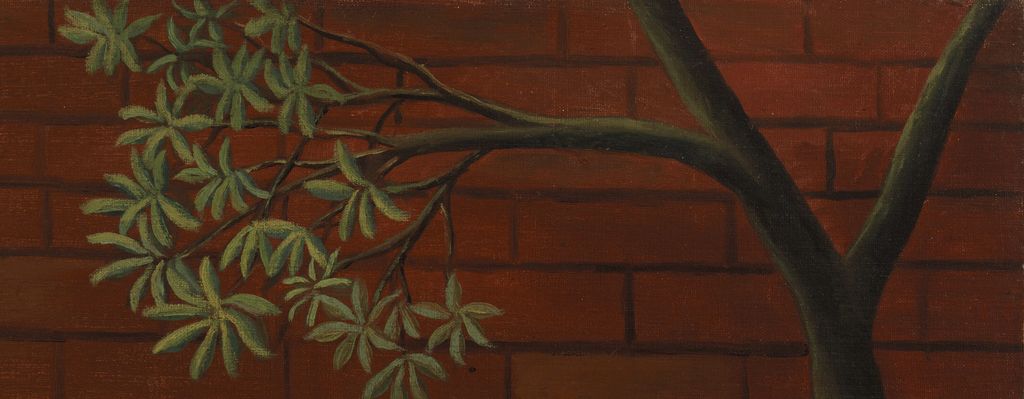
A dark tree grows along the right edge, forking above the rabbit. One branch sweeps left across the upper part of the wall and carries clusters of narrow green leaflets. The trunk is partly cut by the frame, and its upper limbs continue beyond the picture. This cropping suggests that the enclosed view extends sideways and upwards, even while the wall prevents an escape into depth.
The tree offers a different kind of structure from the masonry. Its main fork opens at an angle, while the smaller branches divide unevenly. Farther left, clusters of leaves spread out from small centres. Looking down to the large foreground leaf reveals another branching arrangement, this time traced in pale veins. At the rabbit's mouth, the carrot stems and whiskers turn branching into something finer still.
These patterns connect objects that otherwise have very different surfaces. A brick is solid and regular; a leaf is thin and flexible; fur softens the animal's body. Across them run clear lines that organise our looking. The wall's joints establish a repeated framework, while the tree, veins and whiskers offer variations in direction and scale. Rousseau's style and technique are especially apparent in the way these thin branching lines hold their own against the broad masonry.
The leaves above the rabbit also balance the great leaf below. Between those two green areas, the rabbit's head occupies an interval of comparatively bare wall. The face is therefore surrounded by detail without being overwhelmed by it. The dark tree anchors the right side, while the pale foreground leaf holds the left; the feeding animal joins the two.
Light fur against dark earth
The rabbit's coat moves from nearly black along the upper back to grey around the head and flank, then into pale fur beneath the body. This gradual change gives volume to a shape whose outer contour is otherwise strongly enclosed. The haunch has its own curved boundary within the larger body, and the foreleg descends in a darker band. The body feels assembled from rounded, interlocking masses.
Its lightest areas have a wider role in the picture. The pale belly and feet answer the bright veins and edges of the leaf at the left. Small pale accents on the ears and tail carry this brightness upwards. The eye moves between these separated passages, finding the rabbit's outline again after travelling through the carrots or foliage. Light is distributed in pieces, keeping several parts of the foreground active at once.
The ground provides room for these shapes to settle. It is comparatively quiet along the bottom edge, where there is little to interrupt the vegetables' silhouettes. At the lower right, Rousseau's signature and the date occupy a patch of exposed earth beside the meal.
Annotated Details from The Rabbit's Meal
The numbered points identify visible features discussed in this article. Return from each detail to the whole composition. Henri Rousseau, The Rabbit’s Meal, 1908. Barnes Foundation, Philadelphia, BF578. Museum-derived reproduction published on Wikimedia Commons in 2018. Image source. Public domain. Numbers added to the overview; details cropped from the published original. No recolouring or retouching.
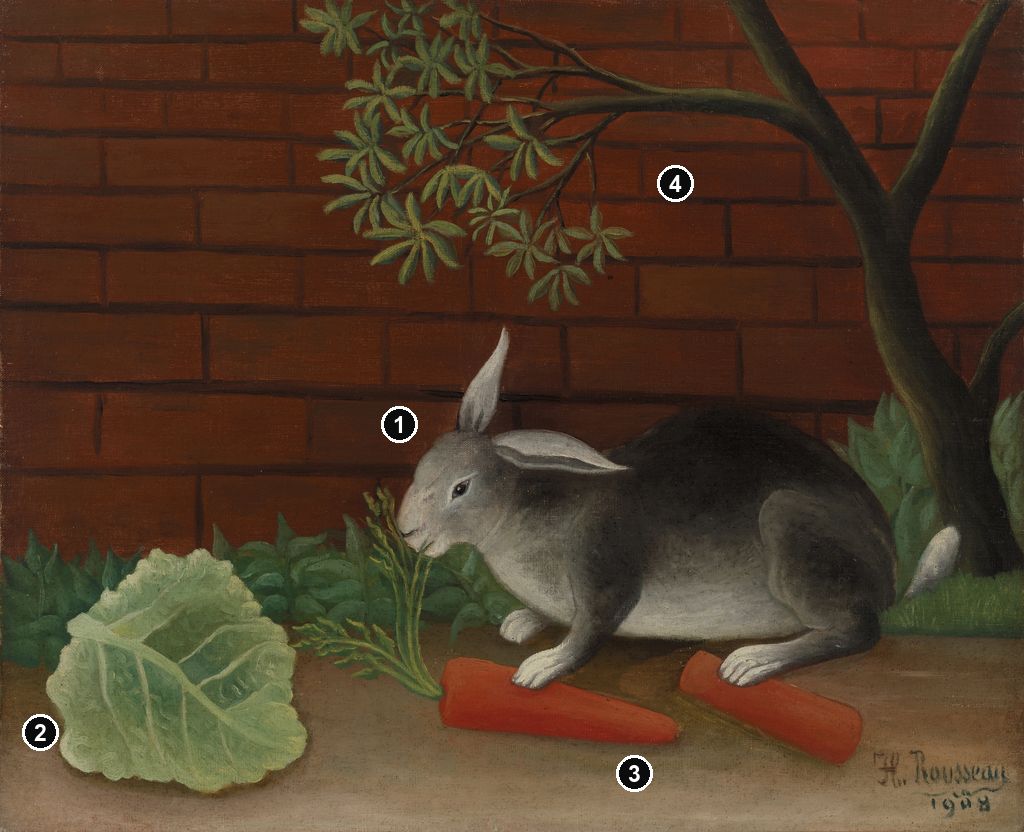
Details from THE RABBIT'S MEAL
Follow the rabbit’s muzzle towards the greens, compare the leaf and carrots, then look at the branching pattern against the brick wall.
Ears, eye and the feeding muzzle
One ear points upwards while the other extends back towards the shoulder. The dark eye and lowered muzzle make small points of focus as the rabbit reaches into the fine carrot greens.
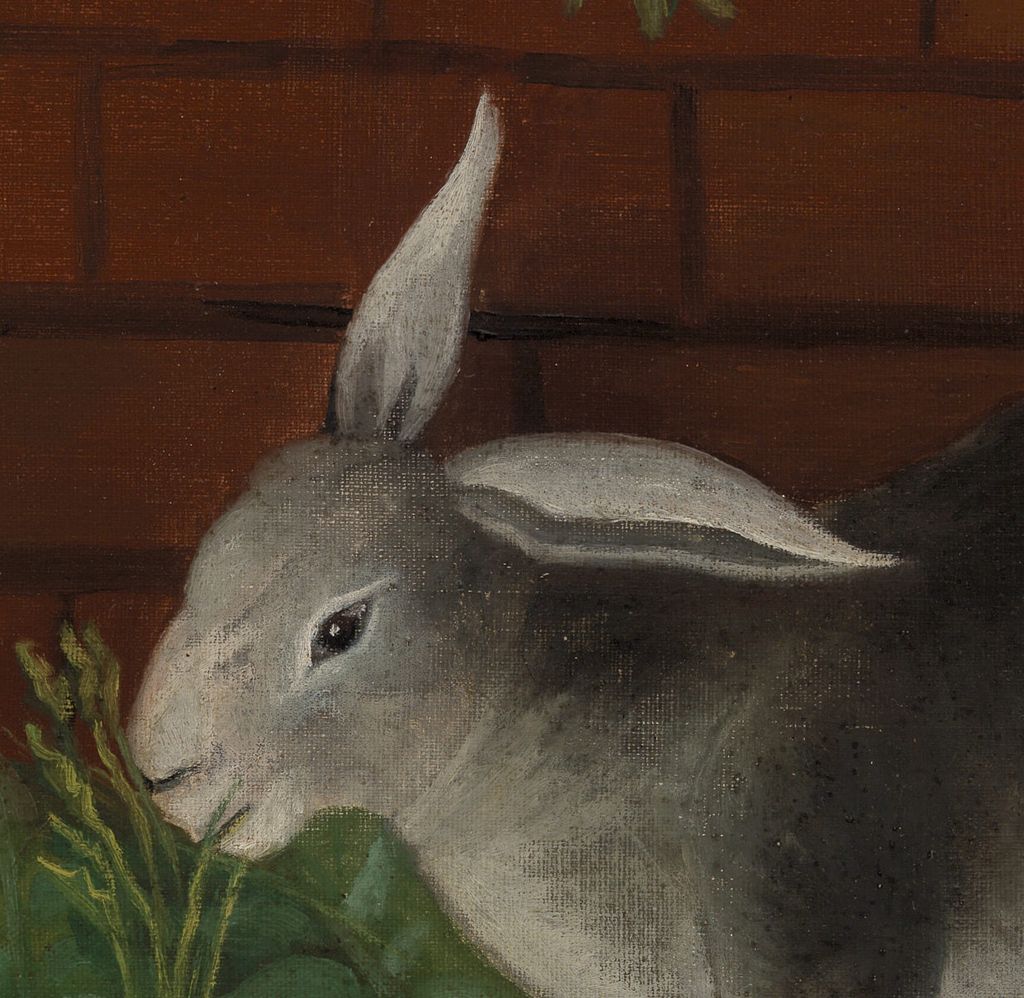
A broad leaf and branching veins
Pale veins divide the large scalloped leaf into smaller passages. Its curling edge and broad surface give this vegetable a substantial presence beside the feeding animal.
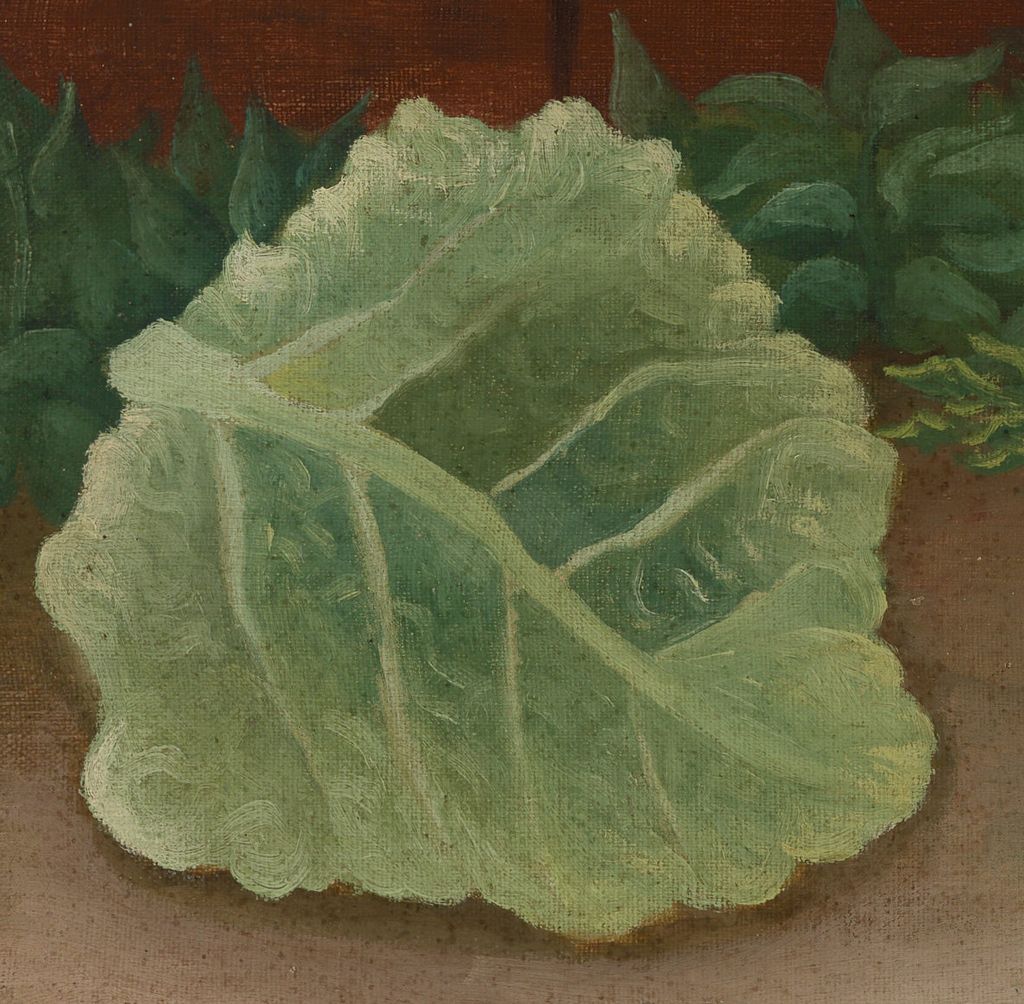
Paws across two orange carrots
The pale feet rest over the emphatic orange shapes. Their contact joins animal and food, while the carrots’ differing angles keep the lower edge from becoming a single horizontal strip.
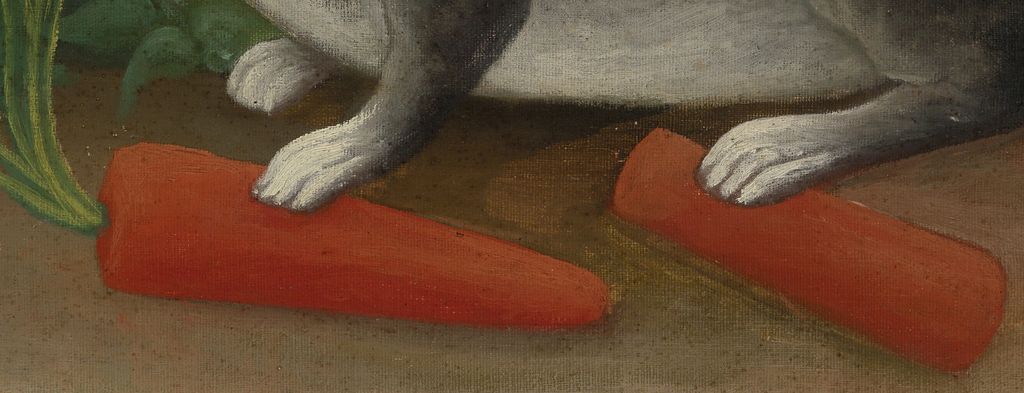
Branching foliage before regular bricks
Small branches and clusters of narrow leaflets cross the red-brown wall. Their changing directions contrast with the long courses and short vertical joints of the masonry behind them.
Exhibition history and later examination
The Barnes Foundation records the painting in a Henri Rousseau exhibition at Paul Rosenberg's Paris gallery in June 1923 and in Trente ans d'art indépendant in Paris in 1926.[1] These appearances give two points in its public history after its creation.
The museum's FY25 annual report also names The Rabbit's Meal among the paintings examined using infrared reflectography in August 2024. That passage records the examination method without announcing a particular discovery beneath this painting's surface.[12]
Henri Rousseau artworks directory
This directory brings together works covered on this site and other works documented in the cited museum records and catalogues. Alternate titles share one entry; distinct versions remain separate. Historical dates for works without an article follow the cited catalogues. This is not a catalogue raisonné.
Frequently Asked Questions
The Barnes Foundation dates it to 1908. The painting is oil on canvas and measures 50 × 61.2 cm.[1]
It belongs to the Barnes Foundation in Philadelphia, where its collection number is BF578.[1]
Its nose meets the green tops of a large carrot. Two orange carrots lie beneath its paws, and a broad cabbage-like leaf occupies the left foreground. The scene concentrates on this meeting of mouth, stems and vegetables.
Discussion
Look again at the images and ideas explored in The Rabbit's Meal. These editorial prompts invite your observations.
Reader Insights
How does the brick pattern affect the way you see the rabbit's ears, back and head?
Which seems more prominent on first looking: the animal or the vegetables? What changes when you follow the carrot stems towards its mouth?
How would the atmosphere change if an opening or a strip of sky appeared above the wall?
Join the Conversation
Share a detail, comparison or question about The Rabbit's Meal below.
References
- Barnes Foundation. The Rabbit's Meal (Le repas du lapin), collection record, BF578, identity fields and exhibition history; accessed 23 October 2026. View source.
- Philadelphia Museum of Art, Carnival Evening,1963-181-64,object59593. View source.
- Musée de l’Orangerie / Juliette Degennes, Henri Rousseau,L’ambition de la peinture: Un artiste dans son époque (in French). View source.
- National Gallery, Surprised!, NG6421. View source.
- Musée d’Orsay, La Guerre,RF19461 (in French). View source.
- MoMA, The Sleeping Gypsy. View source.
- Philadelphia Museum of Art, The Merry Jesters, 1950-134-176, object51097. View source.
- Musée d’Orsay, La Charmeuse de serpents, RF 1937 7 (in French). View source.
- Musée de l’Orangerie, La Carriole du Père Junier, RF 1960 26 (in French). View source.
- Solomon R. Guggenheim Museum / Cornelia Lauf, The Football Players,60.1583: current collection record. View source.
- MoMA, The Dream, 252.1954. View source.
- Barnes Foundation. FY25 Annual Report, “Conservation and Exhibitions,” printed p. 27 (PDF p. 15), Henri Rousseau section. View source.
- The Museum of Modern Art, Henri Rousseau: Essays (1985), selected catalogue entries, chronology and notes on early devotees. View source. Selected entries, chronology (pp.91–95) and early-devotee notes (pp.262–264) were consulted. Historical collection credits do not establish present ownership.
- Daniel Catton Rich, Henri Rousseau (The Museum of Modern Art, 1942), selected drawings and landscape studies; historical catalogue. View source. The dated 1942 publication is used for the two Quai d’Auteuil ink views; its Malakoff date differs from the 1985 catalogue.
- MANAS, Laval, Henri Rousseau, dit le Douanier, urban landscapes and preparatory study (in French). View source.
- National Gallery of Art, Self-Portrait (1895), pen-and-ink drawing, accession 1995.47.66. View source.
- The Museum of Modern Art, War (published January 1895), lithograph, accession 684.1943. View source.
- Barnes Foundation, Landscape and Four Young Girls, object 5521, BF855. View source.


 Henri Rousseau.jpg)


 Henri Rousseau.jpg)